

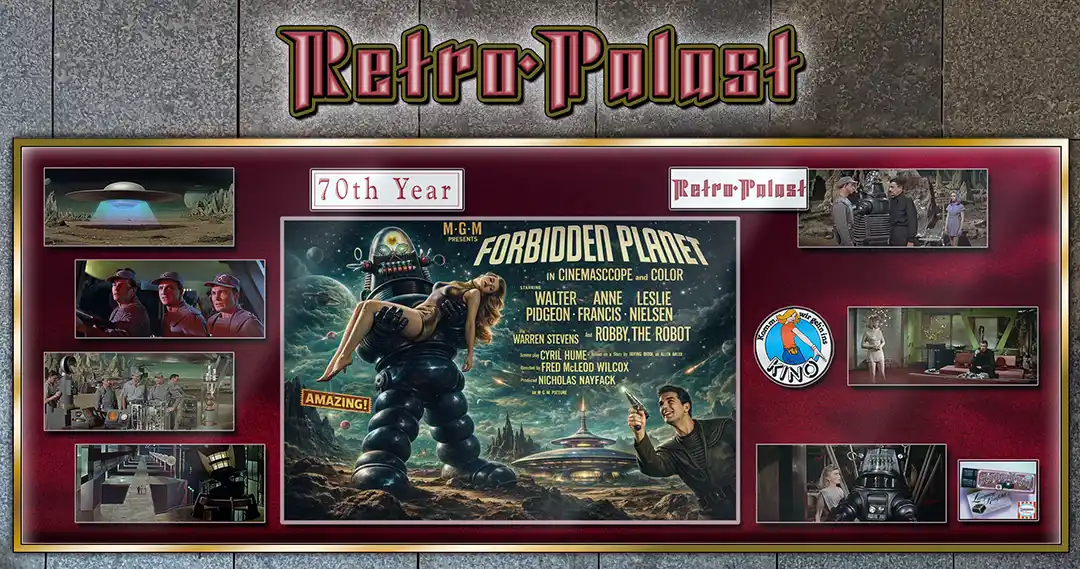
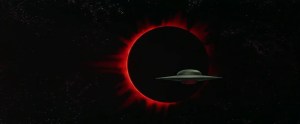
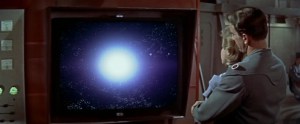
United Planets Cruiser C-57D — now more than a year out from Earth Base,
on a special mission to the planetary system of the great main-sequence star, Altair.
Introduction

Forbidden Planet is a 1956 science fiction film and is now considered one of the most important classics of its genre in film history. It was directed by Fred M. Wilcox and produced by Metro-Goldwyn-Mayer, a studio that was, at the time, more closely associated with lavish prestige productions than with visionary futuristic entertainment. This is precisely why Forbidden Planet was such a remarkable exception in its time. The film demonstrated that science fiction did not have to consist solely of simple monsters, cheap sets, and sensationalist stories, but could also function as serious, visually ambitious, and intellectually challenging cinematic entertainment.
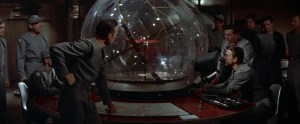
Particularly striking is how masterfully the film interweaves various layers. On the one hand, it tells a thrilling space adventure featuring alien planets, mysterious threats, and technological wonders. On the other hand, it draws on literary motifs, particularly from Shakespeare’s The Tempest, and links these to psychological and philosophical questions. This creates an unusual blend of adventure film, futuristic vision, and character drama. To this day, Forbidden Planet continues to fascinate not only because of its nostalgic charm, but above all because the film feels surprisingly modern in many ways.
Plot
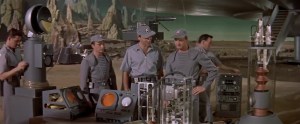
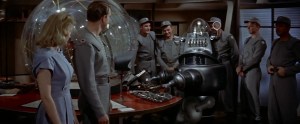
The story is set in the 23rd century. The spaceship C-57D is sent from Earth to Altair IV to investigate the fate of an earlier expedition that has been missing for many years. The crew, led by Commander John J. Adams, expects to find survivors on the alien planet, but initially encounters a strange, tense situation. For in fact, only Dr. Edward Morbius, his daughter Altaira, and Robby—the robot constructed by Morbius—still live there.
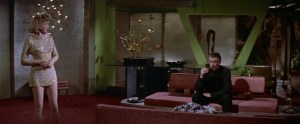
Morbius receives the new arrivals politely, but with a clear sense of distance. He repeatedly warns Adams and his crew against staying on Altair IV. Allegedly, the other members of the earlier colony were killed by an unknown force. Morbius himself now lives in an almost luxurious environment, which stands in sharp contrast to the planet’s hostile, alien landscape. His knowledge and technical capabilities far exceed what his visitors expect. Consequently, the impression arises early on that Morbius knows more than he is willing to admit.
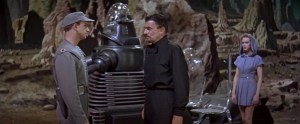
While Commander Adams attempts to assess the situation rationally, a personal bond develops between him and Altaira. Altaira grew up on Altair IV completely isolated from any normal human society. She therefore encounters the spaceship’s crew with a mixture of innocence, openness, and unusual curiosity. These encounters not only create interpersonal tensions but also highlight just how different the social world on this planet has become.
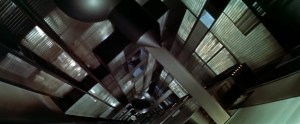
As the story unfolds, Adams and his men stumble upon the remnants of the Krell, a once highly advanced alien civilization. Their underground facilities and technologies seem virtually limitless. Morbius has deciphered parts of this knowledge and uses the Krell’s discoveries to enhance his own mental capabilities. Yet therein lies the true danger. Gradually, it becomes clear that the invisible force killing people and overcoming technical barriers does not come from outside. It is the result of a technology capable of directly materializing thoughts.
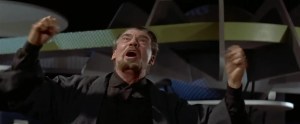
From this, the film unfolds its central idea: the greatest monster is not some alien creature, but the unconscious, destructive side of humanity itself. The threat on Altair IV stems from repressed impulses that take shape through the Krell machines. In doing so, Forbidden Planet shifts the classic logic of the monster movie in a significantly more complex direction. The horror does not come solely from the unknowns of space, but from within the thinking being. This twist lends the plot an impressive depth that endures to this day.
Cast
The film’s leading roles are played by Walter Pidgeon, Anne Francis, and Leslie Nielsen, and it is precisely their very different acting styles that ensure the film works even beyond its ideas.
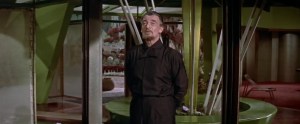
Walter Pidgeon lends Dr. Morbius an imposing presence. He plays the character not as a simple mad scientist, but as a cultured, educated, and thoroughly charismatic man whose intelligence gradually tips over into overconfidence. Morbius is friendly, hospitable, and eloquent, yet at the same time filled with a strong intellectual pride. It is precisely this ambivalence that makes the character so interesting.
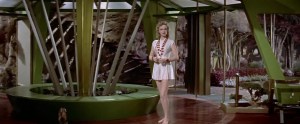
Anne Francis plays Altaira with a mix of naivety, charm, and independence. Her character could easily have become a mere projection screen, but Francis gives her more depth. Altaira is not just the innocent girl from the alien planet, but also a symbol of an existence outside societal norms. She is open, eager to learn, and emotionally direct, yet at the same time shaped by her complete isolation. In many scenes, she reveals just how unusual the living conditions on Altair IV actually are.
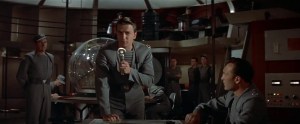
Leslie Nielsen, who is known to a wide audience today primarily for his later parodies and comedies, shows a completely different side here. As Commander Adams, he comes across as serious, level-headed, and responsible. His performance lends the film stability because he embodies the classic perspective of the militarily pragmatic observer. Adams is neither cynical nor arrogant, but a man who tries to apply reason to a situation that is becoming increasingly eerie and irrational.
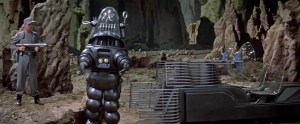
Added to this is Robby the Robot, a character who, while not human, nevertheless possesses an enormous screen presence. Robby is more than a technical gimmick. He takes on comical, service-oriented, and at the same time symbolic functions. His polite manner, his abilities, and his striking design make him one of the most famous robot characters in film history. In a certain sense, he too is an integral part of the film’s ensemble cast, because he is staged not merely as an object but as a memorable personality.
Special Effects
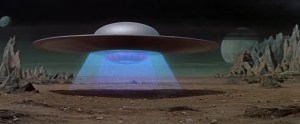
For a film of the 1950s, the special effects in Forbidden Planet were exceptionally elaborate and visionary. Even the design of the spaceship, the depiction of the planet Altair IV, and the futuristic interiors convey an impression of grandeur and technical sophistication that was anything but commonplace at the time. The film did not merely want to hint at its future world, but to make it as fully immersive as possible. This is precisely what gives it its special atmosphere to this day.
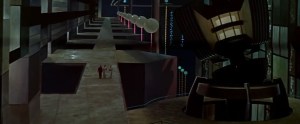
Particularly impressive is the visual design of the Krell technology. The massive underground facilities, the glowing control systems, and the almost incomprehensible scale of the alien infrastructure make the lost civilization of the Krell appear both fascinating and eerie. Here, it is not simply a backdrop that is shown, but an entire conception of technological superiority is crafted. The Krell’s rooms and machines seem as though they come from a world that is far ahead of humanity intellectually and culturally.
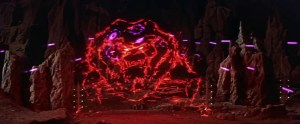
The depiction of the invisible monster is also famous. Precisely because the threat is mostly not fully visible, a strong sense of tension arises. In certain moments, such as when energy barriers or gunfire briefly reveal the creature’s outline, the film achieves an effect that seems remarkably modern for the time it was made. The monster is present less through constant visibility than through anticipation, sounds, reactions, and sudden traces. This lends the production a psychological quality that has influenced many later genre films.
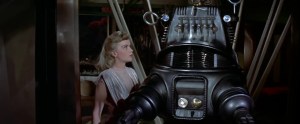
Robby the Robot also deserves special mention in this context. His construction, his movements, and his integration into the film’s world were remarkable both technically and creatively. He did not come across as a cheap prop, but as an actual, living part of this future. The fact that Robby became famous even outside the film is due in no small part to the fact that his design was functional, idiosyncratic, and instantly recognizable.
The soundtrack also contributes significantly to the impact of the effects. Forbidden Planet utilized an unusual electronic soundscape that does not function like a traditional orchestral soundtrack. These sounds amplify the sense of the alien and give the film an almost physically palpable otherness. Sound and image thus merge into a futuristic world that is not merely shown, but made atmospherically tangible. It is precisely this combination of visual and acoustic innovation that sets the film apart from many contemporary productions to this day.
Trivia
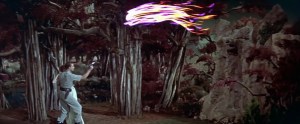
A particularly fascinating aspect of Forbidden Planet is its clear, if not literal, connection to William Shakespeare’s The Tempest. Dr. Morbius is reminiscent of Prospero in many ways, Altaira of Miranda, and the remote planet takes on the narrative function of the desert island. The theme of knowledge, power, and control over invisible forces can also be read as a modern, science-fiction-like variation on classic literary motifs. The film is thus not only a genre piece but also a sophisticated literary reinterpretation.

Forbidden Planet also became famous for Robby the Robot, who later reappeared in numerous other productions, series, and pop culture contexts. Robby quickly became an icon, often recognized even by people who have never seen the film themselves. In this way, Forbidden Planet achieved a rare distinction: a single character from the film became a lasting symbol of classic science fiction.
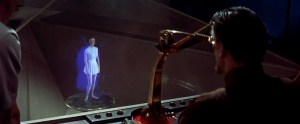
From today’s perspective, the casting of Leslie Nielsen is also intriguing. Many later generations know him almost exclusively as a comedic actor with a dry sense of humor. In Forbidden Planet, there is no sign of that yet. Precisely for this reason, it is fascinating to see him here in a serious, controlled, and heroic role. This contrast makes the film particularly compelling for film fans, even in retrospect.
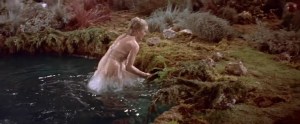
Equally remarkable is how early the film anticipates certain motifs that later became staples of the genre: the landing of a disciplined space crew on a mysterious world, the encounter with relics of a superior species, and the blend of adventure, science, and metaphysical threat. Many later works have adopted or further developed these building blocks, often without acknowledging the pioneering achievement of Forbidden Planet.
Reviews at the Time
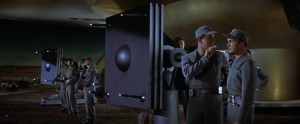
Upon its release, Forbidden Planet was perceived by many critics as an unusually ambitious science fiction film. Particular praise was given to the production design, the special effects, and the seriousness with which the film tells its story. At a time when the genre was often associated with B-movies and simple sensationalism, Forbidden Planet served as a signal that science fiction could also be more elaborate, intelligent, and stylistically sophisticated.
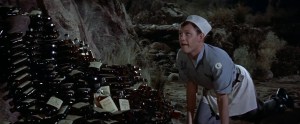
Many contemporary critics praised the visual design and technical execution. The futuristic set design, the creative use of special effects, and the exceptional sound design were recognized as clear strengths. The fact that the film integrated psychological and philosophical themes into the plot also set it apart from many competing productions of its time. For some reviewers, this was precisely the proof that the genre should be taken more seriously artistically.

However, there were also more reserved reactions. Not all critics were immediately convinced by the blend of adventure, intellectual speculation, and symbolic meaning. Some found the film somewhat cold or argued that its conceptual elements were harder to access than the more direct appeal of conventional entertainment films. Yet it is precisely this skepticism that shows how far Forbidden Planet had already strayed from simple formulas.

In retrospect, it can be said that while the film was not immediately recognized by everyone as a masterpiece, it was regarded as an exceptional work very early on. Even where critics had reservations, it was usually evident that something unusual was being attempted here. The reception at the time thus marks the beginning of the reputation that Forbidden Planet was able to build upon over the decades.
Cultural Influence
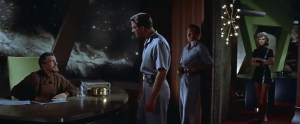
The cultural influence of Forbidden Planet is enormous and extends far beyond its original context. The film had a lasting impact on central visual elements of science fiction. The concept of a technologically advanced spaceship, a professional space crew, and an alien planet full of secrets was later taken up in countless films and series. Parallels to Star Trek are particularly often pointed out, because many building blocks of the kind of space narrative that later became standard can already be found here.
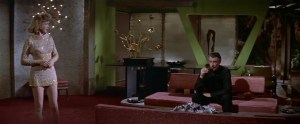
The motif of a fallen supercivilization, whose technological legacy becomes a danger to subsequent beings, also developed into a recurring theme in the genre. Forbidden Planet illustrates this in a particularly striking way: The Krell never appear directly as characters, and yet their absence dominates the entire film. Their machines, their architecture, and their fateful knowledge have a more profound impact than many visible antagonists in other productions. This idea has been revisited time and again in science fiction.
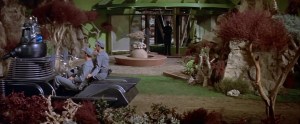
The psychological focus of the story is also of great significance. The film shifts the focus of horror from an external threat to internal conflicts. In doing so, it opens the genre to interpretations that deal with the subconscious, repressed impulses, and the limits of rational self-control. It is precisely this combination of spectacle and psychological depth that made Forbidden Planet a precursor to later, more sophisticated science fiction films.

Last but not least, the film also had a lasting impact on design. Robby the Robot became a pop-cultural icon, and the film’s futuristic design influenced the visual language of the genre for years to come. Even people who have never seen the film in its entirety often recognize individual images, shapes, or motifs because they have been referenced, varied, or parodied in later works. Thus, Forbidden Planet is not only a successful film of its era but also a lasting aesthetic reference point.
Conclusion
Forbidden Planet is far more than a nostalgic science fiction classic from the 1950s. The film combines a choice of themes that was astonishingly mature for its time with visual innovation, unusual sound design, and characters that transcend mere genre archetypes. It is precisely this combination that makes it worth watching to this day. It functions both as a thrilling space adventure and as a reflective narrative about power, insight, and the dangerous depths of the human mind.
What is particularly remarkable is how modern the film has remained in many respects. Its questions about technological progress, moral responsibility, and psychological repression do not seem outdated in the least. On the contrary: looking back, it becomes clear just how far ahead of its time Forbidden Planet was. The fact that the film is still discussed, analyzed, and cited is therefore not merely an expression of nostalgia, but a sign of a genuine cinematic achievement.
Anyone wishing to understand the history of science fiction can hardly ignore this work. Forbidden Planet marks a moment when the genre visibly matured and began to exploit its possibilities more consistently. That is why the film remains not only an entertaining piece of cinematic history, but a milestone whose influence extends into the present day.








Kommentar verfassen