

They let ‚em vote, smoke, and drive, even put ‚em in pants. So what do you get?
Too much for one man to handle!
Introduction
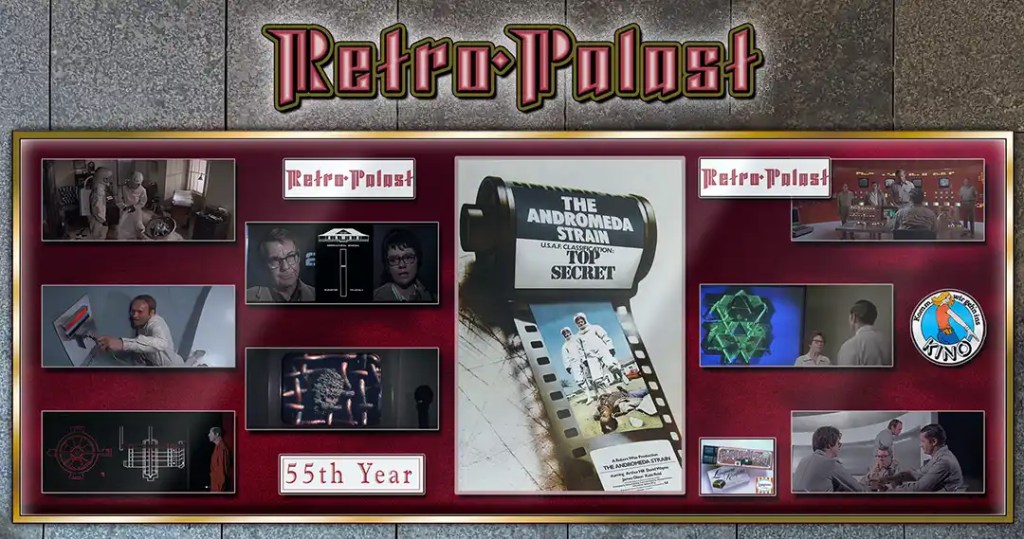
The Andromeda Strain (1971) is an American science fiction thriller directed by Robert Wise, based on the 1969 novel of the same name by Michael Crichton. The film is one of those works in the genre that relies less on spectacle and more on atmosphere, precision, and intellectual tension. Instead of space battles, futuristic action, or classic monster images, it shows sterile laboratories, scientific procedures, control rooms, and people trying to comprehend an invisible danger under extreme pressure. It is precisely this that gives the film its own unique form of menace.
Robert Wise directs the story with great objectivity and almost documentary-like rigor. This form is ideally suited to the material, because the focus is not on a heroic individual, but on a scientific crisis team confronted with a potentially apocalyptic situation. The question is not how to defeat a monster, but how to analyze, contain, and understand an unknown biological threat. This makes The Andromeda Strain seem astonishingly modern even today.
At the same time, the film is a good example of how science fiction cinema changed in the early 1970s. The genre narrative became more serious, more technical, and closer to political and social fears. The Andromeda Strain picks up on mistrust of the military, technology, and bureaucratic security mechanisms and translates these fears into a coolly constructed story. It is precisely this mixture of science, paranoia, and sobriety that makes the film a special contribution to the genre to this day.
Plot
The plot begins with the crash of a US satellite near the small town of Piedmont in New Mexico. What initially appears to be a routine recovery operation quickly turns into a disaster. When the military and authorities investigate the site, it becomes apparent that almost all of the town’s residents have died suddenly and under mysterious circumstances. Members of the first recovery team also lose their lives. The images of empty streets and motionless bodies are shocking, precisely because the film shows them without melodramatic exaggeration.
Suspicions quickly arise that the satellite may have brought an unknown organism from space. As a result, a top-secret emergency program is activated. Four selected scientists are taken to the sealed-off underground research facility “Wildfire,” which was developed specifically for extreme biological emergencies. There, they are to investigate the alien microorganism, which is soon given the name “Andromeda.” This setup alone shows what the film focuses on: not frantic pursuit, but procedures, protocols, and the slow uncovering of connections.
Inside the facility, the researchers analyze samples, reconstruct the events in Piedmont, and try to understand why two people survived: an old man and an infant. This seemingly insignificant observation becomes a crucial piece of the puzzle. As the team collects more and more data, it becomes clear that Andromeda is not simply a deadly germ, but an organism with unusual properties that changes under certain environmental conditions. The scientists must therefore not only decipher the cause of the deaths, but also anticipate how the organism might evolve.
The film’s tension arises from time pressure and uncertainty. The researchers repeatedly reach their limits because their technical security systems are not prepared for such an alien life form. At the same time, the film shows how risky automated military emergency mechanisms can be. Particularly explosive is the realization that a planned security process could potentially escalate the situation. This constellation leads to a finale that relies not on classic action, but on precision, logic, and a chain of critical decisions.
In the end, it becomes clear that the real threat does not lie solely in the extraterrestrial organism. Equally dangerous are human misjudgments, institutional secrecy, rigid security logic, and the tendency to consider technology infallible. This is precisely what makes The Andromeda Strain more than just a thrilling science fiction film: it is also a warning against illusions of control in a highly complex technological world.
Actors
The leading roles are played by Arthur Hill as Dr. Jeremy Stone, James Olson as Dr. Mark Hall, Kate Reid as Dr. Ruth Leavitt, and David Wayne as Dr. Charles Dutton. They are joined by Paula Kelly as Karen Anson and other actors such as George Mitchell and Ramon Bieri in important supporting roles. It is striking that the film does not rely on classic star power. Instead, it creates the impression of a functioning team of experts whose members are characterized by their expertise, temperament, and different ways of thinking.
Arthur Hill embodies Dr. Stone with controlled authority. His character is a scientist who bears responsibility, has to make decisions, and at the same time is constantly confronted with uncertainty. James Olson plays Dr. Hall in a somewhat more accessible and physical manner; his role becomes increasingly important as the plot progresses because it mediates between analytical distance and the immediate need for action. Kate Reid brings sharpness, intelligence, and determination to the ensemble as Dr. Leavitt, providing the team with an important counterforce in the debate.
David Wayne, on the other hand, embodies Dr. Dutton in a way that combines experience and nervousness. As a result, the group never comes across as a set of interchangeable experts, but rather as an ensemble with friction, different temperaments, and individual limitations. It is precisely this lack of pathos that helps the film enormously. The characters appear credible because they are not exaggerated as heroes, but as experts who remain fallible despite their competence.
The supporting characters may have less screen time, but they fulfill important dramaturgical functions. They make it clear how closely scientific analysis, military hierarchy, and political interests are intertwined in the film. This is another example of the strength of the casting: even smaller roles contribute to the dense, matter-of-fact overall effect. The actors thus support the pseudo-documentary style of the film, which does not thrive on great emotional explosions, but on concentrated presence.
Trivial
It is interesting to note that director Robert Wise not only directed the film, but also produced it. Wise had already made a name for himself with a wide variety of films and brought a wealth of experience in handling suspense, rhythm, and visual control to the project. This experience is clearly evident in The Andromeda Strain, as the film is extremely precisely crafted and almost seems experimentally controlled in its form.
The music was composed by Gil Mellé, the cinematography was done by Richard H. Kline, and Stuart Gilmore and John W. Holmes were responsible for editing. The technical side of the film is particularly remarkable. Editing, cinematography, and sound work closely together to make the sterile world of the Wildfire facility appear credible and threatening. The production uses numerous screens, gauges, laboratory instruments, and multi-part image compositions, giving the film a state-of-the-art feel.
The film was released in the US in 1971, has a running time of around 130 minutes, and was produced and distributed by Universal. This is comparatively long for a thriller, which also shows that the film takes its time to build up the story, explain the process, and provide explanations. It is precisely this length that contributes to its special rhythm: it is not a hectic disaster movie, but a film of escalation through insight.
One of the remarkable production details is that Michael Crichton makes a brief cameo appearance as a surgeon. In addition, a great deal of effort was invested in the special effects and set design. The sterile architecture of the research facility and the depiction of the organism in particular contribute significantly to the film’s impact. The rooms do not appear to be mere backdrops, but rather functional parts of a real system. This lends the story credibility.
The film also received two Oscar nominations, namely for editing and art direction or production design. These nominations are logical, because it is precisely in these areas that the special quality of the film becomes apparent. Many viewers remember less the individual big action scenes than the overall clinical atmosphere created by the design and rhythm. This is a remarkable achievement, because here visual design directly produces tension.
Book vs. film
The film is generally considered to be a relatively faithful adaptation of Michael Crichton’s novel. The basic premise remains the same: an unknown alien microform arrives on Earth, triggers a deadly crisis, and is investigated by a team of experts under high-security conditions. The film also adopts the book’s strong scientific and technical focus. Procedures, protocols, analyses, and hypotheses are clearly at the center of attention.
The film also closely resembles the literary source material in tone. Crichton’s novel gives the impression of a factual report reconstructing a real crisis. The film attempts to recreate this effect through its staging: with monitor images, sober dialogue, laboratory procedures, data evaluations, and controlled visual language. Instead of focusing on emotional dramatization, the tension arises from the question of what information is still missing and which wrong decision could have fatal consequences.
Despite this similarity, there are differences between the book and the film. Like almost every literary adaptation, The Andromeda Strain also streamlines certain passages to make the story more compact and clearer for the screen. Some explanatory sections of the novel are visually condensed, while other scientific details are simplified or shortened. This is understandable because a film has to convey information differently than a book. Where the novel analyzes in detail, the film must show, rhythmize, and focus.
Another difference lies in the perception of the characters. In the novel, the scientists often appear even more as parts of an analytical system, while the film gives them a little more individuality through acting, body language, and interaction. Nevertheless, the film adaptation also remains deliberately cool and avoids turning the characters into classic emotional heroes with whom the audience can identify. This is unusual, but precisely because of this, it is consistent.
Overall, it can be said that the film takes the spirit of the novel very seriously. It does not transform Crichton’s technology- and science-oriented narrative into simple adventure material, but preserves the intellectual structure of the original. This makes The Andromeda Strain a rare example of a film adaptation that not only adopts the plot, but also convincingly translates the original’s style of thinking into images.
Critical reception at the time
Contemporary reviews were mixed to respectful. Many reviewers recognized that the film was something unique within the science fiction genre. Instead of relying on sensationalism, it presented science as a dramatic process. It was precisely this seriousness that was positively highlighted by some critics because it lent the film an unusual credibility.
In 1971, Roger Ebert praised the film as a very effective thriller and made it clear that its strength lay not only in the suspense, but also in its precise observation of people, machines, and systems. In doing so, he accurately identified what sets the film apart from many other genre contributions of its time. The Andromeda Strain works not despite its sobriety, but precisely because of it.
Other voices reacted more reservedly. Some critics found the staging too cool, too technical, or emotionally distant. Those who expected science fiction to be primarily about adventure, relatable characters, or spectacular effects may have found the film difficult to watch. The detailed scientific procedures were also perceived by some as slow or dry. These objections are understandable because the film consistently works against the expectations of a more easily consumable thriller.
However, it is precisely this division in the reception at the time that is revealing. It shows how unusual the film seemed in 1971. Today, the combination of laboratory realism, fear of epidemics, and institutional paranoia seems familiar, but at the time, a science fiction film told in such a matter-of-fact way was rather the exception. In this respect, the mixed reactions reflect not only the weaknesses but also the originality of the work.
In retrospect, many elements that were previously considered cold or unwieldy have proven to be particular strengths. The controlled staging, the patient development of the threat, and the scientific approach give the film a longevity that some of the more audience-friendly genre productions of its time did not achieve. This is precisely why the criticism at the time is particularly interesting today: it shows how a film can only be fully appreciated with the benefit of hindsight.
Cultural influence
The cultural influence of The Andromeda Strain lies primarily in the fact that the film helped shape a model for later epidemic, laboratory, and biohazard thrillers. Instead of a visible monster, it depicts an invisible microbial threat that can only be combated through analysis, quarantine, teamwork, and precise research. This idea became central to many later films and series in which scientific procedures themselves become the source of suspense.
In addition, the film helped to connect science fiction more closely with real-world fears. Although the threat comes from outer space, the actual horror is not fantastical, but plausibly staged. It is about contamination, system failure, lack of transparency, and the question of how modern societies respond to extreme biological risks. This makes the film seem like a bridge between classic science fiction and later pandemic or techno-thrillers.
Its influence is also evident aesthetically. The sterile architecture, data displays, control centers, and scientific visualization of danger shaped images that reappeared repeatedly in later films. Many productions that use laboratories or crisis centers as places of tension directly or indirectly draw on a visual language that The Andromeda Strain helped popularize. This applies not only to science fiction, but also to thrillers and disaster movies.
It is also particularly noteworthy that the film is still often perceived as unusually science-oriented. Even if not every depiction is accurate from today’s perspective, the film conveys the impression of serious research and methodical thinking. This is precisely what gives it relevance in later decades. At a time when topics such as viruses, quarantine, and global vulnerability are repeatedly discussed in cultural discourse, The Andromeda Strain seems astonishingly prescient.
Last but not least, the film also influenced the perception of Michael Crichton as an author. Early on, it revealed the combination of science, suspense, and disaster scenarios that would later become typical of many of his works. In this sense, the film is not only an important individual work, but also a building block in the development of the modern techno-scientific thriller.
Conclusion
The Andromeda Strain is not a science fiction film for viewers who are primarily looking for spectacle, humor, or fast-paced action. Its particular strength lies in its precision: in the sterile atmosphere, in its reliance on thought processes rather than explosions, and in the unsettling idea that the greatest danger may not be visible. Robert Wise has succeeded in creating a film that derives its suspense almost exclusively from analysis, time pressure, and criticism of the system.
This is precisely why the film still stands out from many other productions in the genre today. It treats science not merely as a decorative backdrop, but as the actual driving force behind the plot. At the same time, it shows that even highly developed security systems can fail if they are based on false assumptions. This combination of scientific curiosity and institutional skepticism also makes the film thematically interesting.
Even more than fifty years after its release, The Andromeda Strain remains remarkably fresh because it generates fear not through exaggeration, but through plausibility. Its calmness is not a weakness, but a method. It is precisely the controlled, cool, and intelligent nature of its staging that ensures that the film remains etched in the memory.
This makes The Andromeda Strain not only an important science fiction film of the 1970s, but also a precursor to modern pandemic and techno thrillers. Anyone interested in serious, atmospherically dense, and unusually mature genre films will find a work here that remains fascinating to this day. Cool, clever, and disturbingly precise, the film remains an impressive example of how exciting thinking can be in cinema.








 McHenry's Lair
Kommentar verfassen :