

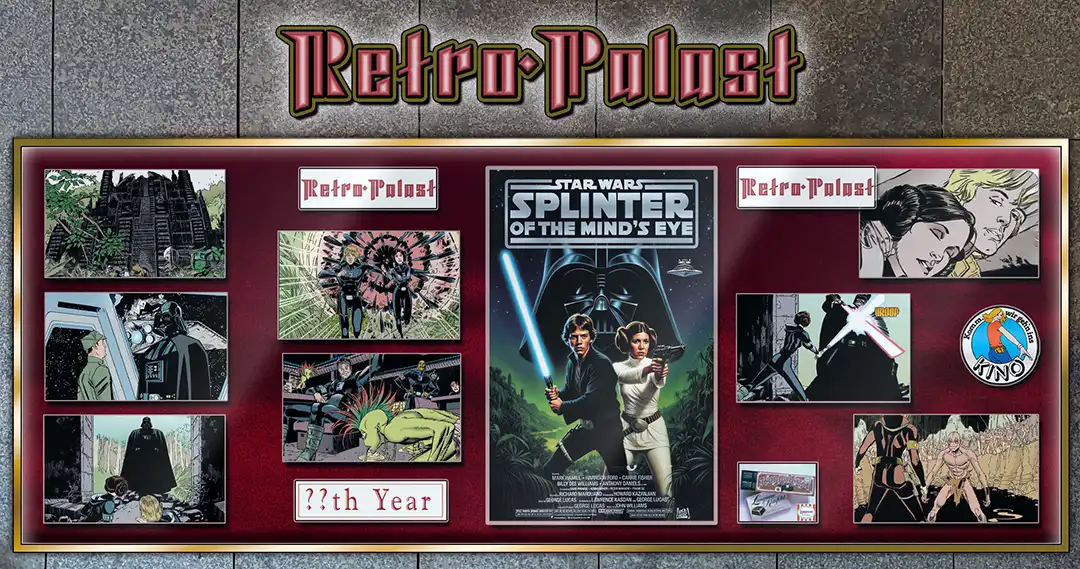
Splinter of the Mind’s Eye
“Splinter of the Mind’s Eye” by Alan Dean Foster, published in 1978, is still considered “the Star Wars sequel that never became reality.” The book was written during a unique transitional phase in film history, when it was still completely unclear whether “Star Wars: A New Hope” would be more than a one-off surprise hit. George Lucas deliberately had the novel developed as a backup: if the film failed at the box office, this story could have been used to produce a comparatively inexpensive sequel. Expensive space battles, large fleets, or spectacular special effects were not planned. Han Solo was also missing, as Harrison Ford’s contract did not guarantee an automatic sequel.
Instead, Foster focused on a concentrated, almost chamber play-like plot with few characters, a lot of atmosphere, and a single, alien planet. The enormous success of the film ultimately made this precaution unnecessary. With “The Empire Strikes Back,” the franchise took a completely different, more epic direction. “Splinter of the Mind’s Eye” thus became the first official novel of the Expanded Universe (now “Legends”) and, in retrospect, marks the beginning of a decades-long tradition of Star Wars stories beyond the cinema screen.
The Plot
The story takes place about two years after the destruction of the first Death Star. Luke Skywalker accompanies Princess Leia Organa, R2-D2, and C-3PO on a secret diplomatic mission. The goal is to win new allies for the young Rebel Alliance and strengthen its network. Right from the start, however, it becomes clear that the galaxy remains dangerous and unstable: a massive energy storm forces the group’s ship to make an emergency landing on the swampy planet Circarpous V, also known as Mimban, which is under Imperial control.
To avoid immediate detection, Luke and Leia disguise themselves as ordinary travelers. They seek shelter and information in a run-down bar. There they meet the mysterious, powerful woman Halla, who plays a central role in the rest of the story. She possesses a shard of the legendary Kaiburr crystal, an ancient artifact that can greatly enhance the power of its bearer. Halla promises to help them escape the planet if Luke and Leia accompany her to the Temple of Pomojema in exchange for the complete crystal.
A seemingly harmless dispute with miners quickly escalates. Imperial stormtroopers intervene, and Luke and Leia are arrested. In prison, they meet the Yuzzem Hin and Kee, two powerful but essentially good-natured beings who also suffer under Imperial tyranny. With the help of the Force, Halla manages a spectacular rescue. The group flees, steals a vehicle, and embarks on a dangerous journey through swamps, fog, and hostile terrain.
Along the way, the group is repeatedly put to the test. A giant monster, the Wandrella, attacks, forcing Luke and Leia to retreat into a cave. There they encounter the Coway, a primitive, isolated people. Through a ritual duel, Luke defeats their champion and wins their respect. This episode highlights Luke’s growing connection to the Force and his development from an inexperienced farm boy to a leader.
However, the Imperial forces under Captain Supervisor Grammel do not give up. They pursue the group to the Temple of Pomojema. There, the plot comes to a dramatic climax: after the rebels find the Kaiburr crystal and have to face a monstrous guardian, Darth Vader himself appears. He kills Grammel without hesitation and demands the crystal for himself. Luke is initially clearly outmatched in the ensuing duel.
In one of the most remarkable moments of the novel, Leia herself picks up a lightsaber and confronts Vader. The Kaiburr crystal amplifies her abilities and gives her enormous power for a short time. Luke is freed, and together – with the help of Obi-Wan Kenobi’s spirit – he manages to sever Vader’s arm. Vader falls into the depths but survives. The crystal then heals the wounded before the group escapes into the thick fog of Mimban.
In retrospect, the clearly implied romantic tension between Luke and Leia is particularly striking. At the time of publication, this seemed completely unproblematic, but today, due to their later revelation as siblings, it has an almost curious note.
Background
Alan Dean Foster was an obvious and strategically wise choice for this project. He had already written the novelization of “A New Hope,” so he knew the characters and the world inside out, and worked closely with George Lucas during this phase. Foster knew how to translate cinematic images into prose, while also adding his own unique touches. The specifications for the book were unusually specific: the story had to be one that could be filmed on as low a budget as possible. This restriction had a significant impact on the novel. As a result, the plot focused on a single, self-contained planet, deliberately avoiding large battles in space and leaving out central characters such as Han Solo and Chewbacca, whose inclusion would have required more complex sets and effects. Even a space battle scene that was originally planned was cut by Lucas in order to keep the concept consistently lean.
The novel was published in February 1978 and quickly became a bestseller, which in retrospect also reflects the enormous hunger of fans for new Star Wars content. Although a film adaptation was never seriously considered, the book impressively demonstrates how flexible and open the Star Wars universe was conceived from the outset. It served not only as potential backup for the film, but also as an early testing ground for ideas, characters, and motifs that were later revisited in other forms.
Trivia
- The Kaiburr crystal is considered the direct predecessor of the later Kyber crystals in the official canon. Many of its properties—in particular, the ability to concentrate and amplify the Force and heal physical and mental injuries—are found in modified form in the Kyber crystals, which later became firmly established in the Star Wars mythos.
- Mimban reappeared decades later in the film “Solo: A Star Wars Story.” There, the planet was visually reinterpreted but retained its function as a gloomy, war-torn setting, thus forming a direct bridge between the early Expanded Universe and the modern canon.
- In 1995/96, Dark Horse Comics published a comic adaptation that visually condensed the story and reemphasized some scenes. In particular, the duel with Darth Vader and the depiction of the Kaiburr crystal were given an additional, iconic layer through the illustrations.
- The book remained on the New York Times bestseller list for several weeks in 1978, proving early on that Star Wars was not only a film phenomenon but also a literary one. This success encouraged the publisher to release further novels set in the same universe.
- The title alludes to the crystal shard that concentrates, amplifies, and symbolically “splits” the Force. At the same time, it can be read metaphorically: as a reference to an early divergence in the saga, where an alternative version of the Star Wars future could have developed.
Criticism then and now
When it was released, “Splinter of the Mind’s Eye” was received positively by most, not least because of the situation fans found themselves in at the time. Many readers were grateful for a quick continuation of the story of Luke and Leia, as there was no certainty about further movies at that point. Critics particularly praised the fast pace of the narrative, the clear structure, and the highly cinematic writing style, which was clearly based on the visual language of the first film. Only from today’s perspective do weaknesses become more apparent: some of the dialogue seems wooden or formulaic in places, and the romantic tension between the main characters is hard to overlook. These aspects are often critically discussed today, but can only be properly understood in the context of their creation at the time. It is precisely this historical framework that remains crucial for the evaluation of the novel and explains why many of its narrative decisions seemed completely natural at the time of publication.
Cultural influence
The novel proved early on that Star Wars could also work outside the cinema and was not solely dependent on the medium of film. It paved the way for the Expanded Universe by showing that new stories, characters, and concepts could credibly exist in the same galaxy without being directly tied to a screen production. As a result, it influenced numerous later books, comics, and games that continued this model and steadily expanded the universe. Although the work was officially declared “Legends” after the Disney takeover in 2014 and is therefore no longer part of the current canon, its ideas, motifs, and narrative approaches remain palpable to this day and continue to have an indirect influence on more modern Star Wars narratives.
Conclusion
“Splinter of the Mind’s Eye” is a fascinating thought experiment: an alternative future for the Star Wars saga that impressively shows how differently the franchise could have developed if its success had not been guaranteed from the outset. The novel offers a rare glimpse into a Star Wars that was still experimental, cautious, and open to different narrative paths. As a historical document of the early Star Wars years, the book reflects not only the creative uncertainty but also the enormous wealth of ideas of this phase. At the same time, it forms an important foundation of the Expanded Universe, as it demonstrated early on how the galaxy could be expanded far beyond the cinema screen. This is precisely why the novel is still worth reading today—especially for fans who want to understand the roots of the galaxy far, far away and comprehend how a single film could give rise to a global mythical franchise.






Kommentar verfassen