

Another visitor.
Stay a while… stay forever!
A milestone on the C64

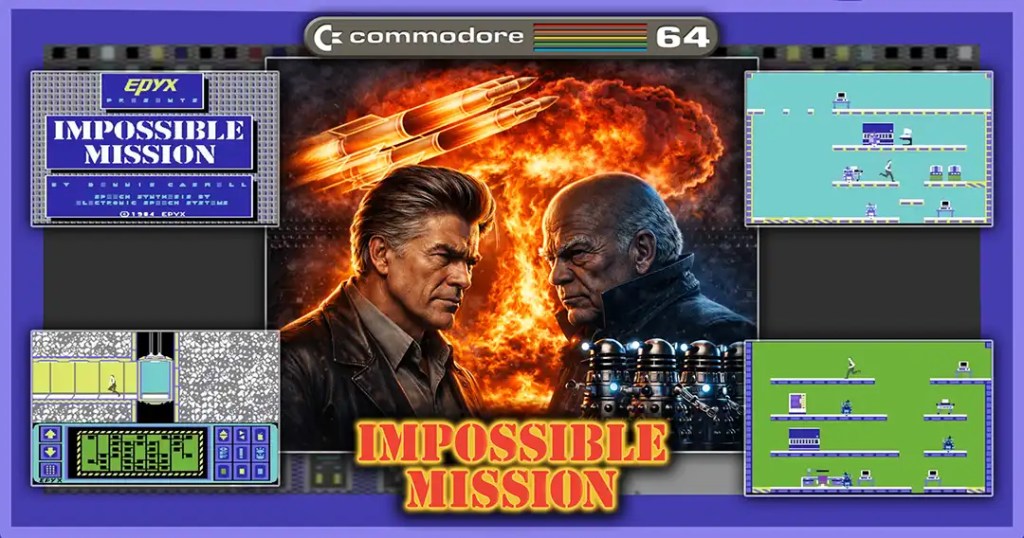
Impossible Mission was released in 1984 for the Commodore 64 and remains one of the best-known and most influential games of that era. At a time when many titles focused primarily on fast-paced arcade action, this game deliberately took a slower, more strategic approach. Developed and published by Epyx, Impossible Mission combined action, puzzles, and classic spy flair in a way that was novel at the time, setting it apart from many contemporary arcade conversions.
Instead of relying solely on quick reflexes, the gaming experience focused on planning, observation, and logical thinking. Every room had to be carefully explored, and every move had to be carefully considered. This comparatively mature game design appealed particularly to players who were looking for more than just tests of skill, and contributed significantly to the title’s special reputation.

The spoken line “Stay a while, stay forever!” is particularly legendary – a moment that has been burned into the collective memory of players and is still inextricably linked to the game today. For many, this was their first encounter with clearly understandable voice output in a home computer game. This short, menacing sentence immediately gave the antagonist character and made the threat tangible.
At the same time, the voice sequence marked a key technical and cultural moment in early video game history, as it showed that home computers could convey not only simple sounds but also narrative elements. Impossible Mission thus seemed surprisingly modern and set new standards for atmosphere and presentation.
Gameplay

The player takes on the role of an unnamed agent who must infiltrate the sprawling underground headquarters of the evil scientist Professor Elvin Atombender. He is planning to launch several nuclear missiles, which must be prevented from being fired within a strictly defined time limit. The story is not told through long texts, but is conveyed exclusively through the gameplay, which reinforces the feeling of being part of a dangerous secret mission.
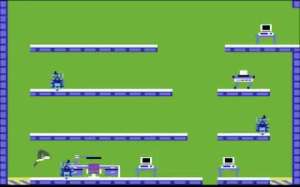
The gameplay combines classic platform action with challenging puzzle mechanics and requires both skill and forward thinking. The player jumps between elevators, ladders, and moving platforms, uses short time windows for risky maneuvers, dodges deadly robots, and systematically searches the individual rooms of the base for hidden code fragments. These fragments are not automatically explained, but must be understood and logically interpreted by the player themselves. Only by correctly assembling the individual parts can the base’s self-destruction mechanism be activated.
In addition, a global countdown creates constant time pressure, making every decision meaningful and punishing failed attempts harshly. Those who fall too often or take detours lose valuable minutes. Particularly innovative was the random arrangement of rooms at each new game start, which meant that no fixed solution or optimal route could be memorized. Instead, the player had to constantly reorient themselves and improvise. This principle greatly increased the replay value and was well ahead of its time, as it generated long-term motivation through variation rather than pure scores.
Technology
Technically, Impossible Mission made impressive use of the Commodore 64 and demonstrated its capabilities within the narrow hardware limits of the system. With only 64 kilobytes of RAM, the developers managed to implement a complex game system with many individual mechanics in a stable and fluid manner. In particular, the voice output via the SID chip was considered a technical sensation in 1984 and was far superior in quality to what many players had experienced on home computers up to that point. It gave the game an unexpected depth and contributed significantly to the characterization of the antagonist.
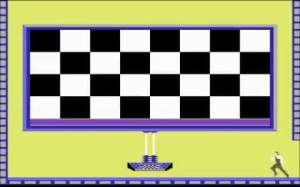
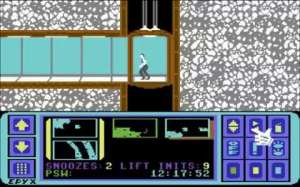
Impossible Mission also set new standards in terms of graphics. Large, smoothly animated sprites, clearly recognizable characters, and detailed, functionally designed rooms created a dense, almost cinematic atmosphere. The animations were deliberately realistic and conveyed weight and dynamics, which was particularly noticeable when jumping between platforms.
Instead of continuous music, the game relied on targeted sound effects such as the humming of elevators, the mechanical clicking of switches, and the menacing noises of robots. This deliberate acoustic restraint greatly enhanced the tension and feeling of isolation, making every action of the player seem meaningful. The controls were considered precise and direct, but they were unforgiving of mistakes and required exact timing and a good sense of distance for each jump.
Trivia

Impossible Mission was one of the first C64 games with clearly understandable digital voice output and was often cited as a technical showcase for this feature. The distinctive voice samples contributed significantly to the game’s recognizability and were often cited in gaming magazines and developer discussions as proof of the Commodore 64’s capabilities. Despite its name, the game is theoretically completely solvable, but requires perfect timing, high concentration, and a lot of practice, which earned it a reputation as a particularly challenging title.
I personally managed to solve the game once, but it took a lot of effort. The real difficulty lay less in the rooms than in the cards. Because these can be rotated in all directions and their colors changed, it is all the more difficult to find the correct combinations, as the “cut edges” are the only clues.
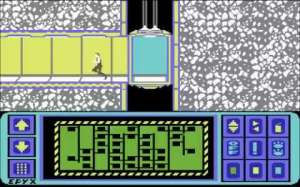
Many players used handwritten maps, notes, and their own symbol systems to remember the complex room layout and areas they had already visited. This approach was typical for the time and made Impossible Mission a game that had an impact far beyond the actual gaming session. Later, versions for other home computers and consoles were released, which retained the core gameplay. In addition, an official sequel followed, which further expanded on the basic concept and introduced new variations on the familiar game mechanics.
Criticism at the time

Contemporary gaming magazines particularly praised the innovative mix of action and brain teasers, the serious, almost threatening atmosphere, and the high level of difficulty, which clearly set it apart from simple action titles. Many editors emphasized that Impossible Mission conveyed an unusually mature gaming experience and challenged players mentally more than most comparable titles of the time. The tension curve and the high replay value resulting from the random room structure were mentioned particularly positively.
However, criticism was mainly directed at the merciless punishment for mistakes and the high frustration potential for inexperienced players. A single misstep could cost valuable minutes or lead to instant screen death, which made the game inaccessible to some players. Some magazines explicitly warned that Impossible Mission required patience and perseverance and was more suited to experienced players who were willing to learn from their mistakes and accept repeated attempts.
Cultural influence

Impossible Mission influenced numerous later games, particularly through randomly generated level structures and the close intertwining of platform action with logic puzzles. Many later titles adopted the principle of designing action not in isolation, but as part of a larger thought process in which planning, risk assessment, and spatial thinking play a central role. Games that combined exploration and puzzle mechanics in particular took up this design philosophy and developed it further.
In addition, Impossible Mission helped establish video games as atmospheric experiences in which presentation and game mechanics are inextricably linked. The deliberate reduction of music in favor of targeted sound effects and the clear visual language were often cited as role models by later developers.
The antagonist’s iconic phrase became one of the most famous quotes in video game history and gained popularity far beyond the game itself. It is still quoted and parodied today and is frequently referenced in retro culture, at trade fairs, in videos, and in game documentaries. Impossible Mission thus also became an integral part of the cultural memory of the early home computer era.
Conclusion

Impossible Mission is more than just a difficult C64 game – it is an important piece of video game history and a prime example of the creative heyday of the home computer era. Thanks to its technical innovation, unique design, and lasting influence on later game concepts, the title is rightly considered a classic that has gained recognition far beyond its original platform.
Even decades after its release, the game impressively demonstrates how much atmosphere, excitement, and playful depth can be packed into just 64 kilobytes. Impossible Mission illustrates that clever ideas, well-thought-out game design, and consistent implementation can be more important than technical superiority. This is precisely why the title is still inextricably linked to the Commodore 64 for many players today and stands as an example of creative milestones that have had a lasting impact on the medium of video games.








 McHenry's Lair
Kommentar verfassen :