


Ghostbusters!!
Ghost hunting with cult status
1984 was a year of great cinema successes, and hardly any other film had such a lasting impact on pop culture as Ghostbusters. The mixture of humor, supernatural horror, clever dialogue, and groundbreaking special effects was something very special at the time – and Ray Parker Jr.’s famous theme song not only became a catchy tune, but also a pop culture phenomenon that burned itself deeply into the collective memory. The iconic question “Who you gonna call?” became the standard phrase for any kind of ghost hunter – on T-shirts, in advertisements, and of course in children’s bedrooms.
The immense popularity of the film almost inevitably led to the development of a video game. The up-and-coming publisher Activision quickly recognized the potential of a home computer version, especially for the popular Commodore 64 (C64). David Crane, a renowned developer who had previously enjoyed great success with titles such as Pitfall!, was commissioned to create the game. He was given early access to the script and began designing the game even before the film was released. The result was an ambitious project that didn’t just replay scenes from the film, but created a standalone game universe with strategic, action-packed, and economic components.
The game Ghostbusters for the C64 was not only one of the first successful film adaptations for home computers, but also early proof that licensed games could be more than just merchandising products. It showed that it was possible to develop a standalone gaming experience from a strong license that appealed to both fans of the film and classic gamers. The mix of strategic depth, catchy action, and a charming, sometimes tongue-in-cheek presentation was unusual at the time – and one reason why the game quickly built up a loyal fan base. Both die-hard Ghostbusters fans and tech-savvy home computer users found this game to be a captivating experience that captured the spirit of the 1980s like no other.
Gameplay
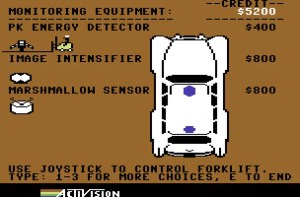
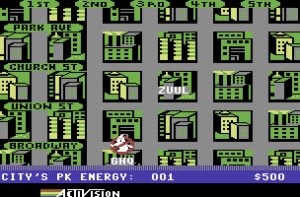
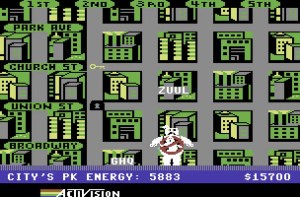
Ghostbusters on the C64 is an unusual genre mix of strategy, business simulation, and action. The game mechanics begin with the establishment of your own Ghostbusters company: the player gives their company a name, selects a vehicle – from a simple VW Beetle to a converted ambulance – and equips it with various ghost-catching devices, including PKE meters, ghost traps, super catchers, and even improved storage upgrades. The choice of equipment has a significant impact on the team’s efficiency, which adds an interesting tactical component to the game. Then the actual ghost hunt begins in the city haunted by paranormal activity, which is depicted as an abstract metropolis with streets, intersections, and landmark buildings.
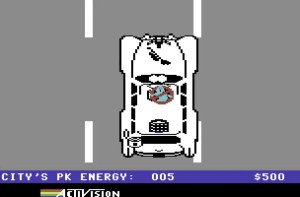
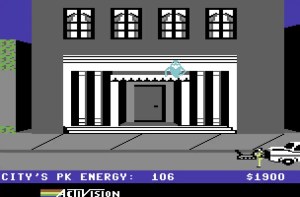
The goal is to catch as many ghosts as possible and make a profit in the process – because the game simulates a kind of business model with income and expenses. For every successful ghost hunt, you receive money that you can use for better equipment, vehicle upgrades, or repairs. At the same time, you have to constantly decide which jobs to accept and whether longer travel distances are worthwhile. Clicking on one of the flashing buildings on the city map starts a short action sequence: two Ghostbusters get out of the vehicle, position themselves tactically, set a ghost trap, and try to catch the flying ghost at the right moment. Not only timing plays a role here, but also the placement of the characters – a simple but effective gameplay element.
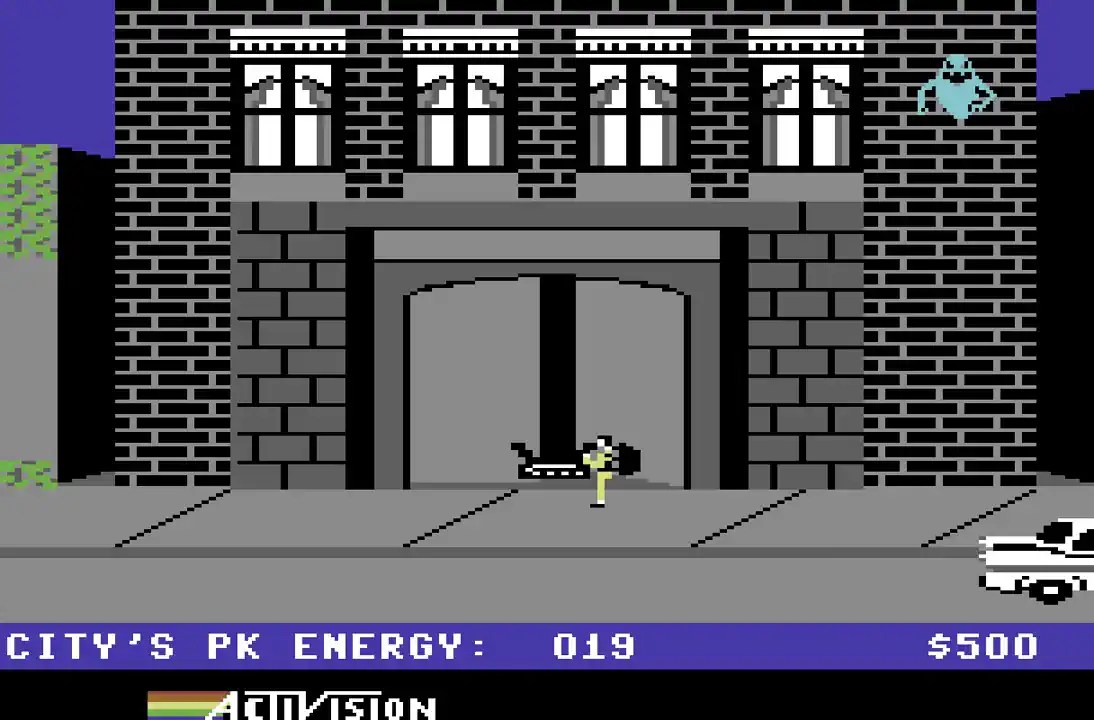
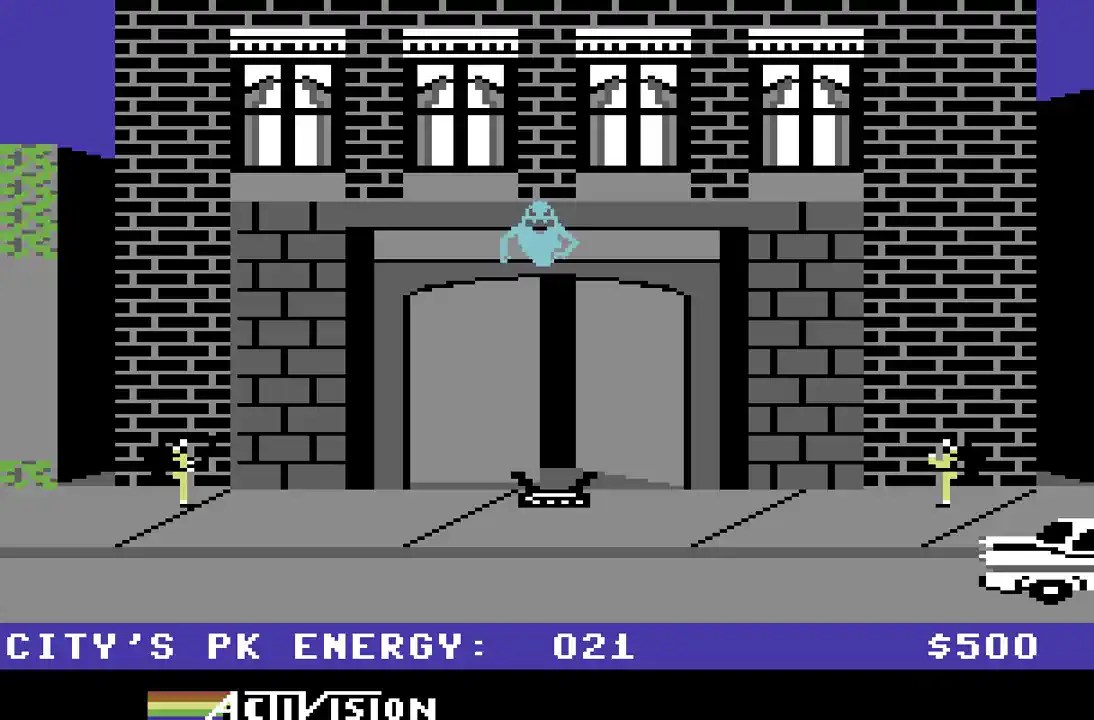
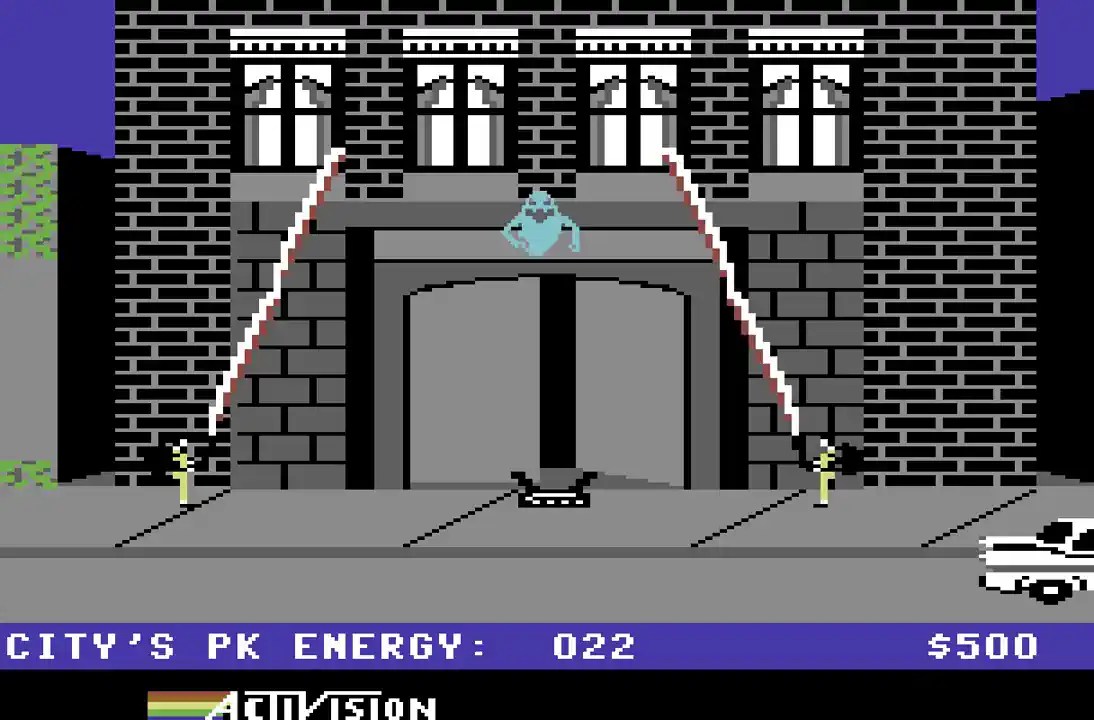
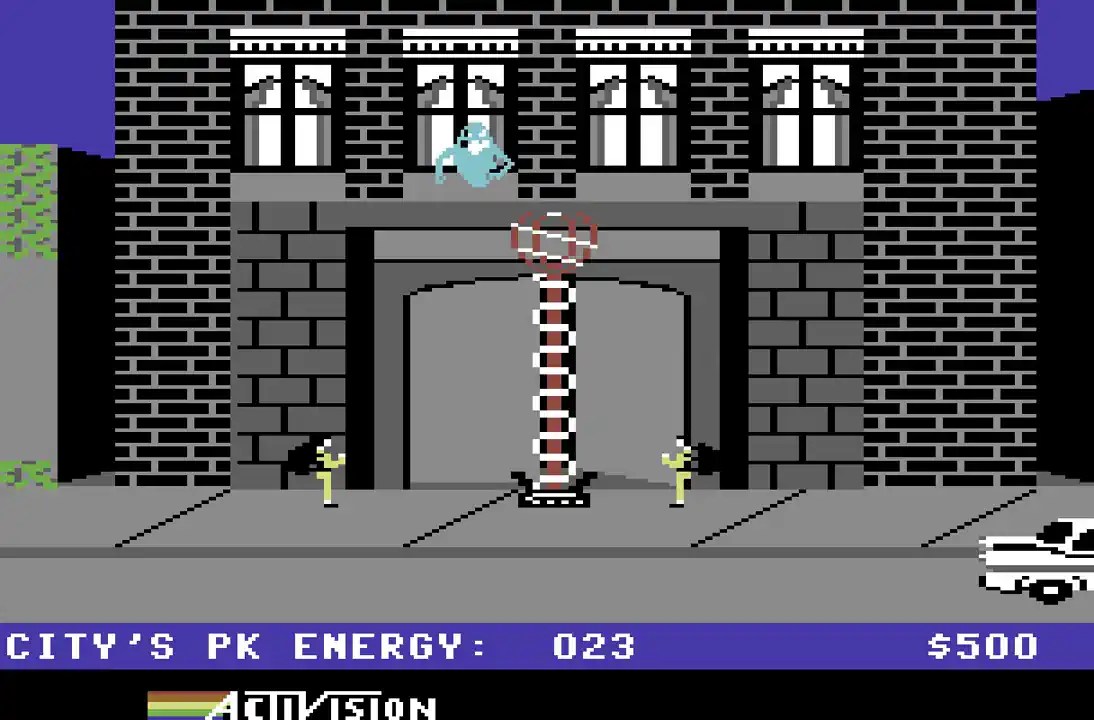
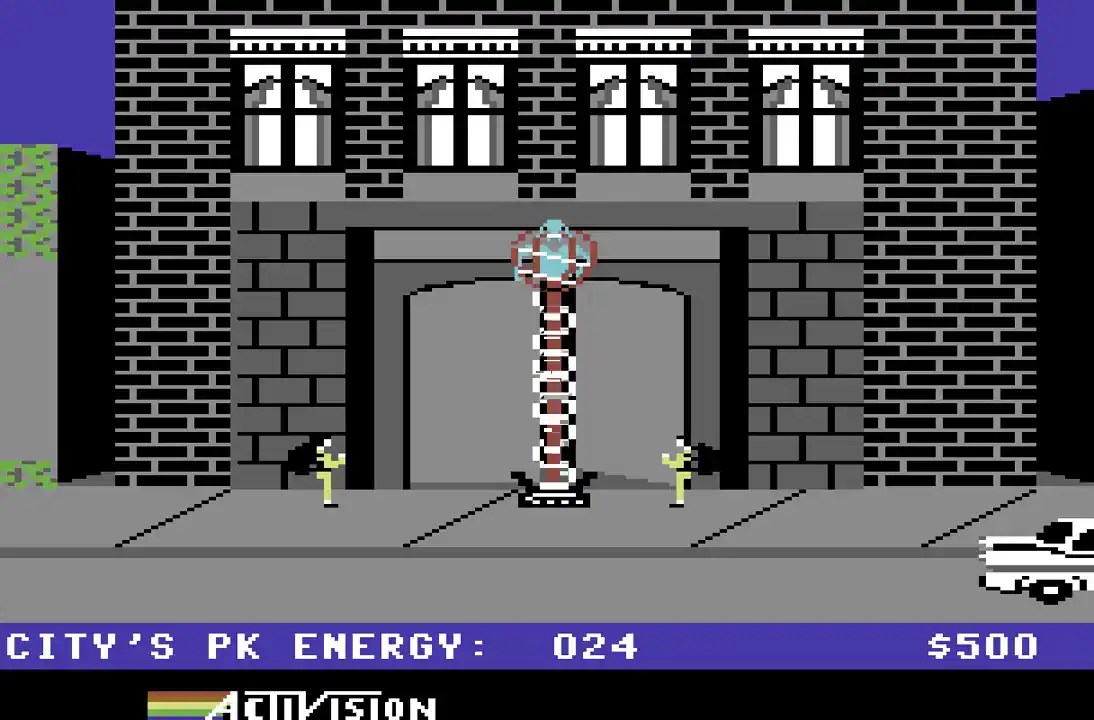
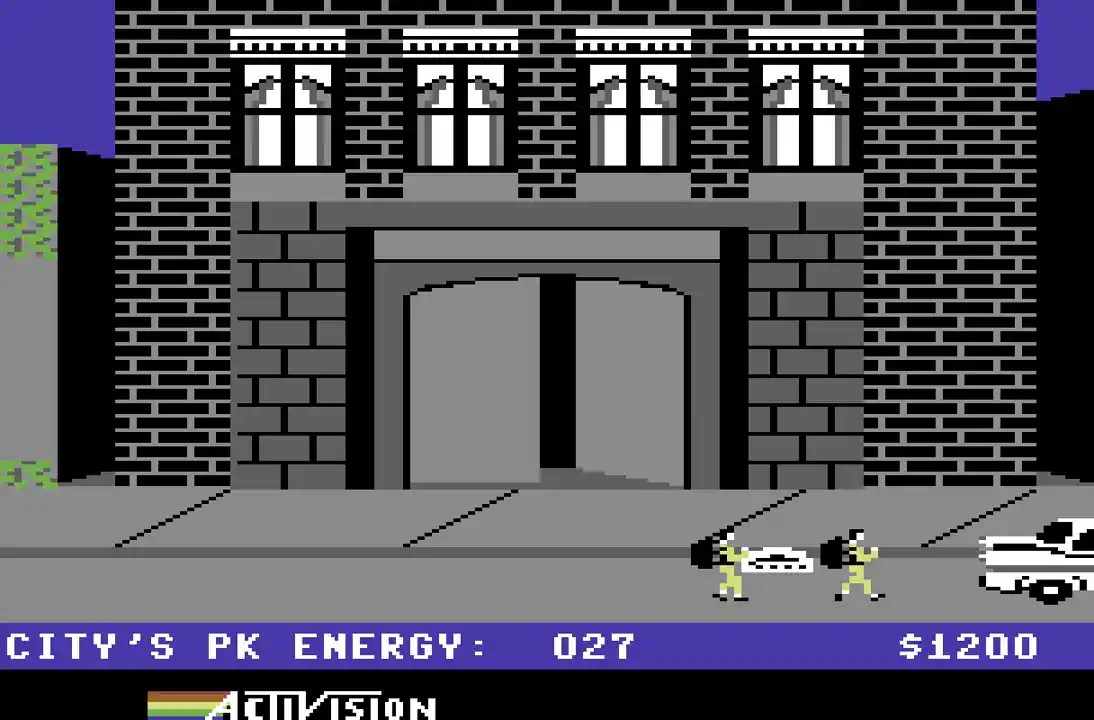
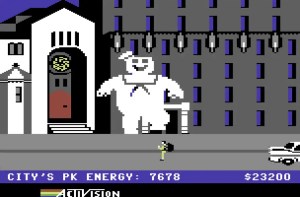
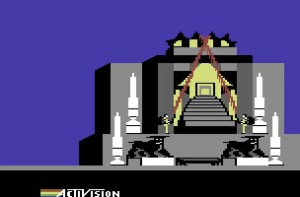
The real-time aspect adds a special appeal: as the player goes on missions, the city’s “PK energy level” rises continuously. If it gets too high, Gozer appears as the ultimate threat – an event heralded by increasing ghost sightings and the sudden appearance of the Stay Puft Marshmallow Man. The game ends with a dramatic showdown at Spook Central, where only precise timing and strong nerves will enable the player to overcome the final challenge: two of their Ghostbusters must manage to get past the Marshmallow Man unscathed in order to enter the building and stop the catastrophe.
In addition to the game mechanics, a dash of humor provides charming entertainment: although the characters are roughly pixelated, their animations and sound effects convey enough wit to remind players of the movie. The Marshmallow Man grins mischievously when he destroys a building, and the Ghostbusters occasionally let out comically distorted cheers. Overall, the result is a surprisingly captivating gaming experience that scores points with its mix of planning, tactics, reaction, and a touch of madness – and remains a prime example of innovative game concepts on limited hardware to this day.
Technology
Technically, Ghostbusters makes amazing use of the C64’s potential and impressively demonstrates what was possible with the hardware of the popular home computer. Particularly noteworthy is the digital voice sample of the title song – a shrill “GHOSTBUSTERS!” scream, which was an absolute highlight for many C64 players. At a time when digital voice effects were still a rarity on home computers, this effect seemed almost revolutionary. The soundtrack itself is a simplified but extremely catchy 8-bit version of Ray Parker’s famous hit. It plays on a continuous loop during the start screen and sets the mood even before the game begins. The track is amazingly detailed, catchy, and a prime example of creative sound programming on limited storage space.
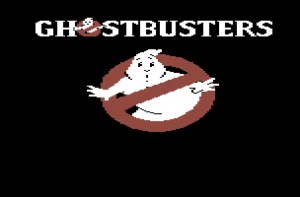
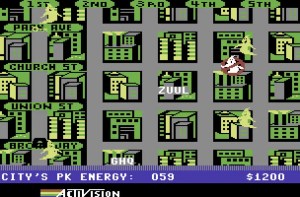
Graphically, the game is quite solid for its time. The city map is functional, clear, and provides sufficient orientation with animated ghosts, flashing buildings, and clear symbols. The vehicles are easily distinguishable and move smoothly through the city. The action sequences in which ghosts are captured seem simple from today’s perspective, but they are easy to understand and convey a sense of dynamism through simple but effective animations. Even though the Ghostbusters are depicted in a rather symbolic way – coarse-pixelated figures with simple movements – you can immediately see what is happening and react intuitively. The user interface is well designed, with logically placed menus and a clear visualization of resources. Even newcomers can find their way around easily after a few minutes, which was not a given at the time.
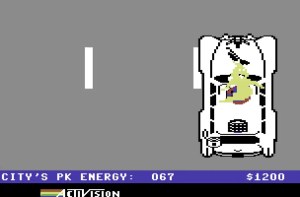
David Crane, who had already set standards with Pitfall!, once again demonstrated his talent for technical sophistication. He knew how to develop creative solutions from the limitations of 8-bit architecture. Clever memory optimizations and skillful programming were necessary to fit voice samples, music, game graphics, and an evolving game world onto a single C64 tape – a true masterpiece in the history of home computer gaming. The programming of the voice samples alone required tricky encoding and compression of the audio data, and the smooth integration of all game elements into a functioning whole underscores the technical finesse with which this game was developed. Ghostbusters thus became not only a playful but also a technical flagship for the C64.
Trivia & Curiosities
- David Crane developed the game before the film was even completed – based solely on the script. Without any reference material from the finished film, he had to rely on his instinct for game mechanics and atmosphere – a creative risk that paid off.
- If you remain inactive in the game for a while, you will be rewarded with an Easter egg: the Ghostbusters logo “sings” the theme song, accompanied by dancing letters. This humorous interlude was a surprising highlight for many players and demonstrated the developers‘ attention to detail.
- Players can give their Ghostbusters company any name they want. Some names activate secret messages or funny comments, including references to developers, movie characters, or pop culture references of the time – an early precursor to today’s cheat codes and inside jokes.
- The Stay Puft Marshmallow Man, known from the movie, also appears in the game as a gigantic threat. Sometimes he suddenly appears and destroys buildings – which is both tragic and amusing. The sudden destruction of skyscrapers creates tension and was technically remarkable.
- There was no save function – a typical feature of the time. If you lost, you had to start over from the beginning. This increased the difficulty, but also encouraged players to develop strategies for efficiency in order to get as far as possible.
- The game included a “password” system for the final showdown, a rare form of progress management for home computers at the time. By entering a code, players could jump straight to the final battle – an unusual but welcome feature that allowed for a certain form of progress preservation.
Reviews at the time
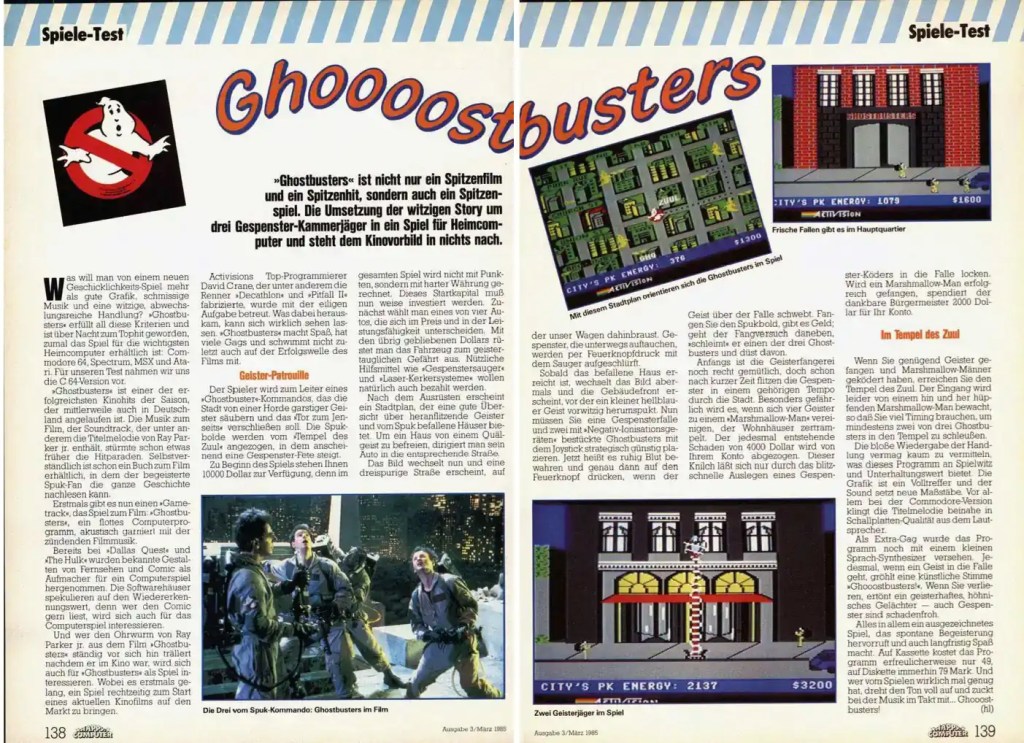
At the time of its release, Ghostbusters received mostly positive reviews on the C64. The trade press was enthusiastic about the successful combination of film template and game mechanics, which was by no means a given at the time. Many games based on movie licenses were hastily produced and disappointed in terms of quality. Ghostbusters, on the other hand, impressed both technically and in terms of gameplay – a rarity in an era when movie adaptations were mostly marketed as mere accessories.
- The British magazine Zzap!64 particularly praised the original implementation, innovative gameplay, and surprisingly high depth of play. In their issue, they described the game as a milestone for licensed adaptations.
- The German magazine C64er particularly highlighted the technical implementation – especially the sound, which was considered a milestone for the C64. The voice output was also emphasized, as it represented a completely new acoustic experience for many players.
- Some critics complained about the limited long-term motivation: after several playthroughs, the game becomes too predictable because the sequences repeat themselves. Some recommended playing it in shorter stages to increase its replay value.
- Despite these criticisms, Ghostbusters was generally considered one of the best licensed games of its time. It managed to thrill both fans of the film and players with no connection to the original. The balance between accessible entry and tactical depth was also particularly praised, making the game attractive to both beginners and experienced gamers.
The game received several awards and sold an impressive number of copies worldwide – further proof of its quality and popularity. In some countries, it was even recommended as educational software because it promoted economic thinking and strategic planning – a remarkable assessment for a game based on a Hollywood blockbuster.
Cultural influence
Ghostbusters was one of the first games based on a major Hollywood blockbuster – and it was also a compelling game. It established a new model for licensed games and showed that film adaptations could be more than just clumsy marketing products. The combination of cinematic template, playful innovation, and technical sophistication set standards by which later licensed games had to be measured. It also inspired many developers to be more creative with well-known brands and turn them into more than just simple adaptations.
The iconic voice sample “Ghostbusters!” was later parodied or quoted in numerous demos and games. In the C64 demo scene, the sample was a popular element and found its way into numerous so-called “cracktros,” i.e., intros to hacked games. It was used not only as a humorous reference, but also as a demonstration of what was technically possible on the C64. Later games such as Ghostbusters II and the humorous Zombies Ate My Neighbors also referenced this game in terms of style and content. They often adopted the mix of horror, humor, and action—a rare combination that already worked so well in the original.
In addition, the game introduced many players to the concept of economic-strategic game mechanics for the first time. At a time when action games dominated, this was an innovative step. The introduction of cost-benefit calculations, equipment management, and entrepreneurial decisions within a ghost hunter scenario was not only entertaining but also educational. The combination of planning, resource management, and action inspired later titles such as Sim City, Theme Park, and even Rollercoaster Tycoon. These titles built on the idea that the player can be a planner, a doer, and a strategist all at once—an idea that Ghostbusters helped shape.
The game’s influence should not be underestimated—even if it is now primarily perceived as a charming relic of the 80s, it was a pioneer at the time. It opened doors for bold design decisions in licensed games and proved that even well-known brands can break new, creative ground. For many developers, it served as early inspiration for how gameplay and branding can merge into a coherent overall experience.
Conclusion
Ghostbusters on the C64 is much more than just a simple licensed game – it’s a piece of living video game history. With its clever combination of strategy, action, and humor, combined with a distinctive sound and iconic moments, it took gamers‘ hearts by storm. The game not only proved that film adaptations can go far beyond mere marketing products with commitment and creativity, but also that technical limitations do not necessarily have to restrict the depth of gameplay or entertainment value. The way Ghostbusters blended different genres into a coherent gaming experience was unusual and visionary for its time. It created a gaming experience all its own that could not be pigeonholed or reduced to a single gameplay element.
Even though it is technically outdated today, its influence remains palpable. It is a perfect example of how creative developers were able to achieve great things with limited resources. The limitations of the C64 were not seen as an obstacle, but as a creative challenge, thanks to innovative programming, clever design, and a loving approach to the original. This mentality—making the most of what is possible—is a central part of retro gaming culture and is still valued today by hobby developers and indie studios alike. Anyone interested in retro gaming, gaming history, or simply the cult atmosphere of the 80s should definitely give Ghostbusters on the C64 a try. It’s not only a nostalgic trip to a bygone era, but also a practical example of successful game design with heart and soul.
Because in the end, there’s only one question: “Who you gonna call?”








 McHenry's Lair
Kommentar verfassen :