

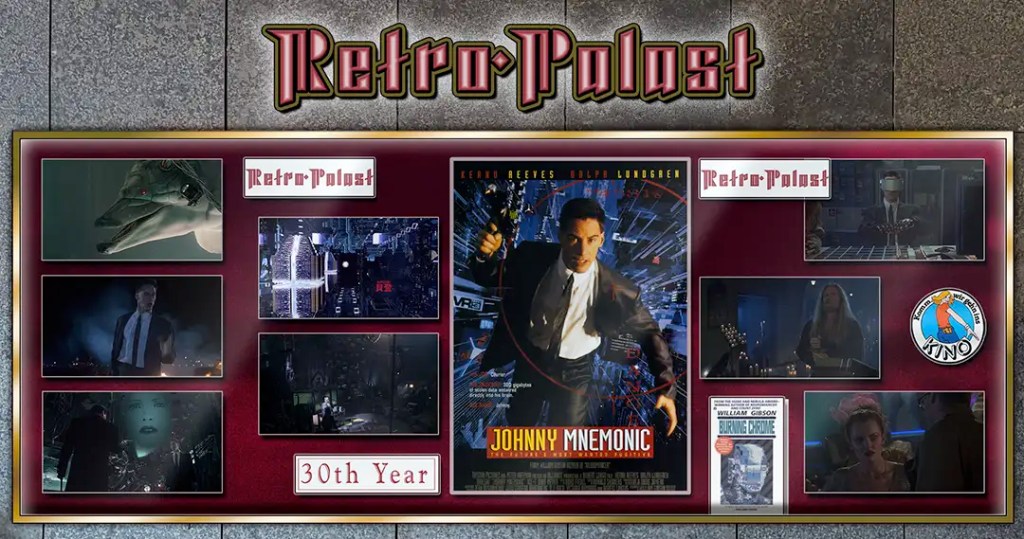
I want to get online… I need a computer!
An underrated Cyberpunk classic
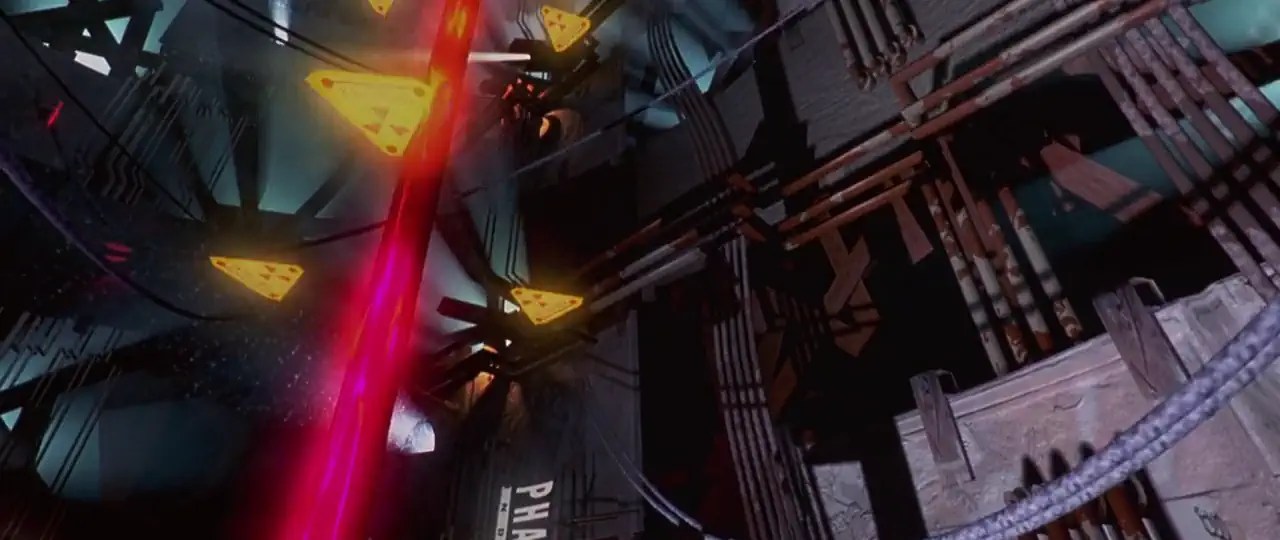
When the film Johnny Mnemonic was released in 1995, the world wasn’t ready for its visionary power. Based on a short story by William Gibson, one of the fathers of the cyberpunk genre and creator of legendary works such as Neuromancer, the film was largely dismissed at the time as bizarre, overambitious, and difficult to access. The quirky characters, wild plot, and experimental visuals seemed confusing and alienating to mainstream audiences. But in retrospect, it’s becoming increasingly clear that “Johnny Mnemonic” is a fascinating document of its time that astonishingly accurately anticipated many themes of the digital age. Its central exploration of information overload, corporate power, digital networking, and artificial intelligence seems more relevant today than ever. Visually, too, the film was a pioneer of the genre, with its rough, over-stylized design and uncompromising aesthetics that anticipated later works such as “The Matrix” and “Ghost in the Shell.” Its mixture of trash, depth, and technological vision made it a cult object that is now receiving the attention it deserves.
Plot
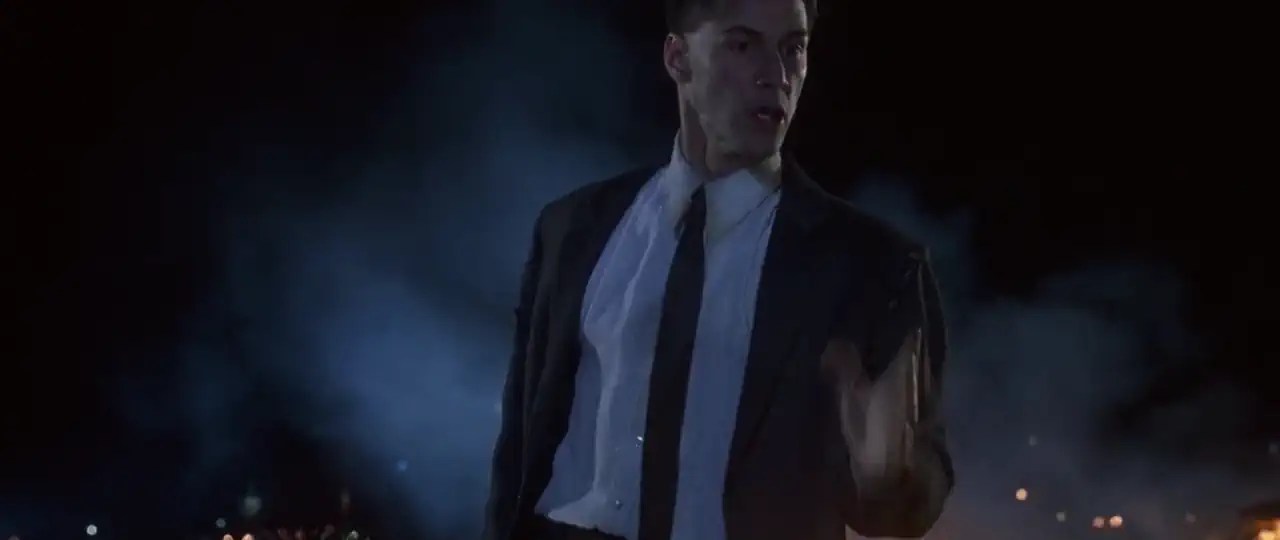
In 2021, the world lives in a dystopian future marked by hyper-technologization, digital alienation, and a mysterious disease called Nerve Attenuation Syndrome (NAS). Society is controlled by powerful megacorporations, while many people live in poverty, technological overload, and health hazards. NAS is killing more and more people, and no one seems to know the cause or a cure. In this cold world defined by data flows, Johnny (Keanu Reeves) works as a so-called mnemonic courier – a human data carrier who smuggles secret information across borders in an implanted memory chip in his brain. To do his job, Johnny had to sacrifice his personal long-term memory, which makes him a restless and emotionally empty character.
His latest assignment is particularly dangerous: he is recording an explosive data set that is said to contain the encrypted information needed to cure NAS. But the volume of data exceeds his storage capacity, pushing him to his limits, both mentally and physically. He quickly becomes the target of a network of ruthless corporations, the Japanese yakuza, and mysterious cyber terrorists who want to get their hands on the data file at any cost. As Johnny desperately tries to find a way out, a breathless race against time begins.
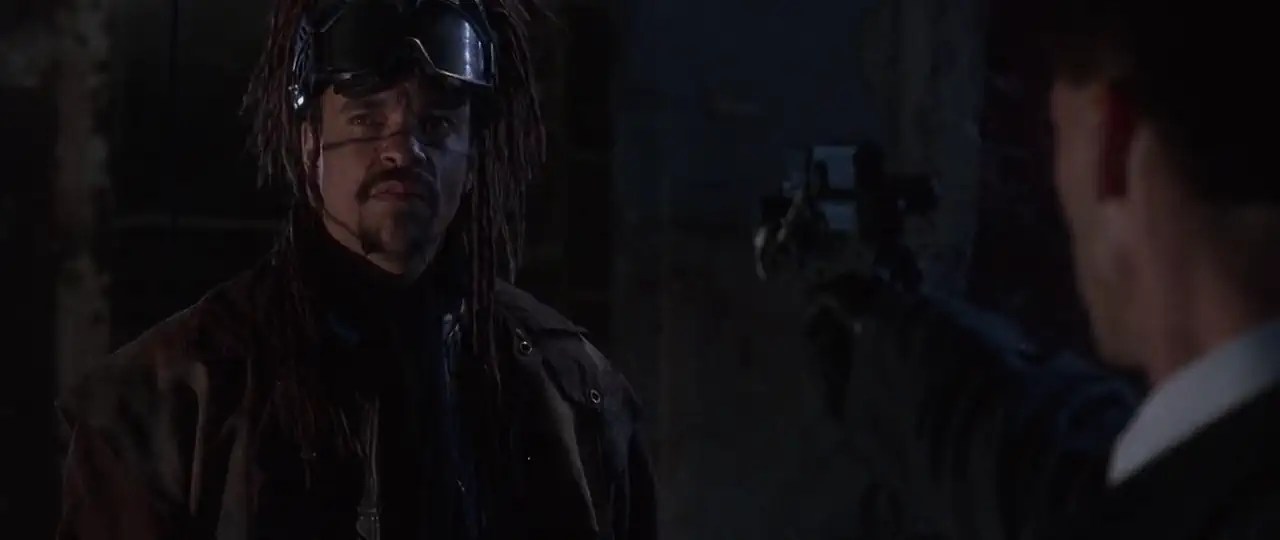
On his escape through a dilapidated, technologically overloaded America, Johnny encounters the combative bodyguard Jane (Dina Meyer), who herself suffers from NAS and hopes to be cured by the secret contents of Johnny’s mind. Together, they seek help from eccentric cyber rebel J-Bone (Ice-T), the leader of an anarchist underground movement that opposes digital totalitarianism. In a desperate battle against overwhelming opponents and using every technical means at their disposal, they attempt to solve the encrypted puzzle – in the hope of saving humanity and restoring Johnny’s memory.







Trivia
- Keanu Reeves accepted a drastic pay cut for his role in order to give the film a larger budget for special effects. His decision demonstrated his passion for the genre and his willingness to support an ambitious project, even if it meant financial disadvantages for him.
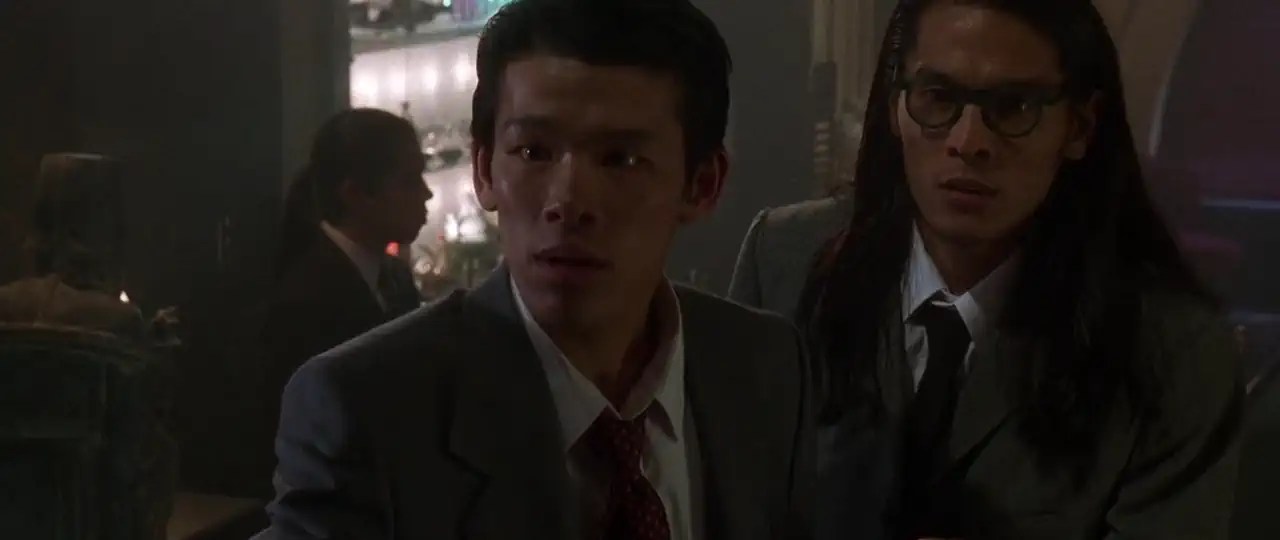
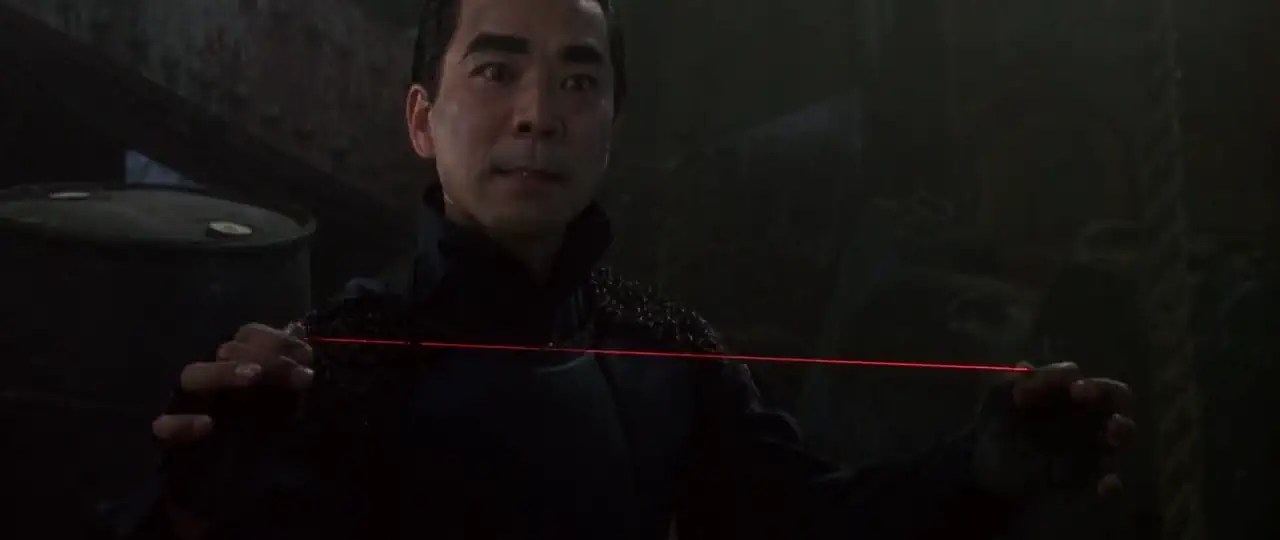
- Japanese rock star, actor, and filmmaker Takeshi Kitano took on the important role of Takahashi at the request of the Japanese co-producers. His casting was instrumental in making the film more appealing to the Japanese market and gave the work additional cultural depth.
- The film was released in two different cuts: one for the US market and one for Japan, with scenes and emphases that varied considerably in some cases. While the American version focused more on action and pace, the Japanese version contained more quiet and explanatory passages that gave greater depth to the characters. These differences also reflect the different expectations of the target markets.
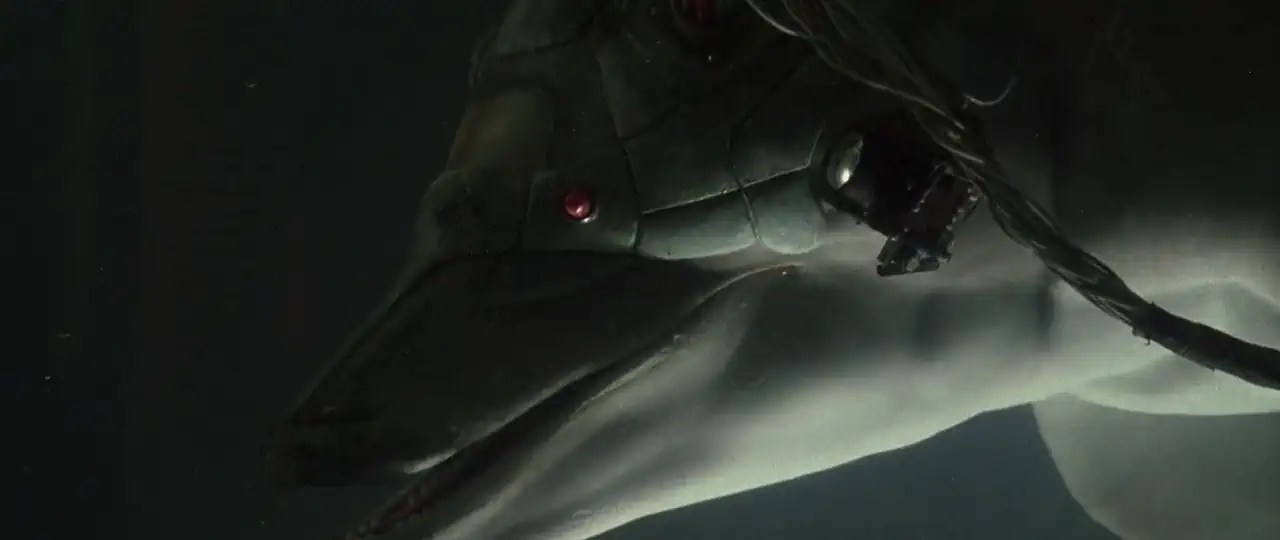
- The famous talking dolphin “Jones,” a former military cybertier with neural interfaces, was one of the earliest digital animations of this scale in mainstream cinema. The complex character, which seemed absurd, profound, and technically visionary at the same time, was brought to life with what was then groundbreaking computer technology and remains one of the most memorable elements of the film to this day.
- In addition, many of the sets were filmed in Canada, particularly in Montreal and Toronto, with old industrial buildings serving as futuristic backdrops. These locations gave the film its unique, raw atmosphere and contributed to the credible portrayal of a post-industrial future.
Actors
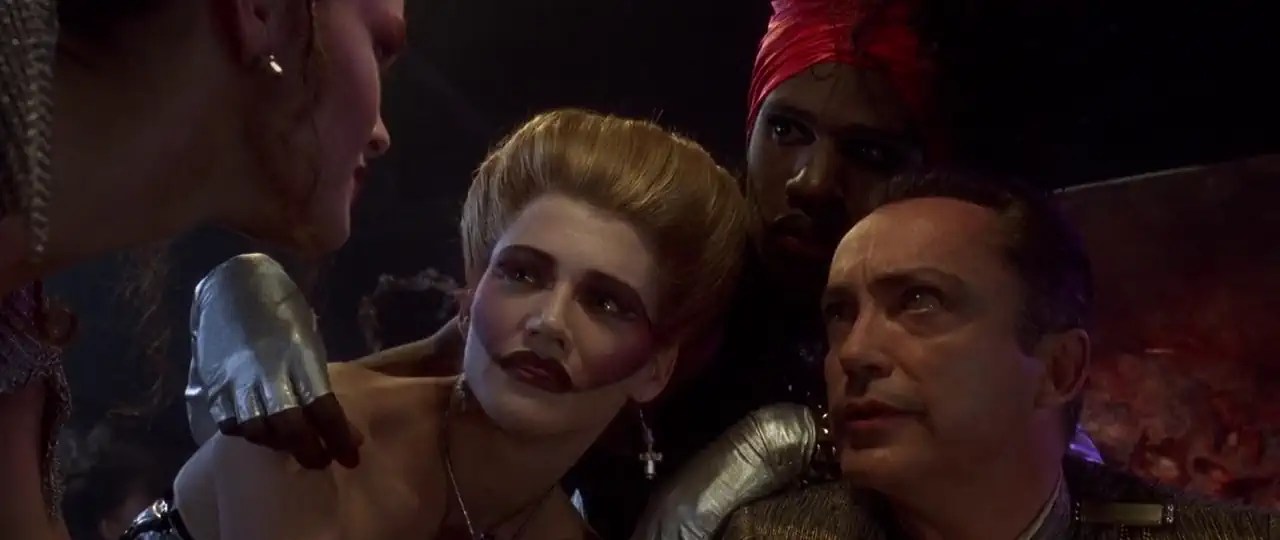
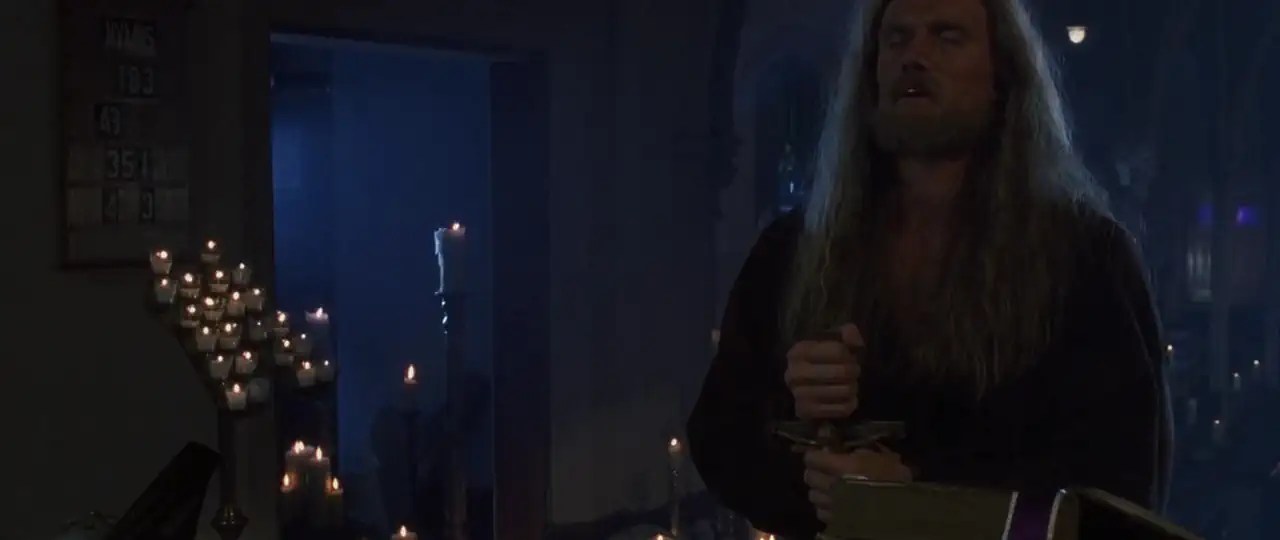
Keanu Reeves plays the lead role of Johnny with stoic restraint, which adds a special touch to his portrayal of an emotionally numb data carrier. His understated performance gives the character a mixture of inner emptiness and tragic vulnerability, reinforced by his cold precision and occasional outbursts of despair. Dina Meyer is convincing as the feisty Jane, whose blend of physical strength and emotional vulnerability provides a human counterweight to the story. Her role is enriched by believable action scenes and a subtle portrayal of her inner turmoil. Ice-T brings an anarchic energy to the role of underground leader J-Bone, which contrasts sharply with the cold techno world. With his rebellious demeanor and laconic humor, he seems like a relic from a lost subculture and lends the film a punk authenticity. Particularly striking is Udo Kier as a shady data dealer with opaque motives, whose cultivated coldness and manipulative elegance leave a lasting impression. Also noteworthy is Dolph Lundgren in a bizarre and almost grotesque supporting role as a cybernetic street preacher with religious delusions, who, through his exaggeration and physical presence, portrays a menacing and sinister character. This unusual collection of characters contributes significantly to the unique atmosphere of the film.
Book vs. Film
William Gibson’s short story “Johnny Mnemonic” was published in 1981 and was much more sparse and intimate than the film. The literary text focuses heavily on Johnny’s inner world and his paranoid view of a technologically permeated society. The plot is concise, atmospheric, and concentrated on a short period of time, focusing less on global threats and more on individual borderline experiences and the loss of control.
The film adaptation, on the other hand, expands the world considerably, linking several motifs from Gibson’s “Sprawl” universe, including references to corporate rule, digital consciousness, and cybernetic rebellions. New characters such as Jane, J-Bone, and the cybernetic street preacher were created specifically for the screen to give the story a broader cinematic scope. This transforms the quiet thriller into an action film with a socially critical subtext.
Many literature fans criticized the sometimes drastic deviations from the original and found the film overloaded and unfaithful. However, Gibson co-wrote the screenplay and saw the film as a bold experiment in bringing cyberpunk to mainstream cinema. He used the opportunity to develop his own ideas in a new form and reach a wider audience. For him, this creative freedom was not a betrayal of the original, but an expansion of his narrative universe.
Criticism at the time
Contemporary reviews were mostly negative, reflecting the irritation of many reviewers toward the unconventional staging. Critics criticized the confusing and at times overloaded plot, which they felt was not coherent enough to captivate a broad audience. The visual effects, which were ambitious but often considered immature compared to contemporary productions, were also criticized. The CGI scenes and stylized cyber elements in particular did not appeal to the mass taste of the time and, from today’s perspective, seem ahead of their time, but at the time they appeared unfinished. The acting performances were considered exaggerated or stylistically inconsistent in many reviews, which further earned the film a reputation as an overstyled and unconvincing experiment. The film was often labeled trash, barely managed to hold its own at the box office, and quickly disappeared from theaters after a short run.
Reputation today
Today, Johnny Mnemonic enjoys cult status. Fans praise not only its visionary power, bizarre design, and dark social commentary, but also the courage with which the film attempted to bring unconventional themes and aesthetics into the mainstream. Its harsh, almost exaggerated vision of the future has proven surprisingly prescient. In light of the digital revolution and the growing debate about data control, surveillance, artificial intelligence, and so-called cyber diseases, the film seems astonishingly prophetic in many ways today. Its scenes, in which people fight against the fragmentation of their identities through digital storage, touch on contemporary debates about memory, cloud systems, and neural interfaces. The stylistic connection to today’s internet culture, meme aesthetics, cyberpunk fashion, and the development of virtual realities (VR) is also increasingly appreciated. In addition, the film is enjoying renewed attention thanks to streaming services and retro waves, especially among young viewers who have come to appreciate its trashy-genius mix of 90s style and high-tech themes.
Summery
Johnny Mnemonic is an underrated gem of the cyberpunk genre that, despite its narrative weaknesses, offers unexpected depth and relevance. The film offers a fascinating glimpse into a dystopian future characterized by technological alienation, data overload, and social breakdown—elements that have become frighteningly relevant in today’s society. The oppressive vision of a corporate-controlled, networked nightmare no longer seems like science fiction, but rather a foreshadowing of real-life developments.
Those who embrace its aesthetic radicalism and punk exuberance will discover a film that not only breaks with convention in terms of form, but is also more thematically complex than it appears at first glance. Between trashy style, surreal ideas, and philosophical undertones, Johnny Mnemonic offers an original mix that, in retrospect, unfolds an unexpected effect. The film was ahead of its time—not only technically, but also ideologically—and has more to say than many were willing to admit at the time. That is precisely why it is worth taking a new, open look at this headstrong work today.
It should not be forgotten that this film is based on the vision of an author who shaped the cyberpunk genre like no other: William Gibson. With works such as Neuromancer and Burning Chrome, he laid the foundation for an aesthetic and thematic world that uniquely combines technology, social criticism, and subculture. “Johnny Mnemonic” is therefore not only an idiosyncratic film, but also an audiovisual expression of Gibson’s formative influence – a piece of cyberpunk history that does not deny its literary roots.






 McHenry's Lair
Kommentar verfassen :