

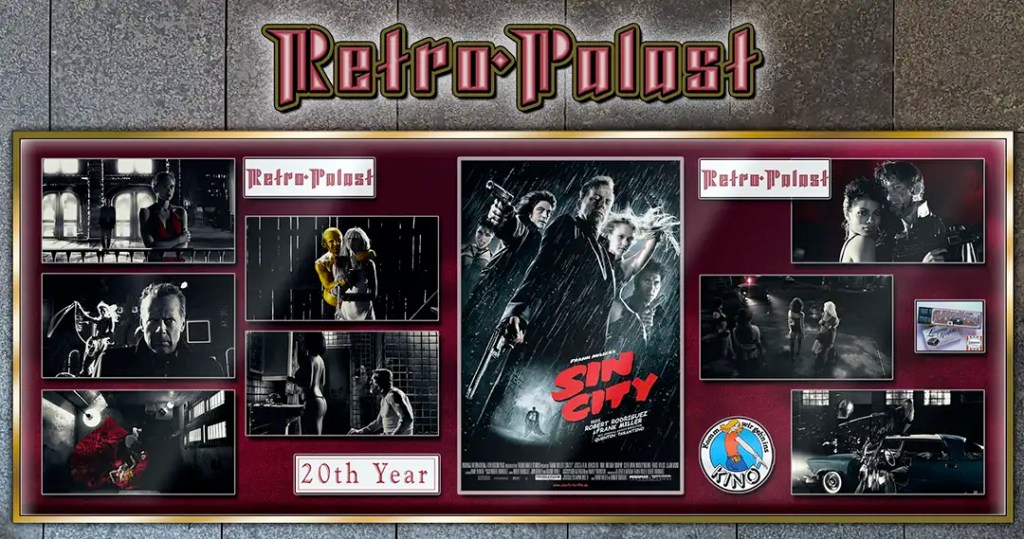
Most people think Marv is crazy.
He just had the rotten luck of being born in the wrong century.
He’d be right at home on a ancient battlefield swinging an axe into somebody’s face.
Sin City
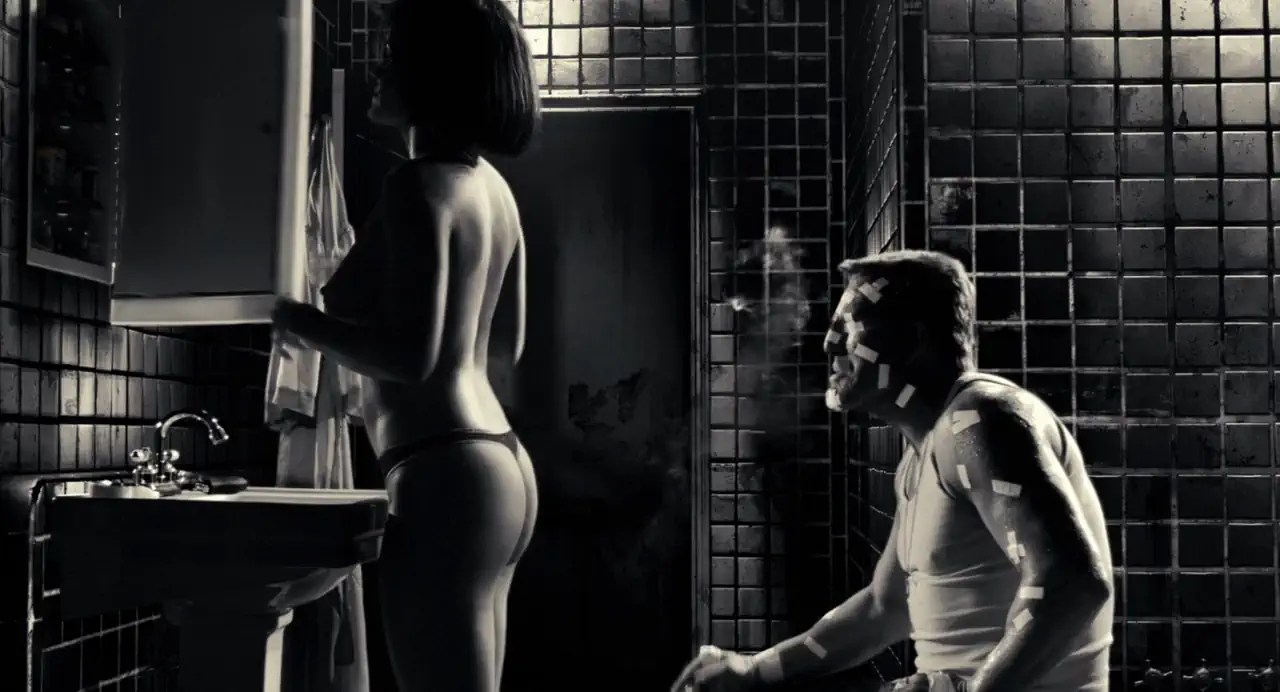
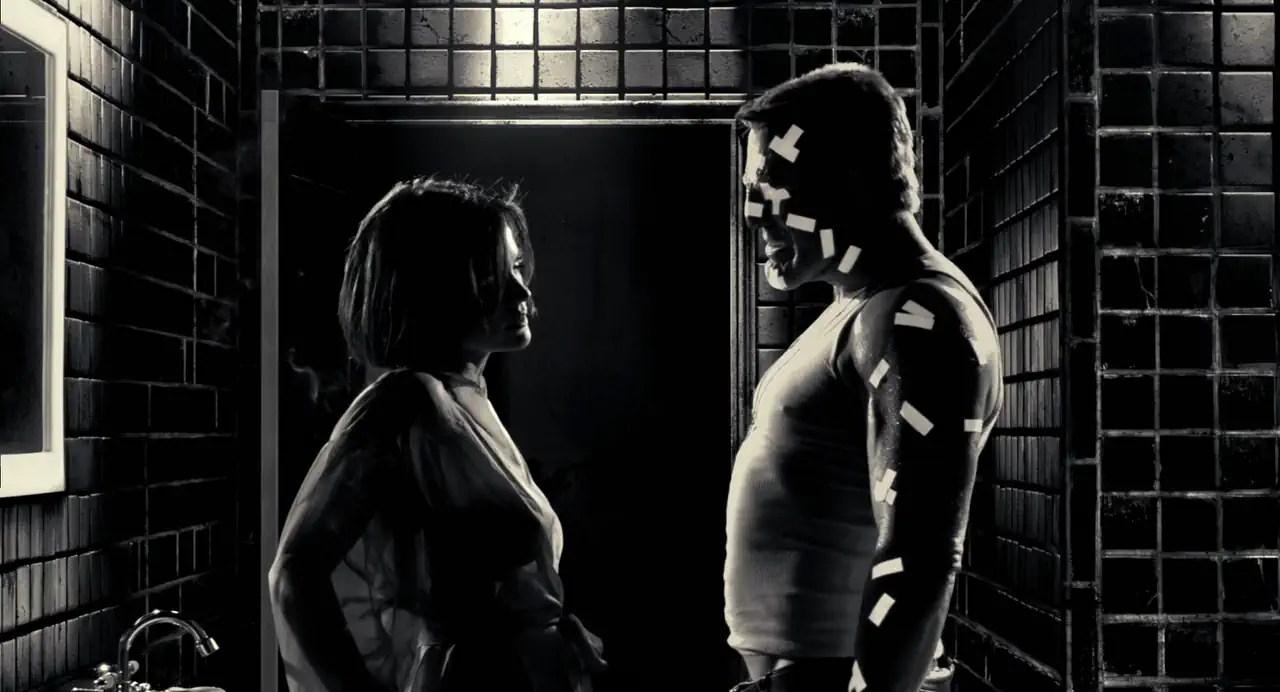
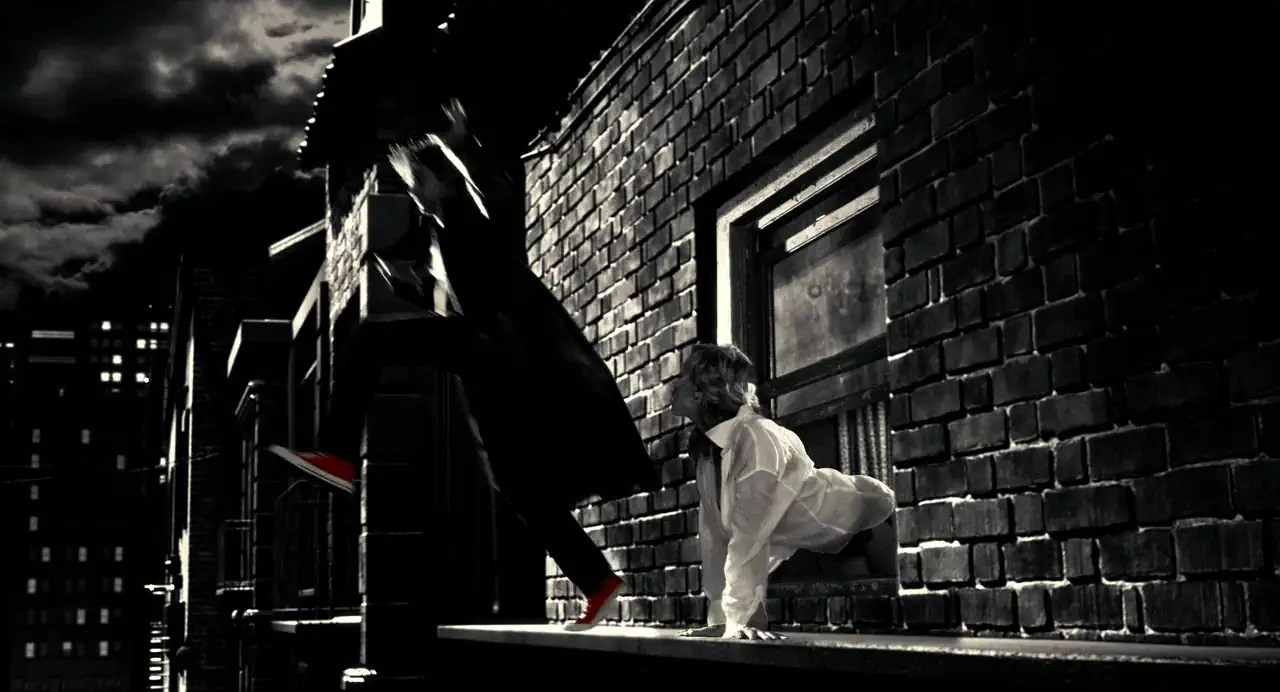
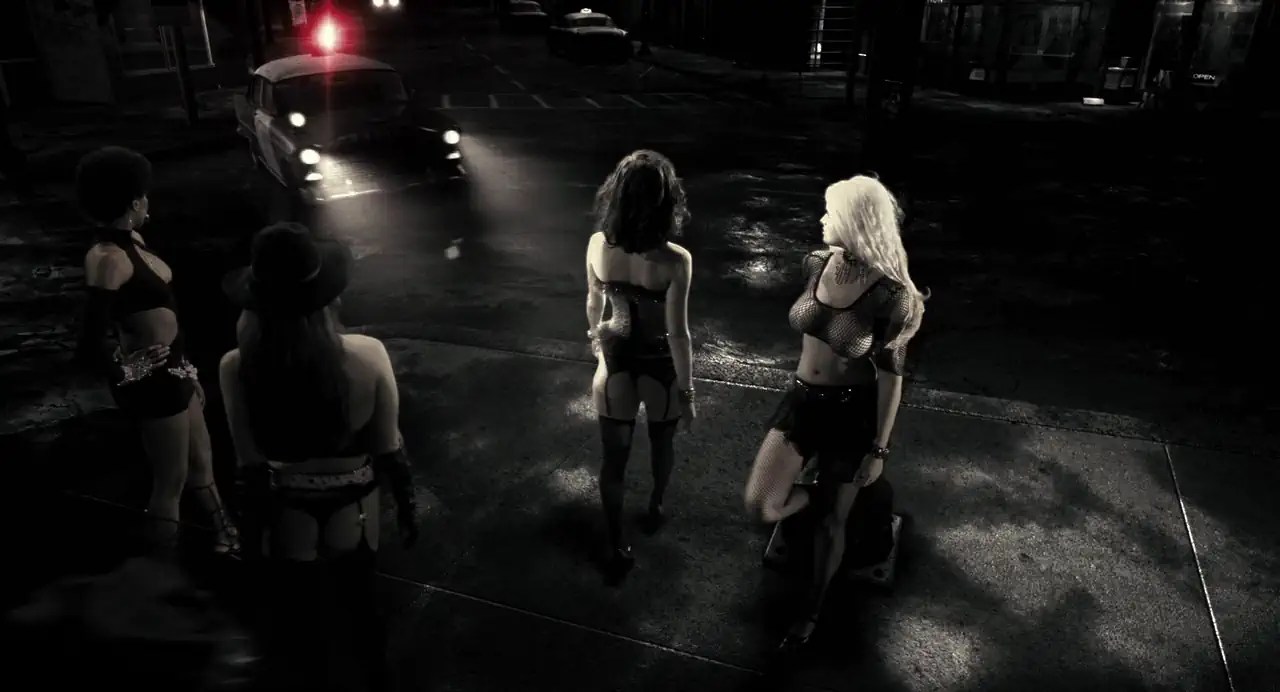
“Sin City” is a style-defining neo-noir film from 2005, based on the graphic novel series of the same name by Frank Miller. It was directed by Robert Rodriguez and Frank Miller, with Quentin Tarantino guest-directing a scene, which brought additional attention to the project. The film was notable for its unique visual realization, which is strongly based on the aesthetic design of the comics and was implemented using innovative digital techniques. The stylized black-and-white look with targeted colour accents created an aesthetic that stood out clearly from other productions of the time and almost looked like moving comic book pages. With a star-studded ensemble including Bruce Willis, Mickey Rourke, Jessica Alba, Rosario Dawson, Benicio del Toro and Clive Owen, “Sin City” brought the raw, brutal and hyper-stylized world of the original to the screen in an impressive way. In addition to the acting performance, the interplay of camera work, digital post-production and sound design was decisive for the overall impression. The film combines various cinematic genres, including crime, thriller and action, in an artistically ambitious form that serves both as an homage to classic noir films of the 1940s and 1950s and can also be read as a postmodern development of this tradition. The combination of stylistic experimentation and narrative uncompromisingness makes “Sin City” a cinematic experience that still resonates today.
Plot
- That Yellow Bastard
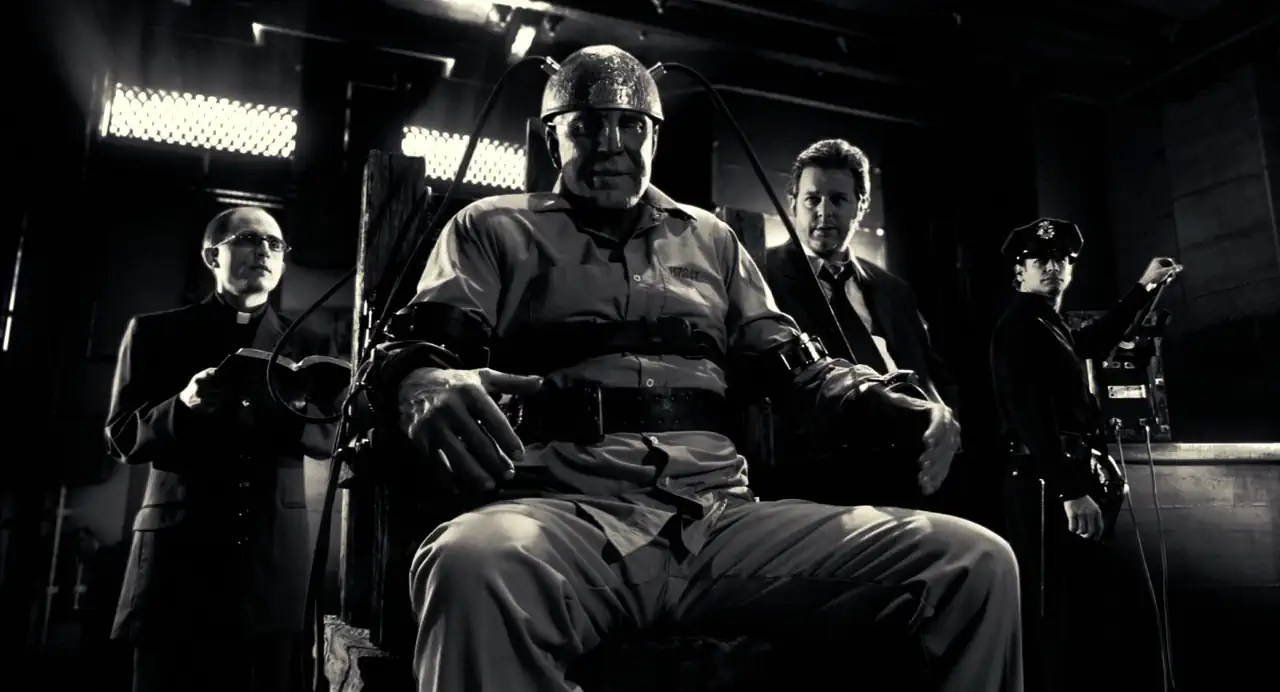
Hartigan, an aging police officer with a bad heart, tries to save a young girl named Nancy Callahan from the sadistic and pedophile Roark Junior. Despite health problems, he manages to protect Nancy, but the consequences of his heroic efforts are tragic. Hartigan sacrifices his career and freedom to protect the girl, and becomes a target of the corrupt police who cover up Roark’s activities. Years later, Hartigan is once again involved with Roark Junior, who now returns as a grotesque yellow mutant to get revenge on Nancy. Hartigan learns that Roark Junior has been watching Nancy all along, which makes him feel guilty. Hartigan must fight one last time to save the young woman, even if it costs him his life. The moral conflict of the aging policeman and his desperation in the face of a hopeless situation give the episode a deep emotional dimension. Hartigans struggle with his physical weakness and his ability to rise above it give him a tragic grandeur that makes him one of the most memorable characters in the film. The episode highlights how Hartigan, despite his physical and emotional vulnerability, does not give up and sees his personal sacrifice as the only possible way out. This duality of strength and fragility makes his story particularly poignant. - The Hard Goodbye
Marv, disfigured and violent, wakes up next to the body of Goldie, a beautiful prostitute who gave him a night of tenderness. Since he is suspected of murder, Marv swears to find and punish the real culprit. His search takes him to the darkest corners of Basin City, where he has to deal with corrupt police officers, street gangs and ruthless backers. Marv finally discovers the truth: the cannibalistic killer Kevin, a psychopathic follower of the Roark clan, is the culprit. Marv fights his way through corruption and violence to get justice for Goldie, even if it means turning into a monster himself. His uncompromising quest for revenge reveals the depths of Basin City and at the same time reveals the human tragedy of a lost soul desperately seeking a spark of justice. The relationship between Marv and Goldie seems almost mythical, a fleeting beauty in the midst of the city’s omnipresent misery. Marv’s brutal determination and ability to endure pain make him a character full of contradictions, oscillating between raw violence and a desperate desire for revenge. - The Big Fat Kill
Dwight McCarthy, a man with a dark past, gets caught in the crossfire between the prostitutes of Old Town and a group of corrupt cops. When Jackie Boy, a violent ex-boyfriend of his new love Shellie, threatens the prostitutes, the situation escalates. Dwight kills Jackie Boy in self-defense, but the problem escalates when he discovers that Jackie Boy was a cop. To maintain the fragile balance of power in the city, Dwight must dispose of the body while facing off against various opponents. The episode combines elements of the gangster film with dark noir motifs and tells a story of loyalty, betrayal and the desperate search for control in a city ruled by chaos and violence. Dwight not only faces his external opponents, but also his inner demons. The dynamic between Dwight and the prostitutes shows a fragile alliance based on mutual necessity, constantly tested by the brutal reality of Basin City. Dwight is shown as a man constantly battling the shadows of his past while trying to maintain some semblance of moral order in a morally bankrupt city. - That Yellow Bastard (Part 2)
The final episode concludes the story of Hartigan and Nancy. After years of imprisonment, Hartigan is released and finds out that Nancy is now working as a dancer in a strip club. Roark Junior, now completely disfigured and known as the “Yellow Bastard”, kidnaps Nancy. Hartigan realizes that Roark Junior has faked his own release from prison in order to lead him to Nancy and make it easier to capture her. In a final act of self-sacrifice, Hartigan confronts his old enemy to free Nancy, knowing full well that he will not survive this fight. The desperate attempt to save a single innocent soul from ruin gives the story an almost mythical dimension. The confrontation between Hartigan and the Yellow Bastard is a symbolic battle between corrupted power and moral integrity. Hartigan’s death at the end of the episode is not only the fulfillment of his duty, but also a tragic climax that illustrates the impossibility of a happy ending in a corrupt world.
The narrative structure is non-linear and nested, which underscores the fragmented, episodic style of the original. Flashbacks, shifts in perspective and overlapping storylines create a kaleidoscopic narrative that is both captivating and challenging. Each story is visually and thematically distinct, with its own unique tonality and mood, but fits organically into the bigger picture of a decaying, hopelessly broken city that itself becomes the secret main character of the film.






Trivia
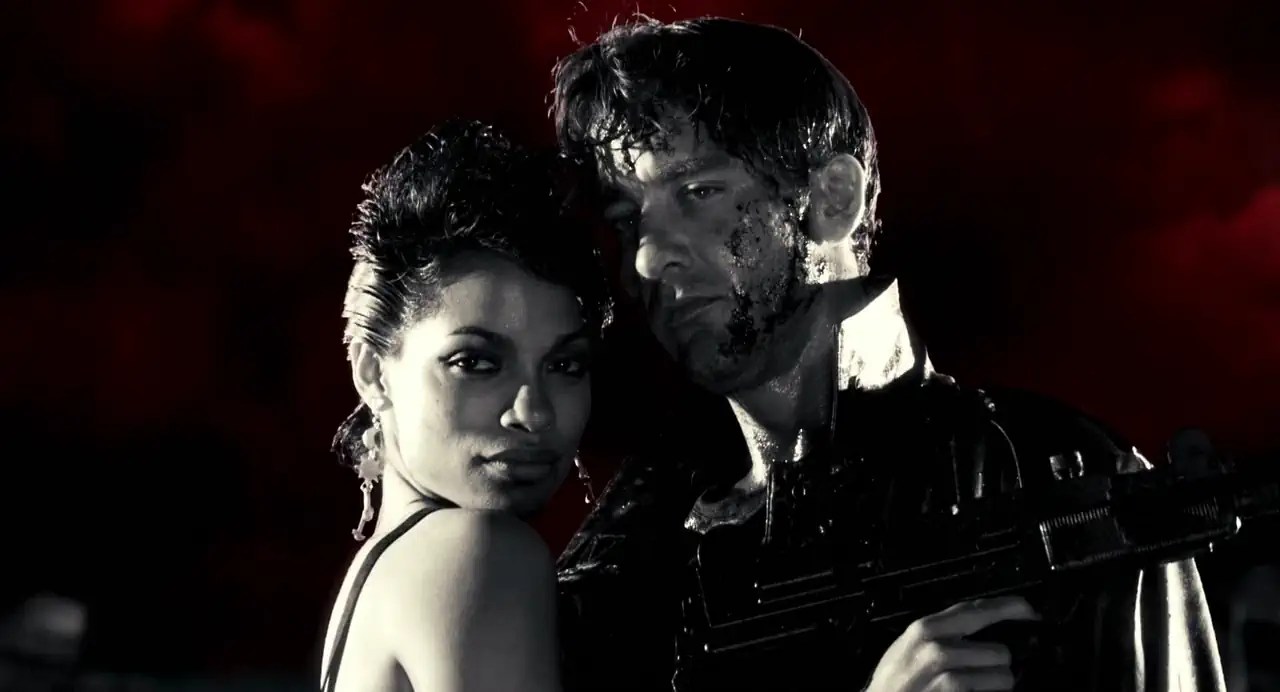
- The film was shot almost exclusively in front of green screens, allowing the entire backdrop to be created digitally. This allowed the production team to create a surreal-looking world that could be controlled down to the smallest detail. Digital post-production allowed the striking comic panels to be recreated with a precision that would have been impossible on traditional sets. By using this technique, the dark atmosphere of Basin City could be visualized in a way that closely resembled Miller’s original drawings.
- Frank Miller insisted that his comics be adapted verbatim; he was given unusually extensive creative control. This was a novelty in Hollywood, as rarely before had a comic artist been given such a say. Miller’s influence was felt at every stage of production – from the choice of dialog to the composition of the images. His direct involvement lent the film an artistic stringency that clearly sets it apart from other comic book adaptations.
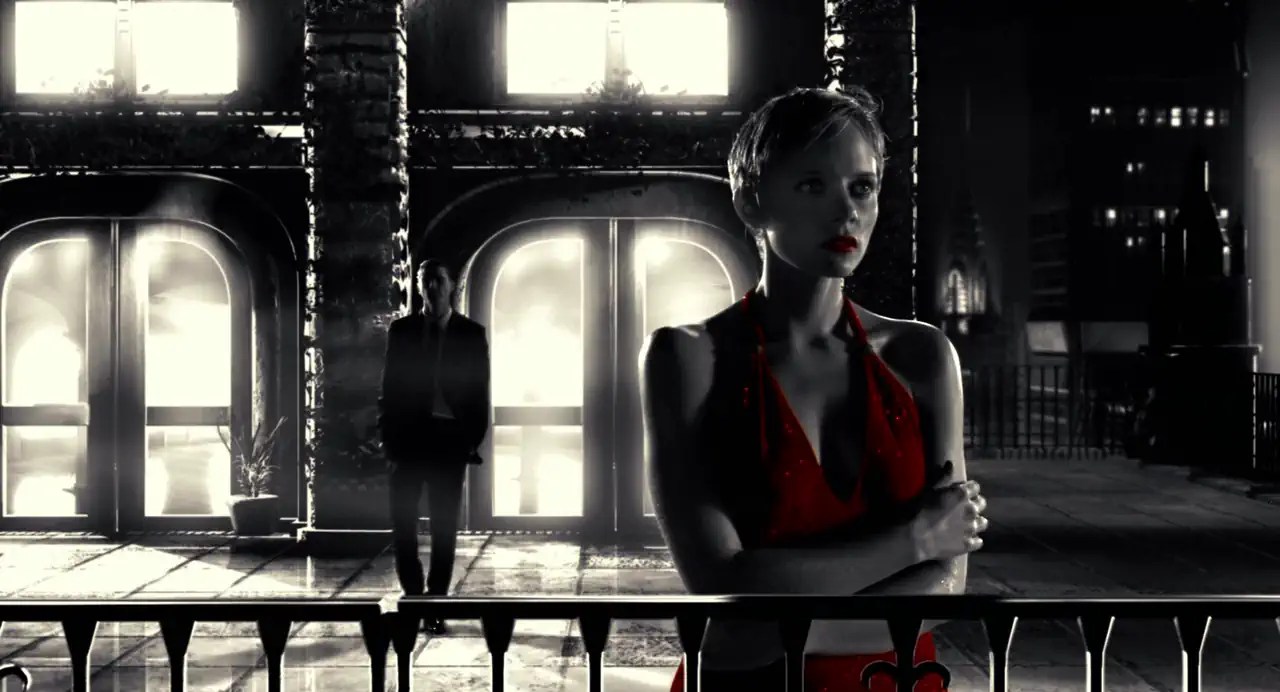
- The black and white look with specific color accents (e.g. red lipstick, yellow skin, blue eyes) was taken directly from the comic and implemented in a technically innovative way. The selective use of color not only served as an aesthetic device, but often also had a symbolic character – for example, to emphasize emotions or moral opposites. These visual effects were largely added in post-production and made a decisive contribution to the unique mood of the film.
- Quentin Tarantino only received a token dollar for his involvement in one scene, as he worked on it out of friendship with Rodriguez. The scene he directed – a dialog between Dwight and Jackie Boy in the car – bears his unmistakable signature. It is characterized by pointed dialogue, ironic subtext and a dense atmosphere that stands out slightly from the rest of the film in terms of style, while at the same time lending it an additional creative facet.
- The actors often had to act without physical props or backdrops, which was a challenge for the acting. Especially for actors with little experience in green screen acting, this meant portraying emotions and spatial relationships based solely on the script and imaginary clues. Intensive rehearsals, precise stage directions and detailed storyboards were necessary to achieve believable performances. Some actors described the experience as theater-like, as they had to rely entirely on their imagination.
Comparison of movie vs. comic
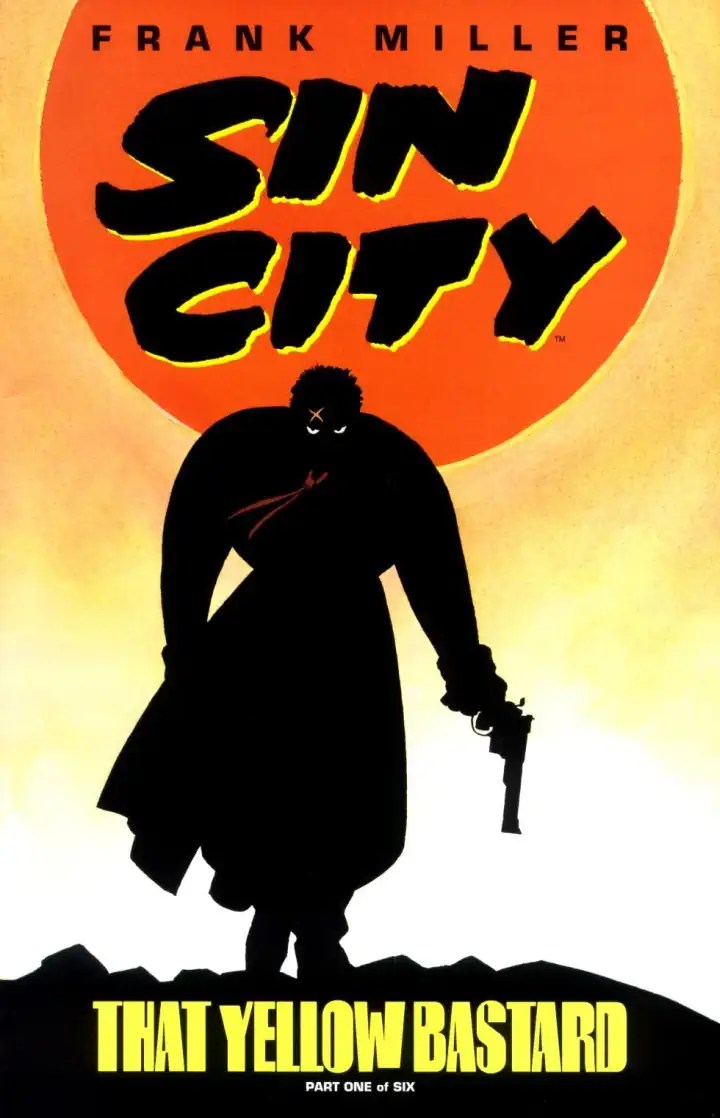
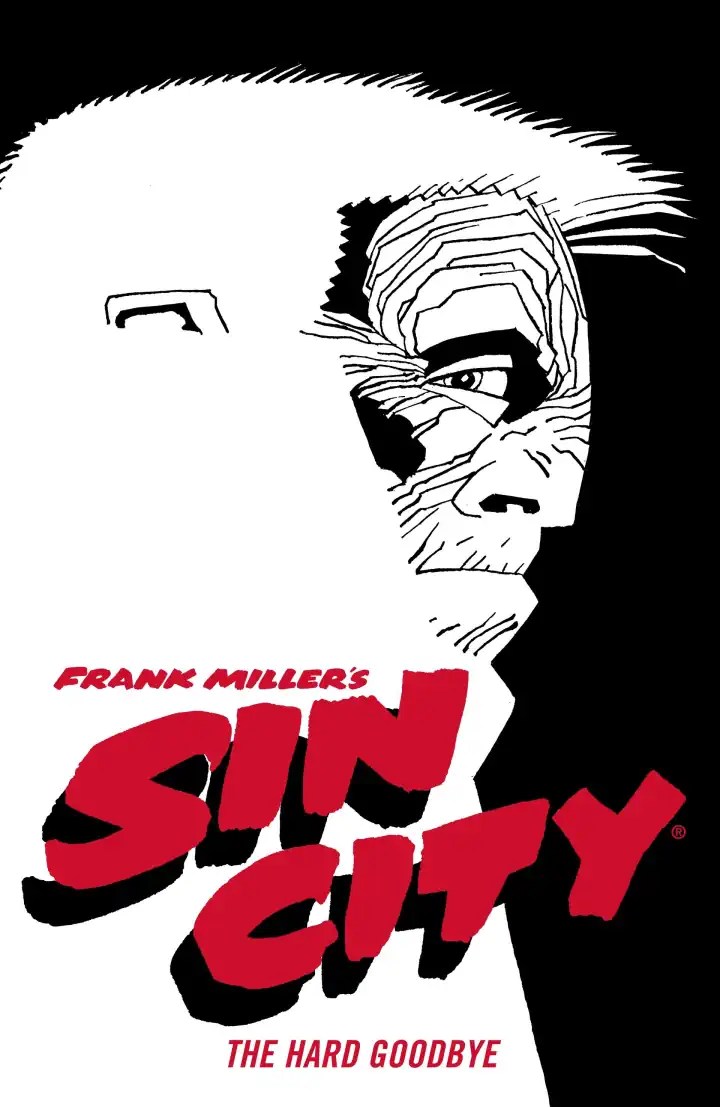
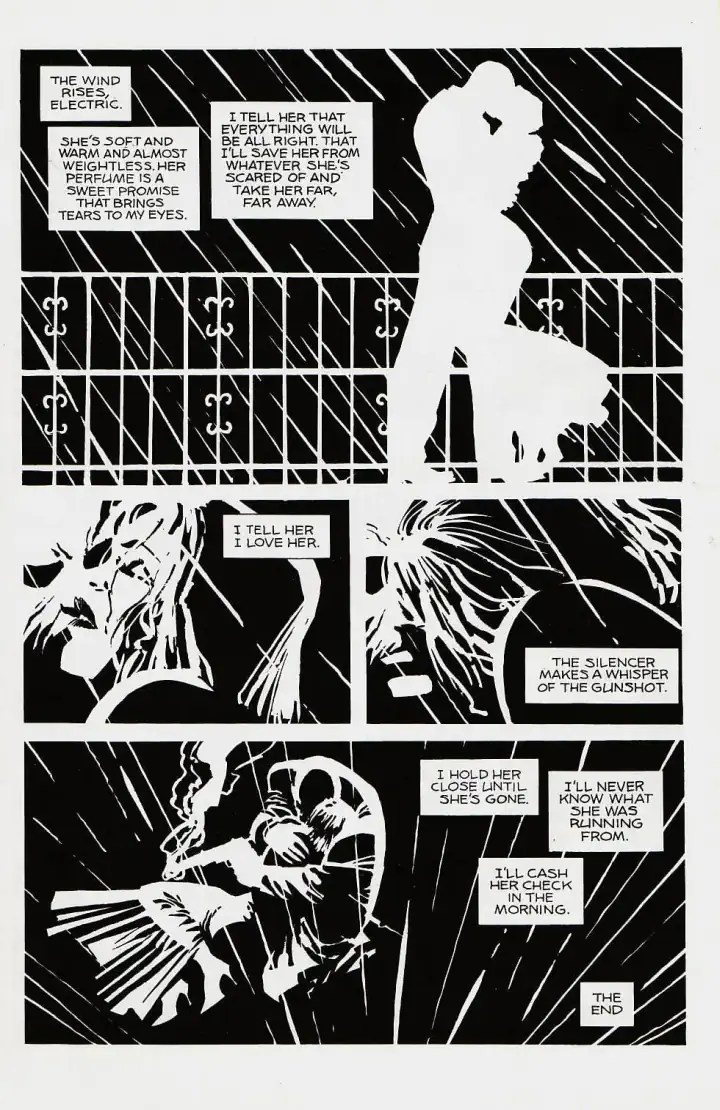
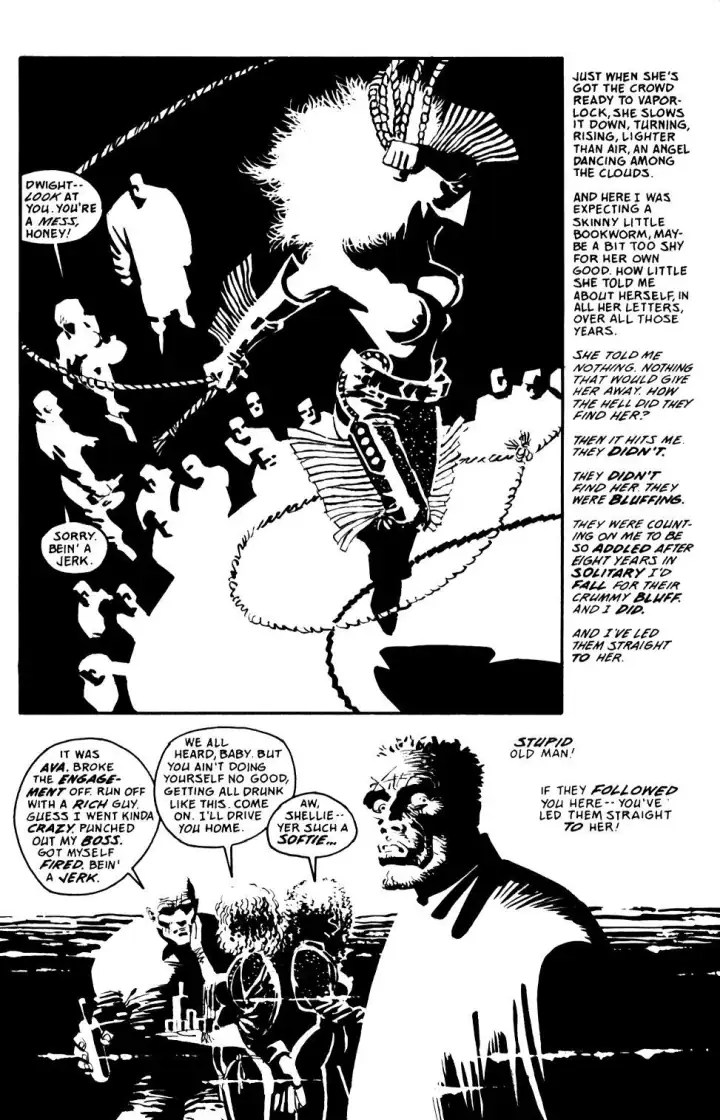
“Sin City” is one of the most faithful comic book adaptations in film history and is now regarded as a prime example of the successful adaptation of graphic storytelling to the big screen. Many shots are direct transfers of the panels, which was made possible by the digital production process that allowed the characteristic aesthetics of the original to be reproduced with visual accuracy. The dialogues were adopted almost identically, including their laconic, often poetic language, which underscores the gloomy, almost fatalistic tone of the film. The use of off-screen commentary and inner monologues, as is typical in the comics, was integrated into the film and reinforces the feeling of witnessing a living graphic novel. The monochrome style with hard contrasts, targeted light accents and shadow areas corresponds exactly to Frank Miller’s visual style and is almost unique in mainstream cinema to this day. The main differences lie in the editing: some scenes were shortened or rearranged to create a cinematic narrative style that is more accessible to cinema audiences and links the individual episodes more closely together. Some characters were also subtly adapted or scenes extended to enhance emotional depth or narrative coherence without distorting the spirit of the original. The filmmakers thus created a successful balance between faithfulness to the original and artistic freedom. Nevertheless, the film remains an almost uncompromising visual and narrative homage to the original, with a degree of innovation that few comic book adaptations achieve and which secures “Sin City” a permanent place in film history.




Critics at the time
On its release in 2005, “Sin City” received largely positive reviews from the press and audience. The visual innovation, stylistic radicalism and faithfulness to the literary source were particularly praised. Critics praised the bold realization, which expanded the visual vocabulary of cinema and set standards for digital film aesthetics. Many also praised the acting performances, particularly from Mickey Rourke as Marv, whose portrayal as the monstrous but deeply wounded antihero is considered one of the best of his career, and Bruce Willis as Hartigan, who shone with understated intensity. The acting performances of Clive Owen and Rosario Dawson were also highlighted as remarkable. Critics emphasized that the film established a new aesthetic in cinema that clearly stood out from conventional action or comic book adaptations by consistently following the panel language of the original. On the other hand, the excessive depiction of violence was criticized, as was the portrayal of female characters, who were often sexualized or reduced to stereotypical roles. Feminist critics particularly criticized the objectification of female characters, while others emphasized the strength and autonomy of characters such as Gail or Miho and interpreted them as strong opposites to the male-dominated world. The debate about gender representation also made the film a subject of academic discussion. Nevertheless, the film was enthusiastically received at festivals such as Cannes and celebrated as a visionary project that broke boundaries and challenged conventions. Commercially, “Sin City” was also a success with box office takings of around 160 million US dollars worldwide, underpinning its status as a cult film at an early stage.
Cultural influence and reputation today
Today, “Sin City” is considered a milestone of modern neo-noir and an influential comic book adaptation that has had a lasting impact on the genre. The film helped to develop the genre beyond traditional adaptations and establish visual experiments in mainstream cinema. In particular, the consistent use of digital technology to reproduce comic aesthetics set new standards in film production and opened the door to a new era of visual storytelling. He influenced numerous works in terms of style, color design and the use of digital technology. Films such as “300”, “The Spirit”, “Watchmen” or series such as “Jessica Jones” and “Daredevil” show clearly noticeable stylistic legacies. Video games and music videos also adapted the typical contrasts, playful colors and dark tone. Sin City” remains present in pop culture, whether through references in music videos, parodies in animated series, fan art, cosplay or through its enduring popularity among comic and film fans. The film was followed up in 2014 with a less successful sequel, ‚Sin City: A Dame to Kill For‘, which failed to achieve the same cult status, despite another attempt to capture the visual power of the original. However, the sequel failed due to a weaker narrative structure and was unable to meet the expectations of many fans. Nevertheless, the first film remains a prime example of how comic book aesthetics can be translated into cinema without losing any of its narrative power. It is proof that stylistic consistency and artistic vision can also work in blockbuster cinema if they are implemented boldly and authentically.
Summery
“Sin City” is more than just a comic book adaptation – it is a visual manifesto, a stylistic daring and a cinematic experiment that was far ahead of its time. The film combines art, violence, style, atmosphere and narrative radicalism to create a unique cinematic experience that continues to have an impact today and asserts its place in the canon of modern film history. The uncompromising realization of the graphic novel, combined with innovative technology and intense acting presence, created a work that reaches far beyond the boundaries of comic book adaptations. Even if the film polarizes, its influence on the genre, on pop culture and particularly on the development of digital film technology remains indisputable. “Sin City” has shown that bold, stylized visions can reach a wide audience if they are consistently and convincingly implemented. Those who engage with the dark, hyper-stylized world of Basin City are immersed in an uncompromising cinematic universe that dissolves the boundaries between comic books and cinema, sets new standards for visual storytelling, and establishes a lasting statement for creative freedom in mainstream film. The lasting impact of the film can still be seen in many audiovisual media today – proof of its visionary power and cultural relevance.





 McHenry's Lair
Kommentar verfassen :