


The 80s – This was the Golden Age of the Commodore 64.
The undisputed ruler of home computing. It brought unforgettable games straight into homes worldwide.
Among its legendary titles was a true classic of its time:
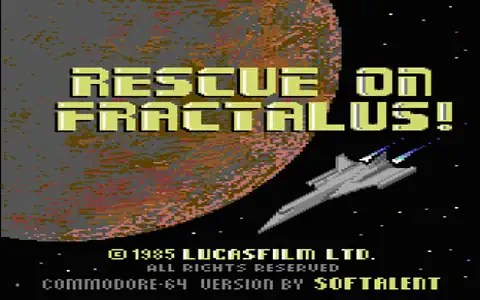
Lucasfilm’s Rescue on Fractalus!
A Milestone of the 8-Bit Era
In the 1980s, the video game industry experienced a groundbreaking development. The Commodore 64 (C64) was one of the leading platforms for ambitious game developers and served as the basis for numerous innovative games. One of the outstanding titles of this era was Rescue on Fractalus!, an action-simulation game developed by Lucasfilm Games and released in 1984. It impressed with its then-innovative 3D graphics and exciting gameplay, which captivated many players. It set new standards for the genre. The game offered an exceptionally immersive experience, enhanced by its technological sophistication.
Gameplay
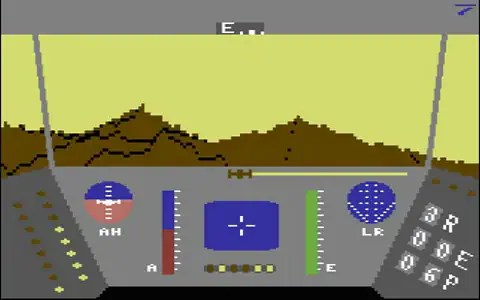
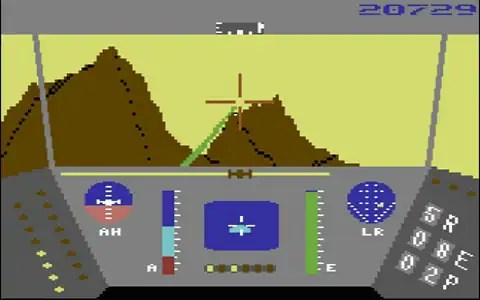
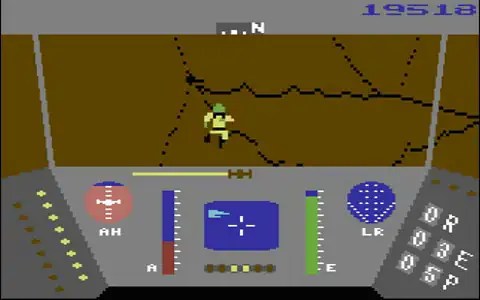
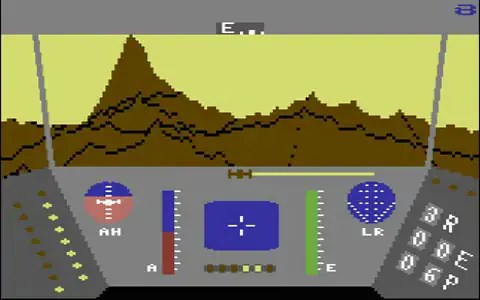
In Rescue on Fractalus!, the player takes on the role of a space pilot in the “Eagle” squadron, who must rescue comrades who have made an emergency landing on a planet occupied by enemies. The game world consists of a procedurally generated, rugged mountain landscape that had to be explored in a space glider. Numerous dangers lurked, such as enemy anti-aircraft guns and alien creatures that not only attacked from a distance but could also disguise themselves as pilots to be rescued.
The controls required a great deal of skill, as the landing process had to be executed with precision to avoid crashing or being detected. Once landed, the player had to pick up stranded pilots and return them safely to orbit – always under the threat of enemy attacks and fuel shortages. As the player progressed through the game, the scenario became more challenging as the opponents became more intelligent and the attacks more intense. In addition, the player had to carefully calculate their fuel consumption, as the missions could last for long periods of time.
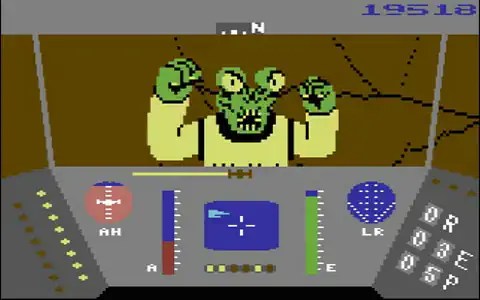
Each rescue mission presented new challenges, as not all pilots were friendly. Some turned out to be hostile aliens trying to sabotage the ship from the inside. These unpredictable elements kept the tension high and ensured that the game did not become monotonous.


Trivia
Interestingly, Rescue on Fractalus! was one of the first games to intensify the gaming experience with an unexpected moment of shock. Some of the pilots who were supposedly to be rescued turned out to be hostile aliens who suddenly knocked on the cockpit window and sabotaged the spaceship – an early jump scare that stuck in the minds of many players. This element of surprise added an extra layer of depth to the game and created an unpredictable dynamic that sent players‘ adrenaline levels soaring.
Another noteworthy detail is that the game was originally developed under the code name Behind Jaggi Lines!, a play on words that referred to the then widespread edge pixelation (“jaggies”) in computer games.
Technology
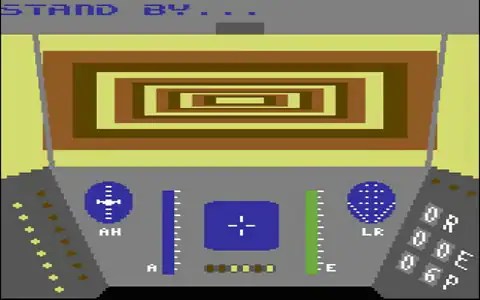
One of the game’s standout features was its innovative use of fractal graphics to depict mountain landscapes – a revolutionary technique for the C64 era at the time. Fractal graphics use algorithms to generate natural, random patterns, enabling the realistic generation of landscapes. This made it possible to display an impressive game world without a large storage capacity. This method made it possible to display complex and constantly changing environments with limited computing power. By using recursive algorithms, it was possible to create natural and dynamic landscapes that varied slightly each time. The game used sophisticated algorithms to calculate the terrain in real time, which was considered a technological masterpiece at the time. This method made it possible to make optimal use of the C64’s computing power and provide an unprecedented graphical display.
The realistic flight physics and atmospheric soundscape further contributed to the immersive gaming experience. Particularly impressive was the depiction of day and night cycles, which visually and playfully enriched the gameplay. During the night, the player had to rely more heavily on instruments and navigational aids, which further increased the difficulty of the game. In addition, a special raster graphics technique was used to enhance the impression of speed and depth – an early attempt to push the limits of the hardware available at the time. The algorithms for real-time terrain generation also had the advantage of working with minimal memory requirements, which was essential on 8-bit platforms. The influence of these techniques was evident in later games that used similar algorithms for terrain generation and real-time rendering. Game developers were inspired by these innovative methods and used similar techniques in subsequent titles, particularly in the science fiction and simulation game industry.
Reviews at the time
When it was released, Rescue on Fractalus! received mostly positive reviews. In particular, the impressive graphics and exciting game mechanics were highlighted. Magazines like Compute! praised the technical sophistication and intense atmosphere of the game. The innovative use of fractal graphics was also considered outstanding, as it provided a unique visual experience for the time.
However, there were also critical voices. Some players found the repetitive game structure monotonous, as the main goal of the game – rescuing pilots – became repetitive as the game progressed. Especially at higher difficulty levels, some players found the lack of new challenges to be a disadvantage. Nevertheless, this criticism was more than offset by the overall quality of the gameplay and the innovative moments of shock. The unpredictable encounters with hostile aliens, in particular, provided thrills time and again. Some later versions of the game and unofficial remakes tried to counteract this problem with varying mission designs, for example by adding different environmental conditions or new enemy types. Modern fan remakes have also sought to expand on the gameplay experience by adding mission objectives and improved AI mechanics.
Cultural influence
Rescue on Fractalus! was one of the early games to show that video games could be more than simple arcade action. The combination of simulation, action and tactical thinking made it a pioneer for many later space games. It was also one of the first works by Lucasfilm Games, which later became world-famous under the name LucasArts. It showed that video games are capable of providing a cinematic experience that goes beyond just collecting points. The game also placed a great deal of emphasis on immersion and exploration, which set it apart from many arcade games of the time.
The game inspired later titles with fractal graphics technology and innovative mission structures. In a way, it laid the foundation for many narrative and immersive games developed by LucasArts in the years that followed. The game’s shocking moments were later incorporated into other titles, particularly horror and narrative science fiction games. Many later developers regarded the dense atmosphere and unpredictable gameplay of Rescue on Fractalus! as groundbreaking for the development of games with psychological horror and in-depth narrative. Even modern games with procedurally generated environments draw on the groundbreaking techniques first tried out in this game.
Reputation today
Today, Rescue on Fractalus! is considered a classic of the 8-bit era and a milestone in the history of early computer games. Retrogaming communities appreciate it for its technical innovation and unique approach to gaming. Although modern gamers may find the graphics rudimentary, the game remains an impressive example of the creative use of limited hardware resources.
Collectors and fans of the retro scene rate the game as an important part of gaming history, and it is repeatedly honored in retrogaming forums and at events such as Gamescom or the Classic Gaming Expo. Many players remember with nostalgia the unforgettable moments of fear that the game offered.
Summary
Rescue on Fractalus! was ahead of its time and remains a fascinating piece of video game history to this day. The game’s mix of technical innovation, exciting gameplay and atmospheric design has made it a classic that still inspires admiration decades after its release. Anyone interested in the roots of modern gaming should definitely experience this game.
Despite the technical limitations of the time, the developers managed to create a gripping experience that transported players to an inhospitable world. It shows that great game ideas often work independently of modern graphics and processing power – a principle that still holds true in today’s gaming landscape. It remains an impressive example of creativity and technological ingenuity in the early days of computer gaming.








Kommentar verfassen