

Pharaoh’s Curse and the Fine Art of Getting Lost
Breaking the Seal
The first thing you learn in Pharaoh’s Curse is that a very long fall won’t hurt you. This is excellent news for anyone about to drop into an ancient Egyptian tomb, and a poor guide to how the rest of the expedition will go. Somewhere below are sixteen treasures, a mummy with a gun, and a bird capable of carrying a grown explorer through solid stone. You can survive the plunge, get your bearings, spot something worth stealing, and still have your afternoon ruined by local wildlife. Few games introduce their sense of humour quite so economically.
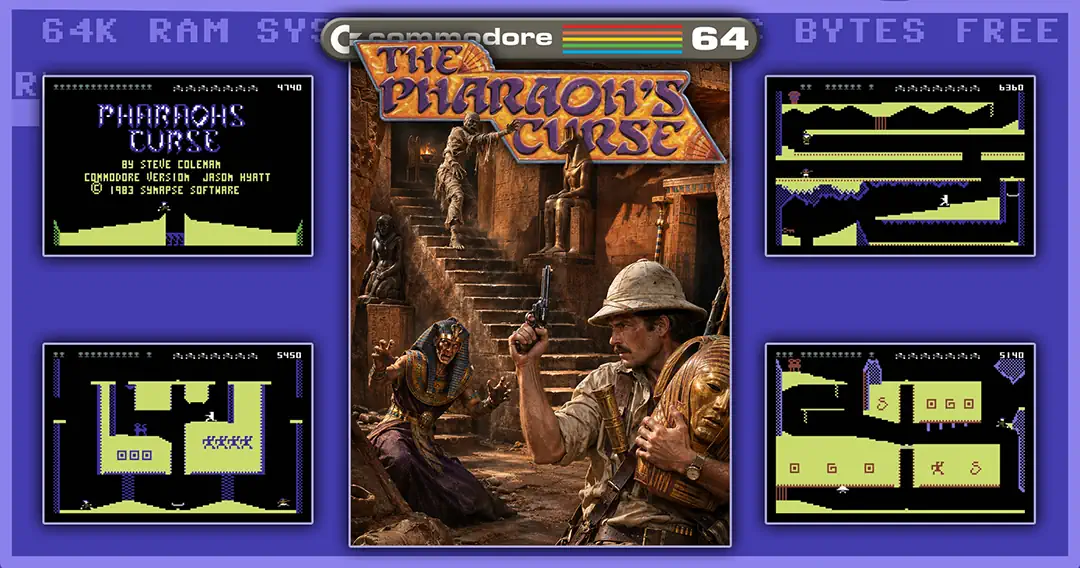
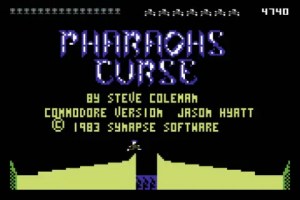
Synapse Software released Pharaoh’s Curse for the Commodore 64 in 1983. Steve Coleman created the original game for Atari computers, and Jason Hyatt handled the C64 conversion. The opening has the confidence of a good adventure serial. You’re already at the entrance, the years spent searching for it mercifully behind you, and a jump breaks the seal. Once underground, though, the pleasure is surprisingly domestic. You begin to recognise corners, remember where you left a key, and develop strong opinions about the quickest way back upstairs. Eventually, the worst thing the curse can do is put you somewhere inconvenient, because by then you know precisely how inconvenient that is.
Learning the Tomb
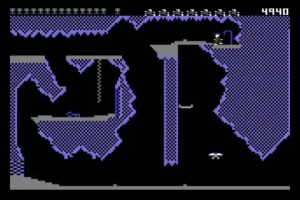
A joystick does nearly all the work. Push left or right to walk, angle the stick upward to jump, and use the fire button to shoot. Ropes and lifts help you gain height, while the generous rules about falling make the journey down considerably quicker. A shaft you took some care to climb can become an express route on the return trip. That difference matters when you’re choosing which treasure to collect next. A prize can be perfectly easy to reach from above and leave you with a surprisingly long walk back to the place where you wanted to be.

Each treasure earns an extra life, a small design decision with a large effect on your courage. Suppose a trap stands between you and a prize while the mummy closes in from behind. Suddenly it makes sense to risk the crossing. Reach the treasure and you’ve bought yourself another attempt at getting out. Firing at the mummy buys a different kind of time. A hit makes it disappear, but it will materialise elsewhere, as will the pharaoh. You can clear a path through a chamber and enjoy a few seconds of peace. The tomb never becomes entirely yours.
Then there’s the Winged Avenger. Its talons leave your stock of lives intact as it picks you up and deposits you elsewhere in the maze. Early on, a free trip can feel like a favour. You might discover a chamber you’ve never seen, and you had only the vaguest idea where you were going anyway. Late in a run, with one treasure left and its location finally clear in your head, the same intervention feels exquisitely personal. It’s a wonderfully expressive bit of enemy design. The bird behaves much the same throughout. What changes is how much you have riding on the next ten seconds.
Screen by Screen
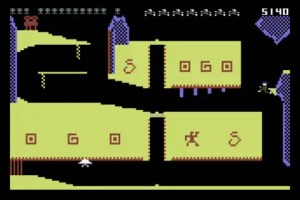
Hyatt’s conversion presents each chamber in a single fixed view. Cross the edge and the next room appears in full. The arrangement gives every entrance a little dramatic pause, just long enough for the eye to pick out a rope, a ledge, an exit and whatever happens to be moving. It also gives the rooms distinct identities. A difficult jump becomes a landmark. So does a stretch of apparently harmless floor that killed you earlier. After a few visits, you can recognise a room from the shape of its empty space, a quality that more elaborate tomb decoration would scarcely improve.
The display is particularly good at answering small, urgent questions. Markers at the upper left disappear as you collect treasures, so a glance tells you how much work remains. Pick up a key and the explorer starts to pulse. That detail puts the information exactly where you’re already looking while lining up a jump. Sound works in short bursts, too. Brief musical phrases and effects give the underground passages an uneasy character, and the gaps leave room for a new sound to catch your attention. The most atmospheric moments arrive when you have time to stand still and would dearly prefer to hear nothing.
Buried Details

The printed material reveals a sense of fun that the little figures on screen can only hint at. Synapse’s manual describes a ruler buried with works of art and jewel-encrusted scarabs, and gives him the distinction of being the sixteenth and last pharaoh of his dynasty. Count the treasures and the number has a familiar ring. A 1983 advertisement even gives the ghost a name, Rama. There’s a nice discrepancy over the age of the tomb, too. One passage in the original Atari manual gives it forty-three centuries of undisturbed repose, while another settles for three thousand years. Apparently the curse extends to the paperwork.
The C64 title screen also holds a small secret. You can press fire and go straight in, or type a password to begin at one of the two higher difficulty levels. The letters don’t appear as you type, which makes entering a word you’ve earned feel pleasingly like trying a charm on a sealed door. The higher speeds are a shrewd reward for learning the layout. On the first visit you have to work out where a passage leads. On a later visit you can remember the whole route and still come to grief because your thumb is operating on last expedition’s timetable.
Critics at Release
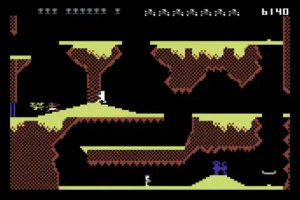
The 1984 Electronic Games software guide gave the Commodore 64 edition an overall score of 8. Its individual ratings tell a more interesting story than the number alone. Both graphics and audio earned a “Good,” while play-action received an “Outstanding” and the single-player experience an “Excellent.” The guide even singled out the ability to fall any distance unharmed when explaining the controls. It’s an astute detail to include in buying advice. Someone looking at a screenshot could judge the appearance of the ledges for themselves. They’d have a harder time guessing how liberating it felt to step off one.
A different verdict appeared in the November 1983 issue of Electronic Fun with Computers & Games. Noel Steere was reviewing the Atari edition, and his reservations concerned a feature C64 owners would recognise immediately. Repeated abductions by the bird wore on his patience. He admired the graphics but felt the game occupied an awkward position between a shooting game and an adventure. He also wondered, with some justification, why people insist on calling an armed man who empties tombs an archaeologist. Read alongside the C64 guide, his review captures the gamble Coleman took. A player who enjoys recovering from a ruined plan and one who wants to execute a route cleanly can have very different evenings with this game.
The Commodore Afterlife

Steere placed the game alongside Tutankham and invoked Indiana Jones, a connection that needed little explanation for his readers. Pharaoh’s Curse borrowed the adventure serial’s idea of Egypt, a place of fabulous wealth whose long-dead inhabitants have had ample time to prepare for visitors. Its cheekiest contribution to that tradition is giving the guardians a reasonable grievance. The pharaoh made a promise to defend his possessions, the mummy is doing its job, and the person who broke the seal has arrived with a gun and every intention of taking all sixteen items. As Steere noticed, the story reads rather differently from the other side of the chamber.
The clearest evidence of the game’s own influence arrived in 1990, when the group Bignonia made an unofficial Amiga version and distributed it as freeware. Pharaoh’s Curse joined a selection of Commodore favourites the group brought to the newer machine, among them Frantic Freddie and Aztec Challenge. That journey also ran in reverse. Years later, a reader on Lemon64 described coming to the older edition through Bignonia’s adaptation. Their verdict on the original was decidedly mixed, particularly where the bird was concerned. It’s a lovely footnote to the game’s history. Someone went to the trouble of recreating this peculiar tomb, and someone else followed the trail back far enough to develop a fresh grudge against its most famous resident.
One More Descent
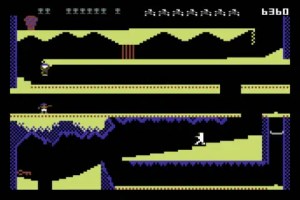
What keeps Pharaoh’s Curse worth playing is the gradual change in the way you see the same few rooms. A newcomer sees a dangerous drop. A few attempts later, it’s a shortcut. Eventually, it’s the shortcut you mean to take immediately after collecting the treasure beyond the gate, provided the mummy gives you a moment. The rough edges are real. Being carted away just as a plan comes together can make switching off the computer seem an entirely reasonable response. Yet even that irritation reveals how thoroughly you’ve learned the place. From the room where the bird drops you, you can already picture the rope you need, the turn you missed and the ledge you’ll have to reach again. And since you know the way, you might as well have one more go.







Schreibe einen Kommentar