

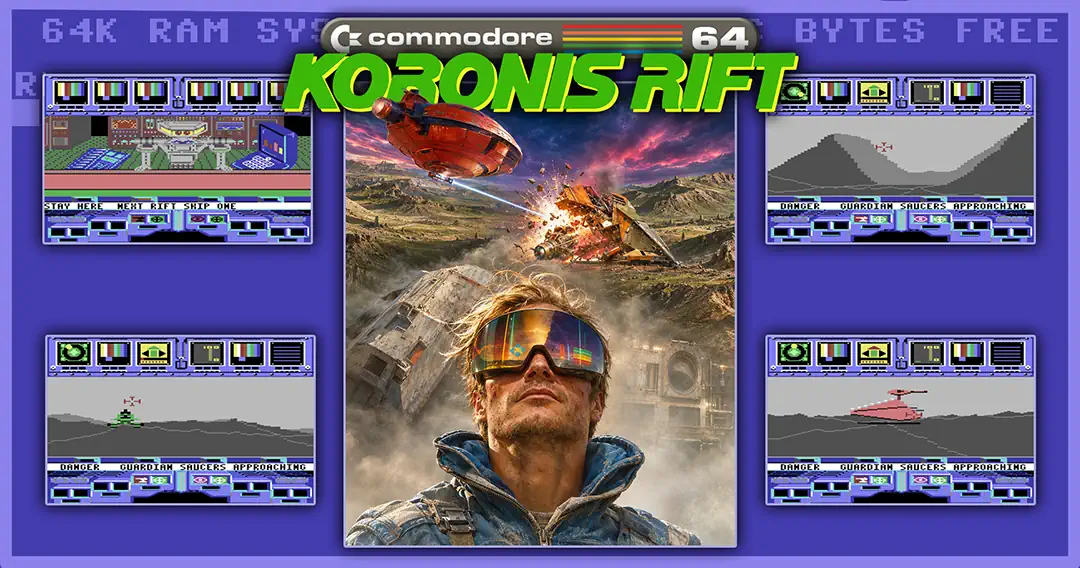
Koronis Rift: Unearthing an Alien World on the Commodore 64
Alien Frontiers
A mountain rises beyond your cockpit. Somewhere ahead, an ancient machine waits to be stripped of its secrets. Your rover is poorly equipped, your knowledge is incomplete, and the flying saucer approaching over the horizon probably has better weapons than you do. Welcome to Koronis Rift, where curiosity can make you rich—or get you killed.
Developed by Lucasfilm Games and released during the 1985–1986 period, Koronis Rift combined exploration, combat, and equipment management in an unusually ambitious package. The Commodore 64 version brought players into a hostile landscape where surviving depended as much on understanding unfamiliar technology as on aiming a laser. Epyx published the game in the United States, while Activision handled its European release.
Its strongest attraction was the promise of discovery. You were a scavenger investigating the remains of something far older and more powerful than yourself. Every abandoned machine suggested a history, even when the game left that history unexplained.
That premise still has considerable appeal. There is something wonderfully unsettling about entering a battlefield whose original combatants have vanished while their weapons remain operational. Koronis Rift turns that unease into a reason to keep moving: the next wreck might contain exactly what you need.
Salvage Strategy
The basic routine is straightforward. Drive your surface rover through a rift, locate an abandoned hulk, and send out your remote scavenging robot to retrieve useful equipment. Recovered modules can be installed in the rover, gradually changing its capabilities. When circumstances permit, you can call your scoutcraft to collect you. Crucially, extraction is unavailable while you are under attack, making the decision to remain on the surface increasingly uncomfortable.
This creates an effective rhythm of anticipation and exposure. Finding a wreck feels promising, but reaching it means spending more time in dangerous territory. Leaving early feels sensible, yet it also means abandoning whatever might lie beyond the next ridge.
The equipment system gives those decisions substance. Energy production and consumption matter, and unfamiliar modules require investigation. Weapon and shield colours also have practical significance: a shield is particularly effective against a laser of the same colour. Success therefore involves learning which combinations suit the threats ahead. A rover packed with interesting hardware is only useful if its systems work together.
The resulting experience is surprisingly thoughtful. An apparently disappointing discovery may become useful once you understand its purpose. Conversely, an impressive new device can complicate an otherwise reliable setup. Progress depends on building knowledge alongside collecting machinery.
The larger objective is to destroy the Guardian base in the twentieth rift. You can also end an expedition by returning to your scoutcraft and cashing in your discoveries. This gives the adventure a useful tension between immediate profit and the much greater prize of securing the planet.
For a modern player, the learning process can initially feel demanding. Yet uncertainty is central to the attraction. You are investigating alien technology, and the game expects that investigation to involve mistakes.
Fractal Landscapes
The visual identity of Koronis Rift rests on its rugged terrain. Mountains and valleys give the journey a physical character: the horizon becomes something to read, and the landscape feels like a place you must negotiate.
Its technological ancestry leads back to Rescue on Fractalus!. In a contemporary Zzap!64 interview, David Fox credited Loren Carpenter with that earlier game’s fractal routines. Fox also explained an interesting difference in development: Rescue grew from an experiment with graphics, whereas the ideas for Koronis Rift and The Eidolon preceded their graphical implementation.
That distinction helps explain why the scenery matters. The terrain supports the fantasy of an expedition into unknown territory. Uneven ground, obscured destinations, and an uncertain route make the act of travelling part of the experience. A wreck glimpsed beyond a rise offers a stronger invitation than an item placed in an otherwise empty arena.
Contemporary reviewers were impressed by the speed and presentation of the fractal graphics, particularly compared with Rescue on Fractalus!. They also singled out the animation of Psytek, the robot working aboard the scoutcraft.
These two visual attractions complement each other. The planetary surface supplies scale and isolation; the shipboard robot supplies character. Returning from a dangerous excursion becomes a change of atmosphere as well as a practical stop.
Today, the display inevitably looks coarse. Nevertheless, its visual economy remains effective. The cockpit frames the world, the terrain establishes distance, and approaching enemies interrupt the landscape with immediate purpose. Your imagination supplies the finer detail.
Hidden Curiosities
Several small details make Koronis Rift especially interesting within the early Lucasfilm catalogue.
First, its credits connect it with names familiar to adventure-game enthusiasts. Noah Falstein is credited as its creator, while the C64 programming credits include Aric Wilmunder and Ron Gilbert. Douglas Crockford receives the music credit. Looking back, the team itself is part of the game’s historical interest.
Second, some releases placed the Commodore 64 and Atari versions on opposite sides of the same disk. It is a charming reminder of an era when supporting different computers could involve physically turning over the software you had just purchased.
Third, the manual extends the fiction into its presentation. Its operating instructions introduce the “Scavenger MK IV” as though the reader has acquired an actual planetary vehicle. That approach makes learning the controls feel like preparing for an assignment. The documentation becomes another doorway into the setting.
Finally, the alien machinery includes stranger discoveries than conventional weapons and shields. C64-Wiki documents modules that provide unusual musical accompaniment, resembling a kind of extraterrestrial car radio.
That detail fits the game beautifully. A scavenger should occasionally uncover something puzzling, frivolous, or difficult to classify. If every ancient object were merely a stronger gun, the civilisation behind those objects would feel considerably less mysterious.
Contemporary Verdicts
The British C64 press greeted Koronis Rift enthusiastically. Zzap!64 awarded it 96 percent in issue 9, dated January 1986. Commodore User also responded positively, giving it four out of five in its February 1986 issue. These were substantial endorsements for a game that demanded patience and experimentation.
The preserved Zzap!64 review text shows what impressed its reviewers. They praised the combination of exploration, combat, and rover customisation, alongside the convincing landscape and animated robot. Their enthusiasm also included reservations: the opening games could be unrewarding while players learned the systems, and the action could become repetitive.
Those criticisms remain useful when approaching it today. The activities that build atmosphere—travelling, searching, retrieving equipment—also establish a repeated routine. Whether that routine feels absorbing or laborious depends heavily on how much pleasure you take in investigation.
The striking point is how readily reviewers recognised the ambition behind it. They were responding to a game with systems worth studying and a world worth navigating. Technical achievement and design depth reinforced each other.
Reading those reactions now also restores some historical perspective. What looks modest on a contemporary screen could once suggest an extraordinary expansion of what a home computer might deliver. The excitement becomes easier to understand when you imagine encountering that landscape without decades of later 3D games behind you.
Cultural Footprint
The cultural significance of Koronis Rift is best understood through its place in Lucasfilm Games’ early identity. Alongside titles such as Ballblazer, Rescue on Fractalus!, and The Eidolon, it represents a studio exploring original worlds and distinctive forms of interaction.
Fox’s contemporary comments make that ambition explicit. He described the team’s interest in giving players the sensation of entering another universe and discussed a growing appetite for deeper games whose environments could sustain extended exploration. Koronis Rift fits that creative outlook closely.
From today’s perspective, its combination of scavenging, equipment choices, and dangerous expeditions feels familiar. Modern players can recognise the appeal of returning from hostile territory with hardware that changes their next journey. That resemblance is a useful comparison, although it does not establish a direct line of influence on particular later games.
Its enduring contribution is the experience it offers: knowledge becomes a valuable resource, and an alien world becomes understandable through repeated encounters. The player’s growing competence provides much of the narrative momentum.
It also broadens the story often told about Lucasfilm’s gaming history. Before the company became closely associated with celebrated graphic adventures, it was already experimenting with immersion through terrain, machinery, and player discovery. Koronis Rift preserves that exploratory spirit in a particularly concentrated form.
Final Assessment
Koronis Rift asks for a certain kind of attention. Its pleasures emerge through studying equipment, learning the landscape, and deciding when curiosity has become recklessness. Players seeking constant action may find its repeated excursions slow.
For those willing to engage with its systems, however, the central idea remains compelling. Each journey offers the possibility of returning better equipped and better informed. Survival feels connected to what you have learned.
The C64 version’s appeal consequently extends beyond its once-impressive graphics. Its strongest achievement is making an uncertain expedition feel meaningful with a relatively small collection of elements: a cockpit, an alien landscape, scattered machinery, and enemies that make every discovery dangerous.
There is still something evocative about a silent wreck beyond a mountain ridge. It might contain a solution, a mystery, or another disappointing piece of scrap. Koronis Rift understands that the possibility alone can be enough to make you drive closer.







Schreibe einen Kommentar