

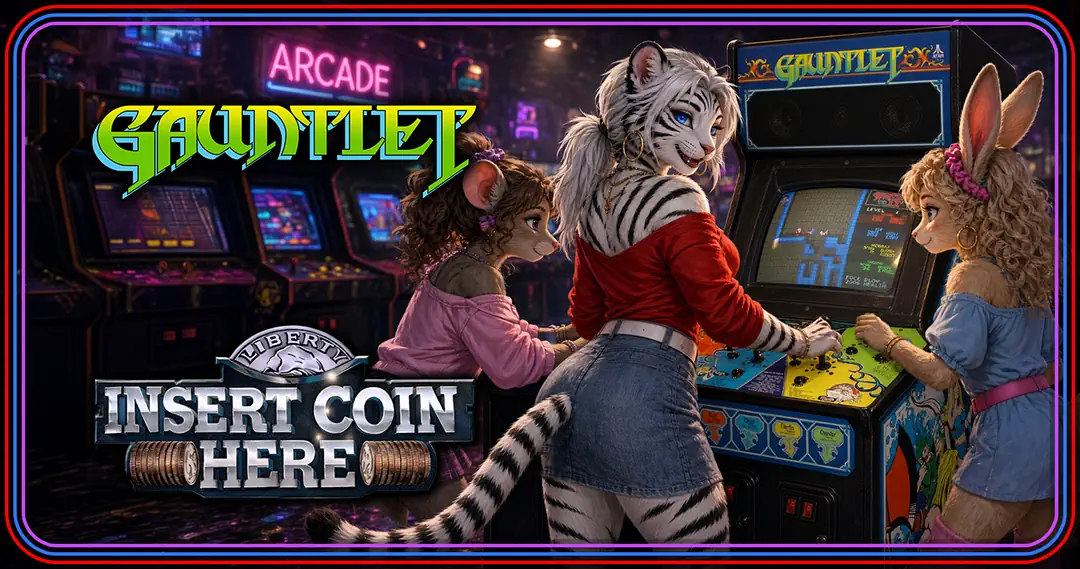
The Arcade Dungeon That Changed Multiplayer Gaming
Dungeon Calling
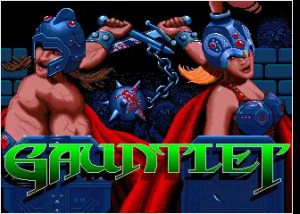
When Gauntlet appeared in arcades in 1985, it offered something that immediately stood apart from the usual rows of shooters, racing games and one-on-one challenges. Developed and published by Atari Games and designed by Ed Logg, the man also associated with classics such as Asteroids and Centipede, Gauntlet transformed the fantasy dungeon adventure into a fast and remarkably social arcade experience.
Instead of controlling a spaceship or chasing a high score alone, players entered a maze-like fantasy world filled with ghosts, demons, sorcerers, thieves, treasure, food and magical potions. More importantly, as many as four people could enter that world simultaneously. Each player controlled a different fantasy hero, and the large arcade cabinet became a meeting place where friends — and often complete strangers — fought side by side.
The concept drew heavily on the language of tabletop fantasy role-playing games. Warriors, wizards, elves, treasure chests, monsters and mysterious dungeons were already familiar to players of Dungeons & Dragons. Yet Gauntlet stripped away character sheets, dice rolls and lengthy campaigns. It converted fantasy adventuring into an immediate arcade formula: move, shoot, survive and find the exit.
That simplicity was one of its greatest strengths. Within seconds, almost anyone could understand what was happening. Staying alive, however, was another matter.
Dungeon Survival
Four heroes are available: Thor the Warrior, Thyra the Valkyrie, Merlin the Wizard and Questor the Elf. They are more than differently coloured versions of the same character. Each has particular strengths and weaknesses. The Warrior is powerful in close combat, the Wizard excels with magic, the Elf is quick and effective at ranged attacks, while the Valkyrie provides a more balanced combination of offensive and defensive abilities.
Players explore large top-down mazes containing corridors, locked doors, treasure rooms and monster generators. These generators constantly create enemies until they are destroyed, meaning that ignoring them can quickly result in the screen filling with hostile creatures.
Combat is deliberately straightforward. Players can fire ranged attacks in eight directions, while contact with enemies results in close-range fighting. Keys open doors, potions can destroy or weaken large groups of enemies, treasure increases the score and food restores health.
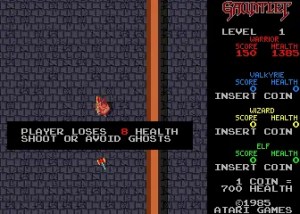
Health is central to the entire experience. Unlike many arcade games of the period, Gauntlet does not simply give the player three lives and wait for a collision. Instead, health constantly decreases over time. Enemy attacks accelerate the process, while food replenishes part of the health meter.
This creates permanent pressure. Even when nothing is attacking you, you are slowly dying.
The mechanic also serves the economics of the arcade machine. Additional coins can provide additional health, effectively allowing determined players to continue their adventure for as long as they are prepared to keep paying. Gauntlet therefore combines game design and arcade economics with remarkable efficiency.
Four-player sessions can become wonderfully chaotic. Someone grabs food that another player desperately needs. A careless arrow destroys a valuable meal. One player rushes through a door while everyone else is still collecting treasure. Cooperation exists, but so does competition for resources and points.
That tension is precisely what gives Gauntlet its personality. It is cooperative without being completely harmonious.
Arcade Hardware
Technically, Gauntlet was an impressive machine for 1985. Its hardware used a Motorola 68010 as its main processor, running at roughly 7.16 MHz, together with a MOS Technology 6502 handling audio duties. The sound system combined Yamaha YM2151 synthesis, Atari’s POKEY chip and a Texas Instruments TMS5220 speech processor.
The display operated at 336 by 240 pixels, providing enough screen space for the elaborate dungeon layouts, large groups of enemies and four independently controlled heroes.
Yet the most memorable piece of technology may have been the sound.
Digitised and synthesised speech had appeared in arcade machines before, but Gauntlet made spoken announcements an essential part of the experience. A deep narrator — often remembered as the Dungeon Master — constantly commented on the players‘ condition.
Warnings about low health, incoming danger or disappearing food gave the machine an unusual personality. In a noisy arcade, that booming voice could attract attention from across the room.
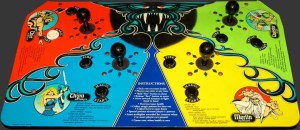
The four-player cabinet was equally important. Each participant had an eight-way joystick and two buttons, giving the machine an unmistakable physical presence. Playing Gauntlet was therefore not just about looking at the screen. Four people had to physically gather around the cabinet, negotiate space and react together.
The cabinet itself became part of the game design.
Dungeon Trivia

One of the most interesting parts of Gauntlet’s history concerns an earlier Atari 8-bit computer game called Dandy, created by John Palevich. Dandy featured multiplayer dungeon exploration and is widely regarded as an important influence on Gauntlet. Sources differ on the exact legal details that followed, but Palevich raised concerns about the similarities, and Atari eventually reached an arrangement with him.
During development, the project reportedly carried the working title Dungeons. Some character concepts were also renamed before release: the Valkyrie had originally been called the Amazon, while the Warrior was at one stage known as Hulk.
Atari’s own marketing department was apparently uncertain about the four-player concept. Four-player cabinets were larger and more complicated than conventional machines, and there was no guarantee that four strangers would want to play together. Designer Ed Logg nevertheless pushed for the multiplayer format.
The gamble worked.
Another clever trick involved the levels themselves. Once players had progressed far enough, layouts could be reused in altered orientations, including horizontally or vertically flipped versions. This allowed the game to create the impression of a huge dungeon without requiring a completely unique map for every stage.
Atari ultimately produced 7,848 arcade units for the original game in the United States, with additional machines distributed internationally.
Lasting Legacy
Gauntlet quickly became more than a successful standalone arcade game. Gauntlet II followed in 1986, expanding the original formula, and numerous home computer and console adaptations brought the dungeon to players who had never encountered the enormous four-player cabinet.
The franchise later evolved considerably. Titles such as Gauntlet Legends in 1998 moved the concept into 3D while preserving the emphasis on multiplayer fantasy combat. Gauntlet Dark Legacy expanded that approach further, while a new Gauntlet appeared for modern home platforms in 2014.
Its larger legacy, however, is visible far beyond games carrying the Gauntlet name.
The fundamental structure — a group of distinct heroes entering hostile areas together, destroying waves of monsters and collecting increasingly valuable rewards — appears throughout later action RPGs, dungeon crawlers and cooperative games.
Modern players accustomed to online parties, raids and four-player cooperative modes may not find this idea unusual. In an arcade in 1985, however, surrounding one machine with four simultaneous players created a dramatically different social experience.
Gauntlet demonstrated that multiplayer did not have to mean one player defeating another. Players could share the same battlefield and pursue the same objective.
Period Reviews
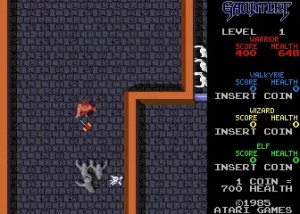
Contemporary response to Gauntlet was strongly positive, particularly because the game combined accessible action with a multiplayer format that felt unusual at the time. Computer and Video Games gave the arcade release a favourable review, and the game’s commercial performance quickly demonstrated that players were equally enthusiastic.
In the United States, Gauntlet reached the top of major arcade earnings charts during late 1985 and early 1986. RePlay listed it among the highest-grossing arcade games of 1986, while industry reporting also showed extremely strong earnings for individual operators.
The home versions were also widely successful. The Spectrum edition became the United Kingdom’s best-selling game of 1986, while several computer conversions were praised for maintaining the speed and atmosphere of the arcade original despite significant hardware limitations.
Not every element aged equally well. Even favourable later assessments have pointed out that the action can become repetitive during extended solo sessions. The basic rhythm rarely changes dramatically: enter a room, destroy generators, eliminate monsters, search for food, collect treasure and locate the exit.
Yet this criticism also reveals what made the original arcade machine special. Gauntlet was never at its best as a solitary marathon. Its real magic came from four people trying to survive the same dungeon while shouting instructions — and accusations — at one another.
Cultural Impact
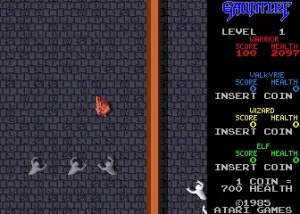
Few arcade sound bites have survived in gaming culture as effectively as the announcements associated with Gauntlet. The Dungeon Master’s health warnings became part of the shared vocabulary of retro gaming, instantly recognisable even decades after the machine’s release.
Those messages also illustrate an important change in the relationship between player and arcade machine. The cabinet did not merely react through images and explosions. It appeared to observe the players, comment on their condition and warn them directly.
More broadly, Gauntlet helped establish cooperative gaming as a public social activity.
Arcades had always been social spaces, but many classic machines encouraged people to take turns or compete for high scores. Gauntlet allowed several people to occupy the same adventure simultaneously. Its oversized cabinet effectively created a miniature gathering place inside the arcade.
It also anticipated the appeal of character classes in later multiplayer games. Choosing the Warrior, Wizard, Valkyrie or Elf was partly an aesthetic decision, but the characters‘ different abilities encouraged players to develop preferences and informal roles within a group.
That idea is now routine. Online RPGs, hero-based action games and cooperative dungeon crawlers regularly ask groups to combine characters with complementary strengths. Gauntlet delivered a remarkably direct arcade version of the same principle decades earlier.
Perhaps its greatest cultural achievement was making fantasy role-playing accessible without requiring players to understand role-playing games. Someone who had never rolled a twenty-sided die could insert a coin and instantly understand the essential fantasy: enter the dungeon, become a hero and fight through an army of monsters with your friends.
Final Exit

Viewed today, Gauntlet can appear almost primitive. The combat is repetitive, character progression is limited and its endless appetite for player health clearly reflects the economics of the coin-operated arcade.
But judging it purely by modern expectations misses what made the machine extraordinary.
In 1985, Gauntlet combined fantasy role-playing imagery, fast arcade action, distinctive character classes, spoken warnings and four-player cooperative gameplay in a form that almost anyone could understand within seconds. Its cabinet turned dungeon crawling into a public performance, complete with arguments over food, desperate searches for exits and four players crowding around the controls.
The technology has aged. The social idea has not.
Modern cooperative dungeon crawlers may feature enormous worlds, online matchmaking, sophisticated progression systems and cinematic graphics, but the central pleasure is remarkably familiar: choose a hero, gather some friends, enter somewhere dangerous and try to emerge together.
Gauntlet understood that formula forty years ago — and few arcade machines ever delivered it with more personality.








Kommentar verfassen