


Into the Void

At the end of the 1970s, arcade gaming was entering one of the most important periods in its history. Space Invaders had already demonstrated that video games could become a mass-market phenomenon, and companies were searching for the next experience capable of keeping players feeding coins into arcade machines. In 1979, Atari found one of them: Asteroids.
Developed primarily by Atari designer and programmer Ed Logg from a concept associated with engineering manager Lyle Rains, Asteroids placed players in control of a tiny spacecraft surrounded by enormous pieces of drifting space rock. There was no elaborate story, no colorful landscape and no final enemy waiting to be defeated. Instead, there was simply a ship, an empty black universe and an apparently endless collection of dangers.
That simplicity became one of the game’s greatest strengths. Asteroids was immediately understandable but surprisingly difficult to master. The glowing white vector graphics gave it an appearance unlike most other arcade games of the period, while its physics-based movement created a sense of momentum that made controlling the ship an important skill in itself.
The result was extraordinary. More than 70,000 arcade cabinets were eventually produced, making Asteroids Atari’s most successful arcade machine and one of the defining games of the arcade era.
More than four decades later, its basic design remains instantly recognizable.
Vector Magic

The objective of Asteroids could hardly be simpler: survive and score as many points as possible.
The player controls a small triangular spacecraft positioned inside a two-dimensional asteroid field. Five buttons provide all the necessary controls: rotate left, rotate right, thrust, fire and hyperspace. Instead of using a joystick, players have to learn this unusual button layout and gradually develop a feel for the ship’s movement.
The physics are crucial. Pressing the thrust button accelerates the spacecraft in the direction it is facing, but releasing it does not immediately stop the ship. Momentum carries it forward. To slow down or change course efficiently, the player has to rotate the ship and apply thrust in another direction.
The screen also wraps around its edges. Fly off the right side and the ship reappears on the left. The same applies vertically, and asteroids behave according to the same rule. There is therefore no safe corner where the player can permanently escape from danger.
Large asteroids split when shot. Instead of disappearing immediately, they become smaller rocks, which themselves must be destroyed. The player can therefore make the screen more dangerous by firing too aggressively. A few slow, predictable objects can quickly become a swarm of smaller targets moving in different directions.
Flying saucers periodically enter the playfield as another threat. Particularly at higher levels, these enemies can transform an already chaotic asteroid field into a deadly crossfire.
When everything becomes too dangerous, the hyperspace button offers an emergency escape. Activating it makes the ship disappear and reappear elsewhere on the screen. The problem is that the new position is unpredictable. Hyperspace may save the player—or place the ship directly in the path of an asteroid.
This mixture of precise control, calculated aggression and uncertainty gives Asteroids its distinctive rhythm. There are no traditional levels in the modern sense and no ending to reach. Clearing one wave simply produces another, increasingly dangerous one. The real opponent is the player’s own previous high score.
Pure Survival

Visually, Asteroids looks extremely minimal today, but its technology was impressive in 1979.
Most arcade games of the period used raster displays. These created pictures by scanning the screen line by line, much like conventional television sets. Asteroids, by contrast, used a black-and-white X/Y vector monitor. Instead of constructing an image from a rectangular grid of pixels, the electron beam could draw lines directly between coordinates.
Atari’s own technical documentation emphasized the advantages of this system: vector displays could create extremely bright, high-contrast images and draw lines at arbitrary angles.
That technology explains the game’s characteristic appearance. The player’s ship is not a sprite in the modern sense. It is essentially a glowing geometric outline. Asteroids are irregular polygons, explosions become expanding collections of luminous points and enemy saucers appear as simple wireframe shapes.
The lack of color almost works in the game’s favor. Against the absolute black background, the bright vectors resemble instruments on a futuristic radar screen. On an original CRT vector monitor, the glowing lines also possess an intensity that modern pixel-based recreations struggle to reproduce exactly.
Inside the cabinet, Asteroids used a MOS Technology 6502 processor running at approximately 1.5 MHz. That figure seems almost unimaginably small compared with modern hardware, yet specialized circuitry and clever programming allowed the machine to manage numerous moving objects while calculating their positions and trajectories.
The vector technology had already appeared in Atari’s Lunar Lander, released shortly before Asteroids. The Computer History Museum identifies Lunar Lander as Atari’s first arcade game with a vector-drawing display, followed quickly by the much more commercially successful Asteroids.
Ed Logg later explained that the high resolution of vector hardware was particularly valuable because players needed to see exactly where their spacecraft was pointing. Technology, in other words, was not merely decoration. It directly supported the gameplay.
Space Oddities
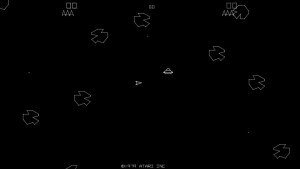
The development and history of Asteroids contain plenty of fascinating details.
One concerns its famous high-score table. Asteroids is sometimes described as the first arcade game that allowed players to enter initials next to their scores. That is not quite true. Ed Logg himself later explained that another game had already used the idea and that he adopted it because he liked the concept of attaching an identity to a score. He memorably compared the practice to a form of graffiti.
Because Asteroids became such an enormous success, however, it helped popularize the feature. Suddenly, three-letter initials on an arcade leaderboard became an invitation to competition. Players were no longer competing only against a machine; they were competing against everyone who had played that particular cabinet before them.
The game’s popularity apparently became obvious even before release. Logg recalled that Atari employees kept playing the development version and would ask when he was leaving so that they could get access to it themselves. New high scores would appear between development sessions. Later field testing confirmed the game’s unusually strong earning potential.
Another interesting detail is that demand became so great that early Asteroids machines could even appear in cabinets originally intended for Lunar Lander. Atari had created a hit considerably larger than expected.
Its success also produced sequels and adaptations. Asteroids Deluxe arrived in 1980, followed eventually by games such as Space Duel and Blasteroids. Home versions appeared as well, with the Atari 2600 adaptation becoming a major commercial success in its own right.
First Reactions
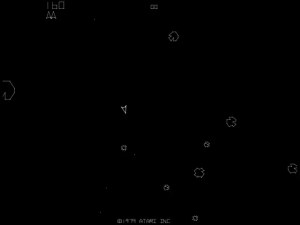
Judging Asteroids by the standards of 1979 requires remembering how different the video-game industry was at the time. The elaborate review culture surrounding modern games hardly existed. For arcade manufacturers, one of the most important forms of evaluation was brutally practical: put a prototype into a public location and see whether people continued inserting coins.
By that measure, Asteroids performed exceptionally well. Logg recalled that its earnings remained strong during field testing over an extended period, a powerful indication that players were returning instead of trying the machine once and moving on.
Not every early reaction was entirely positive. During testing, some players reportedly found the control system unfamiliar. People accustomed to games such as Spacewar! had difficulty with the thrust control, while players familiar with Space Invaders complained about the relentless action and the absence of moments in which they could relax.
Ironically, those features became part of the game’s identity. The unusual controls created a demanding skill curve, while the constant pressure made every successful escape feel meaningful.
Another potential criticism was visual simplicity. Even by early-1980s standards, Asteroids offered no colorful characters or detailed environments. Yet the vector graphics were so clean and responsive that their minimalism became an aesthetic advantage rather than simply a technological limitation.
Ultimately, the strongest contemporary verdict came from the audience itself. Players kept playing, arcade operators kept ordering cabinets, and Asteroids became one of the largest commercial successes of its generation.
Lasting Influence

The cultural importance of Asteroids reaches far beyond the number of cabinets Atari sold.
Its most obvious contribution is the popularization of score-based competition. Putting initials beside high scores transformed an arcade cabinet into a miniature public arena. A player could walk into an arcade and immediately discover the achievements of everyone who had played before. The three-letter signature became part challenge, part reputation and part local celebrity.
Its gameplay also established a remarkably durable formula. Rotation, thrust, inertia, screen wrapping and unrestricted movement around a single playfield appeared in numerous later games. Atari itself continued exploring similar mechanics, and the basic concept has been copied, modified and reinterpreted by generations of developers.
The game’s visual identity has proved equally durable. A triangle, a handful of irregular polygons and a black background are enough for many people to recognize Asteroids. Few games demonstrate more clearly that memorable visual design does not necessarily require complexity.
Its influence also comes from the way it encourages improvisation. There is rarely a single correct move. Players can remain relatively central, circle the edges, carefully eliminate rocks in sequence or move aggressively through the field. Vector-game designer Tim Skelly later praised precisely this freedom, arguing that Asteroids allowed players to develop their own approaches rather than forcing them through one rigid solution.
The name itself has become part of gaming vocabulary. Asteroids has appeared through ports, compilations, remakes and modern reinterpretations, including Atari’s Asteroids: Recharged. The original mechanics remain understandable enough that modern versions require surprisingly little explanation.
That may be the clearest evidence of the game’s influence: its central idea has aged far less than its hardware.
Final Orbit
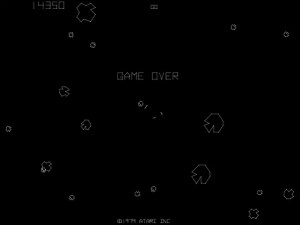
Asteroids represents a period when video games were technologically limited but creatively wide open. Atari did not have millions of colors, cinematic cutscenes, online multiplayer or enormous virtual worlds. What its designers had instead was a black screen, glowing vector lines, five buttons and a deceptively simple question: how long can you survive?
From those ingredients came one of the defining arcade games of the twentieth century.
Its controls reward practice. Its physics create constant tension. Its asteroid-splitting mechanic turns every shot into a small tactical decision. Its vector display gives the game an unmistakable visual personality. And its high-score system helped transform arcade gaming into a public competition between players who might never even meet.
Many games from the earliest decades of the medium are important primarily because of what they introduced. Asteroids is different. It is historically significant, but its fundamental design is still enjoyable on its own terms.
Perhaps that is why the game remains such a powerful symbol of the arcade age. Asteroids does not need a complicated narrative or hundreds of mechanics to create excitement. It gives the player a fragile spacecraft, an empty universe and an endless supply of rocks.
Then it asks one timeless question:
How high can you score?







Schreibe einen Kommentar