

In my mind and in my car
We can’t rewind we’ve gone too far
Pictures came and broke your heart
Put the blame on VCR
A Song That Marked a Turning Point
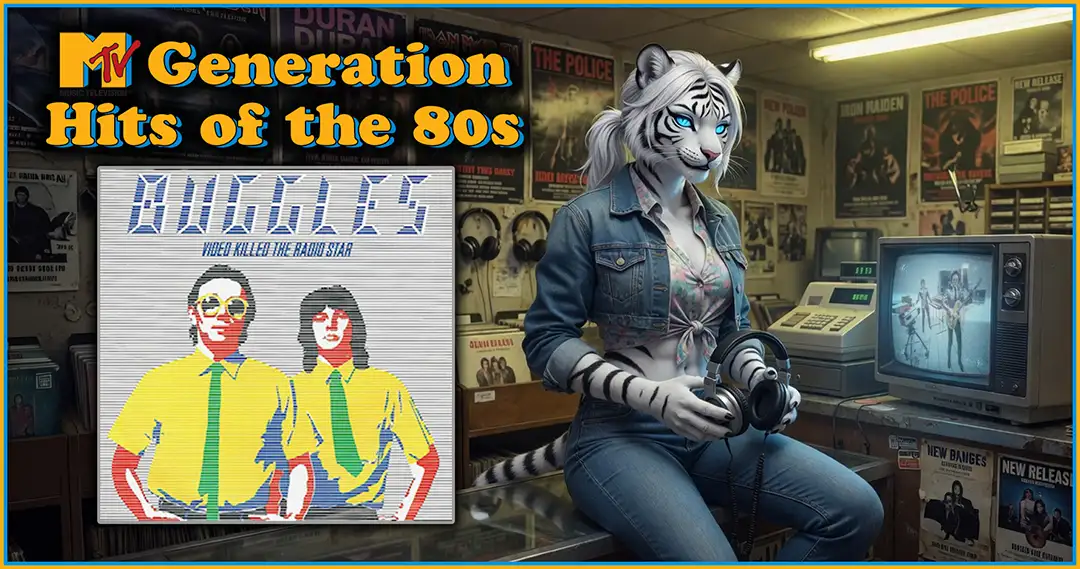
Few pop songs are as closely linked to a historic media event as “Video Killed the Radio Star” by The Buggles. The single was released in 1979, even before the advent of commercial music television in the U.S. Nevertheless, it describes a development that would soon change pop culture: music was no longer just listened to, but increasingly conveyed through images, staging, and the artists’ appearances. The song sounds both nostalgic and futuristic. It evokes the golden age of radio, yet uses synthesizers, electronic effects, and elaborate studio production that already points toward the 1980s.
The Buggles consisted mainly of Trevor Horn and Geoff Downes. Although the group existed for only a short time, their debut single became an international hit. It reached number one in the UK, number two in Germany, and number 40 in the U.S. The song became immortal primarily because its music video was broadcast on August 1, 1981, as the very first video on the newly launched U.S. channel MTV. Thus, a song about the end of the radio star itself became the starting signal for the music video era.
The Message of the Lyrics
The lyrics are told from the perspective of someone reminiscing about the former significance of radio. The focus is on a star whose voice was once able to create a special connection with the audience through the airwaves. Radio was an invisible medium: Listeners knew the voice, but not always the face. This left room for the imagination.
The title provocatively claims that the video “killed” the radio star. This does not mean the complete disappearance of radio, but rather a change in the rules of the music business. An artist now had to not only sound good, but also be visually compelling. Cameras, television studios, and screens became the new intermediaries between musicians and audiences. The former radio star thus appears as a victim of progress: technology alters his music, while images supplant the emotional connection to the pure voice.
However, the message is not unequivocally anti-technology. The song itself employs precisely those modern production tools that its lyrics warn against. Electronic sounds, processed vocals, and a deliberately artificial sound make the track appealing. Therein lies its central irony: the past is mourned, but celebrated using the tools of the future. Musicologist Peter Wicke describes the song as an ironic tribute to the radio star and as a depiction of a seemingly irreversible media trend.
From Demo to Global Hit
The song was written by Trevor Horn, Geoff Downes, and Bruce Woolley. The basic idea and the catchy chorus were largely Woolley’s contribution. Initially, a simple demo recording was made. A later studio version featuring singer Tina Charles helped pique the interest of Island Records. Downes reported that his girlfriend at the time worked at the label and ensured that the recording was played for the right people.
While working on the album *The Age of Plastic*, Woolley left the group and founded The Camera Club. As a result, two early versions exist: the more direct recording by Bruce Woolley and the Camera Club, and the significantly more elaborately produced Buggles version. The latter was recorded in 1979 at Townhouse and Sarm East studios in London. Horn and Downes experimented with synthesizers, vocals, interruptions, and multiple layers of sound. In places, Horn’s voice was processed to sound like an old radio broadcast. By his own estimate, it would have taken about 26 people to recreate all the elements of the studio version live at the same time.
Horn cited Kraftwerk as a major musical influence. Added to this was the science fiction literature of J. G. Ballard, which often deals with technology, media, and alienation. Horn envisioned a future in which computers and music companies could produce artists almost industrially. At the same time, he drew on memories of his childhood, when he listened to Radio Luxembourg at night. Thus, the song combines personal nostalgia with a broader vision of the future of the entertainment industry.
The single was released on September 7, 1979, with “Kid Dynamo” as the B-side. A few weeks later, it reached the top of the British charts. In total, it remained on the charts for eleven weeks and achieved high rankings in numerous other countries.
The Perfect MTV Debut
The music video was directed in 1979 by Australian director Russell Mulcahy. It features a child in front of a radio, Trevor Horn at an old-fashioned microphone, futuristic clothing, technical equipment, and a woman in a transparent tube. The past and the future are intercut directly. The radio symbolizes memory and invisible voices, while the artificial backdrops represent a new visual pop world.
When MTV began broadcasting in the U.S. shortly after midnight on August 1, 1981, the network chose “Video Killed the Radio Star” as its first full-length music video. The decision was clearly symbolic: a television network that wanted to show music videos around the clock began with a song about video replacing the radio. The song was already nearly two years old, but its lyrics fit the concept perfectly.
In the years that followed, MTV turned the music video into a crucial promotional tool. Artists could now gain worldwide attention through striking visuals, fashion, dance, and recognizable staging. “Video Killed the Radio Star” thus became a kind of programmatic motto: from then on, pop music became increasingly audiovisual.
Fun Facts About the Song
Hans Zimmer, who would later become a world-famous film composer, can be seen briefly playing a keyboard in the music video. At the time, he was still at the beginning of his career and working in the London music scene.
The band’s name was also a play on words. The musicians initially saw themselves as an artificial, tech-driven pop group. Downes later explained that the name “Buggles” arose from the idea of “bugs”—that is, studio insects—and a playful comparison to the Beatles. Originally, the members were supposed to remain as anonymous as possible, but the single’s success made that impossible.
Another ironic moment occurred during a recording for “Top of the Pops.” A representative of the British musicians’ union reportedly checked to see whether the group was using synthesizers to replace traditional string sections. This reaction almost confirmed the song’s message: new technology threatened not only radio stars but apparently also the jobs of classical studio musicians.
When several dedicated MTV music channels were shut down in late 2025, the song was once again used as a symbolic farewell clip. It thus marked both the beginning and the belated end of the classic music television era.
Voices from 1979
Initial reactions from music critics were mixed. Andy Partridge, singer and songwriter for the band XTC, is known for his misjudgment. In a single review for the British magazine “Smash Hits,” he essentially deemed the production too clean and too polished and doubted that the song would become a hit. A few weeks later, it reached number one on the British charts. This criticism shows that, in 1979, highly controlled studio production could also be perceived as artificial or overproduced.
Other critics immediately recognized the song’s impact. “Billboard” included the single in its selection of recommended new releases in November 1979. The catchy chorus and the combination of female vocals with orchestral timbres were particularly praised. To some, the track sounded like an overproduced advertising jingle; to others, like an original evolution of the pop song.
It was precisely this seemingly commercial quality that was part of its success. Geoff Downes had previously written advertising music and knew how quickly a melody had to grab attention. What some contemporaries criticized as too contrived was later regarded as exemplary of Trevor Horn’s production style. Horn went on to become one of the most influential pop producers of the 1980s, working with acts such as Yes, ABC, and Frankie Goes to Hollywood, among others.
A Symbol of Media Change
The song’s cultural influence extends far beyond its status as a synth-pop hit. Its title became a set phrase that crops up whenever a new medium supplants an older one. Later variations emerged around the internet, streaming, and digital platforms. They demonstrate that the song created an instantly understandable language for technological change.
His prediction proved only partially correct. Radio did not disappear. Instead of being completely replaced, it was complemented by other media. However, television, music videos, internet platforms, social networks, and streaming services changed the way artists are discovered and evaluated. Visual imagery gained significant importance. In this sense, the song was less of an accurate prophecy than an apt description of the feeling that a familiar cultural form was losing its dominance.
Cover versions, film appearances, and nostalgic retrospectives kept the song in the public consciousness. Among the better-known reinterpretations are recordings by The Presidents of the United States of America and Erasure. The song functions both as a celebration of early synth-pop aesthetics and as a commentary on media history. Its cheerful surface makes it easily accessible, while its theme seems to become relevant again with every technological upheaval.
Furthermore, the track embodies a shift in the role of the pop producer. Trevor Horn was not only a singer and musician but also shaped the song in the studio down to the smallest detail. The production itself became a creative instrument. This approach later shaped much of 1980s pop.
Why the Song Endures
“Video Killed the Radio Star” is more than just a typical one-hit wonder. Its melody is instantly recognizable, its production bridges the late 1970s with the upcoming synth-pop decade, and its theme touches on a question that remains relevant today: What happens to art and artists when a new technology changes the way people experience music?
The song’s strength lies in its contradictions. It laments the loss of an older media landscape while simultaneously celebrating futuristic technology. It sounds light and playful, yet addresses nostalgia, replaceability, and technological progress. Through its role in the launch of MTV, this tension became part of pop history. The video didn’t completely kill the radio star. But The Buggles captured the exact moment when visuals began to fundamentally change the rules of pop music.







Schreibe einen Kommentar