

The Arcade Classic That Changed Nintendo
When Donkey Kong hit arcades in 1981, the game seemed almost absurd at first glance: A small man in overalls climbs across slanted steel beams, jumps over rolling barrels, and tries to rescue a kidnapped woman from the clutches of a giant gorilla. Compared to the dominant arcade hits of its time—such as Space Invaders, Pac-Man, Defender, or Galaga—Donkey Kong was unusually narrative-driven, comical, and almost cartoonish. While many arcade machines at the time relied on abstract symbols, spaceships, mazes, or pure reaction patterns, Donkey Kong presented a small stage scene: a scaffold, a kidnapping, a hero, a villain, and a clear goal.
It was precisely this simplicity that made the game so effective. Donkey Kong didn’t tell a long story, but it immediately conveyed a situation. The player knew who they were, who they had to rescue, and what stood in their way. This made Donkey Kong not only a successful arcade game but also early proof that video games could feature characters, humor, and dramatic tension. Today, it is considered one of the most important titles of the so-called golden arcade era.
For Nintendo, Donkey Kong was more than just a hit. The game marked the company’s breakthrough in the North American arcade market and made Shigeru Miyamoto, then still a relatively young designer, one of the central figures in video game history. At the same time, this was the first appearance of the character who would later become world-famous as Mario. In Donkey Kong, he was initially named Jumpman, a name that directly described his most important ability: jumping. This small, highly stylized arcade hero would later become Nintendo’s mascot and one of the most recognizable figures in pop culture.
The creation of Donkey Kong was by no means the result of a surefire plan. Nintendo had previously failed to find success in the U.S. with Radar Scope. What remained were arcade cabinets and circuit boards that urgently needed to be turned into a marketable product. Out of this predicament emerged a game that not only solved an economic problem but also shaped the medium in the long term. Donkey Kong was thus a prime example of how technical limitations, business pressure, and creative imagination can come together.
Gameplay
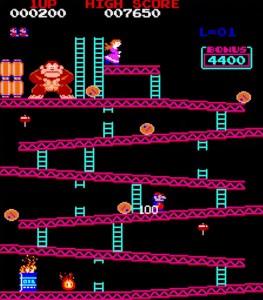
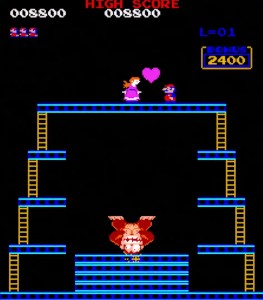
The gameplay of Donkey Kong is easy to explain but hard to master. The player controls Jumpman—later named Mario—as he makes his way upward through several construction site levels. At the top of the screen awaits Pauline, who has been kidnapped by Donkey Kong. Between Jumpman and his goal lie ladders, platforms, chasms, conveyor belts, elevators, fireballs, spikes, and, above all, barrels that Donkey Kong rolls down from above.
The central appeal lies in navigating through dangerous yet manageable spaces. Donkey Kong is not a game where you move freely through a vast world. Each level is a single screen that functions like a small mechanical stage. Everything is visible, everything seems fundamentally understandable, and yet the movements of the enemies, the paths of the barrels, and the player’s position create immense tension. The player must constantly decide whether to keep climbing, wait, jump, retreat, or take a risk.
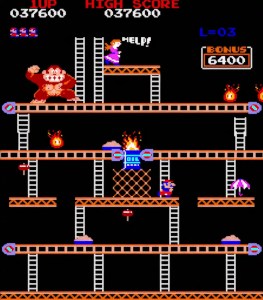
The most famous scene is the first one: Jumpman starts at the bottom left on a slanted steel beam, while Donkey Kong throws barrels from above. These barrels roll across the platforms, fall down ladders, or change their course in seemingly unpredictable ways. The player must jump over them, dodge them, or destroy them with a hammer. The hammer is one of the most striking game elements: when Jumpman picks it up, he can smash obstacles and collect points for a short time. At the same time, it limits him, as you cannot climb while holding the hammer. The power-up is therefore not purely an advantage, but a tactical decision.
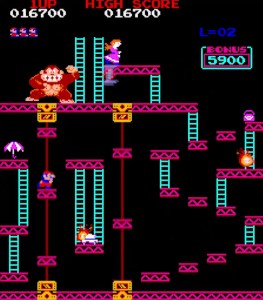
The subsequent stages significantly alter the gameplay experience. In the conveyor belt or “Pie Factory” scene, the ground moves on its own while dangerous objects travel along the belts. In the elevator scene, Jumpman must execute precise jumps onto moving platforms, which was particularly challenging by the standards of the time. Finally, in the Rivet scene, the player gradually removes the bolts from the structure until Donkey Kong falls. This scene feels almost like a little puzzle, because not only reflexes but also a sensible route are important.
An important reason for Donkey Kong’s enduring fascination is the mix of pattern and unpredictability. Many movements can be learned, but the game never feels completely mechanical. The barrels, in particular, ensure that even experienced players must stay alert. You can practice routes, improve jump timing, and optimize your score, but a moment’s hesitation or a misjudged danger is enough to lose a life.
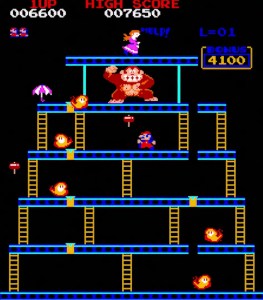
Donkey Kong is also a game about risk. Those who just want to survive take safe paths. Those who want to achieve high scores collect bonus items, use the hammer aggressively, and jump as close as possible over obstacles because that earns extra points. This dual structure of a simple goal and a challenging point hunt was typical of major arcade games, but was implemented here with particular elegance. The machine was designed to be easily accessible, yet to tempt players to insert another coin time and again.
It is also noteworthy that Donkey Kong is not a classic fighting game. Jumpman does not defeat Donkey Kong directly through punches or shots. He overcomes obstacles, reaches Pauline, and ultimately causes the structure to collapse. The main mechanic is not attack, but movement. Jumping thus becomes the game’s actual language. From today’s perspective, this seems obvious, but in 1981, a video game in which jumping served as a central gameplay element was still something special. Donkey Kong thus paved the way for the platformer genre, even if that term wasn’t yet firmly established at the time.
Technology and Graphics
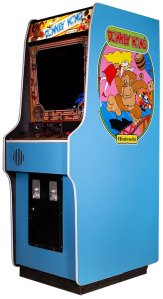
Technically, Donkey Kong is a product of its time, but precisely because of this, it is a masterpiece of minimalism. The hardware was limited: little memory, simple sprites, small color palettes, and scarce processing power. Yet these constraints forced the developers to create clear, instantly recognizable forms. Every pixel had to serve a function. The characters were not meant to be realistic; they had to be understandable at a glance.
Jumpman is the best example of this. His cap, his mustache, his eye-catching clothing, and his bold silhouette were created not only for aesthetic reasons but also out of technical necessity. A face could hardly be rendered in detail at such a low resolution. A mustache replaced visible mouth parts, the cap eliminated the need for complicated hair animation, and the high-contrast clothing made arms and body distinguishable. What began as a technical solution later became an icon.
Donkey Kong himself is also highly stylized. He is large, broad, comical, and menacing all at once. His animations are simple but effective: he stomps, grins, lifts barrels, and thus appears more lifelike than many abstract enemies of his time. Pauline, on the other hand, is less active but clearly recognizable as the object of the rescue. From today’s perspective, her role is narratively very passive, yet historically it shows how early on video games drew upon simple character constellations from film, comics, and fairy tales.
The graphics in Donkey Kong are not just decoration, but game information. The slanted steel beams immediately show the player how barrels will move. Ladders signal possible escape routes. Conveyor belts explain the danger through their movement. Elevators convey timing. The rivets in the final level clearly show what the player must do. This makes the game visually very easy to understand. A spectator quickly understands what is happening; a player usually recognizes immediately why they failed.
The short cutscenes were also remarkable for their time. Donkey Kong features brief moments that connect the sequence: The gorilla kidnaps Pauline, Jumpman pursues him, and after a successful completion, the situation begins anew. These scenes are simple, but they provide the game with a narrative framework. Donkey Kong was thus not just a collection of obstacles, but a kind of mini-drama in several acts.
The sound reinforces this impression. The melodies and effects are short and simple, yet memorable. The rumbling of the barrels, the hammering music, the footsteps, and the small beeps create rhythm. This was especially important in a noisy arcade. An arcade game had to grab attention acoustically without becoming incomprehensible. Donkey Kong achieved this with just a few distinctive sounds.
From a technical standpoint, it’s also interesting how different the later home versions turned out to be. On early consoles and home computers, graphics, levels, and sounds often had to be greatly simplified. It is particularly well known that some ports did not include all the arcade stages. As a result, the original arcade version became a sort of reference version for many fans. It showed how elegantly the four scenes interlock and how much the game thrives on its complete rhythm.
Trivia
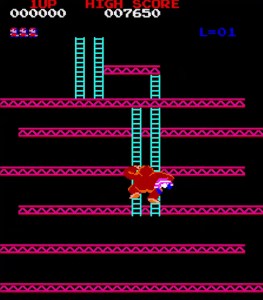
Donkey Kong is rich in anecdotes because its creation is closely linked to chance, improvisation, and the subsequent creation of legends. One of the best-known stories concerns the origin of the characters. Originally, the game was supposed to be based on Popeye. The roles were obvious: Popeye as the hero, Bluto as the powerful antagonist, and Olive Oyl as the damsel in distress. When Nintendo couldn’t use those characters, they created their own. Out of necessity, Jumpman, Donkey Kong, and Pauline were born.
The name Donkey Kong is also famous because it sounds unusual. “Kong” was intended to immediately evoke the image of a large gorilla in Western audiences. “Donkey” was meant to emphasize a stubborn, clumsy, or foolish side. Together, they formed a name that wasn’t quite clean but was very memorable. Precisely because it sounded strange, it stuck.
Jumpman later became Mario. According to legend, Mario Segale, the landlord of a Nintendo of America building, played a role in this. The character was given a more human name, and the carpenter later became a plumber. Donkey Kong is therefore not only the origin of the Donkey Kong series but also the starting point for the Mario character as the world knows him.
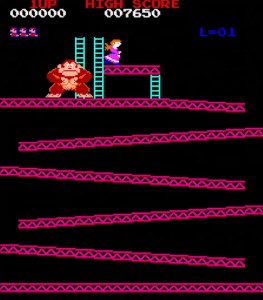
Another interesting fact is the game’s significance for Nintendo’s later home console. Donkey Kong was so important that its adaptation for the Famicom (or NES) served as a technical benchmark. A home console capable of rendering Donkey Kong convincingly promised players a slice of the arcade experience right in their living rooms. Thus, the game also indirectly became a touchstone for Nintendo’s transition from arcade provider to console giant.
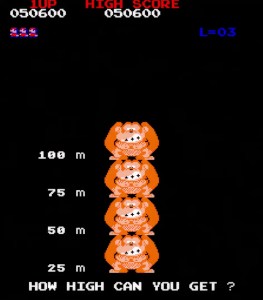
Donkey Kong also has a famous “Kill Screen” tradition. As with several early arcade games, there is a point where technical limitations and scoring logic make it practically impossible to continue playing normally. For high-score players, this very limit became legendary. It wasn’t just achieving high scores, but understanding the game’s inner logic that became part of the fascination.
Donkey Kong also made legal history. Universal accused Nintendo of infringing on King Kong’s rights. Nintendo won the lawsuit. This victory was enormously important for the young company in the U.S., because it concerned not only money and licenses, but also self-confidence. Nintendo was able to demonstrate that it could defend its characters and brands. Later, the lawyer John Kirby, who represented Nintendo in this case, became part of Nintendo lore himself, as it is often said that the character Kirby was named after him.
Reviews at the Time
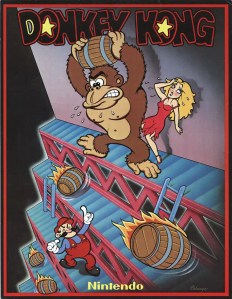
The contemporary reaction to Donkey Kong cannot be directly compared to today’s game reviews. In the early 1980s, there was no specialized gaming press with standardized ratings, in-depth analyses, and online debates. Arcade games were primarily judged by their impact: Did they attract players? Did they bring in enough coins? Did they appeal to arcade operators? Did people stop to watch?
By these standards, Donkey Kong was a huge success. The game stood out because it was different. It wasn’t just another space shooter, not just another maze game, and not merely a variation on familiar reflex patterns. The construction site setting, the gorilla, the kidnapped woman, and the little hero all felt narrative and humorous. For many players, it was immediately clear what to do. It was precisely this accessibility that was a decisive advantage.
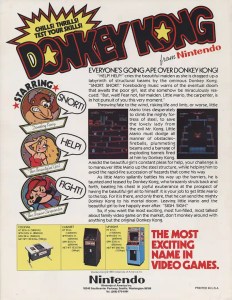
Nevertheless, Donkey Kong wasn’t an obvious hit from the start. There was initial skepticism within Nintendo of America. The name sounded strange, the theme seemed unusual, and compared to the shooters popular at the time, the game was less aggressive and less technically spectacular. It required not only quick reactions but also timing, patience, and spatial awareness. That’s precisely what made it innovative, but also risky.
Many players at the time likely found Donkey Kong difficult. The controls are precise but unforgiving. Jumpman cannot be freely steered in mid-air, falls are dangerous, and a wrong jump quickly ends in death. From today’s perspective, the game sometimes feels harsh or stiff. Back then, however, this difficulty was part of the arcade logic. An arcade machine had to be challenging, because it thrived on repeat plays and coin inserts.
The later home versions were received with mixed reactions. In particular, how closely they adhered to the arcade original was a key criterion. If graphics, sound, or levels were missing, it was noticed. At the same time, many players were impressed simply by being able to play Donkey Kong at home. The gap between the arcade and the living room was still wide in the early 1980s. A successful port could therefore be a strong selling point for a console.
Looking back, one can say: The criticism at the time consisted less of theoretical analysis than of immediate enthusiasm, commercial success, and practical performance. Donkey Kong was a hit because it drew people to the arcade machines. Its quality was evident in the fact that players, after failing, weren’t just frustrated but believed: “I’ll get further on my next try.”
Cultural Impact
The cultural impact of Donkey Kong cannot be overstated. First and foremost, the game established Nintendo as a force to be reckoned with in the international video game market. Before Donkey Kong, Nintendo was not yet the brand in the West that would later shape entire generations of consoles. The arcade game’s success demonstrated that the company could develop original characters, strong gameplay mechanics, and ideas with mass appeal.
Even more important was the birth of Mario. Jumpman evolved into a character who became Nintendo’s central icon in Mario Bros., Super Mario Bros., and countless other games. Without Donkey Kong, Mario would not exist in this form. Many features that were later expanded upon are already hinted at here: the clear silhouette, jumping as the core mechanic, the combination of comedy and skill, the straightforward objective structure.
Donkey Kong also shaped the platformer genre. Although it was not yet a side-scrolling platformer in the later sense, it defined important fundamentals: platforms, ladders, jumps, obstacles, timing, and vertical movement. The player navigates the space not by shooting, but through skillful body control. This idea was further developed in the years that followed and found a form in Super Mario Bros. that remains influential to this day.
Donkey Kong was also significant from a narrative perspective. The game demonstrated that even a short arcade title could depict character relationships and dramatic situations. The conflict between hero, captive, and antagonist is simple yet effective. Later games became much more complex, but the core concept remained: players do not merely act in an abstract manner; they assume a role within a comprehensible world.
Pop culture quickly embraced Donkey Kong. The gorilla, the barrels, and the construction site setting became universally recognizable symbols of classic video games. Donkey Kong appeared in music, television, merchandise, toys, cartoons, and later in films and documentaries. In particular, the high-score culture surrounding the game remained alive for decades. The documentary *The King of Kong* introduced this competition even to people who had never seriously played an arcade machine.
At the same time, Donkey Kong became a symbol of early video game modernity. It represents a time when developers sought new forms with very limited resources. The game is simple enough to be understood immediately, yet complex enough to be analyzed and perfected for decades. This combination is rare. Many old arcade games are historically interesting but have aged poorly in terms of gameplay. Donkey Kong, on the other hand, still possesses excitement, rhythm, and character.
Not least, Donkey Kong influenced Nintendo’s design philosophy. The game embodies an idea that later became characteristic of Nintendo: technology is important, but it serves playability. What matters is whether the player immediately understands what is happening, whether an action is enjoyable, and whether failure is perceived as an incentive rather than a mere punishment. This philosophy is reflected in many later Nintendo games.
Conclusion
Donkey Kong is a milestone because it made history in several ways at once. It rescued Nintendo from a difficult business situation, brought Shigeru Miyamoto to prominence, introduced Mario, shaped the platformer genre, and demonstrated that arcade games could be more than abstract reaction machines. It combined simple rules with narrative clarity, technical limitations with iconic design, and a tough challenge with immediate charm.
From today’s perspective, Donkey Kong naturally seems dated. The controls are strict, the graphics are simple, the gameplay is repetitive, and the story is very straightforward by modern standards. Yet that is precisely where its strength lies. The game wastes nothing. Every platform, every ladder, every barrel, and every jump counts. Donkey Kong is a compact system of risk, rhythm, and repetition.
Its significance lies not only in nostalgia. Many modern games owe fundamental ideas to Donkey Kong: the clarity of characters, the importance of jump mechanics, the appeal of short levels, the connection between gameplay and narrative, and the power of a strong character. The 1981 arcade game was thus not only a product of its time but a starting point for much of what video games would later become.
Donkey Kong therefore remains a classic in the truest sense: a work that can be explained historically, but one that doesn’t belong solely in a museum. Anyone who plays a round today quickly realizes why people back then kept feeding coin after coin into the machine. The path to the top is short, dangerous, and endlessly enticing. And somewhere above the steel beams, a gorilla still stands, holding a barrel in his hands.








 McHenry's Lair
Kommentar verfassen :