


As the 2026 World Cup kicks off,
it’s worth taking a look back at the early digital beginnings of soccer.
Long before today’s games dazzled with licenses, tactics, and TV production,
soccer had to be created from a few pixels and a lot of improvisation.
RealSports Soccer for the Atari 2600 hails from precisely this pioneering era.
Atari’s Attempt to Take Soccer Seriously
When you think of soccer games today, series like FIFA, Pro Evolution Soccer, or Football Manager immediately come to mind. You think of licensed teams, tactical depth, fluid animations, stadium atmosphere, and an audiovisual presentation that aims to recreate the sport almost like a documentary. In the early 1980s, however, the situation looked completely different. Home consoles like the Atari 2600 operated with extremely limited technical resources, and sports games had to compress the essence of an entire discipline into a few pixels, a handful of sounds, and simple controls. Soccer, in particular, posed a special challenge: too many players, too much space, too much movement, too many small moments that, when added together, make up a game.
It was precisely in this context that RealSports Soccer was released for the Atari 2600 in 1983. The game was part of Atari’s RealSports series, with which the manufacturer sought to modernize its older and now visibly outdated sports games. The name was almost a promise: more realism, better overview, a greater sense of the sport. Following early, often very abstract implementations—most notably Pelé’s Soccer, which long stood as Atari’s best-known soccer title—RealSports Soccer was meant to demonstrate that the VCS was capable of more than just flashing blocks and rigid playing fields. That was ambitious, because soccer is almost a contradiction in terms on a console like the 2600: a large field must be depicted, multiple characters must act sensibly, and ball movement and spatial layout must remain comprehensible.
RealSports Soccer is therefore not a classic in the sense of an undisputed masterpiece. It is rather an interesting transitional work—a game that visibly straddles two worlds. On the one hand, it still bears all the limitations and quirks of the early days: reduced teams, idiosyncratic rules, limited movement patterns. On the other hand, it is already evident that Atari made a serious attempt here to bring structure, dynamics, and a minimum of tactical thinking to a soccer game. That is precisely what makes the title exciting in retrospect.
Today, RealSports Soccer is rarely cited as a major milestone, yet it has its place within the Atari 2600 library. It marks the point at which soccer on this console no longer appears merely as a crude caricature of the sport, but as a serious attempt to make its basic principles playable. Whether that always works well is another question. But it is precisely through its strengths and weaknesses that one can clearly see how video game design functioned within strict technical limitations.
Gameplay
The basic premise of RealSports Soccer is easy to grasp: Two teams compete against each other, and whoever scores more goals within the allotted playing time wins. Yet after just a few seconds, you realize that Atari had to significantly condense the sport. Instead of full teams, there are only three field players per side on the field. This drastically changes the nature of the game. Soccer is not simulated here as a complex team dynamic, but rather as a series of small duels and passing situations that take place in a confined space.
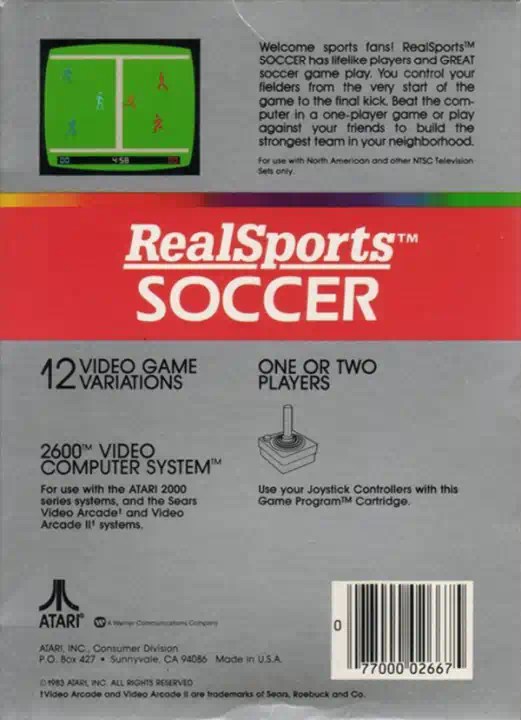
The game is played from a diagonal top-down view, while the field scrolls sideways with the action. Whoever has possession automatically controls the active player with the ball. On defense, you can switch between your own characters with the press of a button. That sounds simple, but it creates a surprisingly distinct division of roles: On offense, you try to find passing lanes and exploit open spaces; on defense, it’s about selecting the right player in time and facing the opponent head-on.
One of the most important features is the so-called lane principle. Players do not move completely freely across the field, but rather within specific lanes. This reduces complexity while simultaneously giving the game a clear structure. As a result, passes become the central means of shifting play from one lane to another. Anyone who simply dribbles straight forward usually loses the ball quickly. On the other hand, those who play the ball at the right moment can set up surprisingly elegant combinations—in a very abstract sense, of course.
It’s also interesting that the defense has the advantage in direct running duels. The player with the ball is slower than a defending, actively controlled opponent. This is clever from a gameplay mechanics perspective because it prevents attacks from ending too easily in solo runs. You’re forced to let the ball move. For an early soccer game, this is remarkable: Atari doesn’t just try to depict the ball and the goal, but also a fundamental principle of the real sport—that passing is often more efficient than blind dribbling.
Shots and passes go in the direction the joystick is pointing. This creates an immediate, almost archaic sense of control. There are no complicated button combinations, no special moves, and no hidden systems. Everything depends on direction, timing, and position. Especially in two-player matches, this creates a certain tension because both sides are working with the same simple tools. You read your opponent’s movements, feint, change direction, intercept the pass, or force a miscommunication in the build-up.
One curious detail is that only the player currently under control can score a goal. This fits the game’s logic but seems unusual from today’s perspective. In general, RealSports Soccer is full of rules that aren’t realistic but are functional. Instead of aiming for a complete soccer simulation, the game creates a rule system that makes sense given the technical limitations of the 2600.
Added to this is a special feature that stood out at the time: the wraparound effect. Players without the ball can run off one side of the screen and reappear on the other. This is, of course, not a realistic soccer moment, but a clever way to simulate greater freedom of movement and make the small playing field appear more dynamic. At the same time, this trick opens up tactical possibilities one wouldn’t necessarily expect in such an early sports game.
There are various game modes with multiple difficulty levels, different match durations, and single- or two-player modes. The latter is particularly important, because as with many early sports games, the true appeal lies less in battling the AI than in a direct duel with a second player. Against the computer, the patterns can be read with a little practice; against a human opponent, however, are the moments when RealSports Soccer truly comes to life.
Technology/Graphics
Technically, RealSports Soccer is particularly interesting because it attempts to display significantly more on the Atari 2600 than the system can comfortably handle. The 2600 was notorious for operating with extremely limited resources. Developers had to use tricks, prioritize, and simplify in order to even create the impression of a larger whole. In a soccer game, this means you can’t simply conjure up eleven players per side, a full field, and fluid movement on the screen all at once.
Atari responded with a series of pragmatic yet clever decisions. The characters are larger and more easily distinguishable than in older soccer games on the same platform. You can clearly tell which player is active because they are displayed in a brighter color. This is not just a graphical accent, but an essential part of the gameplay. Without this visual highlighting, the already simplified action would quickly become confusing.
The diagonal bird’s-eye view was also a sensible compromise. It conveys at least a hint of the feel of the field without making the ball or the players appear too small. Added to this is the scrolling of the field, which gives the whole thing a significantly more modern feel than the static sports fields of earlier Atari titles. This makes the field appear larger and the game less confined, although the actual simulation naturally remains heavily limited.
Compared to Pelé’s Soccer, the earlier Atari soccer game, this was a visible step forward. RealSports Soccer feels clearer, more controlled, and more focused. While the players still look more like stylized sports icons than real people, for the hardware this was already a small statement: soccer on the 2600 no longer had to consist solely of abstract blobs.
Acoustically, too, the game takes a functional approach. The soundscape is sparse but not entirely insignificant. Above all, the referee’s whistle serves as a clear signal for kickoffs, goals, and the end of the game. There is no music in the modern sense; atmosphere is created more through rhythm and feedback than through rich sound. This fits the character of the game. RealSports Soccer does not aim to overwhelm emotionally, but rather to keep the action clear and readable.
Of course, the weaknesses remain visible. The animations are limited, the movements are sometimes stiff, and despite the scrolling, the playing field never truly conveys the vastness of a real soccer field. The reduction to three players per side is not only a gameplay compromise but, above all, a technical one. Yet that is precisely where part of the fascination lies. The game demonstrates how much illusion can be created with very little material. It is not a triumph of photorealistic rendering, but a triumph of omission.
Trivia / Interesting Facts
There are some interesting details surrounding RealSports Soccer that place the title in a broader Atari context. The game was released on the Atari 2600 in 1983, after a version for the Atari 5200 had already been released in 1982. On the 5200, the game initially ran simply under the name Soccer, which clearly shows how much Atari was still in a formative phase back then when it came to branding and series logic.
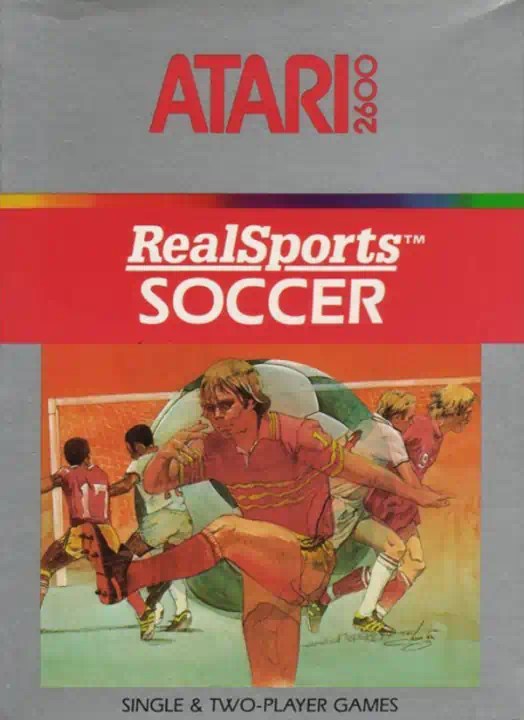
The 2600 version was programmed by Michael Sierchio; Jerome Domurat is credited with the graphics. The cover artwork for the 2600 version was created by Warren Chang. Such credits are particularly interesting in early console games because many Atari titles date from a time when developers were often barely acknowledged publicly. In retrospect, they give the game a more human profile: behind those few kilobytes of code were specific creators with clear solutions to very specific problems.
It is also fascinating that RealSports Soccer was part of a larger initiative. The entire RealSports series was intended to upgrade Atari’s sports catalog and make it appear more modern. In a way, this was a response to competitive pressure, particularly from systems that made Atari’s sports games seem outdated. RealSports Soccer is thus not merely a standalone game, but a building block in a strategic reorientation.
In addition, a version for Atari’s 8-bit computers was apparently planned but never officially released. This is one of those typical stories from the industry’s early years, in which projects were announced, postponed, or quietly shelved—often due to market shifts, platform policies, or the general turbulence of the time.
The game’s subsequent history is also noteworthy. RealSports Soccer did not remain entirely confined to the 1980s, but later resurfaced in retro collections and re-releases. It was made available again on Atari Flashback systems and is also included in Atari 50: The Anniversary Celebration. This shows that, despite its mixed reputation, the title is considered part of Atari’s historical legacy.
Finally, the history of its name is also interesting. Variants such as Soccer, Football, Futbol, or Futebol appear in various markets and databases. This fits a sport whose name varies greatly depending on the region—and at the same time reflects the international marketing practices of those years, in which titles were often flexibly adapted.
Reviews at the Time
The contemporary reception of RealSports Soccer ranged from mixed to skeptical—though not uniformly negative. That is precisely what makes the reviews from that time so intriguing. Many critics acknowledged that Atari had made visible progress here compared to earlier soccer attempts. At the same time, the impression remained that there was a noticeable gap between ambition and result.
A British magazine remarked, in essence, that the game was ultimately “just soccer”—which sounds banal on the one hand, but was meant as a sobering judgment on the other. Behind this lay the expectation that the name RealSports should deliver more than just an improved basic framework. Especially given the high price at the time, people apparently wanted an experience that stood out more clearly from simpler sports games.
On the European continent, too, the press reacted with some reserve. In Germany, the game was criticized for its lack of realism, particularly the absence of real goalkeepers and the overall small-scale, abstract feel of the gameplay. French critics praised the graphics compared to Pelé’s Soccer, but felt that the game ultimately offered too little in the long run. This combination of technical respect and playful disillusionment runs through many reviews of that time.
It is particularly revealing that some reference works from the early 1980s outright panned the game. A book on Atari software criticized RealSports Soccer for lacking the necessary complexity to hold players’ interest over the long term. The rating was correspondingly harsh. Such reviews show how quickly sports games back then were judged on whether they offered more than a short-lived novelty.
On the other hand, there were also more moderate assessments. A 1984 software encyclopedia rated the game as decent overall and particularly highlighted the two-player mode. This makes sense: many of the AI’s weaknesses and the game’s limited depth are less noticeable when two people play against each other. What might seem predictable or monotonous on its own becomes a viable competitive experience in a head-to-head match.
It’s also interesting that later retro reviews often treated the game even more harshly than its contemporaries did. In the 1990s, RealSports Soccer appeared several times in retrospectives, where it was described as having aged poorly. From a more modern perspective, its graphics, controls, and overall pace were, of course, even more open to criticism. At the same time, this highlights a classic problem with historical retrospectives: a game is no longer judged solely by the standards of its time, but by everything that came after.
The bottom line is that the verdict at the time was rarely “catastrophic,” but often “a respectable attempt with limited results.” Perhaps that is precisely the fairest assessment. RealSports Soccer impressed many observers not through perfection, but by squeezing as much soccer feel as possible out of the hardware under harsh conditions.
Cultural Influence
The cultural influence of RealSports Soccer is more subtle than that of major blockbusters or genre-defining classics. The game neither revolutionized the soccer game market nor established a long-standing series. Nevertheless, it holds an important place on a smaller scale.
For one thing, it represents a moment when sports games began to break away from being mere point-scoring simulations. Earlier titles often had only a very loose connection to their respective sports. RealSports Soccer, on the other hand, already attempts to translate roles, spatial positioning, ball movement, and defensive pressure into playable systems. This is still a long way from simulation in the modern sense, but it is a clear step in that direction. Anyone wishing to trace the history of digital sports games will find an insightful link here.
On the other hand, the game is culturally relevant primarily within the history of Atari. The RealSports series marked Atari’s attempt to respond to a changing market. In this respect, RealSports Soccer is not just a soccer game, but also a document of a competitive struggle in the early console industry. It tells the story of a manufacturer that realized its first sports games were no longer sufficient and attempted to correct its image through better presentation and greater gameplay credibility.
For retro fans, the title also has museum value. It shows how designers thought in the pre-crisis era of the U.S. gaming industry: What absolutely must be included in the game? What can be cut? Which rule is dispensable, which is essential? In RealSports Soccer, these decisions are not hidden but clearly visible. That is precisely why the game serves so well as a historical artifact.
Added to this is its preservation through later collections. The fact that the title is included in Flashback systems and in Atari 50 does not mean it is played en masse today. But it shows that it is regarded as a representative part of an era. Such re-releases transform a once-common cartridge into a piece of curated gaming history.
Its influence is therefore less pop-cultural than historiographical. RealSports Soccer lives on not because countless modern games build directly upon it, but because it remains a vivid example of how soccer was reimagined on very early home hardware.
Conclusion
RealSports Soccer is neither a forgotten genius nor an all-around successful soccer game. It is a title full of limitations, quirks, and compromises. The teams are tiny, the realism quickly falls away, and many game situations feel more like a logical abstraction than real soccer. Anyone approaching the game today without historical context will likely see its limitations rather than its qualities.
And yet it would be unfair to judge the game solely by what it lacks. Within its time and hardware constraints, RealSports Soccer is a serious, often clever attempt to make soccer more structured, easier to follow, and more engaging to play than before. The scrolling, the improved overview, the focus on passing and defensive player selection, the clearer presentation—all of this shows that Atari didn’t just slap any sports theme on the packaging, but was actually seeking a better form.
Perhaps the game’s true significance lies precisely in that. RealSports Soccer is less exciting as a finished masterpiece than as a developmental stage. It demonstrates how designers had to set priorities under tight technical constraints and how limitations often gave rise to unconventional but functional gameplay ideas. The result isn’t really “real,” but it’s significantly more ambitious than many of its predecessors.
For collectors, retro enthusiasts, and history buffs, it therefore remains a worthwhile title. Not necessarily because it still captivates for hours today, but because it reveals something that is often hidden in modern productions: the art of creating maximum playability and a recognizable sports experience with minimal resources. As a soccer game, RealSports Soccer is a product of its limitations. As a historical document, however, it is surprisingly revealing.
More
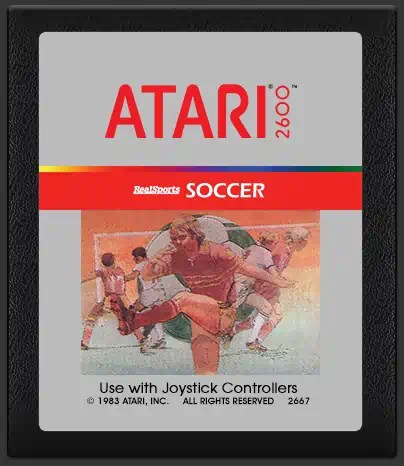
Box and Cartridge








Kommentar verfassen