

The Glittering Promise of the Laserdisc Era
When people talk about the great icons of the Laserdisc era, the name Dragon’s Lair almost automatically comes to mind first. But anyone who delves a little deeper into the history of arcades in the early 1980s will quickly come across a title that is at least as emblematic of the hopes, strengths, and weaknesses of this brief technological fad: Cobra Command. The arcade game released by Data East in 1984, known in Japan as Thunder Storm, was not a classic action game in the conventional sense. Rather, it was a mix of animated film, rail shooter, and reaction test—a game that gave the impression of sitting inside an interactive action cartoon and piloting a heavily armed combat helicopter through a series of spectacular missions.
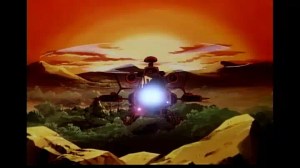
From today’s perspective, Cobra Command seems like a fascinating historical artifact. It was created during a period when the arcade industry was feverishly searching for the “next big thing.” While pixel art from the late 1970s and early 1980s was already well-established, Laserdisc technology promised something that seemed almost unbelievable at the time: smooth, cinematic animations in a quality that conventional hardware alone could not deliver. That was precisely the appeal of games like Cobra Command. They looked different from practically everything else in the arcades up to that point. The characters looked drawn rather than sprited, the environments had dynamism, perspective, and staging, and the gameplay was shaped more by cinematic timing than by free movement.
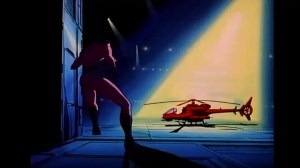
Nevertheless, Cobra Command is not an unproblematic classic. Many players were impressed by the presentation, but at the same time irritated or even frustrated by the actual gameplay. The game demanded less improvisational creativity and more precise recognition and memorization of sequences. Precisely for this reason, it serves as an excellent case study for a transitional period in video game history: It embodies the moment when video games sought to become more cinematic without yet possessing the technical and creative means to realize this vision with true freedom and flexibility.
Today, Cobra Command does not enjoy the widespread cult status of the truly great arcade titles, but it has a firm place among retro gamers, tech enthusiasts, and FMV historians. It is a work that is equally admired, criticized, and historically reevaluated. It is precisely this ambivalence that makes it fascinating.
Gameplay
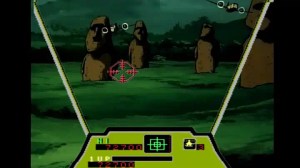
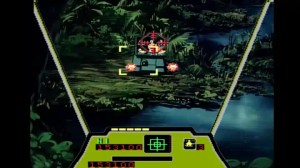
At its core, Cobra Command is an interactive rail shooter. The player does not control a freely moving helicopter through open spaces, but rather follows a predetermined sequence. The camera is practically situated in the cockpit of the futuristic LX-3 Super Cobra, while the flight plays out over pre-rendered animation sequences. The task is to shoot down enemies, dodge obstacles at the right moment, and execute the exact inputs the game demands at specific points.
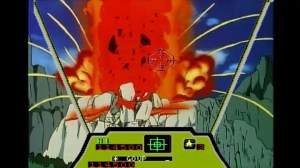
Controls consist of a joystick and two fire buttons: machine gun and missile. This sounds straightforward at first, but the challenge lies in the presentation. Cobra Command often communicates its requirements only indirectly through the animation, enemy movements, or audio cues from the mission commander. You have to quickly determine whether to fire at a target, fly under an obstacle, or initiate a sudden change of direction. If the correct action is performed too late or in the wrong direction, the sequence usually ends immediately with a dramatic crash or explosion.
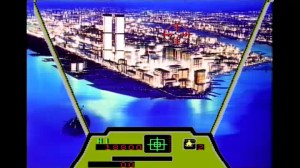
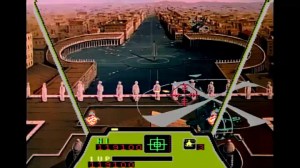
This structure creates a very unique sense of tension. On the one hand, Cobra Command conveys a feeling of speed and cinematic urgency. The helicopter races through urban canyons, over the sea, through canyons, and toward enemy positions. On the other hand, the player’s freedom is significantly restricted. To master the game, you must learn patterns. It is less an open battle than a choreographed test of reaction, observation, and memory.
This led to mixed reactions even back then. For some, it was precisely this condensed gameplay that was appealing: each level felt like a short, highly dramatic action scene in which you could “unlock” a cinematic sequence through perfect inputs. Others found the principle mechanical or unfair, because success depended heavily on memorization. Especially in the arcade, where every wrong decision immediately cost money, this could be frustrating.
Nevertheless, one must not misunderstand the gameplay as a mere string of quick-time moments. Cobra Command certainly attempts to create a sense of military missions. The objectives vary, the settings change, and the shift between shooting, dodging, and navigating keeps the tension high. From today’s perspective, one can recognize in it early precursors to those design ideas that would later reappear in rail shooters, FMV titles, and event-based action games.
Technology and Graphics
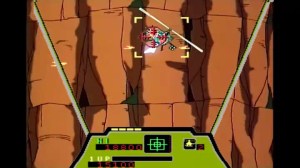
The real star of Cobra Command is its presentation. The game used Laserdisc technology to combine pre-animated video sequences with classic arcade interaction. While the actual input logic was processed by the arcade hardware, the video sequences came from a Laserdisc. This allowed for significantly more detailed and smoother animations than in purely sprite-based games of the same era.
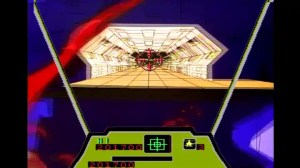
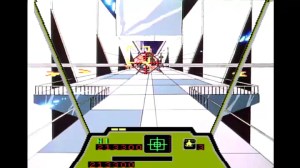
In 1984, this was an effect with a huge impact. Anyone who saw Cobra Command in an arcade wasn’t looking at the blocky characters and simple backgrounds of many contemporary arcade machines, but at an almost cartoon-like action aesthetic. The game relied heavily on perspective: roads flew toward the player, enemies appeared head-on or from the side, landscapes plunged into the depths, and the cockpit presentation gave the impression of sitting in the middle of an animated military mission. This visual impact was a key selling point.
It is particularly noteworthy that animation expertise was also involved in the production. The visual language is much more heavily influenced by anime and action cartoon conventions than by classic arcade graphics. Explosions, image composition, helicopter design, and editing style feel more like they come from a playable animated film than from a traditional video game. This cinematic aesthetic continues to give the game a unique charm to this day.
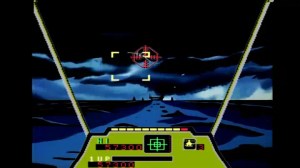
Technically, however, the approach had its limitations. Laserdisc games were delicate, expensive, and high-maintenance. The devices had to reliably access exactly the right video segments, and any delay or wear and tear could impair the gaming experience. On top of that, interaction remained limited by the system itself. Because the video sequences were pre-produced, the player could not improvise to the same extent as in a “real” simulation or action game. The illusion of great freedom thus stood in a certain contradiction to the actual structure.
Cobra Command is also interesting from an audiovisual perspective. Unlike many classic arcade games, it relies less on catchy, continuous melodies and more on sound effects, radio transmissions, and the immediate atmosphere of combat. This reinforces the impression of a technical mission, but at the same time makes the game more sober than other arcade machines of the time. The soundscape serves to provide orientation and set the pace, not primarily to establish a musical identity.
In retrospect, this is precisely what makes the game special: Cobra Command is significant less for its revolutionary mechanics than for the way it foreshadowed the visual future of the medium. It demonstrated just how much arcade games were already moving toward cinema and animation back then—even if the technology wasn’t yet sufficient to truly bring this vision to life.
Trivia and Curiosities
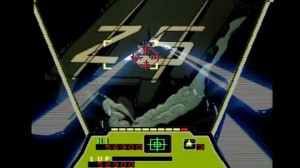
There are several details surrounding Cobra Command that make the game particularly interesting from a historical perspective. It starts with the name: In Japan, it was released as Thunder Storm, while the title Cobra Command was chosen for the Western market. This renaming fits well with the marketing logic of the 1980s, when Western-sounding military and action terms were intended to boost a game’s sales appeal.
Added to this is the frequent confusion with the completely different Cobra Command from 1988, also by Data East. This later game, however, is a classic side-scrolling shooter and has little in common with the 1984 Laserdisc title other than the name. Anyone talking about Cobra Command must therefore almost always specify which version they mean.
Also of interest is the connection to Yoshihisa Kishimoto, who would later gain fame as the creator of Kunio-kun and Double Dragon. In Cobra Command, one can still see an early phase of his work, in which cinematic action, intense drama, and direct, high-stakes gameplay situations are already clearly recognizable. In retrospect, this makes the title a small building block in the development of a designer who would later shape entirely different arcade trends.
Furthermore, Cobra Command was later ported or re-released multiple times, including for MSX, Sharp X1, Sega CD, and, in Japan, for later platforms as well. The Sega CD version, in particular, played a major role in ensuring the game did not disappear entirely into the arcade past. The home versions transformed what was once an arcade sensation into a collectible and historically rediscoverable work.
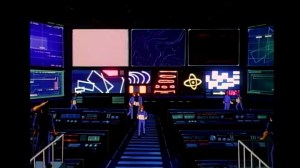
Another curiosity is the game’s tone. It takes its world with great seriousness: Terrorists, global missions, futuristic weapon systems, dramatic operations in iconic locations. It is precisely this blend of Cold War pathos, anime-style staging, and arcade-style exaggeration that gives Cobra Command an almost pulp-like quality today. It feels like a relic from an era in which action movies, cartoons, and video games influenced one another more and more directly.
Reviews at the time
The contemporary reception of Cobra Command was, as with many Laserdisc games, divided. On the one hand, there was an immediate fascination with the presentation. In Japan, Thunder Storm was commercially remarkably successful in 1984 and remained very high in the rankings of Upright and Cockpit arcade machines for several months. In the U.S. as well, Cobra Command was among the more notable Laserdisc successes of the year. That alone shows that the game was not only admired but actually played.
At the same time, it was already clear back then that the title was part of a problematic trend. Laserdisc games initially impressed visually but could not always retain their players in the long run. In the case of Cobra Command, the balance between visual appeal and gameplay depth was a particular point of discussion. The game seemed modern, almost visionary, yet many players quickly realized they were mastering a precise sequence of inputs rather than a dynamic fighting game.
Some voices in the industry at the time still saw this as a step forward. The game was described as one of the few signs of hope in the Laserdisc segment—that is, as an example of how the technology worked, at least to some extent, when presentation and theme selection aligned. The helicopter setting, the military narrative, and the fast-paced scenes gave Cobra Command more kinetic impact than many other FMV titles that relied too heavily on mere spectating.
But these same qualities also had a downside. Players who sought above all control, repeatability based on skill, and immediate system depth in the arcade found little to enjoy in Cobra Command. It was spectacular, but often relentless as well. The learning curve frequently consisted of memorizing the “correct” sequence. That was expensive in the arcade. It was precisely this that earned the game a reputation as a typical “quarter-eater”: impressive, but merciless in its consumption of coins.
From today’s perspective, the criticism of the time is easy to understand. Cobra Command was neither a failure nor an unqualified triumph. It was a prestige piece of a technological era that seemed certain of its future but soon failed due to its own limitations. Many players recognized the visual quality without ever truly loving the underlying design.
Cultural Influence
The cultural influence of Cobra Command is more subtle than that of some other arcade classics. It did not define genres in the same way as Pac-Man, Space Invaders, or Double Dragon. Nevertheless, the game has a historical significance that should not be underestimated.
First, it exemplifies the Laserdisc wave of the early 1980s. Along with other titles from this era, Cobra Command helped popularize the idea that video games could be more than just abstract rules on pixelated backgrounds. It contributed to the idea of the “playable movie”—an idea that later resurfaced in very different forms: in FMV games of the 1990s, in cinematic rail shooters, in quick-time events, and ultimately in modern action titles with heavily scripted sequences.
Second, Cobra Command served as a bridge between anime aesthetics and arcade design. It demonstrated how well Japanese animation language, military action fantasies, and arcade mechanics could be combined. This connection would live on in many other media forms in later years, whether in anime-inspired games, in CD-ROM titles with animated cutscenes, or in the general trend toward staging games in a more cinematic manner.
Third, the game is a key milestone in Yoshihisa Kishimoto’s career. Even though Cobra Command is not his best-known work today, it belongs to that early creative phase from which significantly more influential titles later emerged. In this respect, its cultural value is also biographical: it marks a period in arcade history when designers were still caught between a desire for technical experimentation and the subsequent formation of genres.
Fourth, Cobra Command lives on in the retro and preservation scene. Precisely because laserdisc arcade machines were technically complex and comparatively fragile, preserved versions, emulations, and later ports hold special significance. Today, the game is less a mass phenomenon than an object of historical curiosity: collectors, arcade historians, and fans of early FMV technology regard it as an exemplary title for a brief, intense phase of experimentation.
Not least, Cobra Command also has symbolic influence. It serves as a reminder that video game history consists not only of linear successes, but also of dead ends, side paths, and bold miscalculations. Some of these paths ended quickly—yet still had a lasting impact on how people thought about the future of the medium.
Conclusion
Cobra Command is a game caught between promise and limitation. In 1984, it promised the cinema experience in the arcade: fast animation, dramatic action, global missions, and a cinematic experience unprecedented at the time. In this regard, it certainly kept its promise, at least on the surface. Hardly any other arcade machine of its time looked as though you were sitting right in the middle of an animated action film.
At the same time, the game revealed the limits of this approach. Interaction remained limited, learning was heavily based on memorization, and the technology was complex. What looked like the future visually often still felt like a compromise in terms of gameplay. That is precisely why Cobra Command is so interesting today: not as a perfect game, but as a precise snapshot of an industry that dreamed of cinematic grandeur while grappling with the hardware of the time.
Anyone playing it today shouldn’t approach it with the same expectations as a classic shooter or modern action title. You have to view Cobra Command as a historical hybrid—as an experiment, a spectacle, a testament to the early longing for FMV. That’s when it reveals its true appeal. It’s frantic, often unfair, sometimes rigid, but at the same time visually striking, charmingly over-the-top, and extremely revealing in terms of cultural history.
Perhaps that is precisely where its enduring quality lies. Cobra Command is not an undisputed milestone, but an exciting hybrid: half game, half film, half vision of the future, half dead end. And that is exactly why it’s still worth writing about today.








 McHenry's Lair
Kommentar verfassen :