


The Most Beautiful War in the Arcade
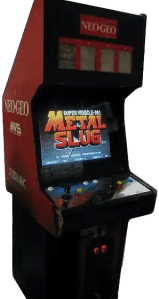
Actually, Metal Slug came out too late for my active arcade days. By the time SNK and Nazca released the first installment on the Neo Geo MVS in 1996, the heyday when I used to spend time at the arcade machines had already passed for me. That’s why I didn’t discover Metal Slug amidst cigarette smoke, coin chutes, and sticky joysticks, but later through MAME. And yet it immediately felt as though this game had always been part of my arcade history.
That is perhaps the greatest compliment one can pay an arcade game: it doesn’t necessarily require the memory of a specific place, a specific cabinet, or the coin you inserted back then. Metal Slug works even detached from this nostalgia. It is not just memory, but substance. Even when you launch it years later on a PC monitor—when you’re essentially encountering it outside its original habitat—it still has that immediate arcade energy. It doesn’t feel like a museum piece; it feels alive.
Because Metal Slug: Super Vehicle-001, as the full title goes, is one of those games where you understand within seconds why it became a legend. It’s a run-and-gun game, yes. You run from left to right, shoot everything to smithereens, rescue prisoners, collect weapons, and take down an oversized boss at the end of each mission. That sounds like standard fare. But Metal Slug turns this standard formula into a fireworks display of animation, timing, humor, and gameplay precision.
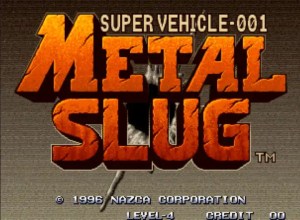
You immediately realize that this isn’t just another game in the genre. Metal Slug feels like a game into which the developers poured everything they loved about 2D action: military machinery, over-the-top explosions, slapstick, tough reaction tests, hidden bonuses, little gags at the edge of the screen, and an almost absurd attention to detail. There’s hardly a moment when nothing is happening. Something is always moving somewhere, burning, wobbling, crumbling, or an enemy is performing an animation that’s easy to miss on your first playthrough.
And yes: For me, Metal Slug is better than Contra. Not because Contra is unimportant. Without Contra, the run-and-gun genre in this form would hardly exist. But Metal Slug is denser, funnier, more beautiful, more immediate. It’s less stiff, less abstract, more of a lively cartoon battle. Where Contra calls for raw reflexes and military coolness, Metal Slug laughs in your face, throws a heavy machine gun at you, and blows the screen to smithereens.
Contra has that hard, iconic ’80s energy. It’s muscle-bound action, alien warfare, nonstop fire. Metal Slug, on the other hand, is more playful and technically rich. It takes the genre’s basic concept and runs it through a pixel art machine, producing something that’s simultaneously brutal, cute, funny, and spectacular. It’s precisely this mix that makes the first game so special to me.
Gameplay
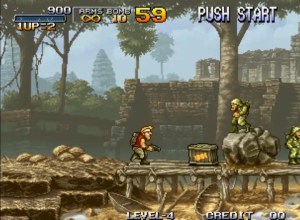
The basic premise is quickly explained: One or two players take on the roles of Marco Rossi and Tarma Roving, soldiers of the Peregrine Falcon Strike Force, and fight their way through six missions against General Morden and his rebel army. The player can run, jump, shoot, and throw grenades. On paper, it’s simple. In practice, Metal Slug thrives on how smoothly each of these actions executes.
The controls are direct but not arbitrary. Unlike in some other games in the genre, you can’t shoot diagonally while on foot. You can fire upward, and straight ahead of course, but the game constantly forces you to consciously choose your position and rhythm. This creates a flow all its own. You don’t just run through the levels firing wildly; instead, you read the enemy waves, look for brief safe windows, and decide when to stop, when to jump, and when to use a grenade.
It is precisely this small limitation that makes the game more interesting. Modern players might initially expect to be able to fire in all directions at any time. Metal Slug, however, demands a discipline more typical of arcade games. You have to take your own body on the screen seriously. A jump isn’t a casual dodge, but a decision. Throwing a grenade isn’t just for show, but often the best solution for a dangerous enemy. And sometimes retreating for half a second is more important than pushing forward.
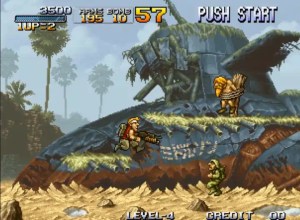
The weapons are a key part of the fun. The Heavy Machine Gun is the classic: loud, fast, satisfying. The Shotgun turns nearby enemies into pixel dust. The Rocket Launcher turns every scene into a small fireworks display. The Flame Shot is brutally effective and visually spectacular. Every weapon has character, and each is announced by the iconic voiceover. Once you’ve heard “Heavy Machine Gun!”, you’ll never forget it.
Not only are the weapons more powerful than the standard pistol, they also change the feel of the game. With the Heavy Machine Gun, you become more aggressive because the screen suddenly seems controllable in short bursts. With the Shotgun, you get closer to enemies, even though it’s dangerous, because the hit feels so wonderfully decisive. The Flame Shot invites you to literally wipe out groups of enemies. Every weapon has its own allure, and that’s exactly what creates small risks: You want to exploit the new firepower and sometimes get overconfident.
Then there are the rescued prisoners of war. They are more than just bonus points. They sit bound in caves, hang from ropes, hide behind rocks, or wait for rescue in absurd situations. After being rescued, they drop weapons, power-ups, or food. At the end of a mission, they are counted individually. If you die before then, the prisoners you’ve collected are lost as well. This motivates you to play more carefully, not just to progress.
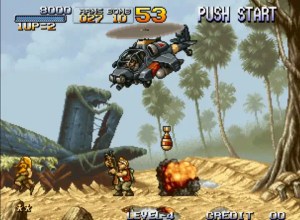
These prisoners are also a good example of how Metal Slug combines reward and humor. Other games would simply drop crates or icons. Metal Slug turns them into little characters who thank you, run away, or leave behind strange objects. Sometimes you wonder why a prisoner happened to have that particular item on them. But that’s exactly what fits the game’s world. Everything is slightly absurd, but never arbitrary.
The eponymous vehicle, the Metal Slug itself, is the centerpiece. This small, chubby tank isn’t a sober piece of military hardware, but a character with personality. It bounces, creaks, smokes, hops, and seems almost alive. Inside the tank, you can fire diagonally, take heavier hits, and wipe out entire groups of enemies with cannon fire. At the same time, it remains vulnerable. If you burn through it too carelessly, you lose not only firepower but often control of the situation as well.
What’s particularly nice is that the tank doesn’t feel like a foreign object. Many arcade games have used vehicles as fleeting gimmicks that were either too powerful or too immobile. In Metal Slug, the vehicle is strong but not invincible. It changes tactics without breaking the game. You feel safer, but never safe. When the tank starts smoking, every second becomes precious. And when you ultimately ram it into the enemy as a suicide attack, it’s both an act of desperation and a triumph.
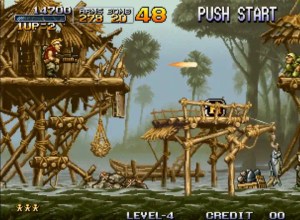
The six missions are short enough to keep the game compact in true arcade style, yet varied enough to avoid feeling like mere repetition. You fight your way through villages, forests, bases, bridges, canyons, and military installations. The boss enemies are giant machines that sometimes look more like caricatures of real military hardware. They’re imposing, but never anonymous. Even the enemy vehicles have grimaces, quirks, and a bizarre sense of humor.
The level design follows classic arcade logic. Each section introduces an idea, varies it, and ramps up the pressure. Sometimes enemies come from buildings, sometimes from above, sometimes from vehicles, sometimes from the background. You learn the patterns, but the game remains lively enough that it doesn’t feel mechanical. Skilled players can breeze through the missions almost as if choreographed. Beginners, on the other hand, experience a controlled chaos where every meter must be fought for.
Of course, Metal Slug is also difficult. One hit is usually enough, and death comes quickly. Nevertheless, the first installment feels fairer and clearer than many later entries in the series, which increasingly overload the screen with projectiles, enemies, and effects. Metal Slug is tough, but it’s understandable. When you die, you usually know why.
That’s an important difference. Difficulty alone doesn’t make a good arcade game. What matters is whether, after dying, you think: “That was cheap,” or: “I could have done better.” In the first Metal Slug, the latter usually prevails. The game takes coins, but it doesn’t cheat. It demands concentration, memory, and quick reflexes, but it remains fair enough that you genuinely improve on your next attempt.
Technology
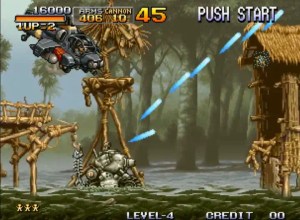
Technically, Metal Slug is one of the best arguments for why 2D was far from over in the mid-nineties. While the industry was pushing harder and harder toward polygon graphics, Nazca demonstrated on the Neo Geo just how much expressive power could be found in hand-drawn pixel art.
The Neo Geo MVS was no longer new hardware by 1996. It was a proven arcade system specialized in 2D that SNK had been operating since the early nineties. That is precisely why Metal Slug is so impressive: it doesn’t rely on raw modernity, but on mastery. The developers knew what the hardware was capable of and packed every scene with details.
This wealth of detail remains astonishing to this day because it’s not merely decorative. Many games look beautiful, but their backgrounds remain just that—backgrounds. In Metal Slug, you constantly feel like you’re running through a world waiting to be destroyed. Barricades splinter, buildings burn, machines crumble, soldiers react to the action. The environment isn’t fully interactive in the modern sense, but it feels handcrafted and meticulously composed.
The animations remain stunning to this day. Enemies stumble, scream, laugh, sleep, salute, flee, burn, fall into water, or are hurled in all directions by explosions. Backgrounds aren’t just scenery—they’re little worlds of their own. Huts shatter, vehicles disintegrate into pieces, projectiles leave trails of smoke, and every boss looks like a lovingly crafted mechanical monster.
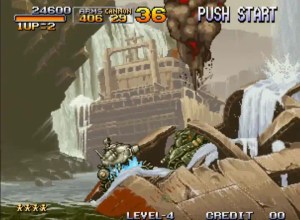
It’s also remarkable how much weight the animations carry. A tank doesn’t just explode—it gives up. It jerks, breaks apart, spews fire, and leaves behind debris. A soldier doesn’t just fall over—depending on the type of hit, he performs a different little scene. Even the food you collect is staged with a comical exaggeration. Every fiber of the world is animated.
Particularly astonishing is the tone, which straddles the line between war scenario and cartoon humor. Metal Slug features tanks, soldiers, machine guns, and prisoners, but it doesn’t portray the whole thing realistically. It’s exaggerated, grotesque, almost slapstick. The soldiers of the Morden Army aren’t faceless targets, but small comedic characters who get scared, laze around, or panic. This humor defuses the military theme without trivializing the action. The result is a peculiar but perfect blend of war movie parody, dieselpunk comic, and arcade spectacle.
This visual humor, in particular, is hard to overestimate. In a less lovingly crafted game, the scenario would have quickly become unpleasant or dull. Metal Slug takes a different approach. It turns violence into an exaggerated stage show, soldiers into caricatures, and machines into mechanical clowns. That doesn’t mean the game is deeply political. But it has a clear sense that arcade action works better when it has personality.
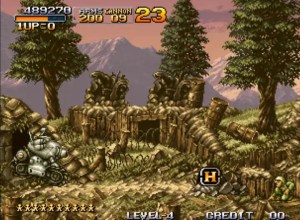
The sound also plays a big part in this. The music drives the action forward without pushing itself into the foreground. The sound effects are legendary. “Rocket Lawnchair,” “Shotgun,” “Thank you!” and, of course, “Mission Complete!” are part of the game’s acoustic identity. The sound effects carry weight: explosions boom, machine guns rattle, tank tracks clatter. Everything sounds like an arcade, like speakers inside the cabinet, like energy.
The voice acting is almost a trademark in its own right. It’s not realistic, not polished, not elegant. It’s loud, rough, sometimes misheard—and all the more iconic for it. Many players still deliberately say “Rocket Lawnchair” today, even though they obviously mean “Rocket Launcher.” Such small acoustic quirks are part of the charm. They give the game a voice that’s instantly recognizable.
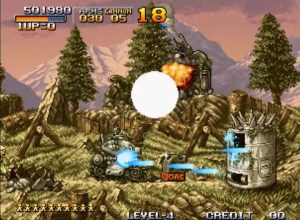
Of course, Metal Slug isn’t technically perfect. There are slowdowns when things get hectic. From today’s perspective, you could see them as a weakness. But in terms of gameplay, they feel almost organic. When the screen is filled with explosions and the game briefly stumbles, it doesn’t feel like a glitch, but like a moment when the hardware groans under the weight of its own greatness.
For many, these slowdowns are even part of the rhythm. In extreme situations, they offer a brief moment to catch your breath, a split second of clarity. We shouldn’t romanticize this: Of course, a stable frame rate would be technically cleaner. But in Metal Slug, these dips are so closely tied to the audiovisual onslaught that they’ve almost become part of the memory.
Trivia
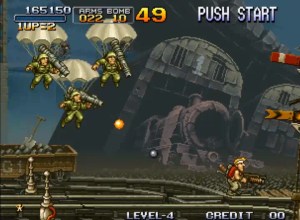
The name “Metal Slug” doesn’t refer primarily to the series, but to the small tank, the “Super Vehicle-001.” Only later did the term become the brand for the entire series.
The game wasn’t developed directly by a classic SNK core team, but by Nazca Corporation. Many members of this studio came from the Irem circle, where games like In the Hunt and GunForce II had previously been created. You can sense this origin: Metal Slug has more in common with detail-oriented 2D shooters and mechanical object animation than one might assume at first glance.
In the Hunt, in particular, is an interesting spiritual relative. It, too, features massive machines, water, explosions, and that penchant for exuberant pixel animation. Metal Slug feels like the more pointed, accessible, and charismatic evolution of this school. It takes the technical attention to detail, makes it faster, funnier, and more focused on immediate arcade satisfaction.
Originally, the tank apparently took center stage. The human characters only became more important when tests showed that a pure vehicle concept didn’t generate enough excitement. In the finished game, you can still sense this origin: The Metal Slug isn’t just a power-up, but almost the actual star.
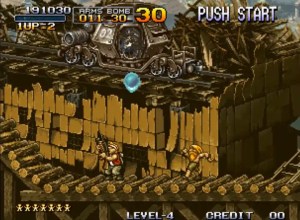
This also explains why the tank has so much personality. It’s not just a sprite with a cannon, but a little character in its own right. Its proportions are almost cute, its movements exaggerated, and its damage states dramatic. You could see it as a mascot even before the series had developed a proper identity of its own.
The series also bears strong influences from manga, anime, and model-building aesthetics. In particular, the mix of cute, stocky vehicles and heavy military technology is reminiscent of Japanese illustrations, in which war machines appear both menacing and playful at the same time.
The names of the characters and units also fit into this idiosyncratic world. Marco Rossi and Tarma Roving sound international, but not particularly realistic. General Morden is simultaneously a dictator, a caricature, and a comic-book villain. The Peregrine Falcons, on the other hand, come across as a deliberately over-the-top elite unit from an action movie that no one is supposed to take entirely seriously. These names are part of the pulp atmosphere.
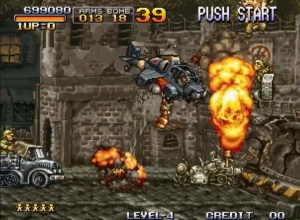
On home consoles, Metal Slug was long a status symbol. The Neo Geo AES version was expensive and later became a collector’s item. While the Saturn and PlayStation versions made the game more accessible, they struggled with the typical limitations of CD consoles: loading times, memory constraints, and a reproduction of the arcade experience that wasn’t always perfect.
That is precisely why MAME was so important to many players. Those who didn’t own a Neo Geo and never had the chance to experience the game on an arcade machine could later at least understand why this system and this game had such a reputation. Metal Slug thus became one of the titles that made emulation feel not just like a technical gimmick, but as a way to preserve arcade culture.
Sequels
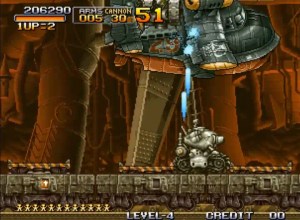
The success of the first installment made Metal Slug one of SNK’s most important brands outside the fighting game world. Metal Slug 2 followed as early as 1998. It significantly expanded the concept: new characters, new vehicles, new locations, and significantly more absurdity. Alongside Marco and Tarma, Eri Kasamoto and Fio Germi were added, who from then on became integral to the series’ identity.
With the new characters, the perception of the series also changed. Metal Slug was no longer just the game with Marco, Tarma, and the tank. It became an ensemble. Fio, in particular, quickly became one of the series’ most popular characters because, with her glasses, backpack, and slightly clumsy demeanor, she fit perfectly into the mix of military and cartoon.
Metal Slug X from 1999 wasn’t a completely new sequel, but a heavily revised version of Metal Slug 2. Enemy placement, balancing, weapons, and pacing were adjusted. For many players, X is the better version of the second game because it feels smoother and more polished.
What’s interesting about Metal Slug X is that it shows just how delicate arcade balancing can be. Small changes to enemies, items, and pacing immediately alter the entire experience. It’s not enough to simply add more content. A run-and-gun game thrives on when something appears, how long a threat remains visible, how much space the player has, and when a reward comes. X transformed a good but sometimes sluggish second installment into a significantly smoother experience.
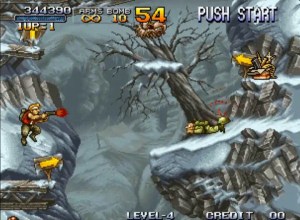
With Metal Slug 3, the classic series reached perhaps its greatest scope in 2000. Branching routes, zombies, underwater passages, aliens, and grotesque vehicles made the game a wild highlight. At the same time, this also marked the beginning of a tendency to cram more and more onto the screen. For some, Part 3 is the best installment in the series; for others, the first one is stronger due to its clarity and focus.
Part 3 is almost excessive. It feels as though the team allowed every crazy idea to make it in. That makes it great, but also more exhausting. The first installment, on the other hand, is leaner. It has fewer transformations, fewer surprise routes, and less sheer absurdity. In return, it is more focused. You can see it as the purest form of the formula: soldier, weapon, tank, prisoners, boss, explosion.
After that, the story got more complicated. Metal Slug 4 and Metal Slug 5 were released after SNK’s financially difficult period and are often rated less enthusiastically than the first three installments. They have good moments, but they no longer feel quite as fresh and organic. Metal Slug 6 later switched to Sammy Atomiswave hardware and introduced characters from Ikari Warriors, among others. Metal Slug 7 was released in 2008 for the Nintendo DS and was later expanded as Metal Slug XX.
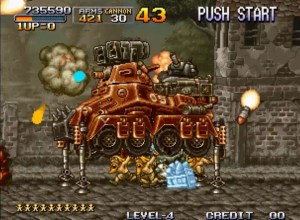
The later installments also highlight a problem common to many arcade series: when the basic formula is nearly perfect the first time around, any expansion becomes difficult. More enemies, more weapons, more vehicles, and more gags are obvious choices, but they aren’t automatically better. Metal Slug always remained entertaining, but striking the balance between clarity and excess became harder with each installment.
There were also handheld spin-offs, mobile games, tower defense variants, and even a strategic reinterpretation with Metal Slug Tactics. But when talking about the soul of the series, you almost always end up back at the early Neo Geo installments—and especially the first one.
That’s not because later games didn’t contribute anything valuable. On the contrary: many of the series’ most famous elements actually originated in the sequels. But the first installment has that special pioneering freshness. It doesn’t feel like a construction kit of expected series features, but rather like the moment when all these features first came into being.
Reviews at the Time
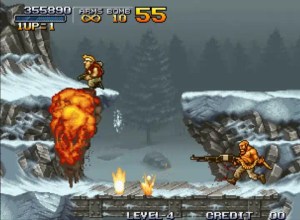
Upon release, Metal Slug was celebrated above all for its presentation. At a time when many players and magazines were fascinated by 3D graphics, this 2D game seemed almost defiant. It said: Look here, pixel art can still be more spectacular than polygons.
That shouldn’t be underestimated. In the mid-nineties, perceptions of technology were changing rapidly. 3D was the new promise, even though early polygon games often looked rough, angular, and have aged far more noticeably today than good 2D games. Metal Slug stood somewhat at odds with this trend. It wasn’t a glimpse into the supposed future, but a perfection of the present. Back then, that could seem conservative. Today, it feels timeless.
Contemporary and early Neo Geo reviews particularly highlighted the animation, the detailed backgrounds, the two-player action, and the humor. The gameplay wasn’t necessarily described as revolutionary. On the contrary: many recognized that Metal Slug was, at its core, a very classic run-and-gun shooter. But that was precisely the point. It didn’t reinvent the genre, but executed it with a level of care that hardly any competitor could match.
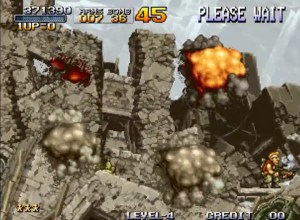
This kind of quality is sometimes harder to describe in reviews than innovation. It’s easy to name a new feature. Perfect timing, smooth animation, satisfying hit effects, and a clean level structure are more subtle. Metal Slug wasn’t a game where you could check off a list of revolutionary ideas. It was a game where nearly every familiar idea looked better, sounded better, and worked better than expected.
Criticism was directed more at its brevity and price. As an arcade game, Metal Slug was designed for fast, intense playthroughs. On the Neo Geo AES, that meant a relatively short game at an extremely high price. Those who bought the home version paid not only for content, but for arcade-quality gameplay in their living room. That was typical of the Neo Geo, but it was still an issue.
Especially from today’s perspective, this point needs to be put into context. An arcade game doesn’t necessarily have to be long. It has to be dense. It has to unleash as much energy in twenty, thirty, or forty minutes as other games do in several hours. Metal Slug is short, but it isn’t small. Every screen is packed with work, wit, and replay value. Still, it’s understandable that an expensive home cartridge was viewed differently back then than a coin-operated game in the arcade.
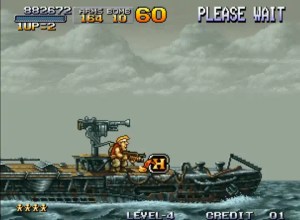
With the later CD and 32-bit ports, technical issues took center stage. The Saturn version was considered a respectable port thanks to RAM cartridge support, while PlayStation versions of 2D arcade games often suffered more from loading times and memory limitations. Those who wanted the real experience usually said: MVS or AES.
Today, the assessment is often even clearer than it was back then. Viewed from a distance, it’s clear that Metal Slug wasn’t just a good Neo Geo game, but one of the definitive 2D action games of the nineties.
One could even say that time has been kind to the game. Many early 3D titles that seemed more modern back then are historically interesting today, but aesthetically clunky. Metal Slug, on the other hand, still looks fantastic. Its technology wasn’t tied to a fleeting trend, but to craftsmanship. And good craftsmanship ages better than mere technical fads.
Cultural Influence
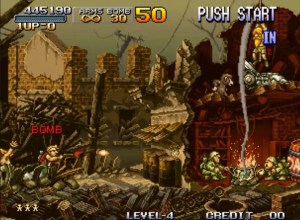
The cultural influence of Metal Slug lies not only in its sequels. It lies above all in a visual language that remains instantly recognizable to this day. The stocky soldiers, the over-animated vehicles, the massive explosions, the charming prisoners of war, the exaggerated bosses: all of this has been burned into the memories of arcade and retro gamers.
This visual language is so strong that individual screenshots are often enough. You don’t need to see a logo to recognize Metal Slug. The proportions, the colors, the way smoke clouds and explosions are drawn, the mix of military technology and caricature: it’s instantly identifiable. Few games have such a distinct visual signature.
Many modern pixel art games are measured against Metal Slug, even if they function quite differently in terms of gameplay. As soon as an indie game features particularly fluid 2D animations, humorous enemy reactions, or lovingly designed machines that crumble apart, the comparison inevitably comes up sooner or later. Metal Slug has become a kind of benchmark: this is how lively pixel art can be.
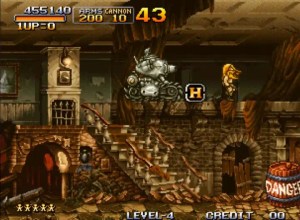
Yet the comparison is often unfair, because Metal Slug was an extreme case. That amount of hand-drawn animation is expensive, labor-intensive, and difficult to reproduce. That is precisely why the game still serves as a masterclass for developers and pixel artists today. It shows not only how to draw beautiful sprites, but how to give them weight, humor, and rhythm.
The game also plays a major role in emulation and retro culture. Many players who never owned a Neo Geo and never saw an MVS arcade machine in the wild later discovered Metal Slug through MAME, collections, or digital re-releases. That’s no shame. On the contrary: it was precisely through emulation that it became clear how many arcade masterpieces existed outside the major console histories.
For an entire generation of latecomers, MAME was not just an emulator, but a window into a missed parallel history of video games. You might have known the Mega Drive, Super Nintendo, PlayStation, or PC, but suddenly arcade machines you’d never seen before appeared there. Metal Slug was one of those games that immediately explained why arcade hardware once had something magical about it. It felt bigger than much of what one was used to from home consoles.
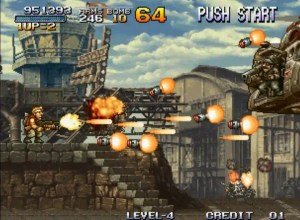
Metal Slug also proved that a game can be politically ambiguous and yet aesthetically precise. It is not an anti-war game in the strict sense, but neither is it a simple militaristic fantasy. It ridicules military hardware, it turns soldiers into slapstick characters, it depicts machines as grotesque monsters, and it lets the player fight in a world that is both threatening and absurd. This tone is hard to replicate.
That is exactly why Metal Slug is so often loved without needing a full explanation. It is a game that defies easy categorization. It is brutal, but not cynical. It is silly, but not cheap. It is technically impressive, but not cold. It is nostalgic, but not just for those who actually played it back then.
Conclusion
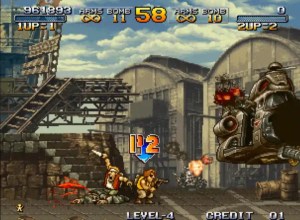
Metal Slug is one of the best run-and-gun games ever. Not because it’s the most complex. Not because it’s the longest. And not because it reinvented the genre. It’s so great because nearly every detail is spot-on.
The controls are responsive. The weapons feel fantastic. The levels are dense. The bosses are unforgettable. The animations are among the best the 2D era has produced. The humor keeps the war scenario from getting dull. And the little Metal Slug tank remains one of the most endearing vehicles in video game history to this day.
For me, the first installment is so strong precisely because it’s still focused. Later entries became bigger, crazier, and more spectacular. But Metal Slug (1) has a clarity that works in its favor. It’s the perfect arcade snack: short, intense, challenging, beautiful, and instantly replayable.
This focus also makes it more beginner-friendly than some of the sequels. Anyone who wants to understand why the series is so revered can start with the first game and immediately grasp its essence. No overloaded lore, no complicated series chronology, no unnecessary systems. You start, run off, free the first prisoner, hear the first weapon cry, and you’re hooked.
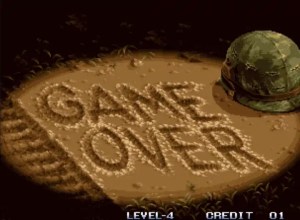
The fact that I first discovered it through MAME doesn’t change that. Maybe it even makes it more interesting. Metal Slug wasn’t a nostalgic memory of a specific machine in a specific arcade for me. It had to prove itself without that bonus. And it did so effortlessly.
In the end, Metal Slug is one of those games that show why arcade design can be so powerful. It needs no long introduction, no complicated story, and no hours-long tutorials. It explains itself through movement, sound, and reaction. You understand it with your hands. And the longer you play, the more you discover in its visuals, animations, and little quirks.
Contra remains a classic. But Metal Slug is the classic I prefer to return to. Not out of a sense of duty, not just out of respect for its significance, but because it’s still fun. Because it still looks good. Because that little tank still rolls, smokes, jumps, and explodes as if 2D had never gone out of style.







Kommentar verfassen