

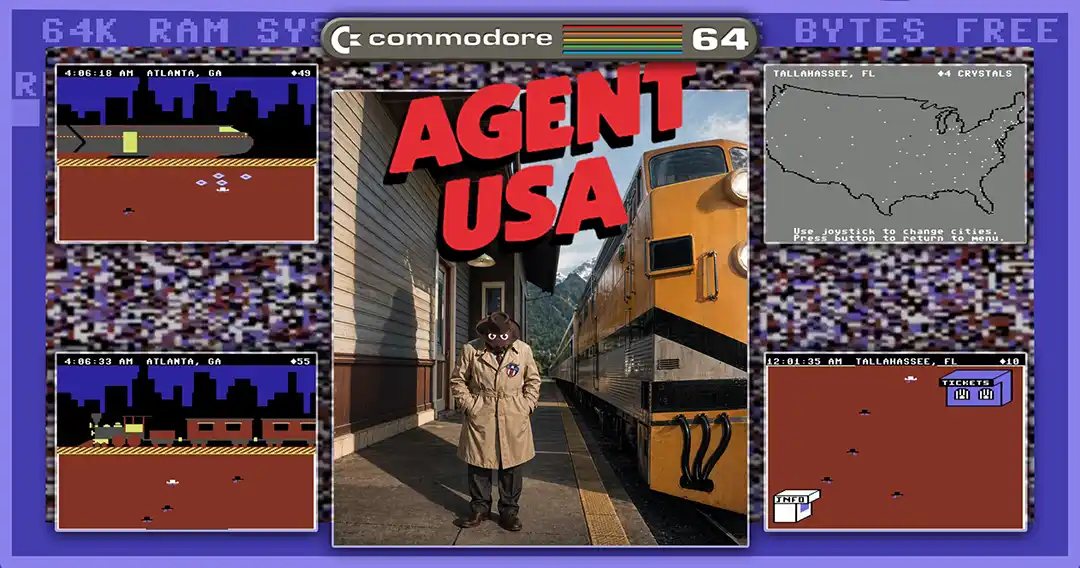
Wandering Hat vs. FuzzBomb
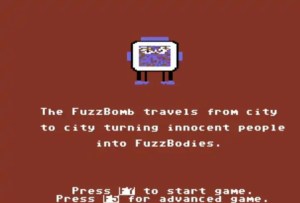
Amid all the space battles, platformers, and high-score chases of the 8-bit era, Agent USA initially seems like a strange oddball. You don’t control a muscle-bound hero, a spaceship, or a knight, but rather a small figure with a huge hat who travels across the United States by train. The goal is as quirky as it is memorable: A runaway FuzzBomb is turning harmless citizens into “FuzzBodies”—confused, contagious creatures. Only Agent USA can stop the spread by gathering information, planning routes, multiplying crystals, and finally striking at the right moment.
This premise alone shows why Agent USA breaks the mold of many C64 games. While the game features a clear threat and a distinct objective, it doesn’t build tension through explosions, weapons, or bosses in the traditional sense. Instead, the pressure arises from movement: the FuzzBomb keeps traveling, the Fuzz spreads, people get infected, and the clock is ticking against the player. As a result, Agent USA is less of a reflex-based shooter and more of a small-scale crisis simulation packaged for children.
The game was developed by Tom Snyder Productions and published by Scholastic, a publisher with a strong presence in the educational sector. Depending on the source, the C64 version is dated to 1984 or 1985; what is certain is that Agent USA was released in the mid-1980s and quickly became one of those games that were hard to categorize. It was educational software, but not dry. It was a strategy game, but without menu battles. It was an action game, but without shooting. It was a travel game, but not a simulation in the strict sense. It was precisely this mix that made it so appealing and continues to distinguish it from many other edutainment titles of its time.
On the Commodore 64, Agent USA encountered an audience that had very different expectations of computer games. Many home computer owners were looking for fast-paced arcade entertainment, while others used it for programming, learning, or experimenting. Agent USA fit perfectly into this in-between world. It was colorful enough to appeal to children, yet complex enough to keep older players engaged. The game’s concept was immediately understandable, but the path to success required patience, a sense of direction, and a willingness to learn from mistakes.
Agent USA is one of those games where you understand what to do after just a few minutes, but only much later realize how cleverly the system actually works. Beneath the simple surface lies a small simulation of movement, contagion, risk, and planning. For many C64 players, it therefore remained in their memory not just as a geography educational game, but as an idiosyncratic classic. The title may seem unassuming today, but it is precisely its modesty that draws attention to what matters most: a strong idea that has been consistently translated into game mechanics.
Gameplay
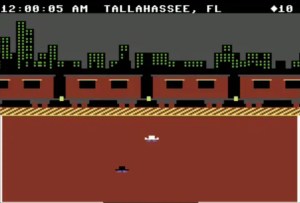
The player starts with a straightforward task: Find the FuzzBomb, collect enough crystals, and touch the FuzzBomb with full force to destroy it. In practice, this turns into an astonishingly thrilling race against time. The rules are simple enough to get started quickly, yet they interlock so skillfully that every game can unfold differently.
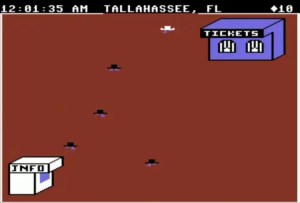
Agent USA travels by train from city to city. At train stations, there are ticket counters where you select destinations and must enter their names correctly. The educational core of the game is already evident here: you learn not through multiple-choice questions, but through application. Those who better understand the map of the USA, its states, capitals, and time zones move more efficiently through the game world. Those who travel blindly, on the other hand, lose valuable time and quickly realize that geographical knowledge is a real advantage.
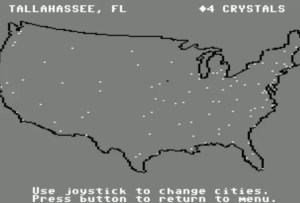
Travel itself is a central game element. The trains don’t simply connect cities at random, but create a network of possibilities and detours. Sometimes a destination seems close, but is difficult to reach with the current connection. Sometimes it’s worth traveling via a larger city because better connections are available there. This fosters a sense of spatial relationships without the game having to provide lengthy explanations. The USA is not presented as a static map, but as a space that is explored through movement.
The information kiosks in the state capitals are particularly important. There, you learn which cities have already been overrun by the Fuzz and where the FuzzBomb is currently located. This information is not permanently reliable, because the FuzzBomb keeps moving. Those who react too slowly or travel too slowly will arrive too late or find the situation has already worsened. The game therefore forces the player not only to gather information but also to evaluate it: How old is the clue? How far away is the target city? Do I have enough crystals to even attempt the attack?
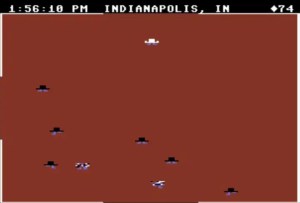
The crystals are the central tool. Agent USA starts with a small amount but can increase it by placing them on the ground. After some time, new crystals grow back, which can be collected again. That sounds peaceful, but the train stations are full of passersby who are also collecting crystals. At the same time, FuzzBodies are running around that can infect ordinary citizens. If Agent USA touches a FuzzBody, he loses some of his crystals; without crystals, he himself gets “fuzzed” and becomes temporarily uncontrollable.
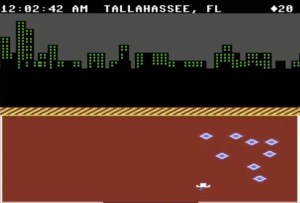
This crystal mechanic is simple but surprisingly effective. It turns every train station into a small tactical arena. Do I place crystals in a safe spot and wait for them to multiply? Do I risk passersby collecting them? Do I chase after the crystals and put myself in danger? Or should I just hop on the next train right away, because the FuzzBomb might have already moved on? Almost every action costs time, and time is one of the scarcest resources in Agent USA.
This creates a unique sense of tension in the game. You have to invest time to multiply crystals, but you can’t stay in one place too long. You have to travel, but every journey can worsen the situation. You have to save people, but sometimes it makes more strategic sense to focus on the actual objective. This is already challenging in the standard version; in advanced mode, the Fuzz spreads faster and more cities are affected from the start. What begins as a leisurely journey through America then turns into an increasingly frantic race against an invisible catastrophe.
It’s striking that Agent USA doesn’t need a classic health meter in the usual sense. The crystals fulfill several roles at once: they are a shield, ammunition, a resource, and a victory condition. Whoever has many crystals is safer and more capable of action; whoever has few lives dangerously. This multifunctionality is elegant because it keeps the ruleset streamlined while still creating depth. The player immediately senses why crystals are important, without needing to read through long pages of the manual.
Victory ultimately requires a clear action: with 100 crystals, Agent USA must reach the city where the FuzzBomb is currently located, dodge the FuzzBodies, and touch the FuzzBomb. Until then, the game is a mix of route planning, resource management, reaction skills, and knowledge of geography. The final moment is satisfying precisely because it requires not only skill but also represents the sum of all previous decisions. Whoever defeats the FuzzBomb hasn’t simply faced a boss, but has successfully managed a crisis.
Technology
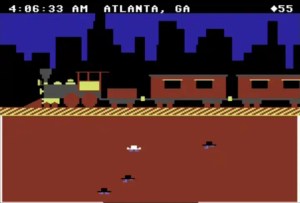
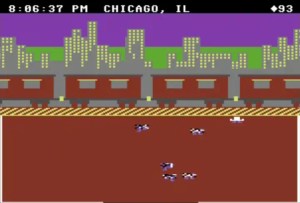
Technically, Agent USA isn’t a game that shines with spectacular C64 graphics. The presentation is simple, at times almost sparse. Cities are very similar; the most significant visual differences lie in the skyline backgrounds, the size of the train stations, and the transition between times of day. Yet it is precisely this simplicity that suits the game. The screen remains legible, the characters are instantly recognizable, and the famous “hats with legs” possess their own personality despite minimal animation.
The graphics rely less on rich detail than on clarity. The player must quickly identify where pedestrians, FuzzBodies, crystals, doors, trains, and switches are located. For a game that can often become hectic, this clarity is more important than decorative flair. Many C64 games of that era relied heavily on large sprites, eye-catching colors, or technical tricks. Agent USA takes the opposite approach: it reduces the visuals to what is essential for the player’s decisions.
It is precisely this reduction that has its own charm. The figures are more symbols than characters, but they fulfill their roles perfectly. Ordinary citizens appear harmless and aimless, FuzzBodies seem threatening due to their behavior, and Agent USA immediately stands out with his oversized hat. One could say that the game transforms its graphical simplicity into a kind of pictogram language. What looks unspectacular in screenshots is significantly more functional in motion.
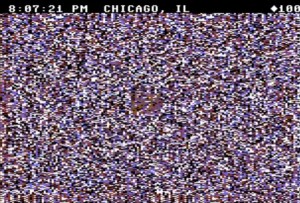
The sound is also sparse. Long passages are almost silent, interrupted by simple effects and the sounds of trains pulling in and out. But it is precisely the trains that bring the world to life: you can hear and see that traffic continues, that the game world doesn’t wait until the player is ready. The brief musical interlude during the train ride has stuck in many players’ memories, partly because the rest of the game sounds so restrained. It marks the transition between two locations and gives the journey a slightly ritualistic character.
Under the hood, Agent USA is more interesting than it appears at first glance. The game simulates the spread of the Fuzz via train connections. FuzzBodies can travel, cities can fall, the FuzzBomb keeps moving, and the player must piece together a picture of the situation from fragmentary information. For an 8-bit game with educational aspirations, this is remarkably elegant. The program must not only manage characters on a screen, but also keep a larger game world in motion.
This technical achievement may seem unremarkable today, but in the context of the C64, it is significant. Memory, processing time, and screen resolution were limited. Nevertheless, the impression of a living, interconnected world emerges. While the individual stations are abstracted, they belong to a larger whole. When the player learns that a distant city has been infected, it feels like news from a world that continues to unfold independently of one’s own location.
The controls combine a joystick and keyboard. Movement and crystals work immediately, while entering city names is a deliberate part of the game. If you make a typo or don’t know a city name, you lose time. This can be annoying, but it’s part of the concept: knowledge is translated into action. Here, the keyboard is not just an input device for commands, but an educational tool. You must not only recognize cities, but be able to name them.
From today’s perspective, this input method may seem cumbersome. Modern games would likely let you select destinations from lists or offer a map with clickable points. Agent USA, on the other hand, relies on a more direct, rough-and-ready form of interaction. This fits the home computer era, when the keyboard, joystick, and manual were often integral parts of the gaming experience. Precisely because of this, the game feels more like a small expedition in which the player takes personal responsibility for navigation and planning.
Trivia
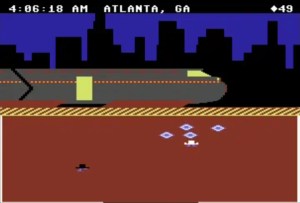
Agent USA is unforgettable primarily because of its main character. The agent looks like a walking hat, which seems almost absurdly simple in the C64 aesthetic but works surprisingly well. This character is not a hero in the classic sense, but rather a mascot: anonymous, comical, and instantly recognizable. There is no elaborate backstory, no dramatic hero’s journey, and no long dialogues. Nevertheless, the silhouette is enough to stick in the memory.
The decision to depict the agent in such a minimalist way was likely not only technically driven but also made good design sense. A neutral, almost abstract hero allows the player to focus more intently on the task at hand. Agent USA doesn’t come across as a person with a fixed character, but rather as a game character in the best sense: a tool with which to influence the world. At the same time, the hat has enough wit to give the game its own identity.
The FuzzBomb is also a typical product of the early 1980s: a menacing, mutated technological fantasy, half machine, half pop culture nightmare. The fact that it transforms people into static, disoriented beings fits perfectly with the television aesthetics of the time and the fears surrounding screen culture that was believed to make people passive. The term “Fuzz” sounds harmless, almost cute, but in the game it evolves into a real threat. This mix of comedy and danger contributes greatly to the atmosphere.
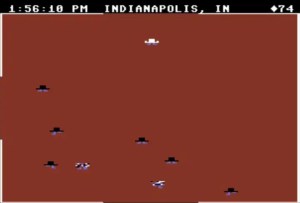
It’s also noteworthy that Agent USA doesn’t treat education as a reward or punishment. The game doesn’t say, “Answer a question, then you can keep playing.” Instead, geographical knowledge is part of survival. Those who know where capitals are located, how time zones work, and which cities are close to one another play better. This is good edutainment because the learning effect stems from the game system. You don’t learn incidentally despite the game, but through the act of playing itself.
Furthermore, Agent USA charmingly conveys American geography, which was exotic to many European C64 players. Names like Albuquerque, Tallahassee, Cheyenne, or Sacramento didn’t appear as dry vocabulary, but as potential destinations for an urgent journey. This gave cities—which one might otherwise have known only from atlases or movies—a playful significance. Anyone who played Agent USA intensively almost inevitably developed a sense of how far certain places were from one another and which cities could be important as hubs.
Another curiosity is the differing categorization in databases and memories. Some players knew Agent USA primarily from the Atari 8-bit or Apple II, others from the C64 or PC Booter. In retrospect, the C64 version was often perceived as a somewhat idiosyncratic but very endearing iteration of the title. As with many home computer games of the 1980s, release dates, ports, and regional availability are not always clearly documented. This almost fits the game’s aura: Agent USA itself seems like a traveler who was at home in multiple system worlds.
It is also interesting that, despite its educational aspirations, the game rarely feels didactic. Many players later recalled not the educational aspect first, but specific gameplay situations: frantically dodging FuzzBodies, waiting for crystals to grow, searching for the right train connection, or the moment when you finally had enough crystals for the attack. The fact that knowledge about U.S. cities and capitals stuck with them was more an elegant consequence than a wagging finger.
Criticism at the Time
At the time, Agent USA was primarily praised for circumventing the usual weakness of many educational games: it didn’t feel like disguised instruction. Magazines and players highlighted that the blend of geography, strategy, and real-time pressure actually worked as a game. Especially at a time when educational software often made a strict distinction between “task” and “reward,” Agent USA felt unusually integrated.
The contrast with many other edutainment programs of the time was particularly stark. While educational software often consisted of isolated exercises, Agent USA made the knowledge useful. The question wasn’t abstract—“What is the capital of Vermont?”—but practical: “Where can I get the information that leads me to the FuzzBomb?” This created a natural learning effect. The player immediately sensed why a capital city is important, because it provides access to information. It was precisely this functional application of knowledge that was remarkable for its time.
The balance between chance and planning was also praised. The FuzzBomb moves, the infection spreads, and individual games can play out differently. Nevertheless, the game doesn’t feel random. Players who pay close attention, plan good routes, and prepare enough crystals significantly improve their chances. This sets Agent USA apart from games that merely test reaction speed. Here, a mix of observation, knowledge, timing, and improvisation counts.
Criticism was directed primarily at the presentation. The graphics were simple, the sound minimal, and those expecting fast-paced arcade action might have found Agent USA too slow or too dry. Entering city names could also be frustrating when under time pressure and making typos. But for other players, it was precisely this friction that was part of the appeal. The game demanded a different approach than many action titles: you had to read, think, plan, and occasionally accept that a game could go off the rails due to poor preparation.
It’s also important to remember that edutainment in the 1980s was often viewed with a certain degree of skepticism. Many children wanted to play on the home computer, not learn; many parents wanted to buy educational programs, not just entertainment. Agent USA managed to reconcile both sides, at least to some extent. For parents, it was a game with recognizable educational value; for children, an adventure filled with danger, pursuit, and a clear objective. This dual role explains why the game holds a special place in so many memories.
From today’s perspective, it’s striking how positively Agent USA was received compared to many other educational games of the 1980s. It was perceived not only as pedagogically valuable but as a standalone game that players wanted to keep playing voluntarily. That is perhaps the greatest praise one can bestow on an edutainment title from that era. Many educational games age poorly because their didactic structure is too obvious. Agent USA ages better because its educational goal is deeply embedded in the game’s structure.
At the same time, one shouldn’t overstate the enthusiasm of the time. Anyone looking for technical spectacle on the C64 would find more impressive graphics, better music, and faster action in other games. Agent USA was never the title you used to demonstrate the C64’s audiovisual capabilities to friends. Its strength lay elsewhere: in the interplay of concept, pace, and the pressure to make decisions. It was precisely these qualities that were less spectacular but more enduring in the long run.
Cultural Influence
Agent USA was not a mass phenomenon like Elite, Boulder Dash, or The Last Ninja. Its cultural influence lies more in a smaller but very enduring cultural memory. Those who played it back then often remember the gameplay with surprising precision: trains, crystals, capitals, FuzzBodies, the race to the FuzzBomb. The game occupied a niche that few titles filled so convincingly. It was neither a pure educational program nor a classic action game, but a hybrid that was able to establish itself precisely because of that.
Agent USA is particularly interesting for the history of edutainment. It shows that educational games do not necessarily have to consist of tests, reward points, and dry lessons. The game teaches geography through movement, risk, and curiosity. It is thus early evidence of an idea that later reappeared in many better educational games: learning works best when it is not separated from the game. In this sense, Agent USA can be viewed as a small precursor to modern serious games, even though the term wasn’t yet in common use back then.
Thematically, too, Agent USA seems surprisingly modern in retrospect. The spread of the Fuzz is reminiscent of infection models, network effects, and crisis management. Of course, the game is cartoonish and simple, but its core consists of a dynamic threat that spreads via transportation routes. The player reacts not to individual enemies, but to a system. It is precisely this systemic approach that keeps the game fresh to this day. You don’t just fight monsters; you try to understand and contain a situation.
This systemic quality makes Agent USA interesting even when compared to many later games. Long before terms like “emergent gameplay” or “simulation literacy” became commonplace in game reviews, Agent USA conveyed in a simple way that actions have consequences, information becomes outdated, and mobility creates risks. An infected city is not just a backdrop, but part of a network. A wrong travel decision is not just a detour, but can mean that the threat spreads further.
In retro gaming communities, Agent USA is therefore often fondly remembered. It is not a game revered for its technical brilliance, but for its concept. It represents a time when home computer games were often more experimental because genres were not yet so rigidly defined. Agent USA could be an educational game, a strategy game, an action game, and a travel game all at once, without needing to justify itself. This openness is one of the most beautiful qualities of many early computer games.
Its influence is measured less in direct imitators than in its status as a memory anchor. Many players associate a specific experience with Agent USA: the feeling that a computer program could be a game, a map, a puzzle, and a lesson all at once. It showed that knowledge in a game doesn’t have to feel like a foreign element. For children of the 1980s, the title could have been a first encounter with strategic thinking, geographical orientation, and dynamic systems, long before such concepts were covered in depth in school lessons or modern educational games.
The character of the agent himself is also part of this memory. The walking hat is not an iconic mascot on a global scale, but is instantly recognizable to connoisseurs. It represents a type of game design that could create its own world with just a few pixels, limited resources, and an original core concept. In today’s retrospective, Agent USA therefore feels not only nostalgic but also instructive for game designers: strong mechanics can achieve more than technical opulence.
Conclusion
Agent USA is one of the most original games available on the C64. It looks simple, sounds sparse, and doesn’t rely on grand spectacle. Yet behind the little hat-wearing character lies an astonishingly clever design. The game combines geography, real-time strategy, resource management, and a whimsical science fiction story into an experience that still feels unique today. It is a title that doesn’t reveal its impact immediately through its surface, but through the gradual understanding of its interconnections.
Its greatest strength is the way it transforms learning into gameplay. You don’t learn because the game instructs you, but because knowledge helps you act faster, smarter, and more successfully. As a result, Agent USA remains more than just a nostalgic curiosity even decades later. It demonstrates that edutainment works when the educational content doesn’t feel like an afterthought but instead defines the game’s structure.
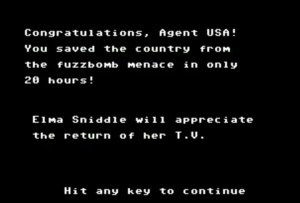
Of course, Agent USA isn’t a perfect game. The presentation is simple, the pace can be uneven, and the controls sometimes feel clunky from today’s perspective. Yet these weaknesses are offset by a remarkably clear design concept. Almost every element serves a purpose: the moves, the capitals, the crystals, the FuzzBodies, the keyboard inputs, and the wandering FuzzBomb. Together, they create a game with more depth than its modest visuals suggest.
For C64 fans, Agent USA is an example of how much personality a game can develop with simple means. It proves that good ideas last longer than elaborate technology. And it explains why so many players still remember this little agent today, who had to save an entire nation with a hat, crystals, and a train schedule. In the history of C64 games, Agent USA therefore remains a special case: not a loud blockbuster, but a quiet classic whose appeal stems from curiosity, planning, and an unusually clever combination of learning and playing.








Kommentar verfassen