

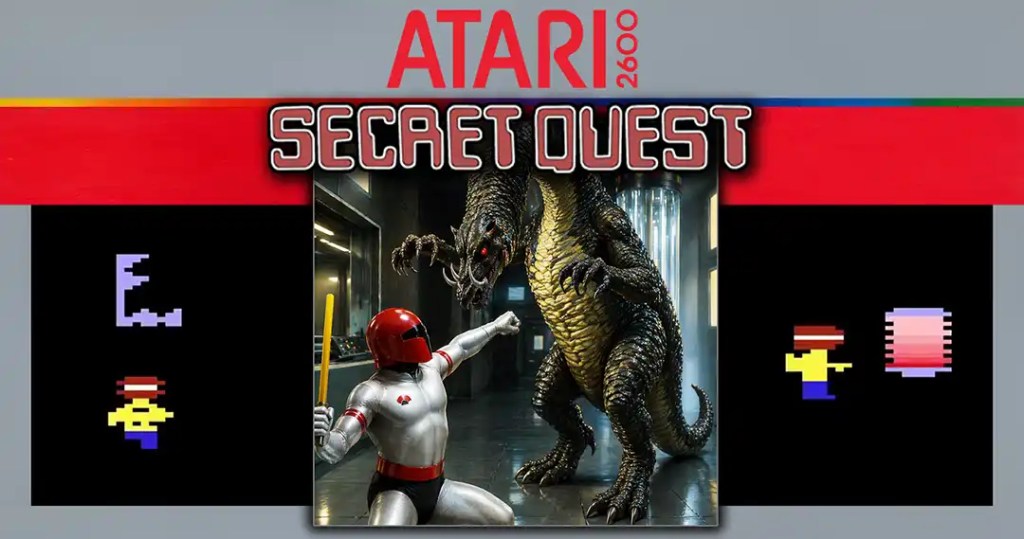
SAVE THE HUMAN RACE!
First there was one alien space station, then there were three. Now
there are eight. If left unchecked, laser gates, dragons, and other
evil creatures will wipe out the human race.
The Legend of Zelda for the 2600
When people talk about the last big surprises of the Atari 2600, one name keeps coming up: Secret Quest. Released in 1989, the game felt like an anachronism even at the time of its release—and for that very reason, like a small miracle. While Nintendo had long since set the tone with the NES and action-adventures like The Legend of Zelda were setting new standards, Atari was trying once again to prove that even a console from 1977 wasn’t completely obsolete.
This is precisely where the appeal of Secret Quest lies. The game isn’t a Zelda clone in the strict sense, but it’s arguably the clearest example of how the core concept of a major console adventure could be adapted for the Atari 2600: exploration, item management, navigating a labyrinthine layout, hidden paths, and a progression system that relies not only on reflexes but also on planning. In this sense, Secret Quest was for the 2600 roughly what Zelda was for the NES: an attempt to turn simple hardware into a “grand” adventure.
This characterization is, of course, a bit provocative. The Legend of Zelda was bigger, more accessible, more elegant, and culturally far more influential. But that is precisely why the comparison is interesting. It describes not parity, but ambition. Secret Quest sought to achieve something on a technically hopelessly inferior platform that wasn’t actually intended for it: an adventure that isn’t over after a few minutes, but demands orientation, patience, and planning.
The fact that the game was released so late only adds to its appeal. By 1989, the Atari 2600 was already a veteran. While the system was still present in many households, the market had moved on. The 2600 was no longer a machine of the future, but a relic from an earlier phase of video game history. This makes it all the more astonishing that, of all times, a title appeared in this late phase that not only functioned solidly but almost demonstratively declared: Even this old console can still surprise.
Secret Quest therefore occupies an interesting intersection. It is both a product of its time and a deliberate counterpoint to it. It adopts modern design ideas but must filter them through the radical limitations of the 2600. The result is neither merely nostalgic nor truly contemporary, but something else entirely: a late, idiosyncratic action-adventure that gains a certain character from its limitations.
Gameplay
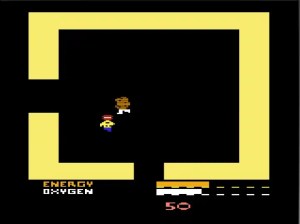
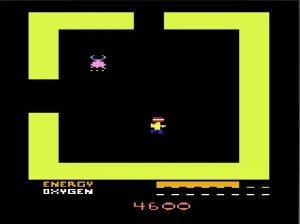
In Secret Quest, you control a futuristic hero through eight space stations occupied by aliens. The goal is always the same, but never quite simple: search rooms, fight enemies, find code fragments on each level, activate the self-destruct mechanism, and then reach the teleport chamber in time before the station explodes.
This basic structure alone sets the game apart from many other 2600 titles. Secret Quest is neither a pure score game nor a simple maze game. It requires the player to orient themselves, memorize paths, and think strategically. The stations consist of increasingly complex, multi-level room complexes. Doors, stairs, hidden passages, and so-called Sonic Keys ensure that you can’t simply run blindly forward. To succeed, you must draw maps or at least form a mental image of the rooms.
Added to this is a resource management system that feels surprisingly modern for the 2600. Alongside weapons like the Energy Sword, Sonic Blaster, and Particle Beam, energy and oxygen play a central role. Combat costs energy, exploration costs time, and time, in turn, costs oxygen. This creates constant pressure: you’re never just an explorer, but always a survivor as well.
This is precisely where the Zelda parallel lies. As in The Legend of Zelda, it’s not just about defeating enemies, but about deciphering a hostile world. The difference is that Secret Quest feels much more abstract and harsh. There is no fairy-tale fantasy world, no NPCs, no narrative warmth. Instead, the game offers cold space stations, scarce resources, and the feeling of being trapped in a technical death trap.
On top of that, the pace of the game keeps shifting. At times, Secret Quest plays almost like a pure action game: enemies close in on the player, projectile patterns must be read, and small mistakes immediately cost valuable energy. At other times, the whole experience becomes much more methodical. Then it’s about exploring unknown rooms, understanding access logic, or deciding which equipment makes the most sense for the next few minutes. This interplay of chaos and planning lends the game a surprising sense of tension.
It’s also interesting how strongly the architecture of the space stations shapes the game’s atmosphere. Although the rooms are graphically simple, their layout creates an almost claustrophobic atmosphere. You never get the feeling of an open adventure world, but rather that of a functional, hostile complex. Every bit of progress feels hard-earned. It’s not uncommon to lose your bearings, run into dead ends, find a previously overlooked passage, and only then realize how cleverly the station is interlinked.
The choice of weapons also contributes to the game’s character. The various pieces of equipment differ not only cosmetically but actually influence how aggressively or cautiously you play. Some tools are better suited for direct confrontations, while others are more useful when you want to conserve resources or overcome specific obstacles. For a NES game, this is remarkable because it forces the player to make real decisions. You don’t just press the fire button; you weigh your options.
Another strength lies in the tension built up in each individual stage. As soon as all necessary parts have been found and the self-destruct mechanism activated, the mood shifts. The cautious, exploratory search suddenly turns into a frantic escape. This final phase is simple in gameplay but psychologically very effective. The game transforms the previously established space into a countdown obstacle course. Those who haven’t navigated well are punished in these moments. Those who have played attentively experience the reward of good planning right here.
Of course, the gameplay also has its rough edges. Secret Quest isn’t particularly friendly to new players. It explains little, seems cryptic at first, and demands a willingness to understand the rules through trial and error. Some will see this as fascinating depth, others as unnecessary complexity. Neither is entirely wrong. The game thrives on the fact that it takes the player seriously, but in doing so, it also risks losing them.
Technology
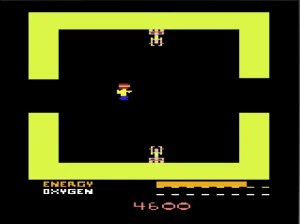
Technically, Secret Quest is one of the most impressive late 2600 games. The Atari 2600 was originally built for much smaller, more straightforward games. The system had only minimal internal resources, and developers had to generate virtually every frame line by line “on the fly.” An expansive action-adventure with multiple levels, saveable progress, and many rooms was actually anything but a given on this hardware.
Secret Quest therefore utilized a significantly expanded cartridge configuration. The game ran on 16 KB of ROM and additional Superchip RAM—far more memory than early 2600 titles. This extra space was what made it possible for the game to accommodate larger room structures, status displays, multiple weapons, various enemies, and a save system.
Particularly noteworthy is the way the game organizes its world. Instead of cinematic illusions or large sprites, it relies on the clever reuse of room blocks, color variations, and logical connections between levels. This creates the feeling of a larger world, even though the hardware is extremely limited. Precisely because Secret Quest doesn’t hide its limitations but arranges them intelligently, it feels today like a masterclass in 2600 design.
The re-entry system is also technically and gameplay-wise exciting. The game has no battery save, but it offers a re-entry code that allows you to save your progress and resume it later. For an adventure of this scale, that was enormously important. Equally clever is the use of the console itself: on the 2600, the status screen is accessed via the TV type switch—a fine example of how late 2600 games creatively reinterpreted existing hardware functions.
Looking back, it becomes clear just how unusual the technical objectives were. Many 2600 games rely on immediate readability: a single screen, clear icons, a straightforward purpose. Secret Quest takes the opposite approach. It aims to convey status values, distinguish weapons, structure complex paths, and yet run on a machine that was never intended for such multi-layered information presentation. The fact that the result remains playable nonetheless is a considerable achievement.
The audiovisual aspects also deserve more recognition than one might initially give them credit for. No one would claim that Secret Quest looks beautiful by modern standards. But beauty isn’t the appropriate category here anyway. What’s more important is that the presentation remains functional enough to convey orientation, threat, and differences between rooms. Colors, shapes, and patterns are used sparingly. The graphics do not rely on a wealth of detail, but on legibility under extreme constraints.
The same applies to the soundscape. The 2600 is not a system that produces lush soundscapes. Nevertheless, Secret Quest uses its acoustic cues effectively to signal danger, hits, actions, and shifts in tension. One could say: The game’s technology is not spectacular in the sense of a showpiece, but spectacular in the sense of a clever, disciplined feat of engineering. Everything has a purpose, and almost nothing is superfluous.
From today’s perspective, Secret Quest therefore comes across as a late manifesto of 2600 design. It shows that technical limitations do not merely block, but also shape. Precisely because memory, display, and input are so limited, a game emerges that must decide, in an unusually concentrated form, what is truly important. This condensation is part of its charm. You can feel in every minute that nothing here was taken for granted.
The Nolan Bushnell Connection
On the packaging and cartridge, Secret Quest was prominently marketed as a game “by Nolan Bushnell.” That was, of course, no coincidence. Bushnell was the founder of Atari and remains an iconic figure in early video game history. His name was meant to radiate authority, tradition, and prestige—especially at a time when the 2600 no longer had a real chance on the market against more modern systems.
The real story, however, is more interesting than the marketing. Bushnell was indeed involved in the project, but not in the way the box suggested. The bulk of the work on the finished game was done by Steve DeFrisco, who programmed Secret Quest and played a decisive role in shaping it. Bushnell provided ideas, collaborated on the concept, and served as a creative figure in the background. The actual implementation, the fine-tuning of the game on 2600 hardware, and the majority of the final design work, however, came from DeFrisco.
One can therefore say: The connection to Nolan Bushnell was real, but stylized. He wasn’t merely invented, but he wasn’t the sole creator either. Atari used his return and his historical aura to lend weight to the project. In a way, this fits perfectly with Secret Quest itself: a game that was both a genuine late-career work and a deliberately staged myth-making statement.
This point is particularly important in marketing. By the late 1980s, the Atari name was still well-known, but by no means untouchable. The reference to Bushnell created a symbolic link back to the company’s founding days. It was meant to signal: This isn’t just another late-period licensed product, but a return to the company’s creative roots. For collectors and longtime Atari players, this was a powerful statement.
At the same time, the story says a lot about the practices of the gaming industry at that time. Authorship in video games was often blurred. Packaging, marketing copy, and magazines created clear names and legends, while the actual development was usually collaborative. In the case of Secret Quest, this is particularly intriguing because the discrepancy does not result in a straightforward forgery, but rather in a kind of strategic simplification. Bushnell was there—but in a different way than the packaging suggested.
As a result, Steve DeFrisco has come more into the center of historical scrutiny today. The more one engages with Secret Quest, the clearer it becomes just how significant his contribution was to the project’s playable reality. While Bushnell served as the iconic name, DeFrisco was the one who turned ideas into a functioning system. Retro historians, in particular, are therefore increasingly interested in this second layer behind the official narrative.
This does not entirely diminish Bushnell’s role, but rather puts it into perspective. His involvement was a real part of the game’s genesis and, at the same time, a marketing tool. Considering both aspects simultaneously is likely the most honest view of the subject. Secret Quest is thus also typical of a transitional period in this regard: between founder myth, brand management, and the slowly growing recognition of concrete development work.
Reviews at the Time
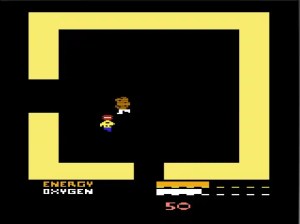
Contemporary reactions within the Atari scene were overwhelmingly positive. Magazines in the Atari community, in particular, highlighted how unusually ambitious the game was for the 2600. The fast-paced action, the complexity of the levels, the many tactical decisions, and the surprisingly polished audiovisual presentation were especially praised. The fact that such a late 2600 game showed little screen flicker while offering a genuine adventure structure made an impression.
It was particularly striking that Secret Quest didn’t come across as a nostalgic, belated product, but rather as a serious attempt to bring the console back to the forefront. The re-entry system, the multi-level structure, and the blend of action and navigation were perceived as genuine strengths.
But those very same qualities could also work against the game. Anyone who associated the 2600 with faster, more immediate games might find Secret Quest cumbersome. The game demands patience, a sense of direction, and frustration tolerance. It is abstract, at times unrelentingly difficult, and significantly less accessible without a manual. Moreover, it simply seemed to arrive too late: in 1989, an ambitious 2600 game was certainly fascinating, but it also felt like an echo from another era.
That’s why the reaction at the time was divided, though not necessarily in the reviews themselves. In the Atari fan community, Secret Quest was seen as proof of what was still possible. In the broader market, however, it remained more of a curiosity—not because it was bad, but because the historical moment had already passed.
It is precisely this division that makes the reviews from that time interesting in retrospect. They tell us not only about the game, but also about the expectations for the 2600 at the end of its life cycle. Those who saw Secret Quest primarily as a new 2600 cartridge might have been impressed, because the technical and gameplay effort was so clearly above average. Those who compared it to contemporary NES or Master System games, however, inevitably saw the shortcomings: crude graphics, limited variety, little comfort, and an overall rough interface.
Added to this was the fact that the game depended heavily on the context of its reception. In specialized Atari magazines or among fans of old hardware, it was viewed more as a triumph. There, what mattered wasn’t just whether it seemed modern, but whether it seemed possible on the 2600 at all. In general gaming contexts, however, Secret Quest seemed less like a challenge and more like a late technical feat. That is a big difference. One is admiration from up close, the other is respect from a distance.
Another point of criticism concerned accessibility. Many players were willing to live with technical limitations, but not necessarily with unclear systems. Secret Quest requires a learning curve. It is not a game that fully reveals its appeal within the first two minutes. Those who approached it without patience could easily get the feeling that the game was unnecessarily cryptic. Those who stuck with it, on the other hand, usually discovered a remarkably multi-layered adventure.
That is precisely why the game is often rated higher in retrospect than in a purely contemporary market comparison. Today, it no longer matters whether it could hold its own against Nintendo in 1989—of course it couldn’t. Today, what matters is how consistently it was conceived within its own limits. And in this light, many of the positive voices from back then appear decidedly prescient.
Cultural Influence
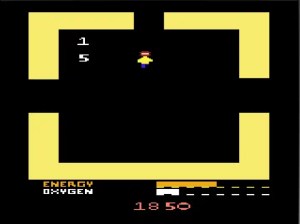
The direct cultural influence of Secret Quest was never as great as that of its obvious inspirations. It didn’t spark a new genre, launch a series, or become a mainstream classic. Its influence is more subtle and closely tied to its status as a late-era 2600 game.
Today, Secret Quest is primarily regarded as the swan song of a console that was fighting against its own obsolescence. In retrospectives, the game often serves as an example of just how far old hardware can be pushed with clever design. In this sense, its cultural value is greater than its reach at the time.
In addition, the game lived on in later Atari collections and retro releases. This not only preserved it but also made it visible to later generations in the first place. Many players today know Secret Quest more as a historical statement than as a contemporary department store find from 1989.
And that is precisely why it has a firm place in retro culture: not as a mass phenomenon, but as an argument. Anyone who wants to demonstrate that the Atari 2600 was still capable of astonishingly complex games toward the end of its life cycle almost inevitably ends up at Secret Quest.
Its influence therefore unfolds less through direct imitation than through its symbolic function. In discussions about “late masterpieces” of old systems, Secret Quest regularly comes up because it fits so well into this category. It is a game to which a larger narrative can be attached: that technical platforms often produce particularly creative works once again at the end of their life, precisely because developers now know every loophole.
Furthermore, the game touches on a romantic idea of gaming history. Many retro fans love not only the big hits, but especially the strange, late, almost hopeless projects that still manage to get released against all market logic. Secret Quest fits this image perfectly. It is not a dominant classic, but a defiant artifact. Its cultural significance therefore also lies in its narrativability. It serves as an excellent example of why retro history is more than just a list of the most popular titles.
Added to this is its role in the reevaluation of the Atari 2600 itself. For a long time, the console was often reduced in retrospect to primitive, short, and technically simple games. Titles like Secret Quest contradict this one-dimensional image. They show that while the 2600 never became a comfortable adventure system, it was nevertheless capable of producing more complex structures when developers were willing to put in the effort. In doing so, the game has also indirectly nuanced the image of the system.
Not least, Secret Quest lives on in the collector and preservation scene. There, it is not only the individual gaming experience that counts, but also the documentation of development histories, variants, packaging, credits, and marketing strategies. In this context, Secret Quest is particularly rich in material because it so closely intertwines gameplay, technology, marketing, and myth. It is a piece of software and, at the same time, a piece of Atari’s self-narrative.
Conclusion
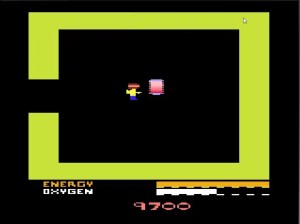
Secret Quest is one of those games that gains value less through its immediate success than through its significance in hindsight. It can be aptly described as “The Legend of Zelda for the 2600,” as long as one understands the phrase correctly: not as a competitor on equal footing, but as an astonishingly bold translation of the same basic idea onto radically weaker hardware.
That is precisely why the game is so fascinating. It shows that, at the end of its life, the 2600 was capable not only of delivering primitive action, but also complex structure, progression, suspense, and a spirit of discovery. At the same time, Secret Quest makes clear just how rigid the console’s limitations remained: abstract presentation, high difficulty, low accessibility, and a gameplay experience that inspires more respect than comfort.
The bottom line is that Secret Quest is not a forgotten masterpiece in the sense of a universally timeless classic. But it is an extraordinary piece of gaming history: ambitious, unwieldy, technically clever, and historically fascinating. If there is one game that encapsulates the late Atari 2600 in a single cartridge, it is this one.
Perhaps that is precisely its greatest quality. Secret Quest is not perfect, not elegant, and not comfortable. But it is a game with attitude. It attempts something that points beyond its platform, and rather than failing at it, it wrings a form all its own from it. It is precisely this mixture of ambition, friction, and technical discipline that makes the title so memorable to this day.
Anyone approaching the game today should therefore expect neither a lost marvel nor merely a curiosity. It makes more sense to understand Secret Quest as a borderline case—as a work that shows how vision and limitation shape one another. It belongs to those games that demand not only to be played but also to be read historically.
And that is precisely where its enduring appeal lies. Secret Quest is not just a late Atari 2600 game. It is a commentary on the longevity of old hardware, on the power of good design ideas, and on the way video game history often becomes most interesting at its margins.
More
Box and Cartridge
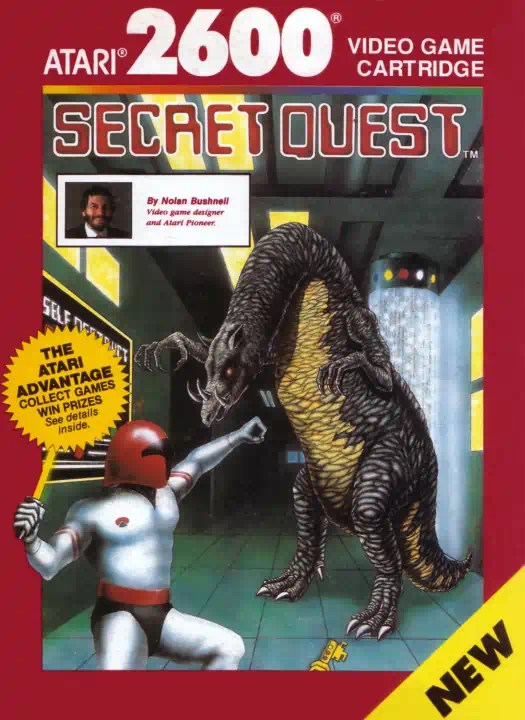
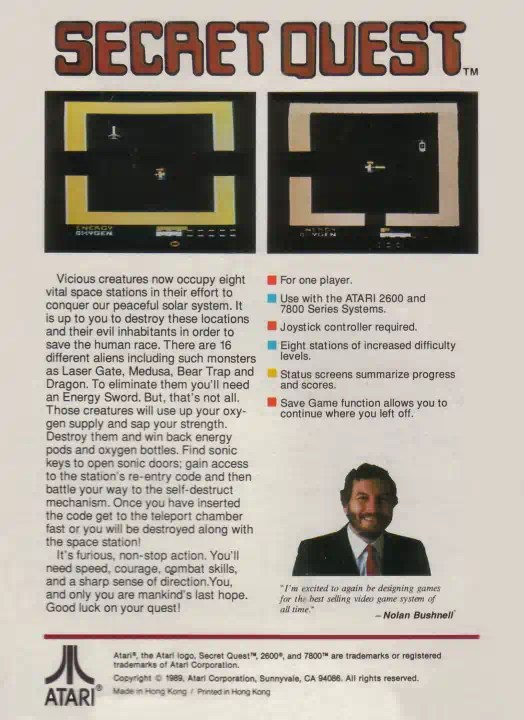
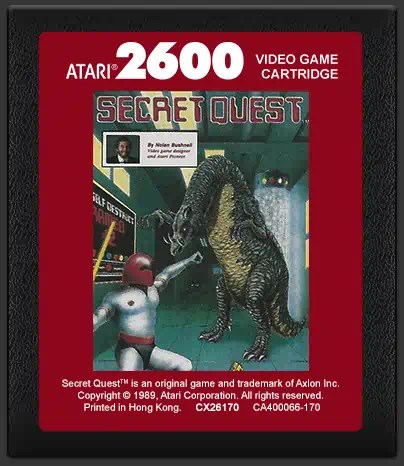








 McHenry's Lair
Kommentar verfassen :