

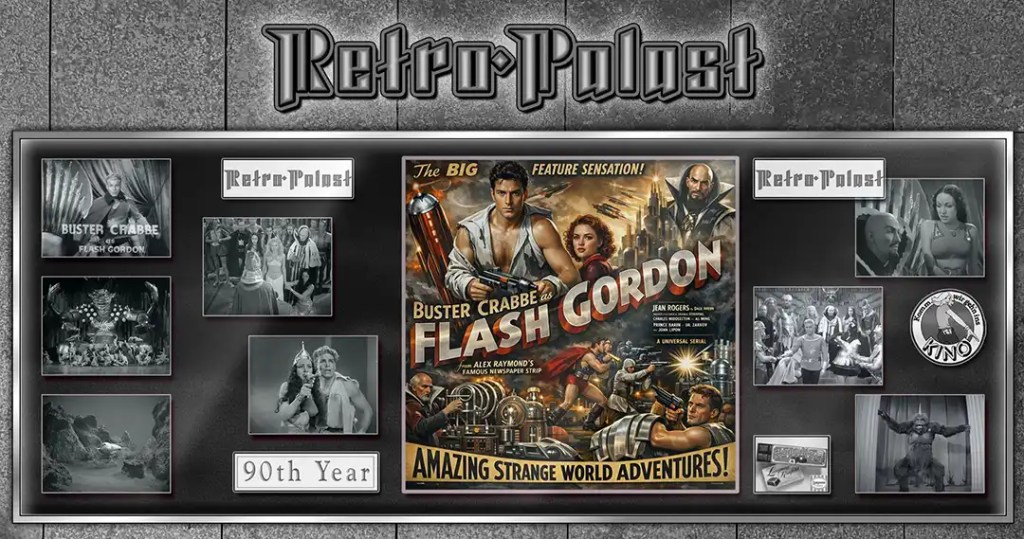
I will destroy your earth in my own way!
Space Opera on the Big Screen
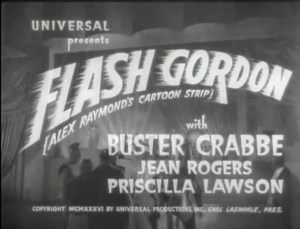
When Universal released Flash Gordon in 1936, it was far more than just another serial for Saturday matinee audiences. The 13-part serial was the first screen adaptation of Alex Raymond’s famous comic strip, which had only been created in 1934 and quickly became one of the most popular science fiction adventures of its time. This alone gave the production a unique starting point: it had to not only entertain a movie audience but also translate the imagination of an existing readership onto the screen.
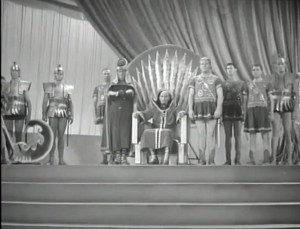
With its unusually high production value for a serial—featuring rockets, ray guns, palaces, laboratories, and exotic locations on the planet Mongo—Flash Gordon seemed bigger, more ambitious, and more imaginative than much of what the format had produced up to that point. Instead of merely delivering a simple action story, the film combined science fiction, fantasy, adventure, and melodramatic serial cinema into a blend that felt fresh at the time and remains instantly recognizable to this day. It was precisely this combination of pulp-style exaggeration and serious spectacle that made the serial so effective.
The success was so clear that the material not only received two sequels but later came to be regarded as a key building block of science fiction film history. From today’s perspective, the 1936 Flash Gordon is therefore not just a nostalgic curiosity but a key work for understanding early popular culture in cinema. Anyone who wants to see how visual science fiction worked before the age of modern effects will find a particularly striking example here.
Plot
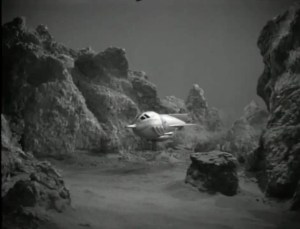
The story begins with a global threat: the mysterious planet Mongo is approaching Earth, causing natural disasters, unrest, and worldwide panic. This opening alone makes it clear that Flash Gordon doesn’t think small. The danger does not affect a single city or a small group, but all of humanity. Thus, the serial quickly establishes the grand dramatic scale that would later become typical of space opera. The apocalypse serves here not merely as a backdrop, but as the immediate driving force of the plot. From the very first moments, this creates the impression that the characters are in a state of emergency, where every decision must be made under time pressure.
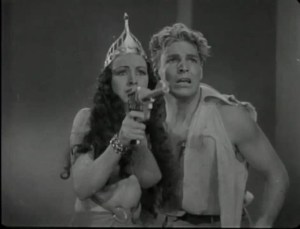
The eccentric scientist Dr. Zarkov is convinced that Earth can only be saved by going directly to the source of the danger. That is why he launches into space in an experimental rocket ship; also on board are the athletic hero Flash Gordon and Dale Arden. This constellation is typical of the adventure cinema of the time: the energetic hero, the threatened but plot-relevant companion, and the brilliant, slightly eccentric scientist. Together they form a team that initially finds itself in a completely alien world on Mongo. It is precisely this trio that allows the story to operate on multiple levels simultaneously: physical action through Flash, emotional tension through Dale, and scientific explanation through Zarkov. Thus, the alien world is not only marveled at, but also fought against, explained, and dramatically escalated.
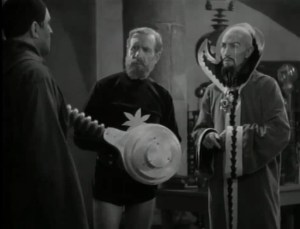
There they discover that the tyrannical ruler Ming the Merciless is partly responsible for the threat to Earth. From this moment on, the rescue mission turns into a political and military conflict. On Mongo, Flash must not only contend with monsters, traps, and soldiers, but also navigate the planet’s various centers of power. He becomes entangled in court intrigues, is captured, escapes again, forges alliances, and increasingly becomes a symbolic figure of resistance against Ming. As a result, the plot takes on a surprisingly broad structure: it is no longer just about escape and survival, but about power, loyalty, and rebellion. Mongo is not merely a backdrop, but an empire with competing interests, where Flash must first learn to distinguish between friends and foes.
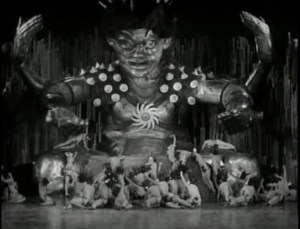
At the same time, the serial thrives on its constant shifts in location. No sooner has one grown accustomed to a setting than the plot leads to a new palace, a laboratory, a dungeon, or another power zone within Ming’s domain. This relentless progression keeps the narrative pace high and makes Mongo seem larger than the actual studio sets might suggest. As a result, the world feels vast, dangerous, and full of surprises. It is precisely this constant movement that is crucial to the feeling of witnessing a real adventure.
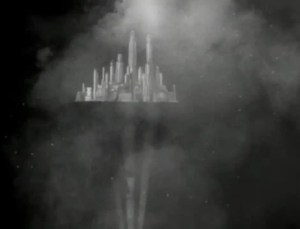
It is this structure in particular that accounts for much of the appeal. Flash Gordon doesn’t simply follow a straight line from A to B, but moves from danger to danger with deliberate exuberance. Almost every chapter ends with a life-threatening climax, a classic cliffhanger designed to draw the audience into the next week. This structure was central to serials, but Flash Gordon uses it particularly effectively because each episode conveys the feeling that behind the next door, behind the next throne room, or beneath the next dome, the next wonder or the next threat is already waiting. The cliffhangers are not merely devices to build suspense but part of the overall narrative rhythm. They give the plot a pulsating rhythm: escalation, rescue, new threat, renewed escalation. This creates an almost breathless pull that keeps the audience hooked from chapter to chapter.
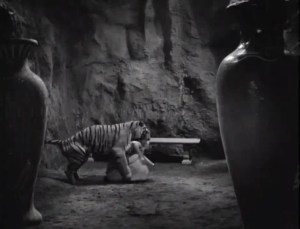
At the same time, the story thrives on its romantic and melodramatic elements. Tensions, jealousy, and emotional entanglements arise between Flash, Dale, and Princess Aura, complementing the battle against Ming. This makes the plot not only spectacular but also more personal. The series thus combines saving the world with romantic adventure, power struggles with palace drama, and science fiction with fairy-tale elements. Furthermore, these emotions can never be completely separated from the larger conflict: personal relationships influence political decisions, and power struggles immediately spill over into intimate conflicts. It is precisely this blend that makes the plot so distinctive to this day. It is not simply a succession of action scenes, but a colorful tapestry of threat, wonder, romance, and power struggle that gives the serial its unmistakable tone.
Actors
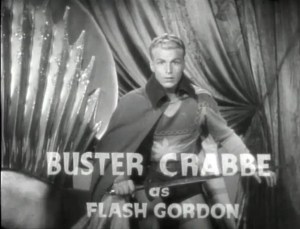
At the center is Buster Crabbe as Flash Gordon. The former Olympic champion brought exactly the physical presence that a character like Flash required. He doesn’t come across as a complex psychological hero, but rather as a projection of courage, determination, and physical superiority. This fits the character perfectly: Flash is less a man of doubt than a classic adventure hero who takes the initiative in every situation. Crabbe embodies this with a direct, energetic charisma that gives the serial much of its forward momentum.
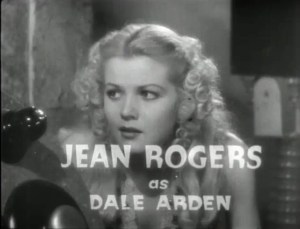
Jean Rogers plays Dale Arden as the central supporting character and emotional anchor. From today’s perspective, the role is in some ways strongly tied to the conventions of the 1930s, as Dale often finds herself in danger or serves as the romantic focal point. Nevertheless, she is indispensable to the serial’s dynamic. She is not merely an accessory, but an essential part of the constellation that emotionally charges Flash’s adventures. Her presence amplifies both the threat posed by Ming and the rivalry with Aura.
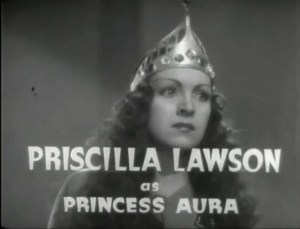
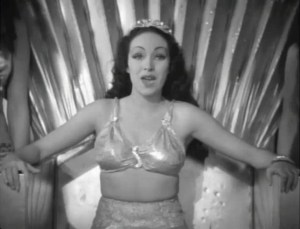
Particularly interesting is Priscilla Lawson as Princess Aura. She lends the serial a distinctly more dazzling touch. Aura is not simply good or evil, but oscillates between loyalty, desire, jealousy, and rebellion. This ambivalence makes her one of the most memorable characters in the entire series. While Flash is portrayed in a very straightforward manner, Aura brings a sense of uncertainty and unpredictability into play. As a result, she comes across as almost more modern than other characters in the serial in some scenes.
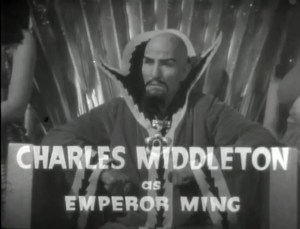
Charles Middleton often leaves the strongest impression as Ming the Merciless. His performance is deliberately grand, theatrical, and imperious. Middleton does not play Ming naturalistically, but as a larger-than-life tyrant who dominates every room the moment he appears. This is particularly advantageous in a story like Flash Gordon. A subtle villain would almost get lost in this world; Middleton, on the other hand, intuitively understands that Ming must appear as a symbolic figure of despotism. His stern demeanor, his voice, and his controlled gestures make him one of the iconic villains of early genre cinema.
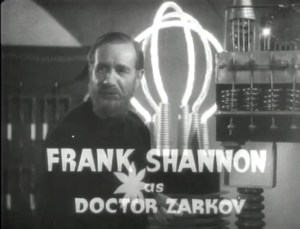
Joining him are Frank Shannon as Dr. Zarkov, Richard Alexander as Prince Barin, and John “Tiny” Lipson as King Vultan. They all contribute to making Mongo appear as a multifaceted world. Zarkov provides the scientific dimension, Barin the heroic resistance within Mongo, and Vultan the spectacle and the exotic expansion of the setting. Together, this cast forms an ensemble that lends the comic-book-style material a surprising amount of energy, rhythm, and recognizability.
Trivia
Flash Gordon is also exceptionally interesting behind the scenes. The budget was approximately $360,000—a remarkably high sum for a serial of that era. This allowed Universal to put together a production that appeared significantly more opulent than many competing works. The sheer volume of sets, costumes, and special effects alone makes it clear that the studio did not intend to produce a mere side project here, but rather a prestige project within the genre.
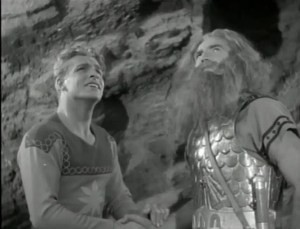
At the same time, the serial illustrates very well how the studio system operated economically. Universal saved money wherever possible: sets and props from other films such as Bride of Frankenstein and The Mummy were reused, as was music from older studio productions. What might seem like a sign of limited resources today was a common and often creative practice back then. In the case of Flash Gordon in particular, this reuse proved to be a stroke of luck, because it gave the production that peculiar blend of futuristic technology and fairy-tale-like unreality that suits Mongo so well.
Buster Crabbe’s dark hair was also dyed blond to bring him visually closer to Raymond’s comic book character. Such details show how important the recognizability of a well-known source material was even back then. The audience was supposed to actually see the hero they knew from the newspaper strips on the screen. In general, Flash Gordon is an early example of just how effectively transmedia recognition worked in the entertainment industry even back then.
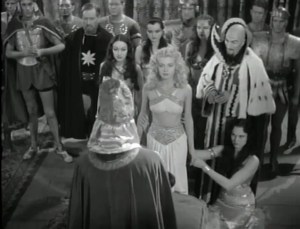
It is also noteworthy that the serial was not only shown at children’s matinees but also received evening screenings in first-run theaters. This was a significant boost in prestige for the format, which was often regarded as rather cheap entertainment. Flash Gordon, in a sense, broke out of its niche and proved that a serial could also be marketed as a major event. This helps explain why the title became so quickly embedded in popular culture.
Another appealing aspect is the visual style itself. From today’s perspective, many effects appear visibly artificial, with models and sets clearly recognizable as studio constructions. But that is precisely part of its charm. The world of Mongo does not rely on perfect illusion, but on imaginative exaggeration. The serial invites the audience to immerse themselves in its artificial, stylized world—and it is precisely this that creates a magic all its own.
Effects
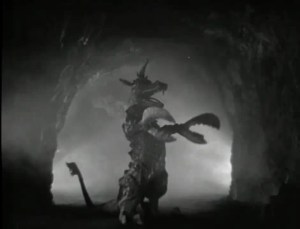
The effects of Flash Gordon are among the most striking reasons why the serial has remained in people’s memories to this day. Of course, many tricks appear visibly artificial from today’s perspective: miniature models, simple cross-fades, set tricks, and stylized contraptions clearly betray the era in which they were created. Yet this very artificiality is not merely a flaw, but an essential part of the effect. The effects do not attempt to simulate perfect reality, but rather to make a fantastical world appear believable enough for the audience to be drawn into it.
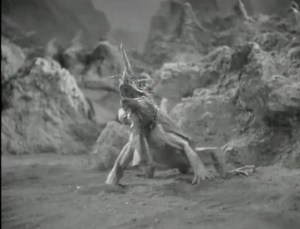
Particularly important here is the connection between special effects and set design. Rockets, ray guns, futuristic devices, and alien-looking structures do not stand side by side in isolation, but together form the image of a self-contained science fiction world. Many of these ideas thrive less on technical perfection than on their visual inventiveness. The serial thus generates a sense of wonder that arises from the richness of its imagery: from laboratories, palaces, flying machines, and mysterious technical constructions that make Mongo appear both modern and fairy-tale-like.
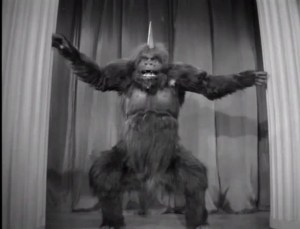
For a 1930s serial, these effects were particularly impressive because they conveyed the impression of a larger, more expensive spectacle. The special effects thus not only enhance individual action scenes but also play a decisive role in making Flash Gordon appear grander than the production format would otherwise suggest. Especially in conjunction with the cliffhangers, they heighten the suspense, as explosions, crashes, threats, and wondrous contraptions reinforce the feeling that the next sensation awaits behind every scene.
Today, these effects can be viewed in two ways: historically as an early achievement in film technology and aesthetically as part of the serial’s unique charm. Those expecting modern perfection will immediately see the limitations. But anyone who engages with the visual language of the time will quickly recognize how imaginatively and effectively Flash Gordon employs its resources. Precisely for this reason, the effects continue to play a significant role in ensuring that the serial is remembered not only as a narrative but also as a visual experience.
Contemporary Reviews
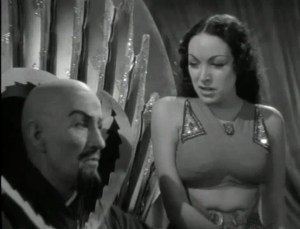
At the time, Flash Gordon was apparently received very positively—at least by the standards that applied to serials back then. The film was a major box-office success and received favorable reviews. That alone is remarkable, as serials were often viewed more as reliable programming than as productions that drew particular critical attention. The fact that Flash Gordon stood out here shows just how much its visual spectacle and production scale stood out.
An important reason for the positive reception was likely the fast pace. The serial wastes hardly any time, instead stringing together danger, revelation, and rescue. For audiences at the time, this meant an immediate, thrilling cinematic experience. Added to this was the exotic setting: palaces, laboratories, prisons, flying machines, and alien peoples created a visual diversity that must have been particularly appealing in the serial format.
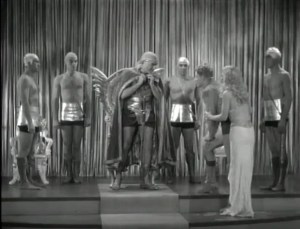
Furthermore, Flash Gordon clearly functioned as a spectacle without losing sight of its simple core concept. The story is clear enough to be immediately understandable, yet rich enough in ideas to remain interesting across many episodes. It is precisely this balance that explains why the serial was not merely perceived as cheap weekly fare, but as an elaborate adventure that stood out from the crowd thanks to its production value, pace, and visual spectacle.
One should therefore not assume that its current cult status emerged much later. As early as 1936, Flash Gordon was a sensation. The subsequent adoration stems not only from nostalgic hindsight but from a quality that audiences at the time already recognized: the ability to create an astonishingly vast world with limited resources.
Cultural Influence
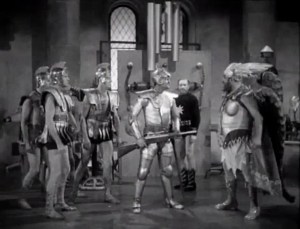
The cultural influence of Flash Gordon extends far beyond the time of its creation. The serial is considered an important inspiration for Star Wars and also for the later Flash Gordon remake of 1980. In particular, the episodic adventure structure, the blend of futuristic technology and fairy-tale spectacle, and the clear juxtaposition of heroic resistance and an overpowering tyrant have left a distinct mark. Anyone examining later space operas will recognize many basic patterns in Flash Gordon.
Above all, the sense of constant motion was defining. The adventure leaps from place to place, from threat to threat, from rescue to new danger. This dynamic is found in many later works of the genre. Equally important is the visual language: throne rooms, flying machines, alien kingdoms, exotic costumes, and technological wonders form a fantasy world that aims to be less scientifically plausible than emotionally and visually overwhelming. It is precisely this that made Flash Gordon a precursor to the kind of science fiction that aims not only to depict the future but also to inspire wonder.
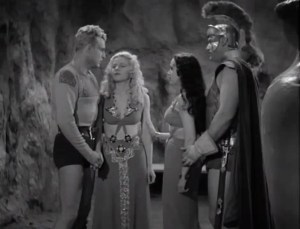
The serial is significant on a broader level as well. It helped establish science fiction in popular cinema as a spectacle suitable for serialized storytelling. The combination of comic book aesthetics, adventure dramaturgy, and the logic of cinematic serialization proved to be extremely effective. Thus, Flash Gordon stands at a point where various media forms intersect: newspaper comics, cinematic serials, a hero figure suitable for merchandising, and later, a myth of film history.
The fact that the serial was inducted into the National Film Registry in 1996 further demonstrates that it is now regarded not merely as a fan object, but as something worthy of preservation for cultural and film-historical reasons. This recognition makes it clear that Flash Gordon is viewed not only for its entertainment value, but also as a testament to how popular fantasy was visually organized in the 20th century. The work is thus not only a classic of adventure cinema but also a document of media history.
Conclusion
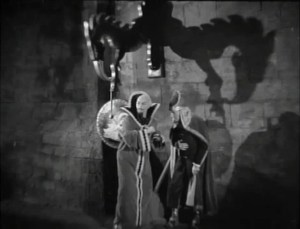
Today, Flash Gordon seems naive in many ways, visibly artificial, and delightfully over-the-top—but that is precisely where its strength lies. The serial brings together almost everything that defines early science fiction in cinema: technological wonders, exotic worlds, melodramatic conflicts, and a thirst for constant adventure. It is loud, direct, imaginative, and completely unabashed in its storytelling. Precisely for this reason, it retains an energy to this day that many smoother productions fail to achieve.
At the same time, the work is clearly a product of its time. Some portrayals, especially those surrounding the character of Ming, are problematic today and must be viewed critically. So anyone watching Flash Gordon today is not just watching an exciting serial, but also a historical artifact that reflects the ideas, fears, and stereotypes of the era in which it was created. This is an essential part of any honest assessment of the work.
Nevertheless, the 1936 Flash Gordon remains a milestone: not merely nostalgia, but a work that played a decisive role in shaping the visual language and narrative style of later space operas. It demonstrates how powerful cinema can be when it boldly transports the audience to alien worlds. As early science fiction, as a serial, and as a pop culture phenomenon, Flash Gordon remains fascinating to this day—and is far more than just a curious relic from a bygone film era.





 McHenry's Lair
Kommentar verfassen :