

A cinematic experience without a movie
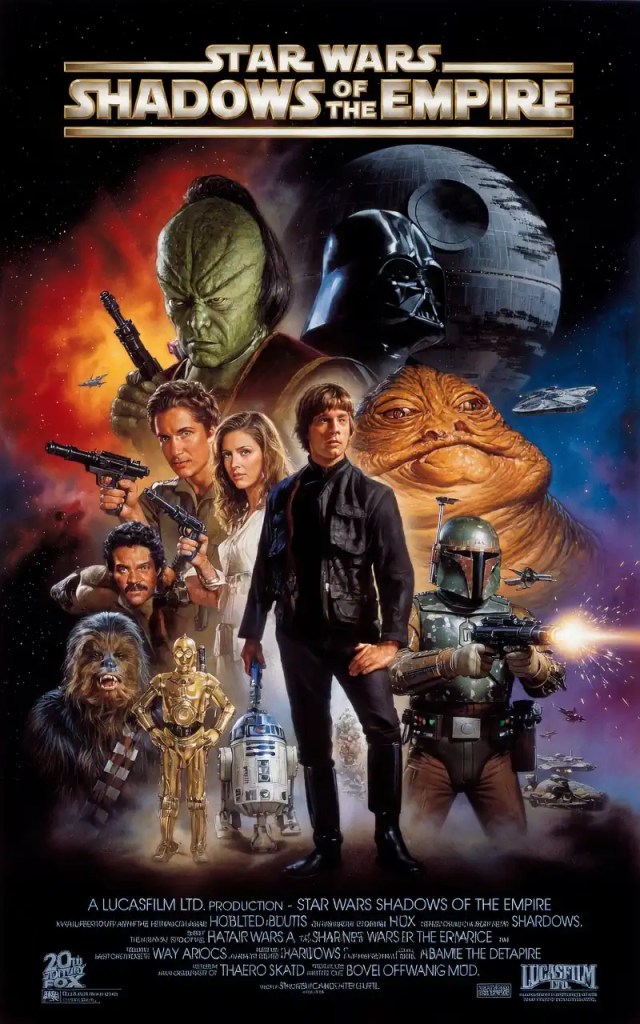
In 1996, Star Wars found itself in a strange in-between period. The original trilogy had long since concluded, the prequels were not yet on the horizon, and George Lucas’s universe lived on primarily in novels, comics, video games, and in the minds of his fans. It was precisely into this gap that Star Wars: Shadows of the Empire burst—a project that felt like a massive blockbuster, even though there was never an actual movie.
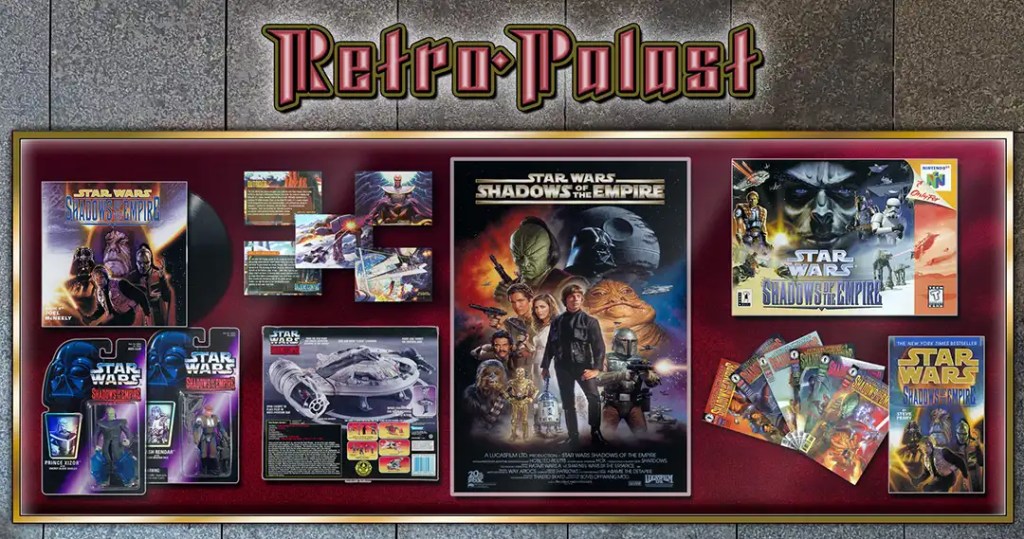
The concept was as simple as it was brilliant: Lucasfilm wanted to test how much of the impact of a new Star Wars movie could be generated without actually shooting a film. So a story was created set between The Empire Strikes Back and Return of the Jedi—essentially “Episode 5.5”—and this story was told and marketed simultaneously across multiple products. A novel, comic, video game, soundtrack, and a broad merchandising line were all designed to collectively create the feeling that you were experiencing the launch of a new cinematic event.
That is precisely why Shadows of the Empire remains a special case in the history of Star Wars to this day: not a film, but staged like one; not an official episode film, but almost as present in its time. It was a transmedia experiment long before the term was used everywhere. Looking back, one could even say that the project didn’t merely fill a void in the franchise, but productively occupied it. Where other brands fade during such transitional phases, Star Wars turned the absence of a film into an event in itself.
This is also interesting from a cultural-historical perspective. By the mid-1990s, franchise thinking had long been around, but it wasn’t yet as ubiquitous and systematized as it is today. There was no flood of streaming series yet, no perfectly timed “cinematic universes,” and no perpetual content machine that instantly spins off every character into five spin-offs. Shadows of the Empire therefore felt like a bold trial run: What happens if you remove the movie from the equation but still fire up the entire marketing and myth-making machine?
The answer was surprisingly clear. Many fans actually treated the project like a new chapter in the saga. They read the novel, played the game, listened to the soundtrack, saw the figures on the shelves, and thereby felt like they were participating in a genuine media event. You could say: Shadows of the Empire wasn’t just a story, but a staged experience. That’s precisely what makes it so fascinating today.
Star Wars – Episode 5.5
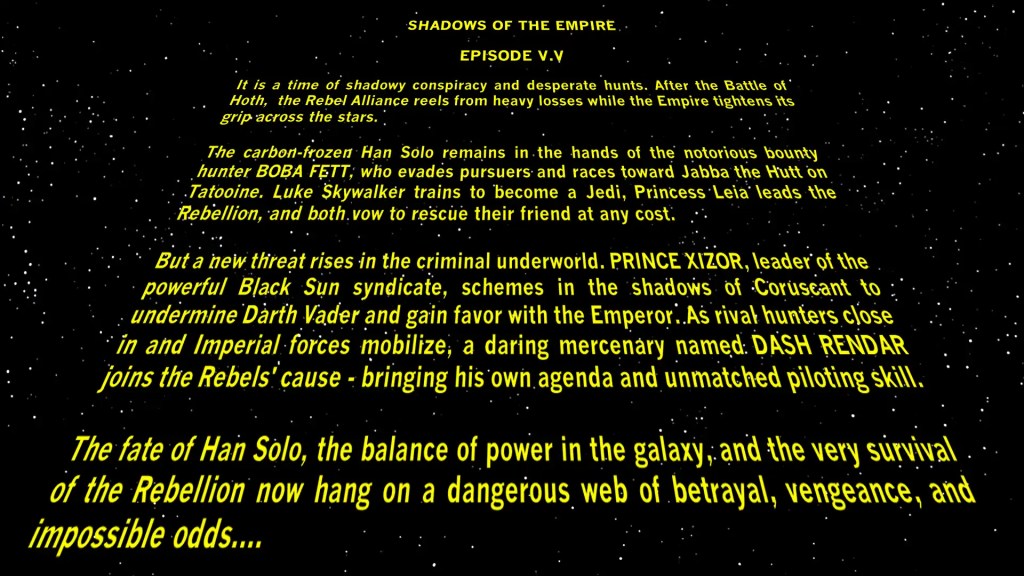
In terms of content, Shadows of the Empire takes place between the end of Episode V and the beginning of Episode VI. Han Solo is frozen in carbonite and on his way to Jabba the Hutt. Luke Skywalker, Leia Organa, Chewbacca, Lando Calrissian, and the Rebels are trying to plan their next steps against the Empire—while also trying to find Han.
The premise is so effective because it picks up directly where one of the saga’s most powerful cliffhangers left off. The ending of The Empire Strikes Back left characters, audiences, and the galaxy alike in a state of uncertainty. Han is lost, Luke is scarred, Vader has turned family history into a catastrophe, and the Rebellion appears battered. Shadows of the Empire exploits precisely this vacuum and uses it as its narrative fuel.
Dash Rendar takes center stage, a daring smuggler and mercenary who was deliberately designed as a sort of mirror image of Han Solo: charming, self-assured, quick-witted, and always a little too cool for his surroundings. Dash gets caught up in the events because, alongside the Empire and the Rebellion, a third power is positioning itself: the Black Sun crime syndicate.
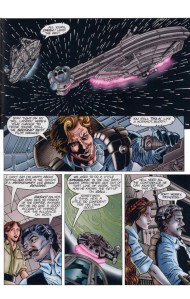
Dash serves a dual purpose. On the one hand, he is a practical adventure figure through whom shootouts, car chases, and smuggler contacts can be told. On the other hand, he is a symptom of the project itself. Because Han, the audience favorite, is frozen in carbonite, the story needs a character who brings that same rough, cheeky, semi-criminal spirit of adventure back into the plot. Dash is thus not merely a character, but a dramatic tool—and that is precisely why he was loved by some fans and viewed with skepticism by others.
Its leader, Prince Xizor, is the project’s true new antagonist. Xizor wants to oust Darth Vader from the Emperor’s side and expand his own power base. To this end, he weaves intrigues against Luke Skywalker, against Vader, and ultimately against anyone who stands between him and his rise to power. As a result, Shadows of the Empire shifts the focus from the pure war front to the underworld, to palace intrigues, and to the criminal parallel structure of the galaxy.
Xizor in particular makes the material interesting because he is not a typical Star Wars villain. He does not rule primarily through battlefields or superweapons, but through influence, seduction, information, and the logic of organized crime. In doing so, he brings a different flavor to the saga. While Vader and the Emperor represent fascist power and mythological darkness, Xizor embodies luxury, decadence, and the political opportunism of the underworld. He is an adversary who exploits the system’s weaknesses rather than attacking it head-on.
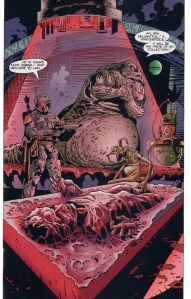
The story therefore functions like a missing interlude: Luke is not yet the fully realized Jedi from Return of the Jedi, but no longer the inexperienced hero of Hoth either; Leia, Lando, and Chewie are operating in the transitional phase between defeat and counteroffensive; and in the background, the threads are already converging that will later lead to Jabba’s Palace and beyond to Endor. Shadows of the Empire thus does not simply tell a side story, but attempts to fill the emotional and political gap between two films.
Furthermore, the material deliberately reimagines familiar motifs from the classic trilogy without simply copying them. There is escape, infiltration, criminal networks, questions of loyalty, and the constant tension between a personal rescue mission and the larger events of war. This is precisely where its strength as “Episode 5.5” lies: not everything has to be world-changing, as long as it fits organically into the gap between two already iconic films. Shadows of the Empire does not seek to redefine the entire saga; it aims to flesh out the gaps—and it succeeds remarkably well.
Merchandising
Book
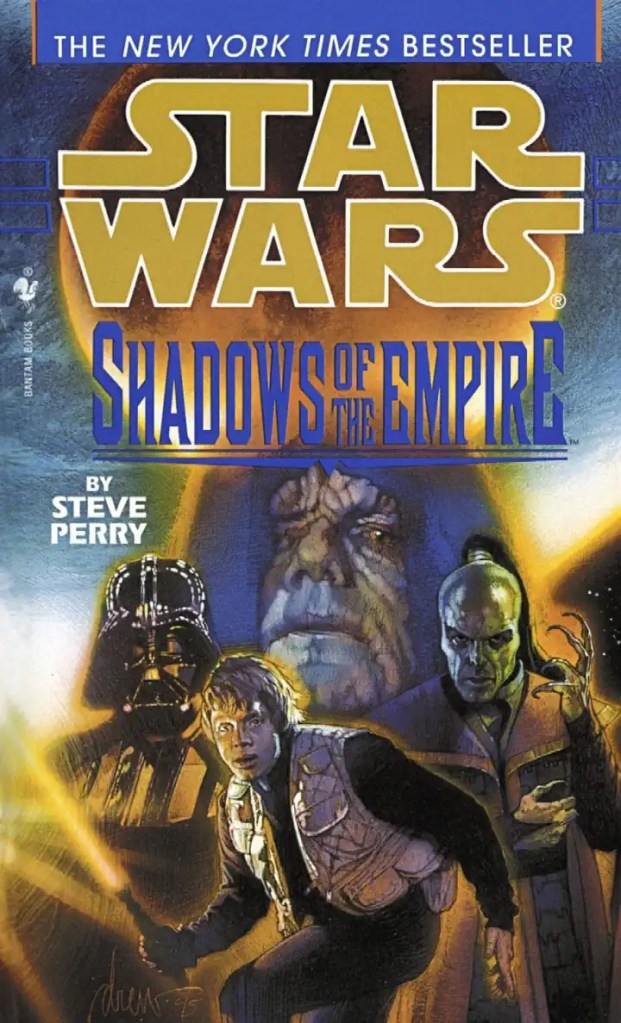
The centerpiece of the project was the novel Shadows of the Empire by Steve Perry. He provided the main version of the story and treated the material as if it were the literary companion to a film that simply didn’t exist. The novel brought together familiar characters from the classic trilogy with new characters such as Dash Rendar, Prince Xizor, Guri, and Leebo.
What was particularly striking was that the novel did not feel like mere window dressing. It was not meant merely to supplement, but to form the narrative backbone of the entire project. For many fans, the book was therefore the actual “film” in their minds—the central version from which the other media drew.
The book had a very specific task: it had to textually anchor the illusion of a major event. Readers of the novel were not meant to feel they were consuming a spin-off, but rather the main storyline of a new Star Wars story. That is precisely why its significance is so great. Even readers who later remembered the game or the comic more vividly usually first encountered the world, the conflicts, and the characters through the novel.
Furthermore, the novel format suited the project well because it could develop political background, motivations, and power struggles in greater detail than an action game or a short comic series. Xizor in particular benefits from this. His intrigues, his rivalry with Vader, and his position within the galaxy’s power structure unfold with greater depth in the novel. The book thus conveys not only plot but also atmosphere: the sense of a galaxy in which the Empire is not the sole source of power.
Comic
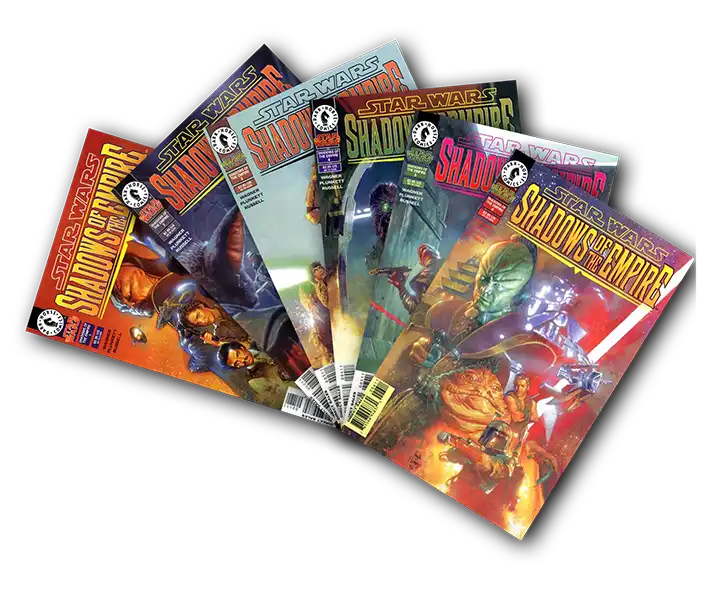
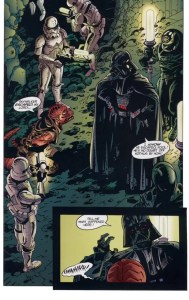
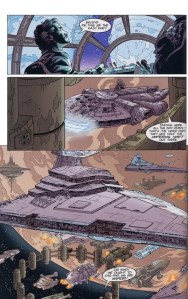
A six-part comic miniseries was released in parallel. It condensed the plot, relied more heavily on visual dynamics, and gave the project its own graphic identity. The comic was not merely a promotional insert but an important part of the overall presentation: readers experienced Shadows of the Empire in a visual form that came closest to an unproduced film.
This is precisely where the strength of the concept became apparent. While the novel explored inner motivations and political intrigues, the comic shone with space battles, the Coruscant underworld, exotic designs, and iconic cover art. This made the material tangible in a different way and reinforced the feeling that a major event was actually taking place here.
The comic also helped to canonize characters and locations—or at least cement them in the minds of fans at the time. A novel leaves more room for one’s own imagination, whereas a comic gives faces, armor, palaces, ships, and cityscapes a concrete appearance. This was especially important for a project that sought to simulate the aura of a film. You had to be able to see what Dash Rendar, Xizor’s court, or the underworld of Coruscant looked like for the event to feel complete.
At the same time, the comic was an example of how cleverly Lucasfilm distributed the individual media according to their different strengths. The project didn’t simply retell the same content identically everywhere, but rather emphasized certain aspects. In the comic, the visual, rhythmic, and spectacular elements took center stage. As a result, Shadows of the Empire felt not only bigger but also more versatile.
Games
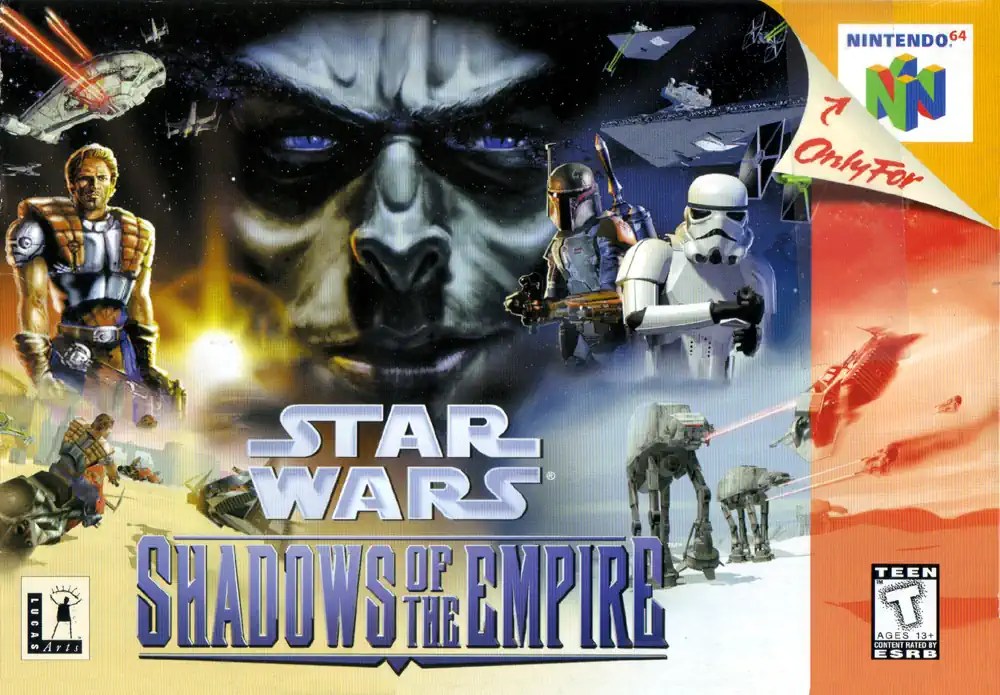
For many, Shadows of the Empire is remembered primarily because of the video game. On the Nintendo 64, the title became one of the most distinctive early Star Wars games of the 3D era; a PC version was later released as well. The game followed Dash Rendar through various mission types—from the legendary Battle of Hoth to shooting sequences, boss battles, and action sequences on Coruscant.
The Hoth opening, in particular, burned itself into the memories of many players. Even this first mission gave the impression of being right in the middle of a new Star Wars spectacle. The game wasn’t technically or gameplay-wise polished in every area, but it delivered exactly what the overall project needed: pace, visuals, recognizability, and the feeling of an interactive movie.
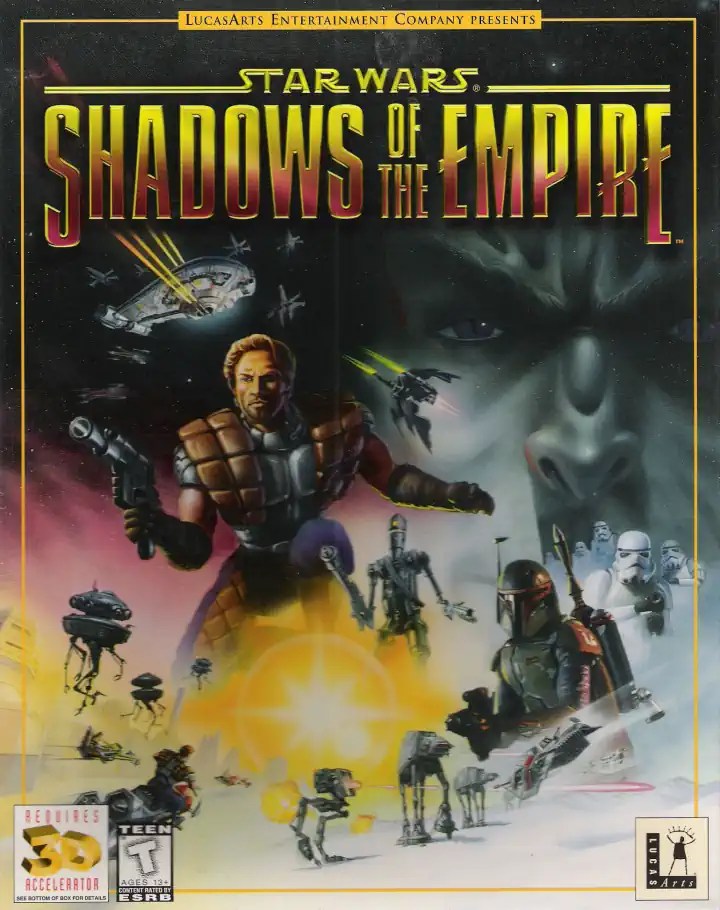
The significance of this game cannot be underestimated. For an entire generation, it wasn’t merely an addition to the project, but the gateway to Shadows of the Empire. This was also because video games in the 1990s increasingly became an experience machine for major brands. Those who could control Dash Rendar themselves, rather than just reading about him, formed an immediate connection to the character and the world.
Added to this was the technological allure of the time. Early 3D action games often had a raw, angular energy that feels nostalgic today. It was precisely this technical transitional phase that fit Shadows of the Empire as an overall phenomenon strangely well. It was a product of the in-between: between two film trilogies, between 2D and 3D gaming, between classic merchandising and modern franchise networking. The game perhaps embodied this in-between state most clearly.
Soundtrack
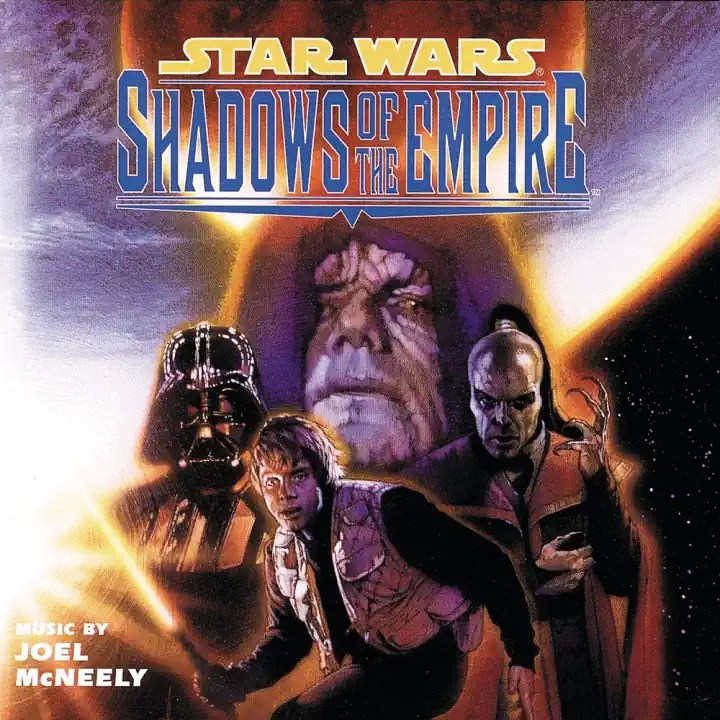
One of the most unusual ideas was the original soundtrack by Joel McNeely. Normally, a film score accompanies an existing movie; here, a symphonic Star Wars score was composed for a movie that didn’t even exist. Precisely because of this, the soundtrack became perhaps the purest expression of the concept of “a movie without a movie.”
The music was audibly inspired by John Williams, yet simultaneously sought to develop its own themes and moods for Xizor, Dash, and the dark corners of the galaxy. Combined with the liner notes describing scenes and the plot, one could almost experience the story as an imaginary cinematic journey through sound. Rarely has a franchise so aggressively attempted to simulate the emotional power of a blockbuster through music alone.
This soundtrack in particular shows just how seriously Lucasfilm took the experiment. They didn’t settle for simply rearranging existing Williams themes or releasing mere background music. Instead, they created a work that carried itself with the dignity of a genuine film score. This is remarkable because music in Star Wars is never merely decorative. It plays a vital role in conveying pathos, grandeur, tragedy, and a spirit of adventure. Composing an original orchestral soundtrack therefore meant: the goal was not merely to sell products, but to truly create the emotional architecture of a non-existent film.
To this day, this is perhaps the most poetic element of the project. For while novels, comics, and games each serve specific media forms, music appeals more directly to the imagination. Anyone who listens to the soundtrack automatically constructs the missing images in their mind. This is precisely why one comes particularly close to the core of Shadows of the Empire here.
Toys & Co.
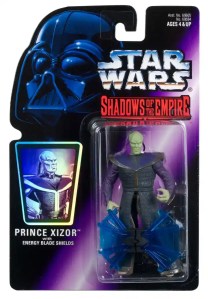
Just like a real movie release, Shadows of the Empire was accompanied by a wide range of merchandise. There were action figures, vehicles, playsets, trading cards, posters, models, mini-comics, and other accompanying merchandise. The merchandising wasn’t merely an afterthought but part of the concept: it was only through its visible omnipresence in stores that the project attained the scale of a major event.
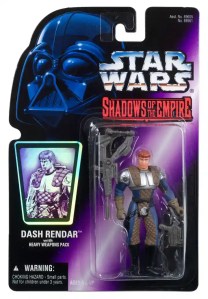
What’s interesting here is that Lucasfilm applied the logic of a summer blockbuster to a project without a big screen. Children could buy figures of Dash Rendar, Prince Xizor, or new vehicles, even though these had never been seen in a movie trailer. This shows just how strong the Star Wars brand already was back then: the aura of a “new movie” could be generated surprisingly far and wide even without a film.
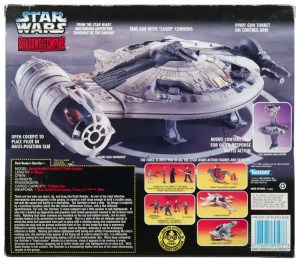
This is precisely where the economic intelligence of the project becomes apparent. Shadows of the Empire was not only an artistic or narrative experiment, but also a marketing one. Lucasfilm tested how far the ritual elements of a movie release—anticipation, visibility, the collector’s instinct, media simultaneity—could be transferred to a different product type. The fact that this worked at all says a lot about the status of Star Wars in the 1990s.
Merchandising was more than just a revenue generator. For many fans, it was the most everyday form of participation. A figure, a poster, or a vehicle made the project tangible and extended its presence into the children’s room, onto the shelf, and into the imagination. Thus, Shadows of the Empire became a kind of private cinema on a small scale: one built one’s own scenes, reenacted them, or continued them in one’s mind.
Trivial
Shadows of the Empire is often referred to as “Episode 5.5” because the plot is set exactly between The Empire Strikes Back and Return of the Jedi.
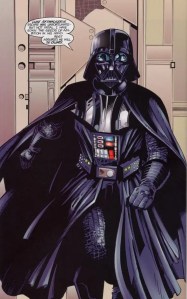
Although this label is half-joking, it captures the essence of the project surprisingly well. It makes it immediately clear that this is not just some distant side story, but material that connects directly to the main film continuity. It is precisely this position between two favorite parts of the saga that has contributed greatly to its fascination.
In many ways, Dash Rendar is designed as a deliberate alternative to Han Solo: a free spirit, pilot, smuggler, and adventurer who fills the same void while Han is frozen in carbonite.
But precisely because of this, Dash was also always perceived with ambivalence. Some liked that he preserved the saga’s cheeky smuggler energy. Others found him too contrived and saw him primarily as a stand-in. It is precisely this tension that is typical of Shadows of the Empire: much of it is both clever and a bit conspicuously calculated.
Prince Xizor was positioned as a new villain in such a way that he not only threatens the heroes but also competes with Darth Vader—an interesting idea, because Star Wars thereby introduced an adversary who operates through power plays and seduction rather than raw military force.
This also set him apart visually and atmospherically from the usual Imperial threats. While Vader appears industrial, black, and stern, Xizor embodies luxury, sensory overload, and an almost decadent style of power. Through this alone, he brings a different social class of the galaxy into the picture.
The soundtrack is also noteworthy: an orchestral Star Wars score for a non-film project was an unusually ambitious decision at the time.
Many fans still remember this today precisely because it’s such a strangely beautiful paradox: a film score for a movie that no one has ever seen. It is precisely this absurdity that makes up part of the charm of Shadows of the Empire.
In addition, Shadows of the Empire later received “Legends” status following the reorganization of the Expanded Universe. While this changed its official canon status, it did not alter its historical significance within the franchise’s development.
On the contrary: precisely because the material is no longer at the center of the official canon today, it can be read all the more effectively as a document of a specific Star Wars era. It belongs to that phase in which the Expanded Universe was almost as important to many fans as the films themselves.
Reviews at the time
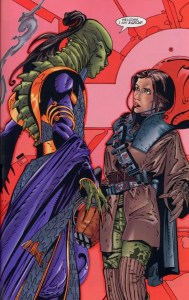
Reactions in the 1990s were mixed but fascinated. Above all, the boldness of the concept was praised. Many fans and observers found the idea exciting: experiencing a new Star Wars event across multiple media simultaneously. The novel was perceived as a major event, the game benefited greatly from the hunger for new Star Wars content, and the soundtrack felt like a particularly ambitious prestige project.
At the same time, the project’s limitations quickly became apparent. Not every release was equally strong. While the video game impressed with its atmosphere, set pieces, and fan service, it was also criticized for clunky controls, camera issues, and inconsistent level quality. The novel, on the other hand, was not perceived by everyone as elegantly written; some saw it more as a functional bridge than as great literature. Dash Rendar also divided the audience: for some, he was a cool new character; for others, he seemed too much like a replacement for Han Solo.
On top of that, the project was inevitably measured against an imaginary standard of perfection. Because it was marketed as a “movie without a movie,” many fans automatically wondered what that movie would have looked like—and in the imagination, a movie that was never made is almost always bigger, cooler, and more elegant than any real-life product. Shadows of the Empire thus had to contend not only with its actual strengths and weaknesses, but also with the expectations of its audience.
Nevertheless, the contemporary response was by no means merely dismissive. Many reviews and fan reactions reveal a sense of wonder that such an endeavor was attempted at all. You could sense that Star Wars still had cultural pull, even though no new film had been released in years. This realization alone made Shadows of the Empire a success: it showed that the brand didn’t just live on memories, but could actively generate new enthusiasm.
But perhaps that is precisely the most interesting truth about Shadows of the Empire: the project was admired less for its perfection than for its ambition. It was big, loud, bold, and sometimes a bit inconsistent—much like a real blockbuster with heavy marketing hype. Perhaps this very slight over-the-top quality is part of its historical appeal. You can tell from the project that it wanted to be everything at once: a literary event, a gaming sensation, a collector’s craze, an audio-visual spectacle, and a franchise test lab.
Cultural Impact
In retrospect, Shadows of the Empire is more significant than it appears at first glance. The project demonstrated early on how effectively a franchise could be told and marketed across multiple platforms simultaneously. Today, this seems self-evident. In the 1990s, however, it was still unusual to deliberately construct a story as a comprehensive package comprising a novel, comic, game, music, and toys.
In this way, Shadows of the Empire became a precursor to modern transmedia strategies. Later franchise campaigns—both within and outside of Star Wars—worked much more aggressively with the idea that a universe does not exist solely within a single medium, but functions as a network of media, products, and narrative fragments.
One should not overlook how early this project tested a logic that is now quite familiar: the center of a franchise does not always have to be a single film. It can also be a hub where various media converge simultaneously. It is precisely this way of thinking that one later finds everywhere—in series universes, game companion books, event comics, soundtrack packages, and large-scale cross-media campaigns. Shadows of the Empire was not a perfect model for this, but it was a remarkably early example.
For Star Wars itself, the project also served as a bridge. It kept interest in the brand high during a phase when there were no new theatrical films, and indirectly paved the way for the saga’s return in the late 1990s. It helped revitalize the original trilogy, popularize characters outside the films, and accustom fans to the idea that important Star Wars stories could also take place beyond the screen.
This bridging role, in particular, cannot be overstated. Without projects like this, the cultural void between the original trilogy and the prequels might have been much more pronounced. Shadows of the Empire kept the mythos alive. It signaled: This world doesn’t stand still just because there’s no movie in theaters right now. In a franchise whose true strength has always lain in the imagination of its fans, that was an invaluable effect.
Not least, the project lives on in fans’ memories to this day because it evokes a specific era so strongly: 90s Star Wars, the Expanded Universe, the N64, Dark Horse Comics, toy shelves, and the feeling that there was an infinite amount of additional material hidden between the films. Shadows of the Empire is therefore not just a story, but also a time capsule moment of franchise culture.
It is a work that smells of cardboard cutouts, soundtrack CDs, strategy guides, comic book stores, and N64 cartridges—in other words, of that material pop culture in which brands were still strongly experienced through physical objects. Perhaps that is why it still touches fans so deeply today: Not just because of its content, but because it preserves an entire way of being a fan. You had to collect, search, read, listen, play, and piece a lot of it together yourself. It was precisely this active engagement and hands-on involvement that made it so appealing.
Conclusion
Star Wars: Shadows of the Empire is not a forgotten spin-off, but one of the most exciting experiments in the entire history of the franchise. The project aimed to prove that the impact of a new Star Wars film could be staged even without a film—and in a surprising number of ways, it succeeded exactly in doing so. Looking back, the endeavor seems almost visionary because it anticipated a narrative form that seems self-evident today: making the same story accessible simultaneously across multiple media, tones, and target audiences, without a single work having to carry everything on its own.
As a story, Shadows of the Empire may not be equally strong in every version. Some characters are controversial today, some elements clearly feel like the 1990s Expanded Universe, and the game in particular shows its age technically. Yet as a concept, it remains fascinating: a blockbuster made of book pages, comic panels, polygons, CD tracks, and action figures. It is precisely this mix that makes it so appealing. The project is interesting less for its flawless execution than for its scale, its self-confidence, and its almost playful belief that Star Wars can still function as an event even without the big screen.
This, in particular, holds an interesting idea for the present. Perhaps a 1:1 film adaptation of Shadows of the Empire that stays as true to the source material as possible would be exactly the kind of project with which Star Wars could regain some of its old sense of adventure today. Instead of always striving to be bigger, darker, or more mythological, such an adaptation could demonstrate how well the saga works when it fills the gaps between the major episodes with pace, charm, an underworld atmosphere, and pure pulp energy. Such a film wouldn’t have to reinvent everything. Its strength could lie precisely in taking existing material seriously and bringing it to the screen with technical consistency, visual elegance, and narrative confidence.
This would also be appealing because Shadows of the Empire embodies a form of Star Wars that is often missing today: a blend of space adventure, gangster intrigue, serialized novel, and playground fantasy. The story has momentum, clear conflicts, iconic character constellations, and precisely that gap between two films that automatically sparks curiosity. An adaptation wouldn’t need to turn this into some grand cultural-theoretical statement. It would be enough if it simply conveyed once again just how exciting, gritty, melodramatic, and entertaining this galaxy can be.
More than that: a film adaptation of this material could bring Star Wars back to a point where the saga was still held together by a spirit of adventure and inventiveness, not by constant pressure from the canon. Shadows of the Empire has a pleasantly effortless quality to it. It is familiar with the films’ grand mythology, but it isn’t weighed down by it. It moves between the underworld, smugglers, power plays, rescue missions, and galactic politics, reminding us that Star Wars is always at its most vibrant when it combines epic themes with pulp energy.
And even if Lucasfilm were never to go down this path, the idea remains appealing that fans with enough time, technical passion, and tools like Seedance might one day create their own version of this “film without a film.” That would fit perfectly with a story that proved as early as 1996 that Star Wars doesn’t necessarily need a movie screen to feel like cinema. Perhaps that is precisely the real point of the project: it practically begs to be expanded upon, imagined, recreated, and dreamed further. Shadows of the Empire was never just a finished product, but always an invitation to the audience to fill in the missing images in their own minds.
Perhaps that would be the most beautiful late twist in this story: that an officially incomplete, fragmented project, scattered across many products, would one day be rediscovered precisely because of its openness. Not despite its incompleteness, but because of it. For Shadows of the Empire thrives on the gaps. It thrives on the fact that space remains between the parts for imagination, reconstruction, and idealized visions. In a present where franchises often seek to define everything and leave nothing open, this feels almost refreshing.
That is precisely why Shadows of the Empire is more than just “Episode 5.5.” It is proof that Star Wars understood, long before streaming, cinematic universes, and transmedia master plans, how to create an event that is bigger than a single medium. It represents a phase in which franchise storytelling still felt experimental, tentative, and yet astonishingly bold. A Star Wars film without a film—and precisely for that reason, unforgettable to this day.





 McHenry's Lair
Kommentar verfassen :