

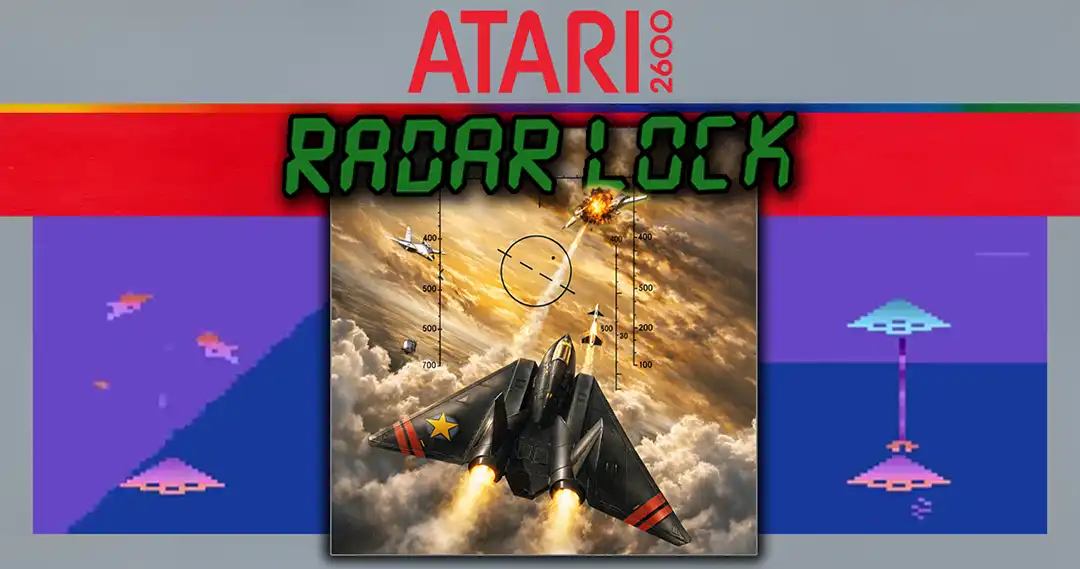
ENEMY JET AT 12 O‘ CLOCK!
You’re locked in fight-to-the-death air combat with the enemy!
You may be outnumbered — but this is far from your first mission.
A late-era triumph
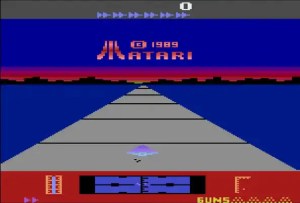
When the Atari 2600 was released in the late 1970s, it wasn’t designed to run spectacular pseudo-3D flight games with a cockpit perspective. Its hardware was designed for simple game objects, clear colors, and very limited effects. Memory was scarce, display capabilities were limited, and many developers had to rely on tricks rather than true processing power. This makes Radar Lock all the more astonishing—a late title for the console that impressively demonstrates just how far experienced developers could push the machine.
Radar Lock was released in the late life cycle of the Atari 2600 and seems almost like a technical paradox: a game that aims to create the impression of modern action on a console released in 1977. Instead of relying on simple on-screen objects, it presents the player with a jet cockpit view, a radar screen, approaching enemies, and the sensation of fast-paced aerial combat. It is precisely this presentation that makes the game remarkable to this day, as it does not simply attempt to be an ordinary shoot-’em-up but rather to create a small illusion of high-speed military action.
This is precisely where its historical significance lies: Radar Lock is less an ordinary action game and more a testament to the fact that the limits of the Atari 2600 were never determined solely by the hardware, but also by the inventiveness of the programmers. The game thus belongs to those late releases that, in retrospect, almost seem like commentaries on the console’s entire lifespan. It shows that a system is often better understood at the end of its cycle than at the beginning, and that this can give rise to games that cast their platform in a new light.
Gameplay
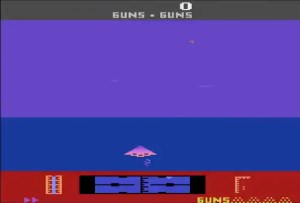
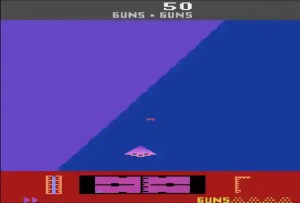
In terms of gameplay, Radar Lock places the player in the cockpit of a fighter jet. The goal is to track down enemy aircraft, lock onto them, and shoot them down before they become a threat. The radar screen plays a central role here: it helps locate enemies in the first place and adds an extra tactical layer to the game. This blend of observation, targeting, and attack ensures that the game feels different from many direct and immediately accessible shoot-’em-ups of the same era.
At its core, Radar Lock combines two elements: quick reflexes and target acquisition. The player must keep an eye on the airspace, track enemy aircraft on the radar, and then lock onto them on the main screen. The game thrives on this tension between orientation and immediate action. Unlike many simpler shooters on the 2600, it’s not just about shooting at objects that happen to appear. Radar Lock aims to create the impression of an aerial dogfight where information, timing, and spatial awareness converge.
This is particularly remarkable for the Atari 2600. The game feels more ambitious than many classic console shooters because it demands not only reaction but also a certain ability to “read” the screen. The radar is not merely a decorative element but part of the gameplay. This creates a touch of simulation without losing direct accessibility. One could say that Radar Lock attempts to suggest a more complex experience with minimal means than the platform would actually lead one to expect.
In addition, the gameplay experience thrives heavily on the interplay of its display elements. The player doesn’t just look at a single action window but must process information across different areas of the screen. This heightens the tension because you’re constantly switching between maintaining an overview and focusing on specific details. This switch is mechanically simple, but psychologically it creates exactly the kind of unease that fits an aerial dogfight: Where is the enemy, how fast is it approaching, and when is the right moment to attack?
Pushing the Limits
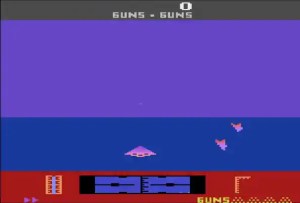
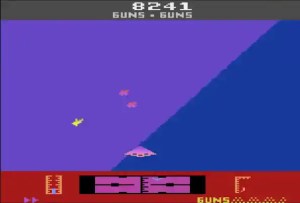
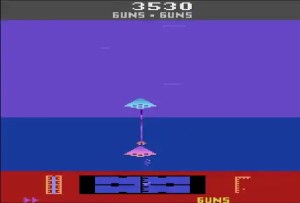
Technically, Radar Lock is one of the more impressive late-period titles for the Atari 2600. The console offered only minimal hardware support for graphical objects. Developers had to organize the screen layout practically line by line and manage extremely limited resources. It is remarkable that a game featuring a cockpit view, HUD elements, radar, and moving enemies was created on this basis. The mere fact that the game suggests a more complex user interface sets it apart from many earlier 2600 titles.
The graphics do not rely on a wealth of detail in the modern sense, but rather on clever illusion. Enemy aircraft appear small, fast, and functional, while the cockpit gives the screen structure and immediately conveys to the player that they are “inside” a machine. The radar, the displays, and the perspective arrangement of the elements create a presentation that goes far beyond what is commonly associated with the Atari 2600. Much of this works not through naturalistic representation, but through cleverly placed symbols and visual hierarchies.
The staging is particularly strong here. Radar Lock conveys speed and technology, even though the console actually has very limited resources. It is precisely this that creates the impression of graphics that are almost or seemingly impossible: through clever cross-fading, precise timing, and the constant adaptation of the few available graphic elements—namely player sprites, missile sprites, and background areas—more is depicted than the hardware would seem to allow at first glance. This is precisely where the breaking of the Atari 2600’s limits is most evident: not through raw graphical power, but through clever presentation, clear prioritization, and an understanding of how to create a lot of meaning with just a few pixels. The game doesn’t look impressive because it’s complex, but because it intelligently transforms its limitations into style.
The cockpit, in particular, is more than just a decorative frame. It helps guide the player’s imagination. Where earlier titles often presented mere play areas without context, Radar Lock creates a sense of role and situation through its framing. The game doesn’t just say: Something is flying across the screen. It says: You’re sitting in a jet and tracking targets. This additional layer is technically simple, but aesthetically enormously effective.
The interplay between the radar and the main view also deserves attention. On a console that originally became known primarily for very straightforward and abstract games, such an interface feels almost luxurious. It mimics ways of thinking more commonly associated with arcade machines or later home computer games. Even if the implementation remains necessarily simplified, it creates an impression of complexity that is exceptional for the Atari 2600.
Context within the era
To properly appreciate Radar Lock, one must also consider it within the context of its release period. By the late years of the Atari 2600, the console was technically long outdated, but this very fact gave rise to an interesting phase. Developers had come to know the hardware very well by then, knew which tricks worked, and were able to translate their experience into games that got surprisingly much out of the old system. Instead of merely implementing obvious ideas, some studios ventured into concepts that would have been considered too ambitious just a few years earlier.
Radar Lock is a prime example of this late phase. The game is not a product of the early experimental period, but rather the result of a mature approach to a limited medium. Such titles often demonstrate particularly clearly that technical limits are not static. The same hardware can be used in a mundane way at the beginning and, at the end of its life cycle, suddenly produce works that seem almost impossible.
Precisely for this reason, the game is often viewed in retrospect not in isolation, but as part of a larger pattern. It belongs to that category of late-period console material that is remembered less for its mass appeal than for its technical sophistication. This is particularly interesting for historians of gaming history because it reveals just how much expertise, programming skill, and design insight can expand a platform’s expressive capabilities.
Atmosphere and Impact
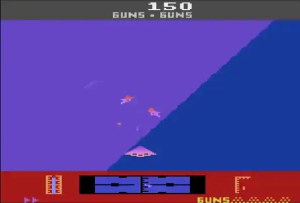
What makes Radar Lock particularly appealing is its atmosphere. Despite its rudimentary means, the game creates a sense of alertness, speed, and technical coolness. The screen resembles a simplified instrument panel designed to place the player in a high-pressure military situation. This effect arises not from realism, but from suggestion. This is precisely the typical appeal of many strong retro games: they show little and let the player’s imagination fill in the rest.
In this sense, Radar Lock functions in a more cinematic way than its technology would suggest. The radar signals danger, the cockpit view defines the focal point, and the enemy targets thereby gain more presence than they actually possess as individual pixel objects. The result is a game that appears larger than it is technically. It thrives on the interplay between display, expectation, and imagination.
This form of impact is particularly interesting because it makes it clear that atmosphere is not necessarily tied to audiovisual richness. On the Atari 2600, atmosphere often had to arise from abstraction. Radar Lock uses precisely this principle: It offers no true simulation realism, but enough cues to create an aerial combat scenario in the player’s mind.
Trivia
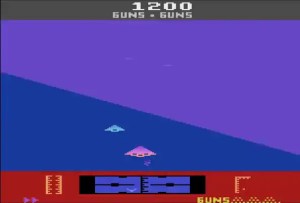
Radar Lock is one of those late Atari 2600 games that are often cited today as examples of just how long-lasting the console actually was. While many players associate the 2600 primarily with early classics like Combat, Pitfall!, or Space Invaders, Radar Lock shows that ambitious titles were still being released even in the later years. Especially in retrospectives on the platform’s lifespan, it therefore often serves as a counterexample to the notion that the Atari 2600 was home only to extremely simple early titles.
Collectors and retro fans in particular often appreciate the game today less for its perfect gameplay balance than for its significance in the console’s technological history. It is one of those cartridges you like to pop in to see “just how far the 2600 actually went.” In this sense, Radar Lock is almost a showpiece: not the most popular, but one of the most interesting games on the system. Its reputation stems less from mass-market nostalgia than from respect for its design.
On top of that, the game often plays a special role in conversations among retro fans. It’s not a title everyone mentions right away, but one that frequently elicits appreciation among connoisseurs. It is precisely such works that often have a long life in retrospect, because they are ideally suited for discussing hardware, design, and historical development.
Reviews at the Time
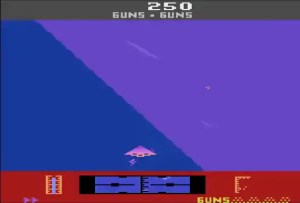
At the time, Radar Lock was generally recognized primarily for its technical ambition. The fact that an Atari 2600 game even attempted to recreate a modern jet combat experience with radar and a cockpit view was considered remarkable. Many observers immediately recognized that this game attempted more than the platform’s usual standard shooters. Even the first impression was therefore often one of amazement: not necessarily because the game did everything perfectly, but because it dared to do things one hardly expected on this console.
Criticism was mostly directed at the gameplay limitations. As with many late 2600 titles, the weakness lay less in the concept than in the gap between ambition and feasibility. The game could evoke the feeling of aerial combat, but naturally couldn’t offer the depth, fluidity, or impact familiar from arcade games or more powerful home consoles. Some therefore found the action somewhat monotonous or the presentation too abstract once the initial technical “wow” factor wore off.
Nevertheless, the overall tone remained respectful: Radar Lock was not a game celebrated for flawless perfection, but because it dared to do an astonishing amount on outdated hardware. It is precisely this aspect that accounts for its fascination today. Many historical games are remembered for their immediate fun factor, whereas Radar Lock is often remembered for its courage and ambition.
From today’s perspective, this is particularly fascinating because contemporary criticism and later retro perception complement each other here. Back then, it was noted that the game was technically bold. Today, it is also seen as a document of the 2600’s maturation phase. The reviews at the time were thus often cautiously positive, while later assessments honor the work even more strongly as a technical curiosity and remarkable achievement.
Cultural Influence
The cultural influence of Radar Lock cannot be compared to that of the truly great Atari classics. It was neither a mass phenomenon nor a title that permanently shaped the mainstream image of the Atari 2600. Its influence is more evident in hindsight. It is one of those games that shaped not so much the general public as it did later discussions among historians, collectors, and enthusiasts.
Today, Radar Lock is often mentioned in discussions about “late-life wonders” of old systems. It exemplifies a phase in gaming history in which developers achieved surprising results once again using mature, long-established technology. The game therefore holds a special place in retro culture: not as a legendary bestseller, but as a symbol of technical creativity under extreme constraints.
Radar Lock crops up time and again, particularly in articles, videos, and forum discussions about underrated 2600 games. It embodies the idea that historical consoles are interesting not only because of their early hits, but also because of those later titles that redefined their capabilities. This makes it one of those games whose cultural value today is perhaps greater than its immediate market impact at the time of release.
One could even say that Radar Lock exemplifies a particular form of retro appreciation: not the veneration of the obvious, but the rediscovery of the technically and creatively unexpected. It is a game that works so well in modern retrospectives because it vividly demonstrates just how surprisingly creative old systems could still be at the end of their lifespans.
Conclusion
Radar Lock is one of the most exciting examples of how developers pushed the Atari 2600 to its limits. The game combines aerial combat action with radar navigation and packages it all into a presentation that feels surprisingly modern for the aging console. It isn’t the most accessible, well-known, or balanced game on the system, but that is precisely where its appeal lies. Its value lies not only in its playability, but also in the amazement it inspires regarding its technical feasibility.
Anyone who knows the Atari 2600 only as the home of very simple early games will be surprised by Radar Lock. The cartridge shows that even at the end of its life cycle, the console was still capable of defying expectations. As a game, Radar Lock is interesting. As a technical statement, it is fascinating. And as proof of pushing the boundaries of the Atari 2600, it remains remarkable to this day.
That is precisely why it remains a worthwhile title for anyone interested not only in the best-known classics, but also in those games that challenged their platform. Radar Lock is not a universal crowd-pleaser, but it is an excellent example of how creative developers were able to make a lasting impression despite severe limitations. It thus occupies a special place in the history of the Atari 2600: not as the biggest hit, but as one of the clearest signs of just how much potential this old hardware still had in the end.
More
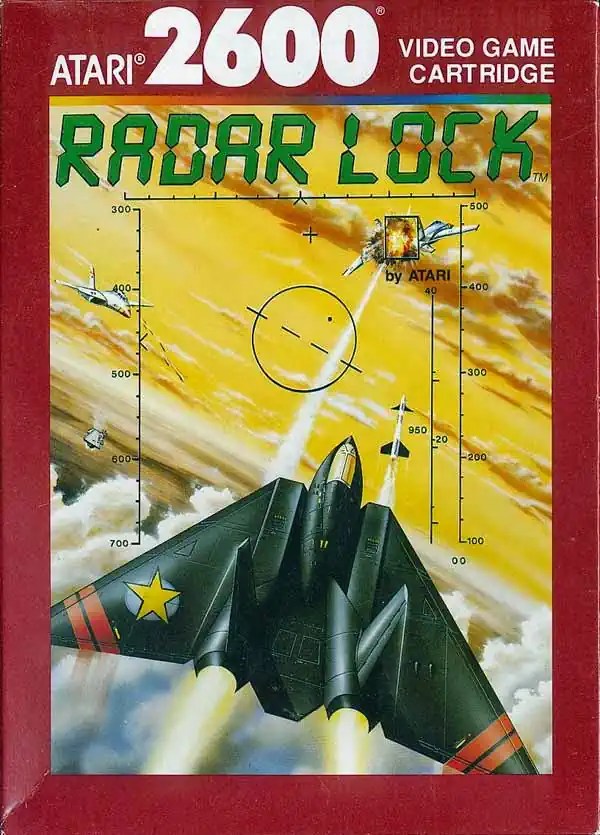
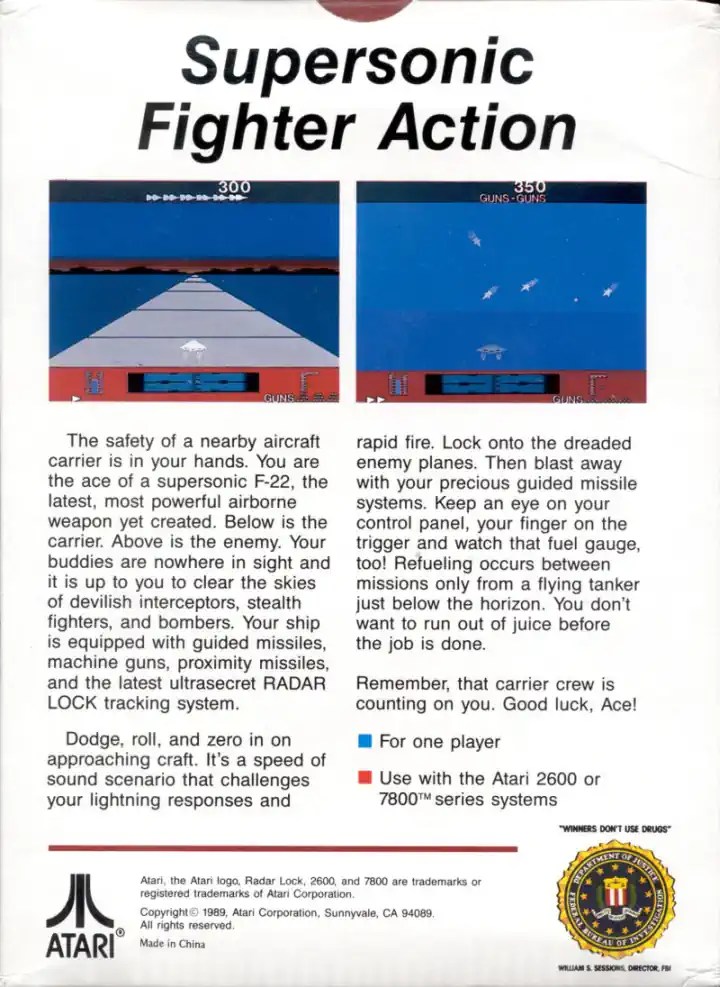
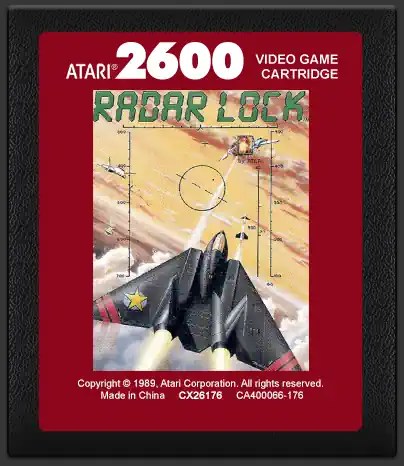
Box and Cartridge








Kommentar verfassen