


Donkey Kong in 3D
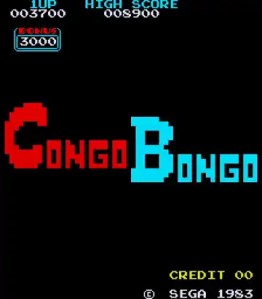
When Congo Bongo hit arcades in 1983, the game immediately felt both familiar and strange. Familiar, because the basic premise clearly evoked Donkey Kong: An angry ape stands at the top, throwing obstacles down, and the player must fight their way upward with precise jumps. Strange, because Sega didn’t present this concept as a classic side-view, but in an isometric, pseudo-3D-like perspective. At the time, it was aptly described as “Donkey Kong in three dimensions”; it was precisely this impression that made the game so striking back then.
This comparison was by no means coincidental. In the early ’80s, Donkey Kong was the benchmark for many players when it came to action-packed climbing and jumping games. Anyone releasing a similar game was automatically measured against Nintendo. Sega therefore decided not simply to create a copy, but a variant with its own technical appeal. The result was a game that seemed familiar at first glance, but conveyed a completely different spatial impression upon closer inspection. It was precisely this blend of the familiar and the new that made Congo Bongo so interesting in the arcade landscape of its time.
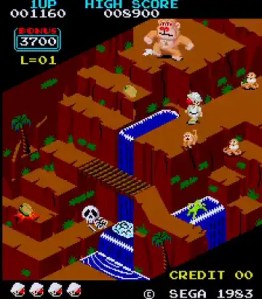
The player controls a safari adventurer whose tent has been set on fire by the monkey Bongo. This sets off a simple, almost cartoonish quest for revenge through the jungle. The plot is secondary, but it serves as the perfect hook: it immediately gets the player moving and gives the game a slightly anarchic humor that fits well with the early arcade era. The game needs no lengthy backstory, no long cutscenes, and no explanatory text. A brief, comical conflict is enough to make it clear why the player is chasing Bongo through dangerous terrain.
At the same time, Congo Bongo is a good example of how strongly arcade games of that era relied on their immediate impact. A single glance at the screen should be enough to pique curiosity. The colorful jungle backdrop, the unusual perspective, and the aggressive monkey perched high up delivered exactly that. Even before taking the first jump, it was clear that this game wanted to stand out. It felt like a technical spectacle and a skill-based game all at once.
Gameplay
At the heart of Congo Bongo are four distinct screens that are played one after another and then repeated with increasing difficulty. This alone makes the game interesting, as it doesn’t rely on a single variation but instead tries out a new basic concept in each section. This structure is typical of the early arcade era, but Congo Bongo uses it particularly effectively: instead of just increasing the speed, it changes the feel of the game from section to section.
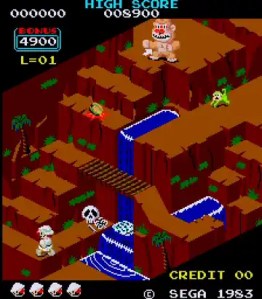
In the first level, the player climbs a mountain while Bongo hurls coconuts down. Additionally, small monkeys intervene and try to make the climb more difficult. This is the phase where the similarity to Donkey Kong becomes most apparent: the monkey above, the player below, and a dangerous climbing route in between. However, the perspective significantly alters the familiar pattern. The path doesn’t simply run from left to right and then upward; instead, it feels more spatial and less straightforward. Stairs, ledges, and platforms must be interpreted differently than in a classic 2D game.
This very first section already reveals the game’s unique appeal. The player immediately grasps the basic concept but must adapt their usual reflexes. Jumps feel different, paths look different, and dangers seem to come from angles other than expected. From today’s perspective, it’s easy to dismiss this as cumbersome, but in the context of 1983, it was above all a powerful statement: Here, a game attempts to combine familiar action rules with a new visual language.
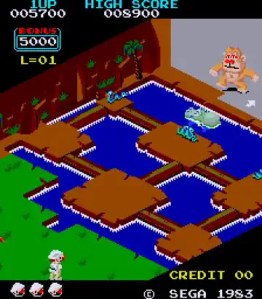
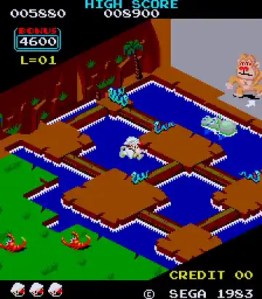
In the second level, the game completely shifts its approach. Now the action takes place across swampy terrain, where the player balances on the backs of hippos while simultaneously dodging snakes and scorpions. This transforms Congo Bongo from a pure climbing game into one that relies more heavily on reaction and timing. This section thrives on rhythms of movement and on reaching the next safe point at just the right moment. It almost feels like a small genre shift within the same game.
What’s particularly well done here is that the jungle isn’t just a backdrop, but becomes a game mechanic in its own right. Animals and bodies of water are not merely decorative but define the player’s route. This creates a stronger sense of adventure than many other arcade games of the time offered. While numerous arcade games presented rather abstract obstacle courses, Congo Bongo conveys, at least to some extent, the feeling of moving through a living and unpredictable wilderness.
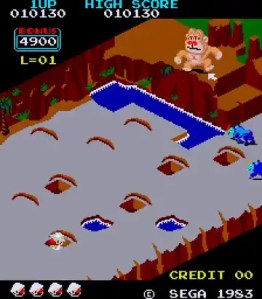
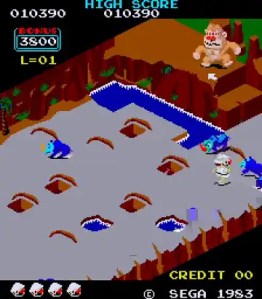
The third level features rhinos. The player must cross open fields and duck into holes in time to escape charging animals. Here, the game demonstrates particularly clearly how it generates tension from just a few elements: you learn not only jump sequences but also movement patterns. Dodging and hiding at the right moment create a rhythm that differs significantly from the previous screens. Here, the player is less of a climber and more of a prey, who must closely follow the movements of the environment.
This variety is one of the game’s greatest strengths. The four screens feel like small variations on a larger jungle theme. Each section emphasizes a different skill: climbing, timing, observation, and reaction speed. As a result, Congo Bongo retains a certain freshness despite its simple core concept. This was particularly important in the arcade, as a machine had to demonstrate within a few minutes that it had more to offer than a single gimmick.
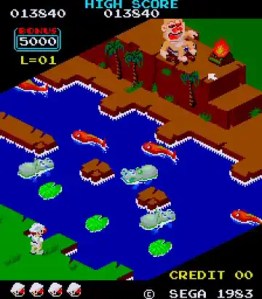
In the fourth level, the path once again leads across bodies of water, water lilies, and animals before a sort of rhino barrier blocks the final access to Bongo. Some contemporary descriptions even saw a certain similarity to Frogger in this section, because safely crossing dangerous areas becomes the central task. At the same time, the game combines several of its previous ideas here: moving at the right moment, observing enemies, and accurately assessing paths.
It is precisely this four-part structure that keeps the game interesting to this day. It is not merely a “high-score machine” that simply gets faster, but an arcade game that continually challenges its players in new ways. At the same time, however, the isometric view also presented a problem: jumps and distances were harder to judge than in a clear 2D side view. This was precisely where both the appeal and the frustration of Congo Bongo lay. Many players likely wavered between admiration and annoyance for this very reason. You wanted to keep playing because the game seemed striking and original; yet you often failed due to the very perspective that made it so special in the first place.
Added to this is the fact that, in typical arcade fashion, the game relies on repetition and increasing difficulty. Once the four screens are completed, the sequence starts over—only harder. Enemies react faster, obstacles become more challenging, and the already demanding perspective shift is put to an even greater test. This demonstrates that Congo Bongo doesn’t just rely on its presentation but was definitely intended as a serious arcade skill game.
Technology
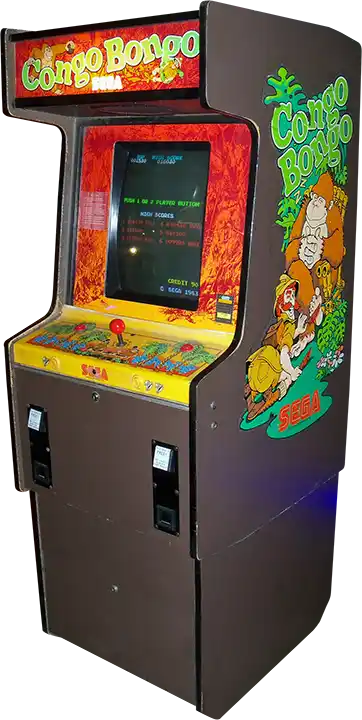
Technically, Congo Bongo is particularly remarkable because it builds on Sega’s experience with Zaxxon. The game also uses an isometric view, though without the shooter’s continuous scrolling. Instead, each section remains a single screen, allowing the hardware to render detailed, colorful scenes with a sense of depth. The result is a game that, in 1983, felt significantly more modern than many flatly presented platform titles. For players in the arcade, this meant, above all, an immediate sense of depth and cinematic presentation.
The isometric perspective was not an end in itself back then, but rather a kind of technological promise. It showed that developers were looking for ways to make the screen appear larger, more vibrant, and more spatial without having true 3D graphics at their disposal. Congo Bongo is thus one of those games that created a sense of three-dimensionality with limited resources. This was not a technical revolution in the modern sense, but it was a notable step forward at a time when even small changes in perspective could have a major impact.
It is also historically interesting that the game is linked to Ikegami Tsushinki in sources; furthermore, references within the ROM are frequently cited. The attribution in popular sources isn’t always entirely clear-cut, but the connection shows that Congo Bongo shouldn’t be viewed merely as a Donkey Kong latecomer, but also as part of that early ’80s phase in which developers experimented with new perspectives and technical presentation. The history of such arcade machines is often preserved only in fragments, yet it is precisely these details that highlight how closely technology, design, and corporate competition were intertwined during the arcade era.
It is also noteworthy how strongly the technology shaped the perception of the gameplay. The perspective made the game visually impressive, but at the same time made it harder to control. What today appears to be a historically exciting design move was immediately noticeable back then: The game looked spectacular, but felt less intuitive than its 2D predecessor. In a way, Congo Bongo is thus a classic case of technological enthusiasm coming at a gameplay cost. Sega gained attention through the visuals, but had to accept that some players found the action harder to follow.
Acoustically and atmospherically, too, the game fits well into the early 1980s arcade scene. The soundscape is sparse, concise, and functional. Sound effects signal danger, hits, and movement without ever becoming a standalone musical composition. This is typical of the era, yet together with the colorful graphics, it creates a cohesive overall picture. Congo Bongo doesn’t rely on epic scope, but rather on immediate sensory intensity: the screen is meant to captivate, the sounds to alert, and the game to draw the player into its rhythm quickly.
Trivia
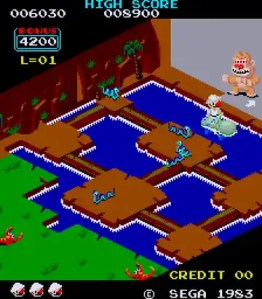
A nice detail is the name “Tip Top”, under which the game appeared in Japan and in early versions. In later international versions, Congo Bongo eventually prevailed—the title with more jungle and cartoon charm. This renaming alone illustrates how heavily arcade games were marketed through their names. Congo Bongo sounds playful, loud, and instantly memorable—exactly how a machine in an arcade should come across.
Also interesting: The game was ported to a large number of home platforms, including Atari 2600, Atari 5200, ColecoVision, Commodore 64, Apple II, MSX, SG-1000, and other systems. However, these ports were often significantly stripped down; several versions reduced the four arcade screens to just two. This in particular clearly illustrates just how ambitious the original was in relation to the home hardware of the time. What still looked impressive in the arcade with specialized technology often had to be simplified, compressed, or reworked for home use.
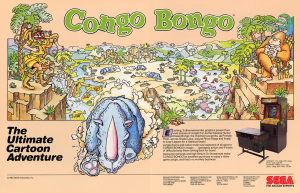
Such ports are more than just a side note. They show how important successful arcade games were as brands and role models. A title didn’t have to be perfect in every version to be widely distributed. What mattered was that it had a recognizable appeal and that its core concept could be adapted to as many systems as possible. In the case of Congo Bongo, however, this often meant that the technical appeal of the original was only partially preserved. Many home gamers therefore experienced the game in a form that only partially reflected its reputation.
Another trivial but interesting detail is the game’s position within Sega’s catalog. Congo Bongo is not one of those titles immediately mentioned in the same breath as the all-time great Sega classics. Nevertheless, it regularly appears in retrospectives because it marks a specific moment in Sega’s history: the attempt to combine technical innovation with popular game concepts. This is precisely what keeps it appealing to retro fans and gaming historians.
Reviews at the Time
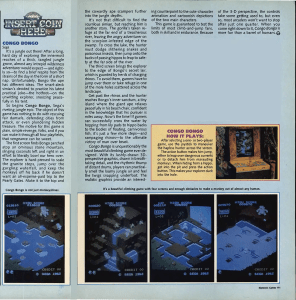
The reaction to Congo Bongo at the time was mixed, but by no means negative. The basic idea was particularly highlighted: The magazine Computer and Video Games described the concept as “Donkey Kong in three dimensions”, hitting the core of the game pretty much spot on. This phrasing alone shows that the title was understood at the time as a technically and conceptually striking variation on an established successful model. For an arcade game, that was a strong compliment, because it meant: The audience immediately recognized what the game was alluding to, and at the same time saw what was new about it.
However, the gameplay was viewed more critically. The very perspective that made the game so distinctive could make orientation difficult. Later retrospectives on early reviews and design analyses emphasize that the controls were harder to master due to the spatial presentation than in classic 2D platform games. This aligns with the general impression that Congo Bongo looked stunning but didn’t quite achieve the gameplay clarity of Donkey Kong. This tension between visual appeal and precision is likely the main reason why the game remained historically interesting but never quite attained the same cult status as its famous predecessor.
Criticism of the home versions was, in some cases, significantly harsher. Electronic Games wrote about an Atari version that four screens had been reduced to just two, and that fans of the arcade original would likely find this port disappointing. This is important because the game’s mixed reputation in later years did not refer solely to the arcade original but was heavily influenced by the often weaker ports. Anyone who encountered Congo Bongo not in the arcade but on a technically limited home version could easily get the impression that it was a nice but unpolished game.
Nevertheless, the game was not insignificant in the market. In Japan, it appeared in the Game Machine charts in 1983, where it was listed in June as the fifth-most successful table arcade machine of the month. It was therefore by no means just a pretty curiosity, but quite a visible title of its time. This ranking shows that the eye-catching presentation and the familiar basic concept certainly drew an audience. Even if the game was not without controversy, it was still successful enough to be noticed in everyday arcade life.
The criticism at the time can therefore be seen as typical of many ambitious arcade games. On the one hand, people admired the technical leap forward; on the other hand, it quickly became clear that innovation did not automatically mean better playability. It is precisely at this point that Congo Bongo continues to divide opinions to this day: For some, it is a fascinating experiment; for others, a somewhat clunky game with a striking exterior. Both perspectives have good reasons.
Cultural Influence
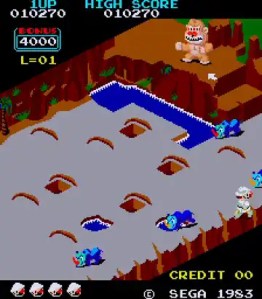
The cultural influence of Congo Bongo lies less in the fact that it became a long-lasting, dominant mega-hit, and more in the fact that it represents a very early and highly visible attempt to break the platform game out of the flat 2D perspective. In this regard, it occupies an interesting intersection between Donkey Kong and later isometric games that used spatial effects as a unique selling point. The game is thus less of an endpoint and more of a transitional title—one that demonstrates how the industry experimented with perspective, readability, and visual spectacle.
Furthermore, Congo Bongo shows how quickly the industry responded to successful ideas in the early 1980s. Nintendo established a structure with Donkey Kong, and Sega responded with a technically more striking, spatially staged variant. This race to develop similar game concepts with a new technical twist is typical of early arcade history. Precisely for this reason, the game remains culturally and historically fascinating, even if it is not always considered the greatest classic in terms of gameplay. It documents a moment when originality was often sought less in the basic principle than in the presentation.
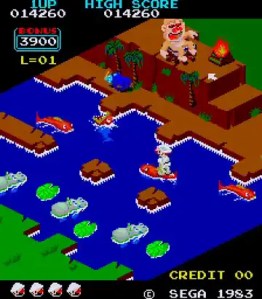
The fact that the game was later re-released in collections such as Sonic’s Ultimate Genesis Collection and also received a remake in the Sega Ages series further demonstrates that Sega has preserved the title as part of its own historical catalog. Congo Bongo is therefore not a forgotten niche product, but rather a second-tier classic: not as famous as Sega’s biggest arcade hits, but important enough to be unearthed time and again. Such re-releases are more than just nostalgia products. They reveal which games a company itself considers part of its identity.
Furthermore, Congo Bongo is also culturally and historically interesting because it shows how early on arcade games were already experimenting with cinematic effects. The elevated vantage point of the enemy, the path upward, the obstacles emerging from the depths, and the chase through various jungle scenes lend the game a touch of drama. It doesn’t tell a complex story, but it stages movement and danger far more consciously than is typical of many purely abstract games from the same era. It is precisely this blend of cartoon-like concepts and technical prowess that secures its place in arcade history.
Conclusion
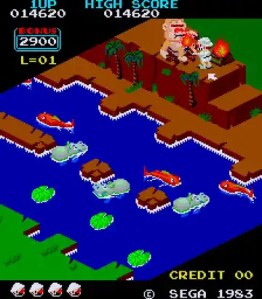
Congo Bongo is a fascinating arcade game from the early ’80s, precisely because it is both imitation and innovation. It takes the basic concept of Donkey Kong, translates it into an isometric 3D illusion, and thereby creates one of the more striking technical and stylistic experiments of its era. The four levels provide variety, the graphics are impressive by the standards of the time, and the presentation retains a unique charm to this day. Anyone interested in the transitional period between simple 2D concepts and more elaborately staged arcade experiences will find a particularly vivid example here.
Its weakness lies where its greatest strength begins: the spatial presentation makes the game spectacular, but also more cumbersome. That is precisely why Congo Bongo may not be as timelessly playable as the true genre classics. It is historically interesting nonetheless—or perhaps precisely because of that. It is a game that shows how the arcade industry thought in 1983: not just copying more successfully, but staging more successfully.
In the end, Congo Bongo is less a flawless classic and more an exciting document of a moment when arcade games were experimenting more boldly with form and perspective. It has its rough edges, but it is precisely these that make up its historical appeal. Anyone playing it today experiences not just an old skill game, but also a glimpse into a time when a new perspective alone was enough to feel like a glimpse into the future.








 McHenry's Lair
Kommentar verfassen :