

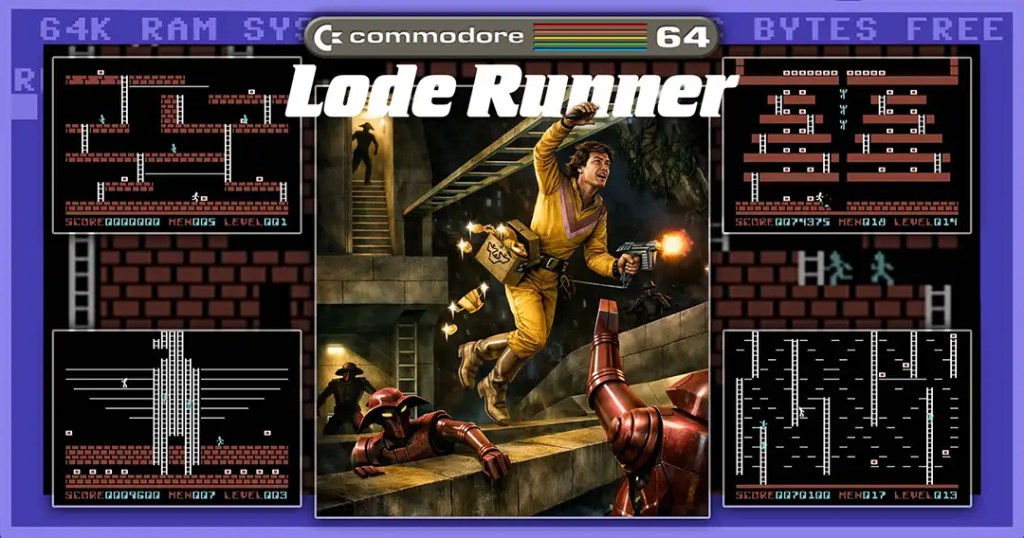
The quiet classic with depth
When “Lode Runner” was released on the Commodore 64 in 1983, the game seemed almost unremarkable at first glance: small characters, sober graphics, little show. But behind this simple surface lay one of the cleverest and most enduring games of its time. The C64 version not only offered the famous 150 levels, but also included an editor on disk that allowed players to build, test, and save their own boards – a remarkably advanced concept for the early home computer era.
Lode Runner was neither a pure action game nor a classic puzzle game. It combined quick reactions with planning, timing, and spatial awareness. Especially on the C64, where many titles focused more on arcade spectacle, this design seemed almost modern: less showmanship, more system depth. No wonder the game quickly became a title that many not only played, but literally studied.
Gameplay
The basic principle is simple and still brilliant today. The player controls the Lode Runner through a screen full of ladders, horizontal bars, blocks, and enemies. The goal is to collect all the gold boxes in a level. Only then does a previously invisible escape ladder appear, allowing the player to leave the level. Enemies patrol the screen at the same time, making every mistake immediately dangerous.
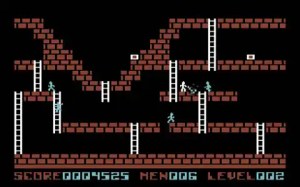
The real highlight is the ability to dig holes in certain floors to the left or right of the player. This allows enemies to be trapped for a short time or new paths to be opened. However, the holes close again after a short time. So if you plan poorly, you can not only free enemies, but also maneuver yourself into a dead end. This mechanic makes “Lode Runner” a game that looks like a platform game, but at its core is often more of a tactical puzzle.
In addition, enemies can pick up gold, sometimes changing the ideal solution. This ensures that levels do not always unfold in a completely mechanical way. The best moments in the game arise when planning and improvisation collide: you know the right route – until an enemy suddenly appears with a gold chest in a place where it shouldn’t be.
Technology
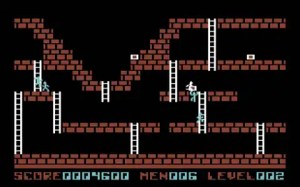
Technically, the C64 version shows very nicely how much effect could be achieved with limited resources. The display is clear, high-contrast, and functional. Characters and objects are small but easy to read. This visual reduction is a particular strength: in a game based on precise movement and quick comprehension of paths, overloaded graphics would have been more of a hindrance. Contemporary and later reviews describe the presentation as simple but functional and effective.
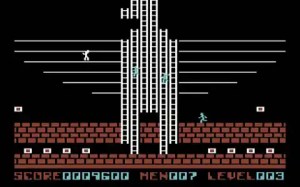
The implementation is also remarkably precise in terms of game mechanics. “Lode Runner” thrives on fixed rules: which floors can be dug up, how enemies react to holes, when ladders appear, and how the playing field can be read. The C64 implements this logic cleanly. Added to this is an unusually large scope: the master disk contains 150 different game boards, and after completing them, the game starts again with increased enemy speed, which, according to the manual, leads to a total of 1500 playable levels.
It is also interesting to note that there were both floppy disk and cartridge versions for the C64; the floppy disk version was particularly attractive because it supported more convenient handling of the many levels and the editor. The disk version is therefore still the one that, in retrospect, is mostly perceived as the “more complete” C64 experience.
Hidden disk blocks
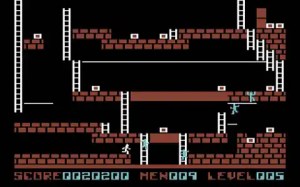
The hidden blocks in the C64 version also refer to the way data was organized on the original disk. This means not only invisible game elements in the level, but also areas on the data carrier that were not readily apparent when simply copying or quickly glancing at the disk structure. Such methods were common in the home computer era to make content less accessible and to make simple copying more difficult.
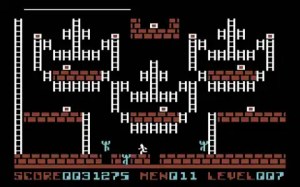
In “Lode Runner,” this fits well with the character of the disk version: it contained not only the many levels, but also editor and memory routines. When level data or administrative information was stored in a less obvious structure, it had a double effect. On the one hand, the boards were not immediately recognizable or directly editable by curious users, and on the other hand, this type of arrangement could also act as a simple form of copy protection.
It is important to note that this was usually not unbreakable high-end copy protection, but rather a clever technical hurdle. Hidden or unusually arranged disk blocks, special loading procedures, or data formats that were not immediately transparent were intended to prevent a standard copy from cleanly replicating all the characteristics of the original. Especially in a game like “Lode Runner,” whose value lay heavily in the quantity and structure of its levels, this was an obvious method of combining content protection and data carrier technology.
Level editor
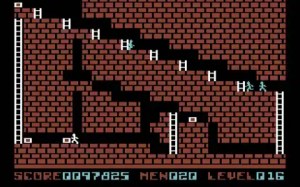
The level editor is one of the most important features of the C64 version. The manual calls it a “game generator”: players could not only play levels, but also design, move, delete, test, and save them on a prepared data disk. This was done entirely without any programming knowledge. You moved a cursor across the screen and used the number keys to insert the various building blocks: grabable ground, indestructible ground, ladder, horizontal bar, trapdoor, hidden ladder, gold, enemies, and player character.
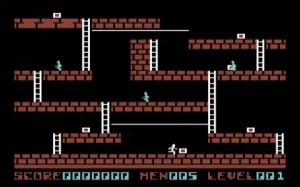
The systematic structure of the editor seems particularly modern. Custom boards had to be saved on an initialized data disk; up to 150 custom boards could be created in this way. The editor also allowed users to directly call up specific levels, swap or delete boards, and, of course, playtest. These tools made “Lode Runner” not just a finished product, but a small modular platform.
In retrospect, this is perhaps the most forward-looking aspect of the game. Today, user levels, modding, and creator tools are taken for granted. In 1983/84, however, it was unusual for a mainstream game to allow players to participate so openly in its design. This is precisely why Lode Runner is often cited in gaming history as an early precursor to later editor and construction kit ideas.
Criticism at the time
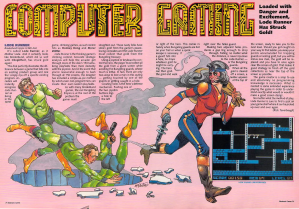
Contemporaries praised Lode Runner for two things in particular: its addictive nature and its unusual mix of action and thinking. Contemporary reviews emphasized that the game relied more on strategy and brainpower than on pure force or reflexes. The editor in particular was recognized early on as an outstanding feature.
Historically interesting is the comparison with the 1980 arcade game Space Panic. At first glance, Lode Runner seems like a title that has borrowed only a few ideas from it: ladders, platforms, hunting enemies, and digging traps. In fact, the connection goes deeper. “Lode Runner” doesn’t just borrow motifs, but consistently develops the basic principle of “Space Panic” further: the rather direct survival and trap-setting game becomes a precisely constructed system of pathfinding, item collecting, enemy control, and puzzle design. In this sense, Lode Runner is less inspired by Space Panic than it is a further development of the same design line in terms of game mechanics.
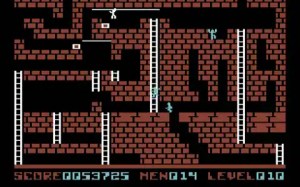
For the C64 version, a later summary of contemporary reviews is particularly revealing: Zzap!64 described the game as no longer brand new, but still one of the best and a future classic; while openly admitting that the graphics and sound were rather simple. But that was precisely the appeal: the playful quality clearly outweighed the audiovisual restraint.
Magazines such as Ahoy! also explicitly praised the C64 version as a first-class action game that required a quick mind as well as nimble hands. The key point is that critics at the time did not see “Lode Runner” as a technical gimmick, but as an excellently designed game system. This also explains why the title has weathered the typical aging process of many early home computer games better than some of the more pompous productions of the same period.
Cultural influence
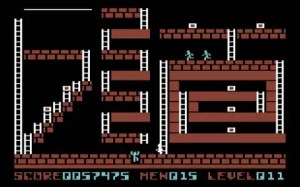
The cultural influence of Lode Runner is greater than the modest C64 presentation would suggest. The game was an international success; it sold in very high numbers early on, was converted into numerous versions, and developed an astonishingly strong aftereffect, especially in Japan. Several arcade and console spin-offs were created there, and the brand remained present for many years.
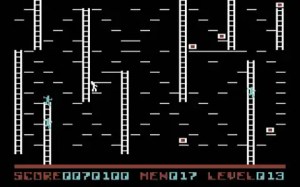
It is also noteworthy that Irem’s arcade version is considered the early or first adaptation of an American computer game into a Japanese arcade game. This shows how strongly the basic concept transcended platform boundaries. “Lode Runner” was not only a successful home computer title, but also a link between Western computer culture and Japanese arcade/console culture.
The influence of the editor was even more lasting. The fact that players could build, test, and share their own levels fostered an early form of community creativity. Later games with modular or user-generated content ideas may be in completely different technical worlds, but they follow the same basic idea: players don’t just consume content, they also produce it. From today’s perspective, this is what makes “Lode Runner” so astonishingly visionary.
Conclusion
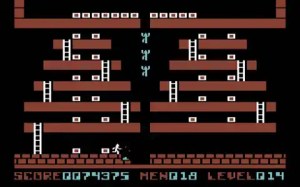
The C64 “Lode Runner” is a prime example of how a great game doesn’t have to be loud. It impresses not primarily with its graphics or sound, but with its clear design, intelligent rules, and editor-supported longevity. The 150 levels, the tricky digging, the hidden ladders, and the powerful level editor make it much more than an ordinary platform game.
On the Commodore 64 in particular, “Lode Runner” is one of those titles that embodies the appeal of the system particularly well: technically limited, but enormously rich in terms of gameplay. Those who define the C64 solely by large sprites, SID music, and fast-paced action easily overlook games like this. Lode Runner reminds us that the real magic often lay in the level design—and in the moment when a seemingly simple screen suddenly reveals all its secrets.








 McHenry's Lair
Kommentar verfassen :