

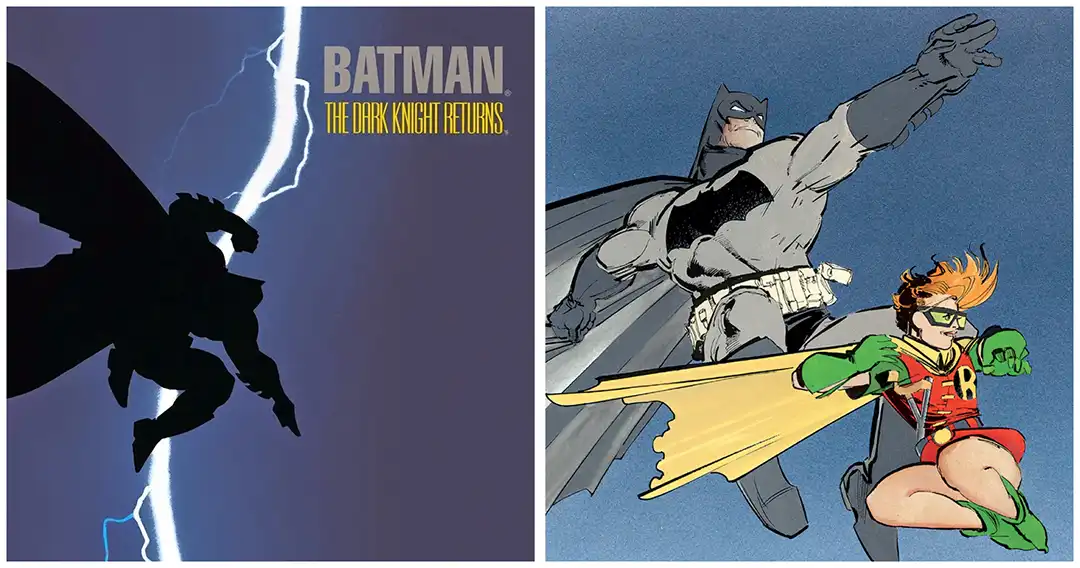
Let’s just say I’m glad you survived Batman’s retirement and
I was hoping you’d keep it that way.
The comic that redefined Batman
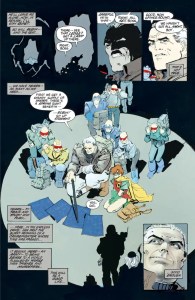
Forty years ago, “The Dark Knight Returns” was published, a comic book that not only changed the character of Batman, but also the entire superhero genre. Written and drawn by Frank Miller, colored by Lynn Varley, and lettered by John Costanza, the four-part miniseries was published by DC Comics in 1986. It presented an aged, physically scarred, and internally torn Bruce Wayne in a dystopian vision of the future – setting new narrative, visual, and thematic standards for the comic book medium.
In the mid-1980s, superhero comics were still largely considered escapist entertainment for a young audience in the mainstream. Although there had already been more serious tones, “The Dark Knight Returns” clearly pushed the boundaries. Miller told an uncompromising, politically charged, and deliberately provocative story about violence, media manipulation, state power, and moral ambivalence—topics that had rarely been dealt with in such a radical way in the superhero genre before.
The comic was created at a time of massive social tension. The Cold War dominated world politics, and the arms race between the US and the Soviet Union created an omnipresent fear of nuclear annihilation. At the same time, conservative values and a strong focus on security shaped the political culture of the Reagan era. All these influences are reflected in Miller’s bleak vision of the future. Batman does not appear here as a shining savior, but as a traumatized veteran who enforces his own uncompromising code in a morally depraved world.
The Plot
The story takes place in the near future, about ten years after Bruce Wayne hung up his cape. At 55, he is a broken man, physically scarred from past battles and emotionally empty without his nightly mission. Gotham City has descended into chaos during his absence. Crime, hopelessness, and social tensions dominate the cityscape. A brutal youth gang calling themselves “Mutants” terrorizes the streets and spreads fear.
At the same time, Harvey Dent, once Batman’s adversary Two-Face, appears to be cured after extensive surgery. The disfigured half of his face has been reconstructed, but he remains mentally unstable. When he falls back into old patterns of behavior, it becomes clear that the scars run deeper than any surgical correction.
Bruce Wayne increasingly realizes that his retirement was a mistake. The violence in Gotham is like a call he cannot ignore. Driven by inner demons, memories of his parents, and an insatiable need for control, he finally returns as Batman. His comeback is spectacular and deliberately staged. In an iconic moment, he rescues a victim from the mutants and announces his return to the city.
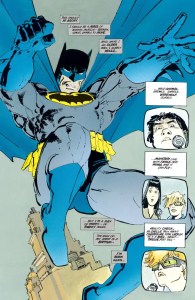
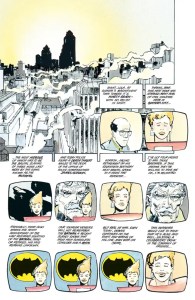
The media plays a central role in the narrative structure. Talk shows, expert panels, and news programs comment on Batman’s actions around the clock. Psychologists, politicians, and citizens discuss morality, law, and vigilante justice. Miller uses these interludes to portray a polyphonic, often cynical society that vacillates between sensationalism and moral outrage.
Batman first defeats Two-Face in a dramatic showdown that reveals that Harvey’s madness never really disappeared. He then confronts the leader of the mutants. In the first fight, the aging hero is physically defeated—a painful reminder of his limitations. But Bruce Wayne is not only a fighter, he is also a strategist. In a second duel, he uses experience, psychology, and tactics to publicly humiliate the mutant leader. This symbolic victory leads many members of the gang to join him and henceforth call themselves the “Sons of Batman.”
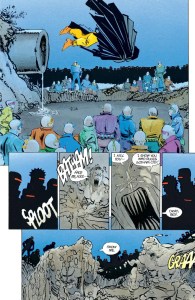
Meanwhile, the global political situation escalates dramatically. The US and the Soviet Union are on the brink of nuclear war. Superman is not portrayed here as an independent hero, but as a tool of the US government. He intervenes in international conflicts to protect American interests. When a nuclear explosion triggers an electromagnetic pulse, much of the United States descends into chaos. Power outages, looting, and panic dominate the scene.
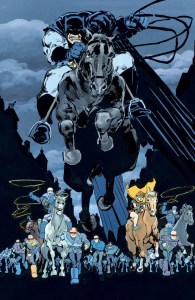
Under Batman’s leadership, however, Gotham becomes a bastion of relative order. With disciplined organization and a clear hierarchy, he manages to guide the city through the crisis. This development illustrates Miller’s ambivalent attitude: authoritarian structures appear both problematic and effective here.
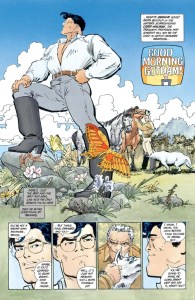
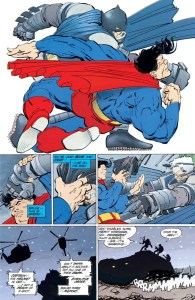
The ideological and emotional climax of the story is the duel between Batman and Superman. Under political pressure, Superman is supposed to stop the Dark Knight, who has spiraled out of control. Batman knows that he is physically inferior and prepares meticulously for the fight. With kryptonite, technical equipment, and the support of Green Arrow, he manages to bring Superman to the brink of defeat. In one of the most famous scenes in comic book history, Batman whispers in his opponent’s ear that he should always remember who defeated him.
Shortly thereafter, Bruce Wayne suffers a public cardiac arrest. The world believes he is dead. But it is all a ploy. He retreats into hiding with his loyal followers to train a new generation underground, determined to bring about more profound change in the long term.
Origin story
Frank Miller had already made a name for himself with his work on “Daredevil.” There, he revitalized a previously rather marginal character and established a dark style heavily influenced by film noir and hardboiled crime novels, which focused on moral ambivalence, urban violence, and existential conflicts. His clear, high-contrast visual language and his flair for dramatic climaxes quickly earned him a reputation as an innovator of the superhero genre. At DC Comics, he was finally given the opportunity to develop a standalone Batman story outside of the regular continuity—a creative freedom that allowed him to make radical decisions in terms of content and form without having to take long-term series requirements into account.
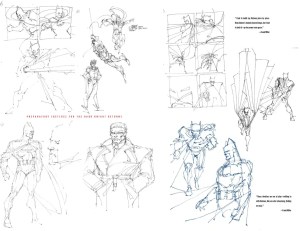
Miller wanted to take the character back to his roots: Batman as a fearsome, almost mythical figure of the night, less a colorful adventurer than an urban legend. He was particularly attracted to the idea of showing the hero not at the height of his powers, but at the end of a long, exhausting career. At the same time, he was interested in the question of what would become of such a person in old age. How does someone who has devoted their entire existence to an uncompromising crusade against crime continue to live? What physical traces, what psychological scars does a life in a permanent state of emergency leave behind? This consistently thought-out psychological perspective formed the core of the project and gave the story a depth unusual for the genre.
Formally, Miller experimented with innovative narrative techniques that clearly set the comic apart from conventional superhero stories. The inclusion of television talk shows, news tickers, street vignettes, and expert commentary gave the plot a fragmented, modern structure that reflected the influence of mass media on public perception. Plot and commentary intertwine to create a multi-layered panorama of social voices. Lynn Varley’s color design supported the dark atmosphere with expressive contrasts, cold blue tones, and aggressive lighting accents that heightened the emotional intensity of individual scenes. The publication in a prestigious format – larger, printed in higher quality and on better paper – was also a deliberate signal: “The Dark Knight Returns” was not to be perceived as an ordinary comic book, but as an extraordinary, almost literary event.
Trivia and special features
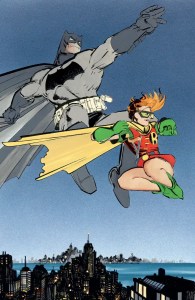
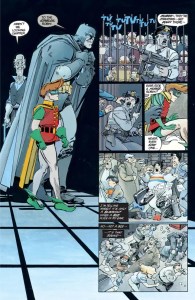
With Carrie Kelley, Miller introduced a new Robin character – young, courageous, independent, and endowed with a down-to-earth attitude unusual for the genre. Unlike previous Robins, she is not a circus acrobat or a tragic reflection of Bruce Wayne’s trauma, but a teenager who chooses Batman out of conviction and admiration. She was the first female incarnation of this role in the mainstream Batman canon and quickly became a fan favorite. Her pragmatic nature, technical skills, and unwavering optimism form a deliberate contrast to the embittered, aging Bruce Wayne and add an extra emotional layer to the story.
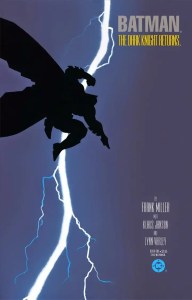
The cover featuring Batman’s black silhouette against a bright flash is now considered one of the most iconic motifs in comic book history. The reduction to a powerful, graphic composition – a massive body silhouette against a bright, jagged light – programmatically reflects the content: a focus on the essentials, raw energy, and an almost mythical elevation of the character. It symbolizes Batman’s radical reorientation from colorful adventurer to dark legend and has been quoted, varied, and honored countless times.
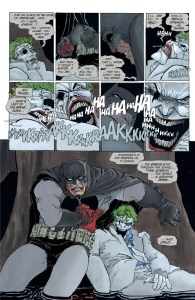
The portrayal of the Joker, who awakens from catatonic rigidity as soon as Batman returns, is also one of the most impressive elements of the story. Miller stages him as a grotesque, yet frighteningly clear figure whose existence is directly linked to that of the Dark Knight. This interpretation emphasizes the symbiotic, almost parasitic relationship between hero and villain: Without Batman, the Joker seems meaningless, but with him, he blossoms with destructive energy. Their confrontation is thus portrayed less as a classic battle between good and evil and more as a tragic dependence between two extremes.
The uncompromising depiction of violence and the political dimension also ensured that the comic was repeatedly the subject of academic analysis. Questions about vigilantism, authoritarianism, the media’s portrayal of violence, and the role of the state in the superhero genre are still being discussed today. Literary and cultural scholars examine the work as a reflection of the time in which it was created, as well as a timeless example of the deconstruction of a myth.
Reviews at the time
Upon its release, the comic was enthusiastically received by many critics. Particular praise was given to its psychological depth, the visual power of the drawings, and its narrative innovation. Reviewers emphasized how consistently Miller deconstructed the character while at the same time returning him to his dark origins. The complex page architecture, cinematic dramaturgy, and experimental use of media inserts were also seen as evidence of a new artistic maturity in the medium. Numerous critics saw the work as proof that comics can have literary and social relevance and no longer need to be limited to pure genre conventions.
At the same time, there were critical voices that viewed the work with skepticism. Some felt that the depiction of violence was exaggerated or an expression of a problematic zeitgeist that glorified harshness and authority. Others were bothered by the political dimension of the story, especially the ambivalent portrayal of state power and vigilante action. The depiction of Superman as an agent loyal to the government sparked intense discussions among fans who missed the character’s classic idealism and moral optimism. For some readers, this reinterpretation represented a bold update, while for others it was a deliberate provocation.
In retrospect, however, “The Dark Knight Returns” is almost unanimously regarded as a milestone that, together with other significant works of the 1980s, ushered in a new era. The initial controversies now appear to have been part of a productive discourse that advanced the medium in a lasting way. The work is now considered not only stylistically influential for later Batman stories, but also a key text for understanding the development of modern superhero comics as a whole.
Cultural influence
The influence of comics on pop culture cannot be overestimated. “The Dark Knight Returns” ushered in a phase in which superheroes were portrayed as increasingly complex, broken, and political. Antiheroes, inner conflicts, and moral gray areas came more into focus, supplanting the black-and-white thinking that had previously dominated many genre narratives. From then on, characters no longer had to be flawless to be considered heroes; instead, doubts, traumas, and ideological tensions became central components of their characterization.
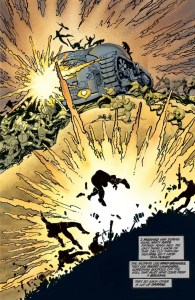
Later comic book authors deliberately adopted Miller’s tone and visual language or engaged with it productively. The edgy panel dramaturgy, the expressive physicality of the characters, and the harsh, often laconic inner dialogue influenced numerous Batman series in the following decades. The work also left a clear mark on film. The idea of an older, embittered Batman reaching his physical limits, as well as the emphasis on the realistic consequences of violence, found their way into modern interpretations of the character. In addition, Miller’s portrayal of a conflictual relationship between hero and state influenced later adaptations in which superheroes not only fight villains, but also political systems or social expectations.
Furthermore, the series influenced the understanding of what graphic novels can achieve. “The Dark Knight Returns” was increasingly perceived not only as entertainment, but as a serious narrative commenting on society. Libraries and arts sections began to increasingly consider comics as culturally relevant publications. In academic contexts, the work served as an example of the literary and visual complexity of the medium. In this way, the series contributed significantly to consolidating the reputation of comics as a serious art form and paving the way for ambitious, adult material in the mainstream.
Use of scenes in DC films
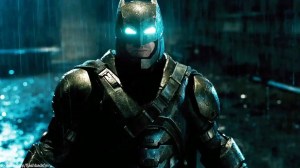
The influence is particularly evident in Batman v Superman: Dawn of Justice. Batman’s armored suit in his battle against Superman is visually strongly based on Miller’s template and adopts its massive, angular design almost unchanged. The staging of the duel – from the nighttime setting to the use of kryptonite to the physical force of the blows – also references central image compositions from the comic. Even individual moments of dialogue and the basic characterization of an older, more cynical Bruce Wayne draw on motifs from “The Dark Knight Returns.” The dark, desaturated color palette and the emphasis on Batman’s physical presence and tactical superiority are immediately reminiscent of Miller’s interpretation of the character.
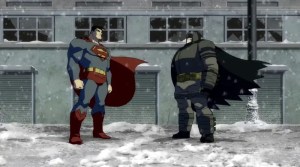
The two-part animated film adaptation also stayed very true to the original story and made it accessible to a new audience who may not have read the source material. Many panels were translated almost one-to-one into moving images, preserving the visual power of the original. Individual motifs – such as the fight in the rain, Batman’s strategic preparation for overpowering opponents, or the iconic confrontation with Superman – have become an integral part of the iconic imagery surrounding the character. In addition, echoes of Miller’s aesthetic can also be seen in other DC productions, further underscoring the lasting influence of the work on the cinematic image of Batman.
Conclusion
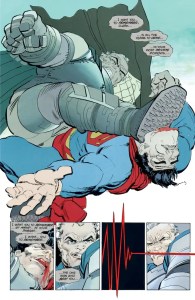
Four decades after its publication, “The Dark Knight Returns” remains a central reference point in comic book history. Hardly any other work has so lastingly shifted the perception of an iconic figure and at the same time changed the self-image of an entire genre. Frank Miller not only created an alternative vision of Batman’s future, but also posed fundamental questions about power, control, responsibility, and the role of the individual in the state. He confronted readers with the uncomfortable possibility that heroism and authoritarianism, idealism and obsession are closer together than classic narrative patterns suggest.
The work permanently changed the way superheroes can be portrayed. It proved that the genre offers scope for political reflection, psychological depth, and formal experimentation without losing its mythological power. Miller’s Batman is not a simple figure of identification, but a complex, contradictory symbol—both a beacon of hope and a warning. It was precisely this ambivalence that made the story so influential and opened up new creative possibilities for subsequent authors. Without this comic, many modern interpretations—whether in comics, films, or video games—would be inconceivable, as it showed how far familiar characters can be stretched without completely losing their core.
On its 40th anniversary, one thing is certain: “The Dark Knight Returns” is far more than a Batman story. It is a turning point in pop culture, a work at the intersection of entertainment and social commentary, of myth and deconstruction. Even after four decades, it has lost none of its impact. Its images remain present, its themes astonishingly topical, its questions unanswered – and therein lies its enduring relevance.






Schreibe einen Kommentar