

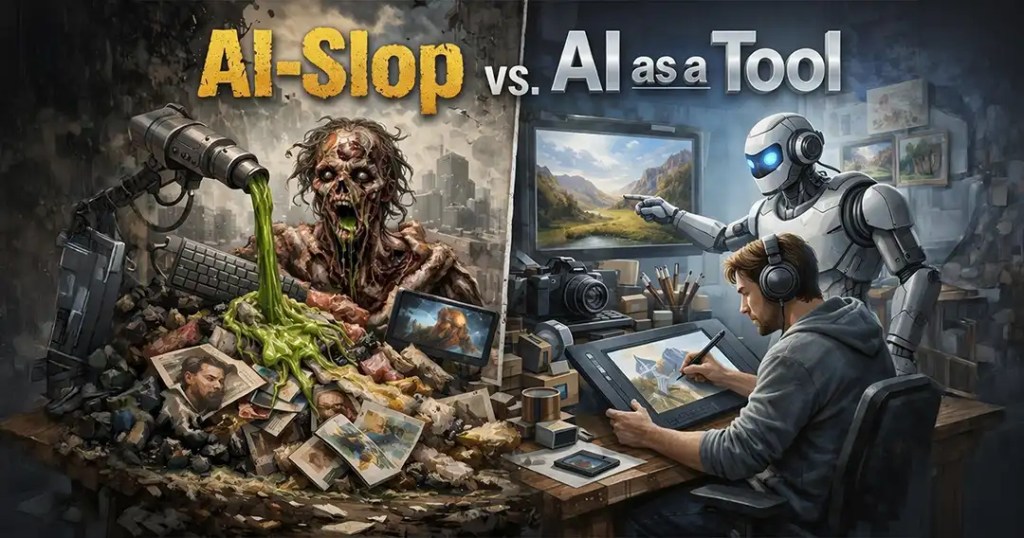

An important topic—and something that many (too many) people misunderstand: AI slop.
I notice it particularly on YouTube, but it’s also the case on other platforms: the extreme increase in so-called „AI slop.“
By this I mean quickly produced, unchecked, inferior mass-produced images, videos, texts, music, etc. On YouTube, „documentaries“ (it hurts to call them that) are particularly popular. You choose a topic – or even let the AI suggest one. The AI creates a text about it, then you let the AI gather video snippets from the internet. You paste the whole thing together and have the AI read the text aloud. And just like that, in less than 30 minutes (20 of which is waiting for the AI), the YouTube clickbait video „Biggest Box Office DISASTERS of 19XX“ is ready. Upload it unseen – and the money starts rolling in.
Two problems:
Firstly, it’s noticeable. For example, in the pronunciation: strange emphasis on punctuation in film titles; „in the year 1980“ is pronounced as „in the year one thousand nine hundred eighty“; „the 80s“ becomes „the 80 seconds,“ etc. Added to this are incorrect video clips—and not only when there are several films with the same title. And, of course, research errors in general.
All things that would be noticeable with a simple review before uploading. But why invest the time? People watch it anyway—and the money keeps flowing.
The much bigger problem is that this garbage further damages the image of AI among the general population. The mainstream press seems to enjoy spreading half-truths and misinformation, especially when it comes to AI. And after job losses and deepfakes, it’s now AI slop content that’s supposed to show how evil and pointless AI tools are.
I am writing this article to set the record straight.
First, let me clarify:
Yes, I use AI tools for my projects! (including for this text)
But I consciously check how I use AI in my projects (blog articles, text, images, videos, etc.). I deliberately select the prompts, and the result is always checked for content and revised manually. I check for research errors; whether the statement/wording corresponds exactly to what I want to express; whether the details in the image are exactly as I imagine them; etc.
As a result, I may work on some projects for days or even weeks. Or that I give up after dozens of attempts and write the text myself from scratch – or build the image myself from scratch. I have open projects that I have been working on (regularly) for over 1 1/2 years because the results I have gotten from AI so far do not meet my expectations.
For my blogs, I often write down my idea for the article RAW (literally): as bullet points, half-sentences, without regard to grammar, etc. – unfiltered, just as they come into my head. Then I let the AI turn it into a coherent, readable text. Of course, I have to check and adjust it afterwards to ensure that the message – and especially the tone I want to convey – is preserved. This article was created in exactly the same way.
Or I let the AI do the research first. It can search the internet faster than I can and compare or summarize the results. Then I already have a bunch of material and don’t have to start with the famous, daunting blank page. After that, I continue with the usual: checking, looking up anything that stands out, adjusting, revising the tone, etc.
It’s well known that AI can make mistakes when researching. And as long as you check, recognize, and adjust, that’s not a problem. For example, in „C64: Beach-Head,“ the AI incorrectly described the content of the individual levels. Or it misrepresents movie plots because it mixes them up with other movies.
AI is a tool: nothing more, nothing less!
For me, AI tools such as ChatGPT, Grok, and DeepL are nothing more than tools—comparable to Photoshop, word processing software, search engines, or Encyclopedia. They support, expand, and accelerate my creative and editorial process, but they don’t replace it.
The key point here is that I don’t delegate thinking to AI, but use it to reach my goal faster. It can improve wording, bring structure to chaotic notes, or provide ideas that I might not have come up with myself right away.
It’s like an assistant, a researcher, an editor—it advises and supports me, but I control it.
And that’s exactly where I see the difference between AI slop and AI as a tool.
AI-generated content is soulless.
AI-generated content is boring.
AI-generated content requires little effort.
AI-generated content is repetitive.
AI-generated content is a waste of time and resources.
AI as a tool to promote human creativity.
AI as a tool can automate repetitive tasks.
AI as a tool can help with brainstorming.
AI as a tool can increase efficiency.
AI as a tool can be a powerful tool when used correctly.








 McHenry's Lair
Kommentar verfassen :