

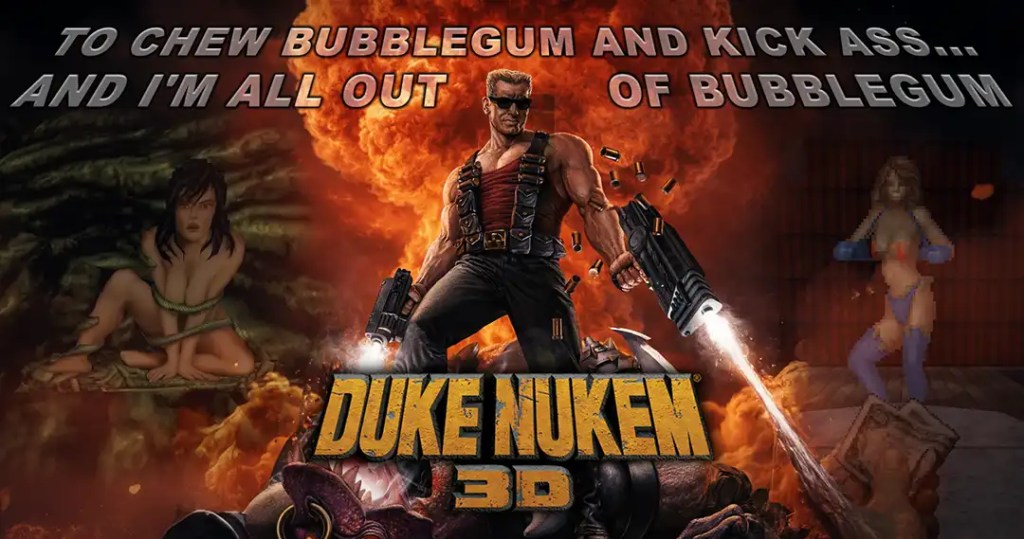
To chew bubblegum and kick ass… and I’m all out of bubblegum
… and I’m all out of bubblegum.
In 1996, Duke Nukem 3D burst onto the PC gaming scene like a bad-tempered action hero and turned many of the genre’s conventions upside down. At a time when first-person shooters often consisted of gray corridors, clearly defined arenas, key searches, and endless waves of enemies, Duke relied on attitude, pithy one-liners, and a game world that felt surprisingly lively, playful, and tangible. The player was not just a shooter, but part of an interactive action setting full of details, gags, provocations, and deliberate transgressions.
Within the first few minutes, it became clear that Duke Nukem 3D wanted to be more than just another representative of its genre. The title presented itself as confident, loud, and irreverent, poking fun at both movie action heroes and its own medium. Three decades later, the game is considered a milestone in gaming history – not despite, but precisely because of its exaggerations, its humor that pushes the boundaries, and its uncompromising self-confidence. Duke Nukem 3D was never subtle, nor did it want to be, and thus defined its own unique style that clearly set it apart from the competition.
Save the babes
The story is very simple: after an alien invasion, the invaders kidnap our “babes,” prompting Duke Nukem to set out as their self-appointed savior. The plot is only roughly sketched out and is mainly conveyed through environments, enemies, and Duke’s comments, while the journey takes you from destroyed cities to grotesque alien bases. This minimalist narrative style keeps the focus clearly on action, pace, and the feeling of being part of an over-the-top 90s action movie.
In terms of gameplay, Duke Nukem 3D combined straightforward, fast-paced shooting with a level of environmental interactivity that was unusual at the time. Light switches clicked, toilets flushed, sinks overflowed, mirrors reflected the player character – and almost every room seemed to hide a little secret. The level design encouraged players to search corners, test walls, and experiment with the environment instead of just running linearly from A to B and taking out enemies.
This openness made the levels feel like real places: movie theaters, bars, police stations, hotels, and subway stations didn’t just feel like backdrops, but like functioning spaces with their own logic. Doors could be blown open, alternative paths discovered, and entire sections of levels bypassed. Duke Nukem 3D rewarded attention and experimentation, giving players the feeling of being clever rather than just trigger-happy.
Duke’s arsenal of weapons contributed significantly to the variety of gameplay. In addition to classics such as shotguns and rocket launchers, the shrink ray, pipe bombs, freeze gun, and devastator rockets ensured creative battles. Enemies could be shrunk and trampled, frozen and smashed, or taken out with explosive charges from a safe distance. This made the battles feel less mechanical and much more playful than in many other games of the genre.
The treatment of sexuality and provocation was both controversial and influential. Strip clubs, suggestive posters, and the babes were part of a deliberately exaggerated, satirical portrayal that sought to provoke and reflected the spirit of the times. In the 1990s, this mix of macho humor, irony, and transgression fit in with the self-image of many action movies and games, making Duke Nukem a caricature of the exaggerated action hero. Even back then, the line between satire and bad taste was deliberately thin.
The Build Engine
Technically, the shooter impressed with the Build Engine, which did not yet offer true polygonal 3D, but used clever tricks to create a previously unattainable sense of space. Sophisticated level design created an illusion of depth that gave the game a new spatial credibility. Height differences, sloping planes, elevators, glass surfaces, and dynamic lighting created levels that felt organic and believable, generating a much stronger sense of immersion than many contemporary titles. The game world felt less like an abstract obstacle course and more like a coherent, functioning space.
Particularly noteworthy was the high degree of interactivity that the engine enabled, which clearly set Duke Nukem 3D apart from the competition. Compared to other popular engines of the time, the Build Engine focused less on technical purity and more on gameplay possibilities: while many shooters still relied heavily on clearly defined, flat level structures, Build allowed for complex spaces, vertical planes, and believable locations that felt like real places. Destructible objects, movable level components, switches, doors, and reactive environments conveyed the feeling of moving through real locations rather than abstract arenas. Many elements reacted immediately to the player’s actions, reinforcing the feeling of control and presence within the game world. At the same time, the game ran smoothly on the hardware of the time, which also made Duke Nukem 3D a showcase project from a technical standpoint. The comparatively accessible tools also laid the foundation for an active modding and mapping community that provided the title with new content, experiments, and their own ideas for years to come.
Easter eggs and curiosities
Duke Nukem 3D is a real treat for explorers and detail lovers. Hidden throughout the game are movie quotes, pop culture references, self-deprecating allusions, and absurd jokes that underscore the game’s anarchic humor. Particularly striking are the numerous Easter eggs that deliberately refer to other games and movies: Allusions to Doom, hidden references to Terminator, and tongue-in-cheek quotes from action and sci-fi classics of the 80s and 90s are scattered throughout many levels. Entire areas are optional and reward curious players with ammunition, items, or simply a good laugh, often accompanied by a tongue-in-cheek comment or a surprising situation.
Even seemingly mundane actions such as drinking from a tap, shooting surveillance cameras, operating light switches, or interacting with slot machines conveyed a new sense of freedom and self-determination at the time. The game world responded to the player and invited them to play with it rather than just pass through it. Many of these little gimmicks later became standard in the genre, but here they still felt fresh, cheeky, and experimental, contributing significantly to Duke Nukem 3D’s identity as an interactive action playground.
Between enthusiasm and frowns
Contemporary reviews praised above all the game’s fast pace, creative level design, and technical sophistication. In particular, the lively environments, high interactivity, and enormous fun factor were repeatedly highlighted. Many magazines emphasized how fresh and unspent Duke Nukem 3D felt compared to the competition and saw it as a clear evolutionary step for the first-person shooter genre.
At the same time, the high level of violence, sexualized content, and Duke’s deliberately exaggerated macho behavior sparked controversial discussions in the media, debates on the protection of minors, and in parents‘ homes. Moral debates accompanied the game’s success from the very beginning, but were unable to slow it down. Despite – or perhaps because of – these provocations, Duke Nukem 3D became a commercial success and an integral part of countless LAN parties. Especially in multiplayer mode, the title quickly became a classic that strengthened friendships, created heated rivalries, and pushed keyboards and nerves to their limits.
An antihero shapes a genre
Duke Nukem 3D impressively demonstrated that first-person shooters could be more than just shooting galleries. Humor, personality, and a credible, interactive world came more into focus and had a lasting influence on numerous later games. The shooter proved that a protagonist could have character and didn’t have to function as an anonymous game character – even if that character was deliberately exaggerated, arrogant, and provocative.
Duke’s sayings, his attitude, and his iconic appearance quickly became his trademark and found their way into the pop culture of the 1990s and later into the meme history of the internet. Duke Nukem became a projection screen for a certain zeitgeist that combined coolness, irony, and exaggeration. Even though later spin-offs of the series were unable to replicate the original success, the influence of this one game remains undeniable. Many design decisions in modern shooters – from interactive environments to more elaborately designed characters – can still be traced back to Duke Nukem 3D.
Hail to the King
Thirty years later, Duke Nukem 3D is clearly recognizable as a child of its time: loud, provocative, politically incorrect, and technically groundbreaking. The title openly displays the spirit of the 90s – an era in which boundaries were deliberately pushed and coolness was often more important than sensitivity. Not everything has aged well, and some things seem more strange than cool today, but it is precisely these rough edges that reveal the historical context of the game.
The important thing is that the heart of the game – the playful freedom, the creative level design, and the irreverent, often self-deprecating humor – is still going strong. Duke Nukem 3D still invites players to explore levels, break rules, and have fun interacting with the game world instead of just mechanically working through enemies.
Duke Nukem 3D thus remains an important milestone in shooter history and a defining document of the 1990s. Duke himself became an icon of this gaming era: a digital action hero who combined coolness, irony, and exaggeration and helped shape the self-image of an entire generation of gamers. To this day, the game shows how much style, technology, and attitude can influence a genre. Hail to the King.








 McHenry's Lair
Kommentar verfassen :