


The Masterpiece of the Atari 2600

Yars‘ Revenge is a milestone in video game history and one of the most iconic titles for the Atari 2600 console, frequently cited as a defining example of early console creativity. The fixed shooter game was developed in 1982 by Howard Scott Warshaw and published by Atari, Inc., at a time when the home video game market was rapidly expanding and technical limitations forced developers to rely on ingenuity rather than raw processing power. It marked Warshaw’s debut at Atari and arose from an initial instruction to port the arcade hit Star Castle—a task that Warshaw deemed impossible given the limited memory, display resolution, and performance capabilities of the Atari 2600. Rather than abandon the project, he chose a bold alternative approach. Instead, he created an entirely new concept under the working title Time Freeze, carefully designing gameplay systems that embraced abstraction, asymmetry, and constant motion while still delivering fast-paced, high-tension action, and this vision was released as a finished product in May 1982. The story is set in the Razak solar system: the fly-like Yars, descendants of radioactively mutated houseflies, seek revenge on the Qotiles, a mysterious mechanized enemy that has destroyed their home worlds, blending pulpy science fiction themes with arcade-style immediacy. A special highlight was the accompanying comic book Yars‘ Revenge: The Qotile Ultimatum, based on Warshaw’s own 10-page story, which expanded the game’s narrative universe and, for the first time, prominently featured an Atari programmer (Warshaw) on the cover—an unusual and influential acknowledgment of individual game creators at the time. With over a million units sold worldwide, it became the best-selling original game for the Atari 2600, securing its place as both a commercial triumph and a lasting cultural landmark.
Gameplay
At its core, Yars‘ Revenge is a single-screen shooter in which the player controls the Yar—an agile, fly-like unit—that can be moved freely in all directions with a strong sense of momentum and responsiveness. The screen wraps vertically, meaning the Yar seamlessly exits at the top or bottom and reappears on the opposite side, encouraging constant motion and spatial awareness rather than static positioning. The primary objective is to break through the Qotile’s protective energy shield—displayed as an arc or rectangular grid of destructible cells—by either firing energy shots or deliberately “nibbling” the cells away, a risky but rewarding tactic that requires close proximity to danger. Once a sufficient opening has been carved into the shield, the player can summon the powerful Zorlon cannon—a pulsating, screen-spanning fireball that travels horizontally across the playfield and must strike and destroy the Qotile to complete the stage.
Opposing the player, the Qotile continuously fires Destroyer missiles and periodically unleashes deadly Swirls, whirling disc-like enemies that actively chase the Yar and force rapid evasive maneuvers. A central neutral zone, also known as the ion zone, provides temporary protection against incoming missiles but comes at a cost, as it prevents the Yar from firing weapons while inside it, creating a constant tension between safety and offense. As the player’s score increases—most notably after thresholds of 70,000 and 230,000 points—the game escalates in difficulty: Swirls appear more frequently and move faster, enemy pressure intensifies, and the Qotile’s shield changes color from blue to gray to pink as a visual indicator of rising challenge. Seven gameplay variants further deepen replayability by offering customized parameters such as speed adjustments or the popular “Ultimate Yars” mode, in which the Zorlon cannon ricochets across the screen and players must collect trons (energy units) to summon it. Control is handled through a single joystick and fire button, yet the simplicity masks surprising depth, as difficulty switches subtly affect swirl behavior, collision detection, and overall pacing, making mastery dependent on precision, timing, and risk management.
Technology
Yars‘ Revenge makes masterful use of the Atari 2600 hardware, pushing the console to its conceptual limits through highly optimized programming techniques. With only the TIA chip responsible for both graphics and sound and a mere 128 bytes of RAM available, every visual element and audio cue had to be carefully planned and reused wherever possible. Symmetrical graphics play a crucial role in conserving ROM space, as only one half of many on-screen objects needs to be stored in memory and then mirrored in real time by the hardware. The sparkling neutral zone stands out as a particularly ingenious trick: the scrolling program counter—often referred to as overlay or self-modifying code—intentionally reads changing memory values, generating pseudo-random data that produces the iconic glittering effect without requiring dedicated graphic assets. This technique exemplifies Warshaw’s deep understanding of the machine’s timing-sensitive architecture and his ability to transform technical constraints into distinctive visual flair. Sound effects are equally purposeful and far from simple bleeps; they dynamically reinforce player tension and rhythm, with shifts in pitch and intensity corresponding to movement, incoming Swirls, explosions, and imminent danger. Together with the Qotile’s color changes, these audiovisual cues overwhelm the senses just enough to draw the player into a sustained “flow state,” where reaction and intuition take precedence over conscious thought. Today, complete disassemblies of the game exist for reverse-engineering enthusiasts, who closely analyze the kernel—the cycle-accurate display code—to better understand how such complex behavior was achieved on such primitive hardware, cementing Yars‘ Revenge as a case study in early video game engineering brilliance.
Trivial
- The name “Yars” is “Razak” (from Atari CEO Ray Kassar) spelled backwards—a subtle in-joke and sci‑fi homage that reflects the playful, experimental culture inside Atari at the time, while also giving the alien species a name that felt suitably otherworldly.
- Warshaw developed the game in approximately nine months, an intense and focused production cycle that involved extensive hands-on playtesting both inside and outside Atari. He later noted that the distinctive “nibbling” mechanic—where the Yar consumes pieces of the enemy shield—proved especially appealing to women players, partly because of its tactile, almost “oral” interaction style, drawing frequent comparisons to the pellet-eating appeal of Pac-Man.
- Hidden Easter eggs appear in Warshaw’s later Atari titles, with Yars-themed graphics or references embedded in Raiders of the Lost Ark and E.T., serving as personal signatures and rewarding observant players with a sense of continuity across his body of work.
- Yars‘ Revenge was the first Atari game to prominently credit its programmer on the box and in the accompanying comic book, a groundbreaking move at a time when Atari typically treated developers as anonymous. This recognition helped inspire later creator-forward projects such as Swordquest and contributed to shifting industry attitudes toward authorship and creative ownership.
- Warshaw also envisioned a full arcade adaptation of Yars‘ Revenge as well as a direct sequel titled Saboteur, which was later reworked under an A-Team license. Neither project ultimately materialized, but their existence highlights Atari’s early ambition to expand the Yars universe beyond its original cartridge and into a broader multimedia franchise.
Reviews at the time
Upon its release in 1982, Yars‘ Revenge received mostly positive reviews for its originality and strong addictive qualities, even as some critics pointed out a degree of repetitiveness inherent in its single-screen structure. Electronic Games (October 1982) praised the title’s excellent sound design and acceptable, if restrained, graphics, noting that the audiovisual presentation was unusually effective for the Atari 2600; however, the magazine also criticized the game’s relatively static playfield and limited variety, and in a follow-up rating published in November it was labeled “mediocre” when judged against rapidly evolving arcade standards. Video Games (October 1982) likewise complimented the graphics and sound effects, but expressed reservations about the cyclical nature of the levels and the lack of clear progression beyond increasing difficulty. Outside the United States, reception was often more enthusiastic: French magazine Tilt (Nov/Dec 1982) described the game as both addictive and revolutionary, emphasizing its originality and intense pacing. Ken Uston, writing in Guide to Buying and Beating (1982), celebrated its “superior graphics” and compulsive gameplay, recommending it as a standout cartridge for serious players. Taken together, contemporary reviews positioned Yars‘ Revenge as a so-called “sleeper hit”—a game that may not have impressed every critic at first glance, but one whose depth, tension, and replayability gave it substantial long-term playability potential.
Cultural influence
Yars‘ Revenge shaped the 2600 era and lives on in numerous remakes, reinterpretations, and homages that demonstrate its enduring appeal across multiple generations of players. These include Yars‘ Return (2005, Flashback 2), which revisited the original mechanics for dedicated retro hardware; Yar’s Revenge (2011), a visually stylized Xbox Live Arcade rail shooter that reimagined the concept in a modern, narrative-driven form; Yars: Recharged (2022), which blended classic single-screen design with contemporary audiovisual effects; Yars Rising (2024), a WayForward-developed Metroidvania that expanded the universe into exploration-driven territory; and Yars‘ Revenge Reimagined in Atari 50 (2022), which paid respectful tribute while updating the presentation for modern audiences. Beyond remakes, ports to platforms such as the Game Boy Color (1999), Game Boy Advance, PSP, and various digital compilations helped ensure the game’s continued accessibility long after the original Atari 2600 hardware faded from mainstream use. The Yars concept also inspired comics and references in other Atari-era titles, reinforcing its status as a recognizable franchise rather than a single isolated game. Frequently appearing on retro “best of” lists—including a #5 ranking in Retro Gamer (2008)—the title is widely regarded as a benchmark of early console design. Warshaw’s legacy, spanning from the genius behind the Atari 2600’s best-selling original cartridge to the much-debated creator of E.T., underscores his lasting influence on video game history and the evolving perception of authorship in the medium.
Conclusion
Yars‘ Revenge remains a brilliant example of creative hardware mastery and innovative design achieved under remarkably primitive technical conditions, standing as a testament to what disciplined imagination can accomplish within severe constraints. Despite its simple visuals and limited color palette, the game captivates players with intense, almost hypnotic action, cleverly interlocking mechanics, and a finely tuned risk–reward structure that consistently encourages experimentation, learning, and skill development over repeated play sessions. Its enduring replayability stems not from surface-level content variety or narrative progression, but from the depth and elegance of its systems and the escalating psychological pressure it places on player reflexes, timing, and moment-to-moment decision-making. As a result, Yars‘ Revenge stands as a timeless classic that not only pushed the limits of what was thought possible on the Atari 2600, but also helped shape the design sensibilities, creative ambitions, and expectations of generations of gamers and game developers alike, influencing how constraint-driven design is understood even decades later.
More
Box and Cartridge
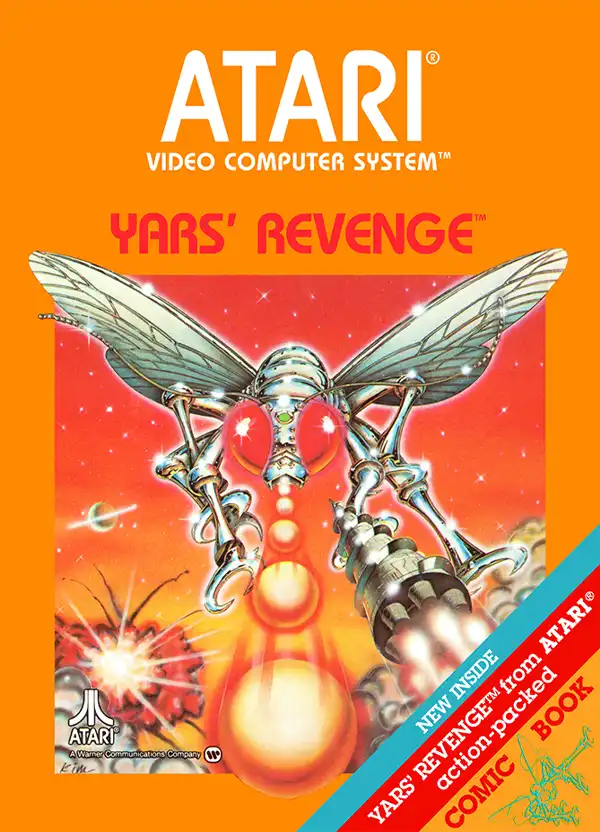
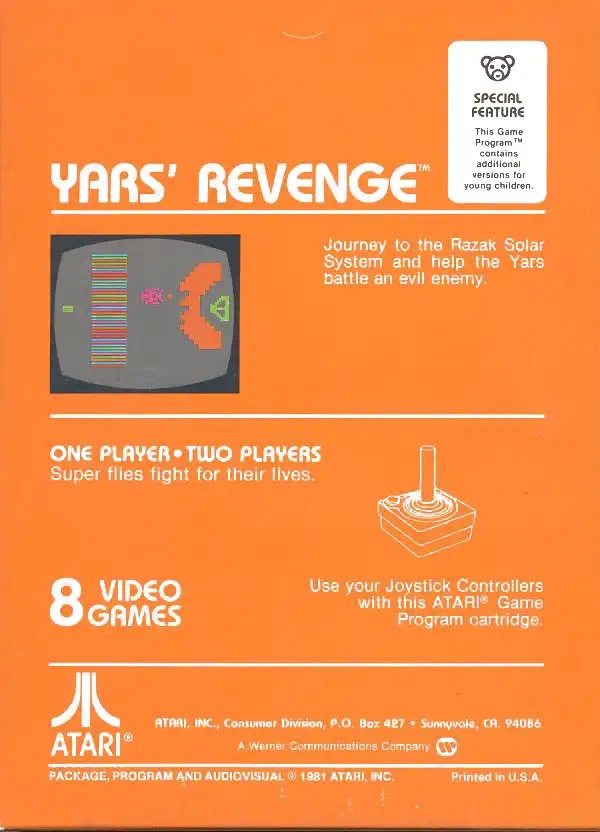









 McHenry's Lair
Kommentar verfassen :