


An early game from Activision

Fishing Derby is a fishing game for the Atari 2600, published by Activision in 1980. It belongs to the first generation of games from the then fledgling publisher, which was founded by former Atari programmers who were dissatisfied with the corporate policy of their former employer. This split marked an important turning point in the early video game industry, as developers wanted to be perceived more as creative authors for the first time. From the outset, Activision set itself the goal of developing games with higher quality, clear authorship, and greater playability, deliberately distancing itself from the rather anonymous mass production of many Atari titles.
The first four from Activision
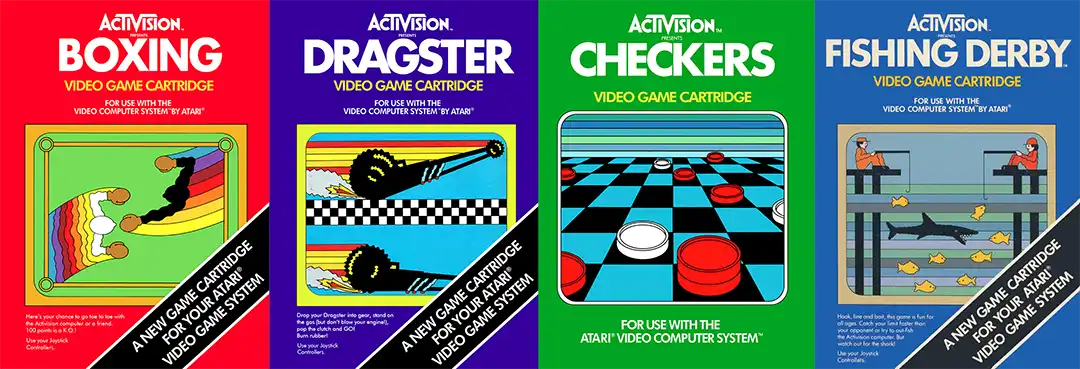
At a time when many console games seemed extremely simple or technically crude, Activision sought to bring more personality, competition, and playful depth to its productions. Instead of pure reaction games, the aim was to create titles that encouraged social interaction and kept players engaged for longer. Fishing Derby is a particularly good example of this: the game is easy to understand, immediately accessible, and yet consistently designed for multiplayer fun. It was precisely this mixture of simplicity, direct competition, and clear design that made it a typical representative of the early Activision philosophy and contributed to its lasting recognition value.
Gameplay
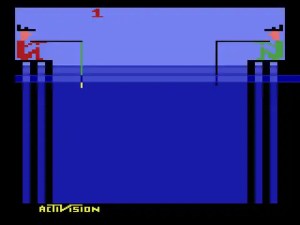
Fishing Derby is consistently designed for two players at the same time, which was not a given at the time of its release and clearly set the title apart from many contemporary single-player games. The screen is divided horizontally so that each player has their own fishing area in the upper or lower part of the screen and can keep an eye on their opponent’s progress at all times. The goal is to catch as many fish as possible within a limited time and thereby score more points than your opponent, with quick decisions and efficient action playing an important role.

The game is controlled with the classic Atari joystick, whose simple input options are optimally tailored to the game principle: the fishing rod moves horizontally across the water surface, while the fire button casts and reels in the line. Fish of various sizes swim past under the surface of the water, each with different point values and slightly different behaviors. Small fish are relatively easy to catch and offer quick success, but are worth fewer points, while large fish are significantly more valuable but also more difficult to catch and require more precise timing.
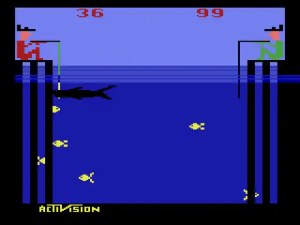
A central element of the game is the direct competition between the two players, which forms the core of the gaming experience. Since both players have access to the same schools of fish and can compete with each other for fish, there is constant competition for the best catches. Often, it is not only pure skill that decides victory or defeat, but also the right timing, the assessment of the opponent, and a certain amount of tactics. This simple but extremely effective game mechanic ensures excitement, short, intense rounds, and high replay value, especially in local multiplayer mode.
Trivia & Special Features
- Fishing Derby was programmed by David Crane, one of the most famous and influential early Activision developers. Crane was instrumental in shaping the creative direction of the studio and his work influenced numerous early console classics.
- The game is considered one of the early examples of competitive split-screen multiplayer on home consoles. It is particularly noteworthy that both players act simultaneously and on equal terms, which puts the focus on direct competition.
- The console switches can be used to set different game variants and difficulty levels, including different time limits and game modes, which provide additional variety.
- The graphics are very minimalistic, but the smooth animations of the fish were considered technically impressive at the time and gave the game world an unexpected liveliness.
- The game makes clever use of the limited hardware resources of the Atari 2600 and completely dispenses with unnecessary visual effects, which contributes to a clear visual language and stable game performance.
Reviews at the time
Contemporary reviews from gaming magazines and trade journals were overwhelmingly positive, reflecting the good reputation Activision already enjoyed among many gamers and industry observers at the time. Particular praise was given to the clear focus on multiplayer mode, the precise and reliable controls, and the fair, easy-to-understand scoring system, which allowed even new players to get started quickly and without frustration. Many reviewers also emphasized that Fishing Derby does not require complicated rules or lengthy explanations, instead focusing on the immediate gaming experience. It was precisely this direct access that made the game attractive to both casual and competitive players and ensured lasting excitement in direct duels.
Criticism was mainly directed at the limited long-term motivation in single-player mode, which offered significantly less appeal than the multiplayer experience and was perceived more as a supplement than a main component. Without human opponents, the game lost its excitement relatively quickly, as there was neither artificial intelligence in the classic sense nor long-term goals, high score lists, or unlockable content that would have motivated repeated play. However, Fishing Derby shared this weakness with many other console games of the era, and most critics therefore considered it only a minor, hardly surprising flaw that did little to detract from the overall positive impression of the game.
Cultural influence
Fishing Derby is exemplary of the early Activision style: simple rules, clean programming, and a clear focus on immediate gameplay fun. The game played a significant role in establishing Activision as a serious alternative to Atari and strengthening players‘ confidence in the new publisher. At the same time, Fishing Derby showed that former Atari developers were capable of producing more creative, accessible, and playfully compelling titles than many official Atari releases of the time. This made the game a silent symbol of the beginning of change within the video game industry, in which developers were increasingly perceived as creative designers.
Furthermore, Fishing Derby underscores the importance of local multiplayer experiences in the early days of video games. Long before online gaming or global rankings existed, the appeal of such titles lay in direct competition on the couch at home, spontaneous duels, and immediate social interaction. Games like Fishing Derby encouraged playing together in the same room and strengthened the social aspect of the medium. In this context, Fishing Derby occupies a firm and recognized place in the history of early console games and is considered a typical representative of an era in which simplicity and direct gaming fun were the focus.
Conclusion
Fishing Derby is not a complex or extensive game, but that is precisely where its particular strength lies. With its clear structure and minimalist gameplay, the title succeeds in bringing the core of the fun to the forefront without distraction. It is an important piece of video game history that clearly reflects the design principles of the early 1980s and exemplifies how games of that era were conceived and implemented. The game embodies Activision’s early strengths, showcases clever competitive design, and impressively demonstrates how much fun could be had even with severely limited hardware when design and mechanics are sensibly coordinated.
For retro fans, collectors, and video game historians, Fishing Derby remains a charming and remarkably well-aged example of the early days of console multiplayer gaming. At the same time, it symbolizes the creative awakening of a new game company that had the courage to go its own way and thus had a lasting influence on the development of the video game industry.








 McHenry's Lair
Kommentar verfassen :