


My first arcade game
Around Easter 1978, in Holm on the Baltic Sea – more of a spa resort foyer than a neon bunker – I stood in front of an arcade machine for the first time.
A Pong clone: 70s wood veneer cocktail cabinet, large rotary knobs. Two lines, a flickering dot, the metallic clink of coins and that dry “beep” – that’s all it took to spark my fascination with arcade and later computer games.
A passion that continues to this day – except that today it’s RTX photorealistic Mechs in 24-bit color and Full HD, and no longer just lines and a flickering dot in black and white ..
The arcade big bang
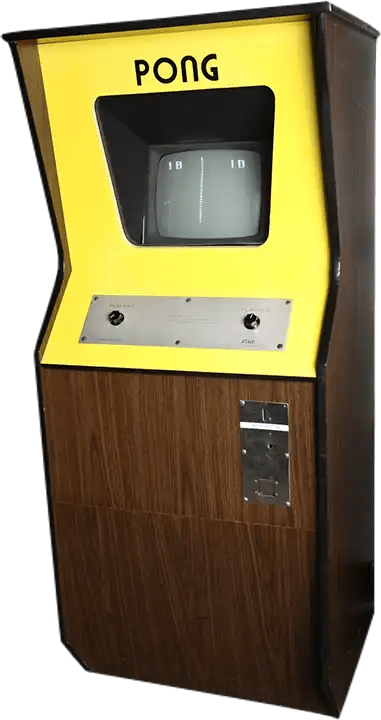
Pong was released by Atari in 1972 and is considered the first commercially successful arcade video game. It is often claimed that it was “the first video game ever” – historically correct is: Pong was the first to become suitable for the masses and reliably brought in money in bars, bowling alleys, and arcades. (The actual first commercial arcade game, Computer Space from 1971, remained complicated and sold poorly.) The immediately understandable table tennis metaphor, robust hardware, and a clever business model turned a pub experiment into a market entry for an entire industry. At the same time, Pong struck a social chord: simple rules, immediate duels, a clear winner – perfect for places where people already gathered. The yellow cabinet aesthetic, the highly visible score display, and the loud “beep” signals acted like a neon sign in noisy environments and spontaneously attracted audiences who, out of curiosity, often reached for the coin slot themselves.
Why “the first commercial” is important: Pong showed that video games can generate recurring revenue – with short, exciting games that encourage players to insert another coin. It professionalized the distribution, installation, maintenance, and billing of arcade machines, shaping the coin-op paradigm for years to come. The decisive factor was scalability: from a prototype in a bar to series production with a distributor network, standardized spare parts, and service manuals. Operators learned how location selection, point limits, and volume levels influence throughput; manufacturers established trade show demos, leasing models, and replacement boards – early building blocks of a sustainable value chain around the medium of video games.
Game Play
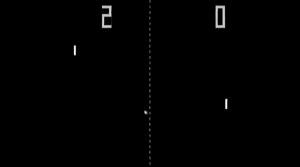
Two players each control a vertical paddle on the left and right. A square ball bounces off the paddles and the top and bottom edges of the screen.
Objective: Outplay your opponent so that they miss the ball. Each mistake results in a point; the current score (left/right) is displayed permanently. There is no time limit – only rallies, points, and sets.
Angles & sweet spots: The bounce angle depends on where the ball hits the paddle – near the edge, the angle becomes more acute and the ball faster. In many revisions, the paddle is segmented into zones (e.g., 6–8) that create defined angles. This results in tactical placements instead of pure reaction duels.
Speed curve: Longer rallies increase the speed, heighten the tension, and at the same time shorten the average playing time – which is desirable from an economic perspective. After each point, the speed resets to a base level, resulting in short dramatic arcs from long rallies.
Set length: In the arcade version, the game is usually played to 11 points; operators could adjust the settings (regionally also 15). The end of a set triggers a short reset, after which the next game begins or the ball is thrown again.
Controls: Rotary knobs (potentiometers) allow precise, analog control – intuitive, stable, with “grip” even for sweaty hands. Input is low latency and linear; there are no dead zones, which allows for fine adjustment.
Audio/visuals: Monochrome display, high contrast; “beep” tones mark ball contacts and points. The minimalist design supports readability from several meters away. The scoring is marked more clearly acoustically; after the serve, attention is “flashed” back to the game with a loud beep.
Serve & reset: The ball starts in the middle; the serve alternates between sides. A short idle period after each point allows the hands to be positioned on the controller and ensures regulated starting conditions.
Operator settings & variants: Depending on the hardware revision, the point limit, ball speed, and in some cases paddle height can be adjusted via DIP switches. Operators can thus optimize throughput (shorter sets) or attractiveness (longer rallies).
Skill expression: Successful players use changes of pace, edge balls, and deliberately risky outside line shots. A classic pattern is the build-up: first increase the pace, then flatten unexpectedly to provoke timing errors.
Single player? The original is strictly two players. Later variants (and many home clones) offered rudimentary computer opponents or training modes (wall/practice).
Design idea: Pong is a prime example of readability + feedback. Every action has a clear result (ping/beep, ball trajectory), the rules can be learned in seconds, but mastery takes much longer.
Trivial
No CPU: The original ran on discrete TTL logic – a circuit made of standard components; game logic and timing were hardware. Image synchronization, score display, and collision detection were created using counters, flip-flops, and gates; there was no frame buffer, everything happened in real time at the line level. This architecture made the behavior extremely deterministic and easy to test.
Coin box myth: The prototype at Andy Capp’s Tavern (Sunnyvale) “broke down” because the coin box was overfilled – a classic anecdote about unexpected success. Operators reported blocked locks and jammed coin validators; Atari’s series devices were equipped with more robust boxes and clear service instructions for emptying them.
Service-friendly: The cabinet, electronics, and potentiometer knobs were designed for continuous operation; the simple mechanics reduced downtime. Generous component spacing, pluggable cables, and adjustable trimmers facilitated repairs in the field; spare parts kits could be installed without special tools.
Economy in the code – pardon, in hardware: Point limits, speed curve, and reset behavior kept games short but crisp. The balance was chosen so that average rallies were noticeably challenging but not frustrating – ideal for repeat games and queues in front of the machine.
Readable ball: The choice of a square “ball” was not a stylistic gimmick, but a hardware compromise – pixel grid, clear edges, stable collisions. The monochrome display with high contrast and the phosphor afterglow of the CRT ensured good visibility even in bright environments.
No frame buffer/graphics chip: The graphics were time-controlled: lines, ball, and scores were composed as signals, not drawn. This saved costs and minimized the number of components.
Calibration & drift: Potentiometers and internal trimmers occasionally had to be readjusted (temperature, aging). Regular cleaning of the control tracks prevented input flutter.
Collision logic: Instead of complex physics, Pong used comparator circuits and defined zones on the paddle – this resulted in reproducible bounce angles with minimal circuit depth.
Anti-loop precaution: Many revisions prevented practically perfectly horizontal ball trajectories through minimal angle offsets – a safeguard against endless, boring rallies.
History
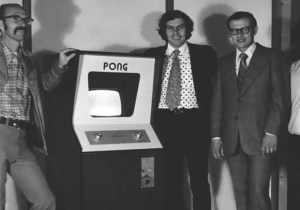

Atari co-founders Nolan Bushnell and Ted Dabney gave Allan Alcorn a “practice project”: a simplified table tennis simulation inspired by the Magnavox Odyssey, among other things. Alcorn added rally acceleration, varying bounce angles, and score display, and built the circuit so that it was bar-ready—resistant to smoke, vibration, and continuous operation. Field testing in late summer/fall 1972 made the cash register ring; Atari scaled up production, organized distributors and service networks, and established its reputation as an innovation engine. In addition, Alcorn calibrated sweet spot zones on the paddle, reduced the racket height for more exciting rallies, defined a short serve pause, and adjusted the volume and beep frequencies for noisy restaurants. At the same time, Atari set up production islands with serial numbers, burn-in tests, and spare parts kits; the series devices were equipped with larger coin boxes, lockable service flaps, and easily accessible trimmers. Field feedback flowed back into rapid circuit revisions—an iterative cycle of setup, observation, and adjustment.
Internationalization: Devices quickly appeared in Europe and Japan – partly through partners, partly through replicas. Pong became an export hit of American tech culture long before “Silicon Valley” became a buzzword. Through importers and licensing partners, machines reached trade fairs and department stores; devices were adapted for 220 V/50 Hz, PAL signals, and metric coin validators. Manuals were published in multiple languages, and compact cocktail models served cafés with limited floor space. In addition to licensed variants, bootlegs circulated, leading to regional differences in case designs, logos, and control panels.
Legal background: The similarity to Odyssey Tennis led to disputes with Magnavox/Ralph Baer. The result: licensing and settlement agreements that showed the industry early on that intellectual property also counts for game ideas – with consequences for later console and arcade generations. In practical terms, this meant that Atari licensed relevant patent claims, while Magnavox took action against a number of imitators. The precedent created planning security for investors and forced manufacturers to choose between innovation and licensing. Atari licensed relevant patent claims, while Magnavox took action against a number of imitators. The precedent created planning security for investors and forced manufacturers to weigh up innovation, licensing and clone protection – a decision that made Pong significant far beyond the game principle.
Clones (arcade)
The success triggered a veritable wave of clones. Between 1973 and 1976, countless “ball-and-paddle” titles appeared in the US, Europe, and Japan within a very short time – often on compatible circuit boards, some as licensed offshoots, some as bootlegs. Distributors bundled entire product lines to cover every installation environment (bar, bowling alley, department store):
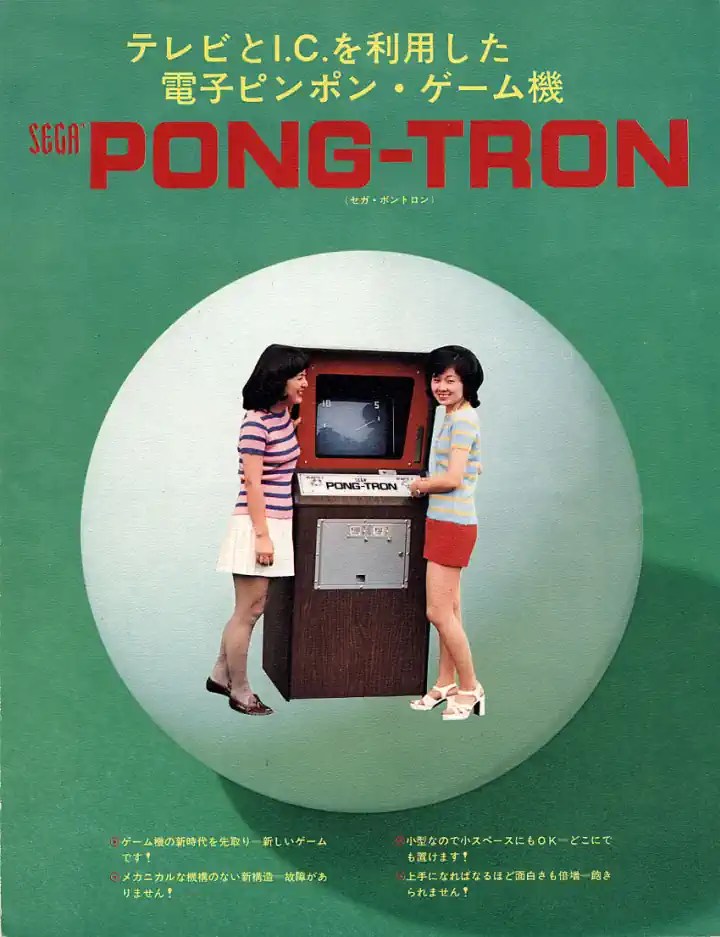
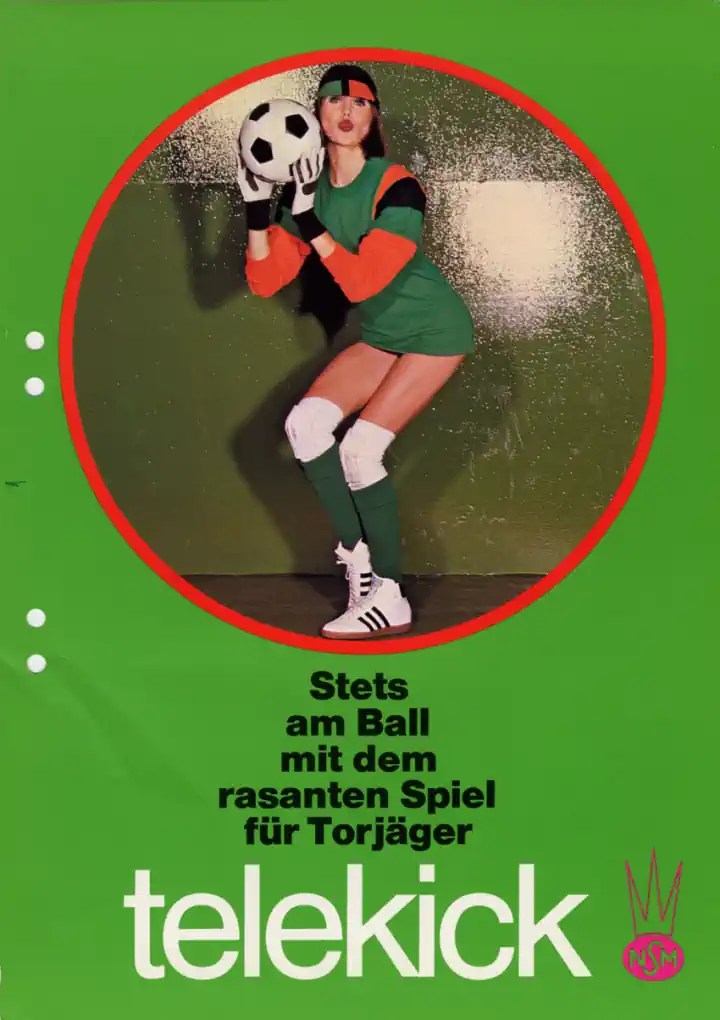
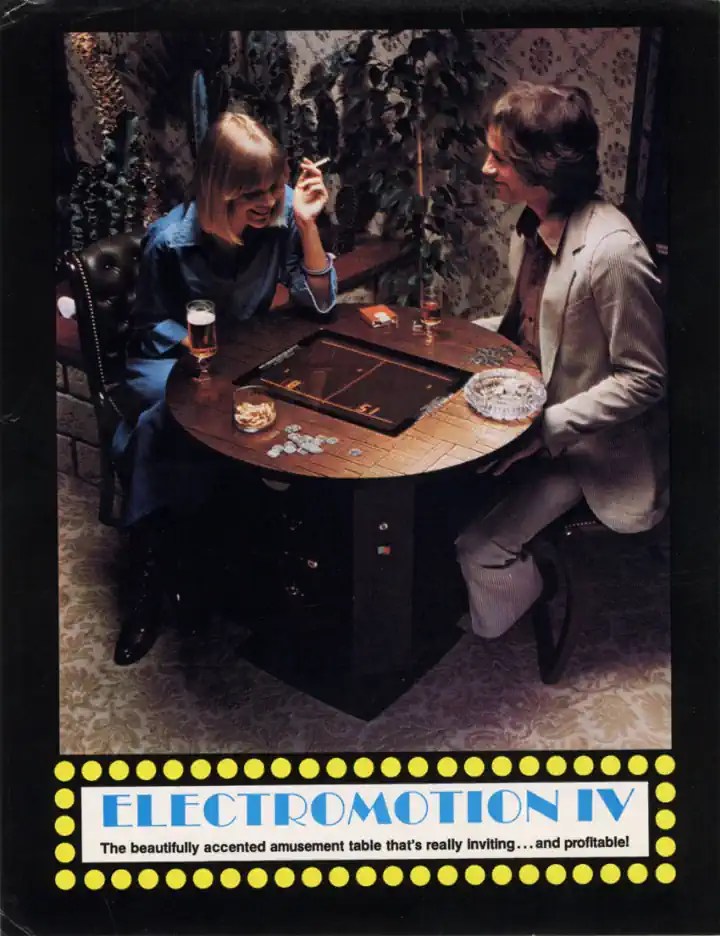
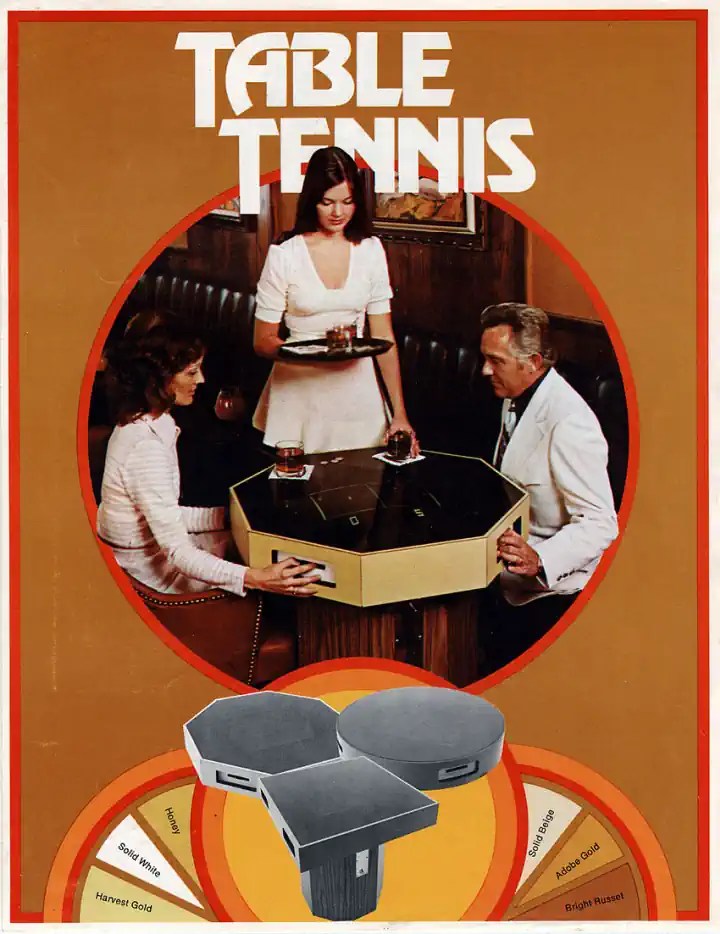
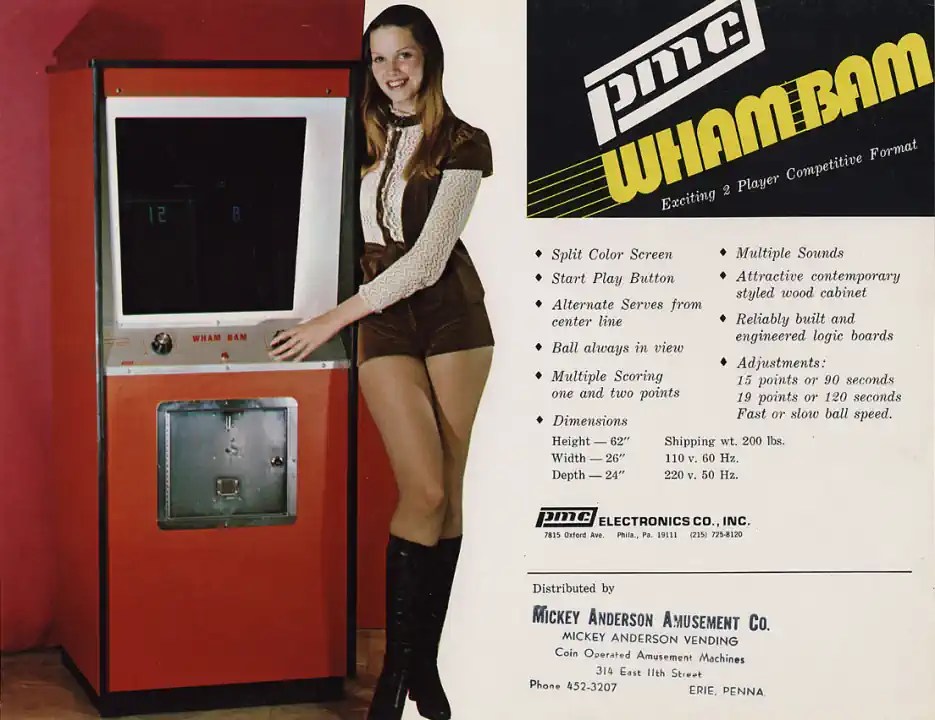
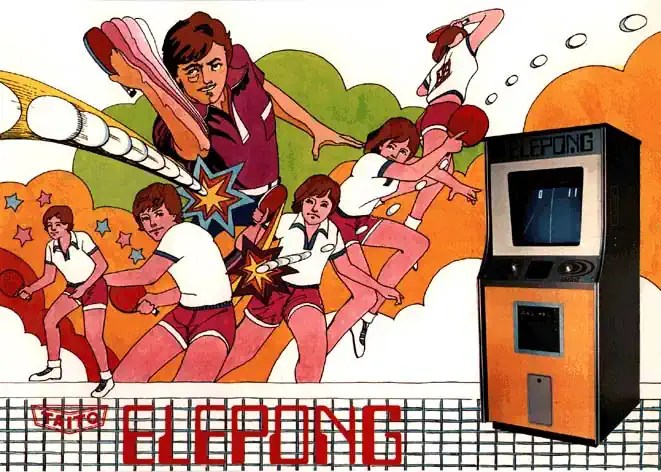
1:1 conversions with new names and cabinets – often only the marquee, bezel, and control panel were replaced; the electronics remained virtually identical.
Variants with double paddles, center line obstacles (“hockey”), modified playing field proportions, or multi-point scoring zones; well-known examples are Pong Doubles/Quadrapong and “soccer” layouts with goal areas.
Brand adaptations: Manufacturers such as Taito, Midway, and Sega packaged the basic principle in their own cabinets; regionally, there were rebrands and OEM conversions in which identical circuit boards ran under different logos, among other things.
Technical experiments: Color overlays, mirror tricks, cocktail and sit-down cabinets, as well as finer sync stabilization improved visibility and installation flexibility.
Control concept experiments: Rotary knobs plus serve/reset buttons were standard; some manufacturers tested joystick or slider hybrids, while others used larger potentiometer knobs for fine control.
Location specialists: Compact mini-cabs for counter areas and eye-catching showcase cabinets with lighting for entrances and hallways.
For operators, the flood of clones meant choice and price pressure: low entry costs and quick amortization met with accelerated depreciation cycles because new variants were constantly appearing. Many operators experimented with A/B setups (point limits, cabinet height, volume), introduced local tournaments, and strategically positioned the machines (entrance area vs. counter) to maximize throughput.
For players, it was the first big wave of easily accessible, competitive digital games in public spaces – with house rules (“winner stays seated”) and emerging regional metas (aggressive edge balls vs. defensive center control). The flood of clones also paved the way for more complex concepts such as Breakout and shaped the legal strategy against bootlegs; at the same time, an ecosystem of parts dealers and repair services emerged, professionalizing the young industry.
Home Clones (for the living room)
With Home Pong (from 1975, including as Sears Tele-Games), the fun moved into the living room. The real turbo boost, however, was the General Instrument AY-3-8500 (“Pong-on-a-chip,” from 1976):
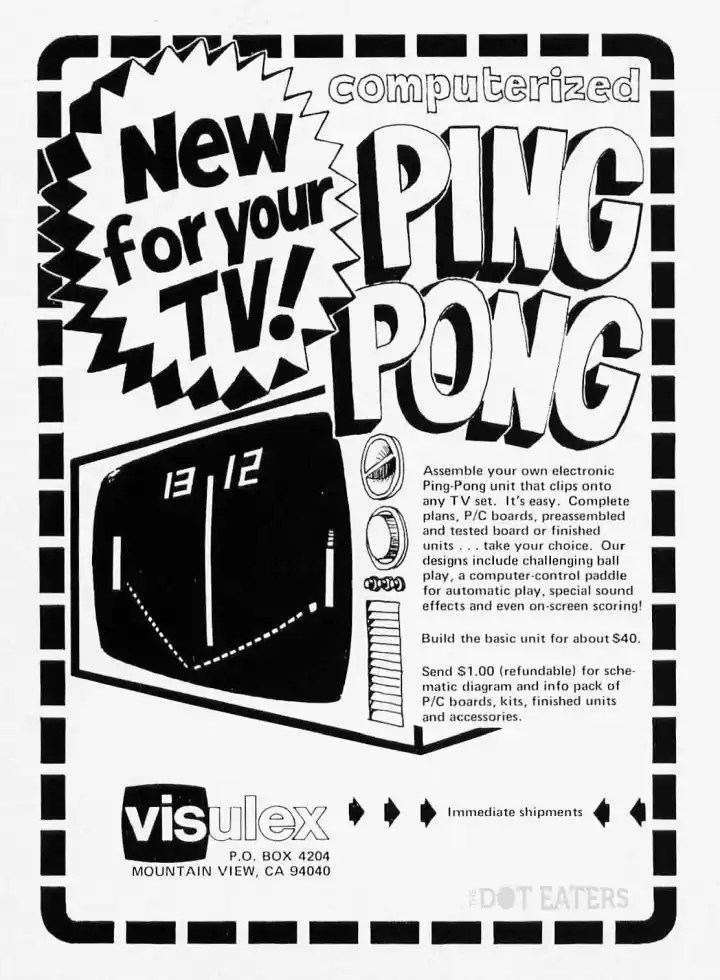
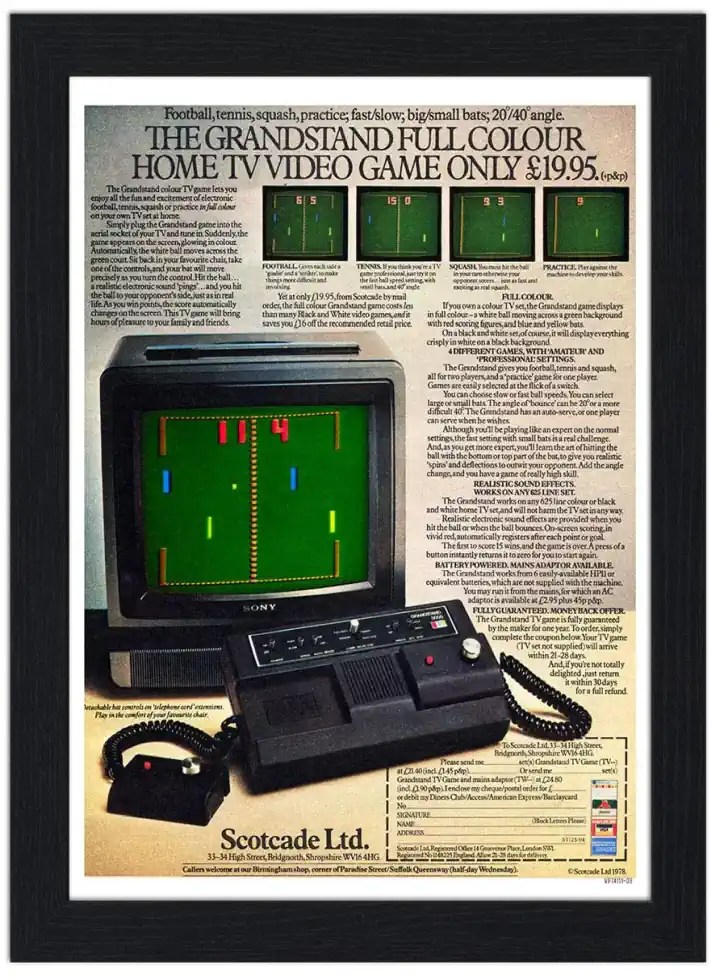
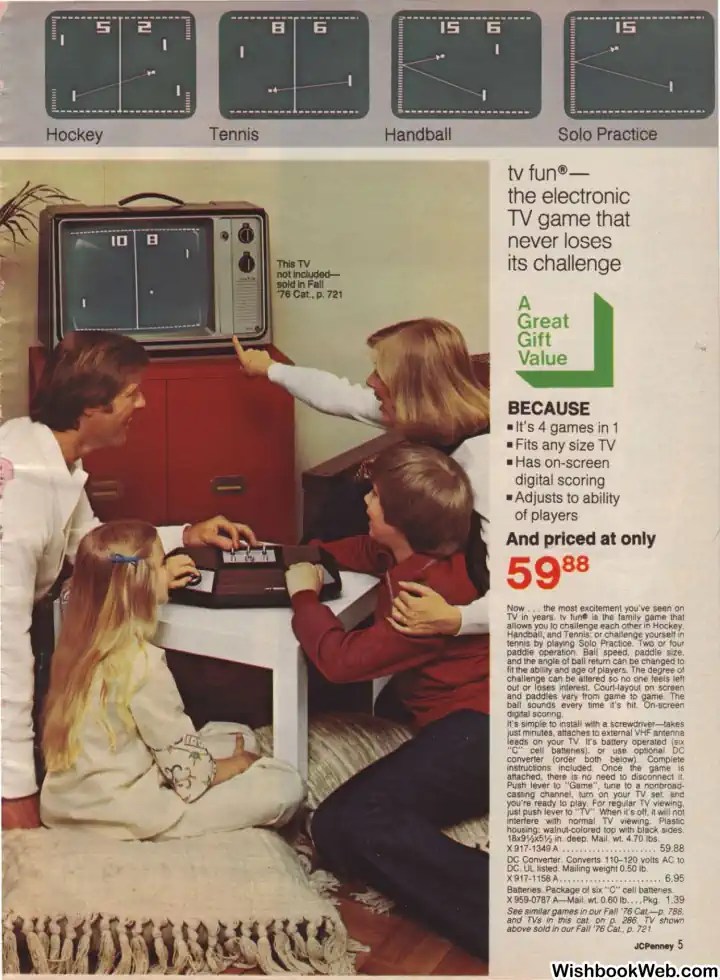
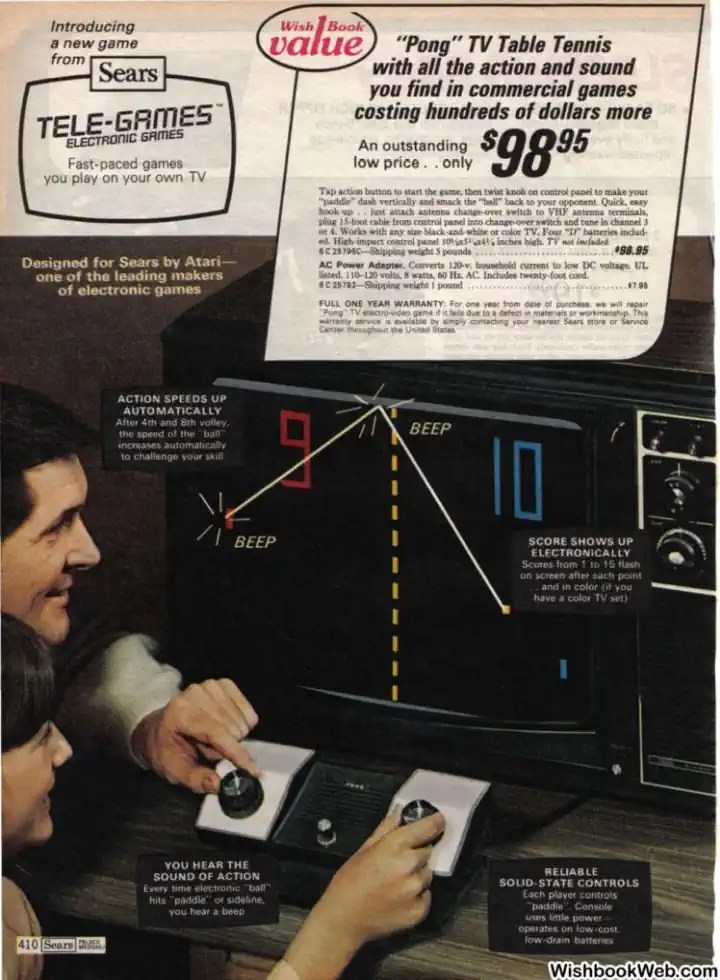
Everything on one chip: The component combined game logic and video output; manufacturers essentially needed only a housing, power supply, controller, and RF modulator. This reduced unit costs and allowed for assembly line production in large quantities – crucial for the price war in the mass market.
Dozens of brands: Coleco Telstar, Binatone, Universum, Hanimex, Radiola, and many others brought affordable dedicated consoles to market – often with slide switches for tennis/hockey/squash/practice. Regional OEM rebrands ensured that technically identical devices were available in department stores under different names.
Controllers & ergonomics: Depending on the model, fixed rotary knobs on the housing or removable paddles with cables; large, non-slip knobs prevented slipping, serve/reset buttons were easily accessible.
Price pyramid: From inexpensive battery-powered devices (without power supply) to wood veneer “luxury” models with power adapters, better RF modulators, and decorative fronts—there was an option for every household. Some bundles included replacement controllers or antenna cables.
Game variants & add-ons: In addition to tennis/hockey/squash/practice, some models offered two/four-player modes, selectable ball speeds, and racket sizes. Individual series had light gun connections and emitted beeping sounds via piezo speakers.
Bridge technology: These devices created the market and expectations for programmable consoles (Atari VCS/2600, 1977). At the same time, they paved the way for the transition to microprocessor/ROM designs, in which game content became interchangeable.
There were also replicas, regional rebrands, and dealer-exclusive models in the home segment. Pong thus became the basic vocabulary of early home computer gaming: a common denominator across brands and countries that transformed living rooms into game rooms and provided schoolyards with house rules (“best of 3,” point cap).
Criticism at the time
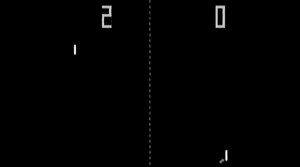
Press & audience: Frequent buzzwords were “immediately understandable,” “pure competition,” and “easy to learn, hard to master.” The rotary knob control was considered an eye-opening experience: precise, immediate, without “dead zones.” In addition, Pong was praised as “pick-up-and-play”: you could play spontaneously in bars or bowling alleys, spectators commented loudly on the rallies, and the clear beep signals added a little drama to each rally. Many contemporary witnesses describe the game as family-friendly – cross-generational, without complicated instructions.
Skepticism & cultural pessimism: Some commentators mocked its simplicity – “two lines and a dot.” At the same time, it was precisely this reduction that made it timeless. Critics occasionally complained about its monochrome dreariness and machine noise, while others warned against “wasting time” on the machine. Educational voices countered that it trained fine motor skills and reaction times; what was crucial was moderation and context.
Learning curve: Returning players developed tactics (pacing, edge balls, feints). This encouraged a regular audience and early mini-tournaments. Advanced players practiced serve patterns (e.g., fast outside line vs. delayed center shot), angle drills, and micro-feints on the controller. There was even talk of “spinner technique” (rotating knob with palm vs. fingertips) to achieve finer acceleration.
Media & advertising: Local newspapers reported on “new electronic table tennis machines,” and department store catalogs touted home versions with “easy-to-use controllers.” Product photos often showed family duels in front of the TV—an image that underscored the casual access.
Youth protection & debate: Alongside uncritical enthusiasm, addiction and pocket money discussions arose early on (“too much change in the slot”). Many operators responded with house rules (no children after 10 p.m., “winner stays seated” only until two wins) and thus provided an orderly framework for competition.
Cultural influence
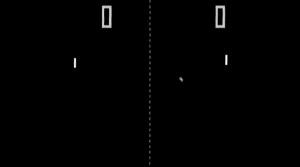
The starting signal for an industry: Pong proved that games could be an independent economic sector – with suppliers, services, distribution, trade press, and trade fairs. This gave rise to Breakout, early racing games, shooters, mazes – a whole family tree of interactive genres. In addition, Pong drove the development of supply chains (monitors, power supplies, coin acceptors, cabinet construction) and the professionalization of operator networks; showcases and industry events established best practices from location selection to maintenance.
Icon of reduction: Pong stands for “gameplay before graphics” . To this day, many designers refer to the principle that clear rules, good feedback, and finely tuned speeds are more important than technical effects. In game design teaching and workshops, it serves as a reference for paper prototyping, fail-fast iterations, and the conscious omission of everything superfluous; indie jams regularly reconstruct the mechanics as a design exercise.
Pop culture presence: Pong appears in movies, TV shows, exhibitions, and retro installations. Its minimalist look became a hallmark of the early days of video games – often as a nostalgic symbol of “the beginning.” In addition, the motif appears in advertising campaigns, music videos, shirt designs, and installation art; it functions as shorthand for “digitality” and “play.”
Social form “couch versus”: Pong established shared, local multiplayer – shoulder to shoulder, looking at the same screen, with a spontaneous spectator role. This social DNA lives on in party and indie games to this day. Arcade bars and retro nights build on this; house rules (“best of 3,” “winner stays”) and trash talk promote audience dynamics and a low-threshold tournament culture.
Entrepreneurship & work culture: The story of its creation – garage prototype, rapid iteration, direct field testing – shaped the startup myth of the gaming industry. To this day, it inspires founders to start small, test early, and focus on robust simplicity.
Conclusion
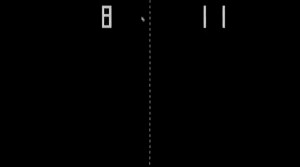
Pong is more than a historical milestone—it is an operating system for game ideas in miniature form: clear rules, direct control, finely tuned excitement, robust technology. Its economic elegance made arcades profitable; its design clarity still defines what good playability means today. Even though modern systems push billions of pixels, the basic promise of Pong—competitive, readable, instantly fun—remains relevant. Without Pong, the gaming landscape would look different: less bold, less sociable, and perhaps lacking the confidence that simply good ideas can carry an entire medium. It teaches us that restriction unleashes creativity; that precise haptic feedback and fair, reproducible rules are often more important than opulent backdrops; and that shared, local play can create social cohesion. In this sense, Pong remains a touchstone for designers—a minimal benchmark for speed, readability, and excitement—and a low-threshold entry point for new generations of players, whether on CRT monitors, flat screens, handhelds, or in browsers. Those who understand the original form will more quickly recognize why so many later classics work—and where they fail when they overdecorate the essentials.








 McHenry's Lair
Kommentar verfassen :