

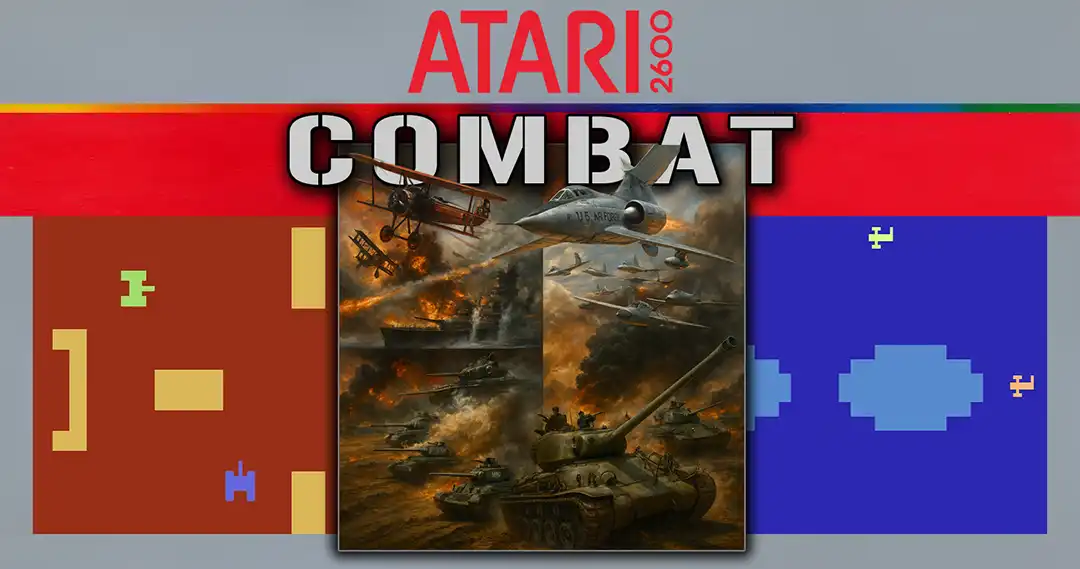
The first game for the Atari 2600
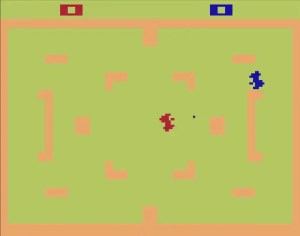
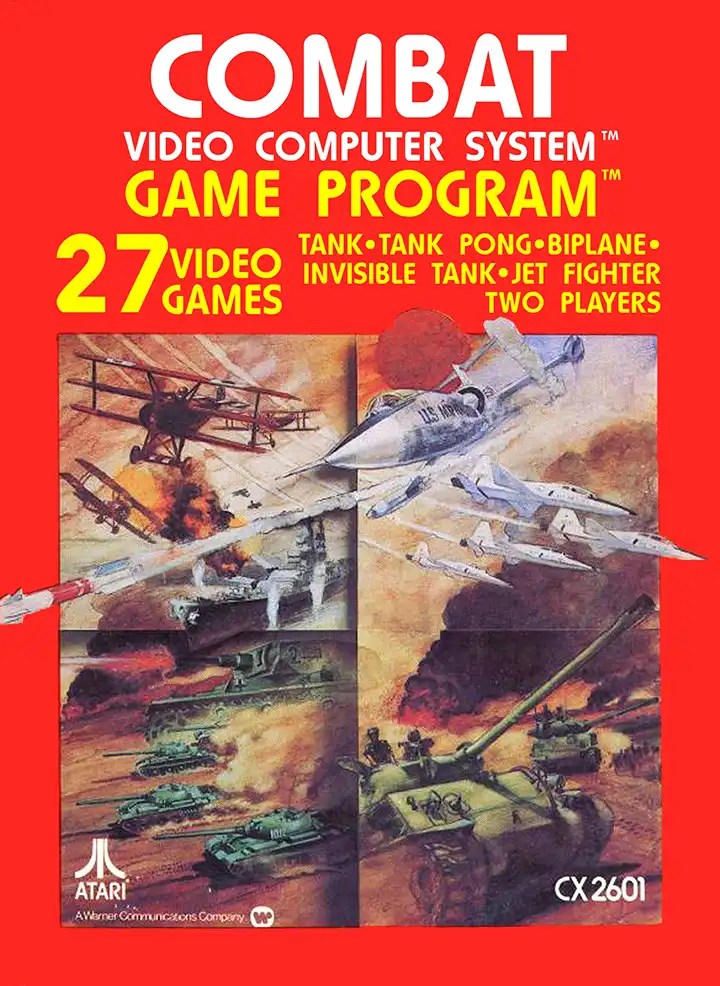
When the Atari 2600 (then still known as the Atari VCS – Video Computer System) was launched in 1977, “Combat” was the game that came with the system. This made it not only the first game for many video game enthusiasts, but also a milestone in the history of home consoles. At a time when arcade machines dominated and home computers were not yet widespread, “Combat” brought the fun of gaming into people’s homes – and thus laid the foundation for the commercial success of Atari and the home console industry as a whole. It was a game that demonstrated that video games were not just technical toys, but a new and exciting medium.
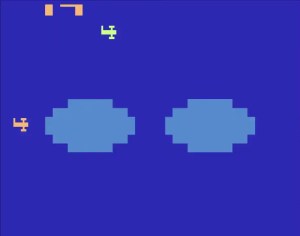
It was also interesting that Combat introduced many Atari 2600 buyers to the mechanics and functionality of a game console for the first time. Operating it with a joystick, inserting cartridges, and simply starting the game shaped an entire generation. Its accessibility quickly made it a topic of conversation among young people and families alike. Shortly after its release, the first game tips, strategies, and competitions began circulating in private circles, further reinforcing the social aspect of the game.
Furthermore, “Combat” was not only perceived as entertainment, but also as an example of how technology and gaming fun can intertwine. Many technology enthusiasts saw “Combat” as an inspiring project that motivated them to delve deeper into computers and game development. It thus acted as a catalyst for many young people to engage with this new digital world.
Gameplay: Tanks, planes, and lots of action
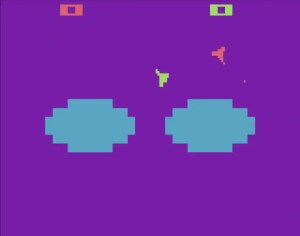
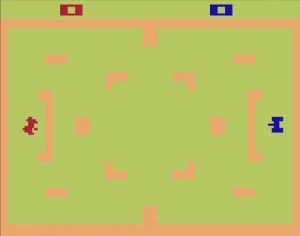
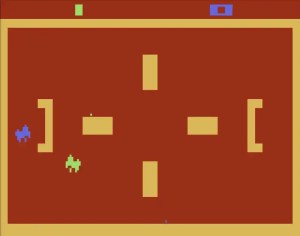
Combat is a competitive two-player game in which players face off in different scenarios. The game offers a total of 27 different variants, which are divided into three main categories and generate high replay value through small but effective rule changes. Each of these variants comes with its own challenges, so no two matches are alike and new strategies can be tried out again and again.
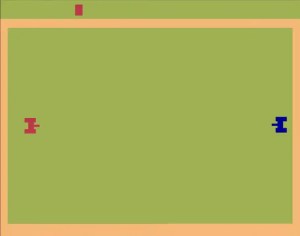
- Tank (tank battles): Two tanks duel in maze-like arenas. Various game modes such as invisible tanks, ricocheting shots, control delay, or narrow corridors add tactical depth to the game. Some variants offer mazes where cover and precise maneuvering determine victory or defeat. The gameplay varies greatly depending on the map and combination of rules, which increases the appeal of trying out all the options. It gets particularly exciting when players try to outsmart each other through a combination of camouflage and positioning.
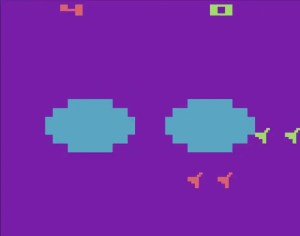
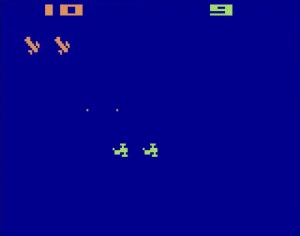
- Biplane (double-decker): Air battles with classic propeller planes, sometimes with obstacles or multiple planes on one side. You can compete against an opponent in a duel or act as a “team” with several small machines, which opens up new strategic possibilities. The different flight speeds and maneuverability of the machines contribute to the game balance and challenge both beginners and pros. The verticality of the arenas plays a major role here, forcing players to think in multiple dimensions.
- Jet (modern jet aircraft): Faster aerial combat with rules similar to those of biplanes, but with a higher game speed, less inertia, and more dynamics. Jets enable lightning-fast attacks, but also risky evasive maneuvers, which tempt particularly experienced players to perform daring maneuvers. The variants with tight fly-bys, which require reflex-like reactions, are particularly exciting.
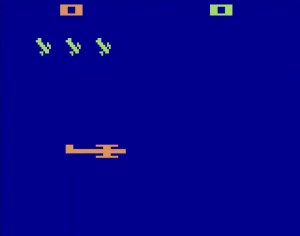
The goal is always the same: to land more hits than your opponent before the time limit expires. This depends on timing, skill, and responsiveness. Although the controls are simple, experienced players can clearly dominate – a sign of good game design. The game rewards patience, a willingness to learn, and a spirit of experimentation – qualities that ensure long-term motivation. Competition among friends often led to hours of duels and heated rematches, quickly making “Combat” the centerpiece of many game nights. The variety of game modes meant that it never got boring, and the desire to beat your opponent in the next round provided a lasting incentive to keep coming back to the game.
Technology: Simple but ingenious
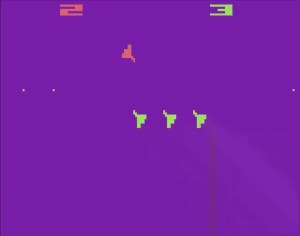
Technically, “Combat” was a minor marvel for its time. The Atari 2600 had extremely limited hardware: only 128 bytes of RAM, no background graphics in the modern sense, and simple color display with limited resolution. Nevertheless, the developers managed to implement varied game modes and smooth game mechanics with the help of clever programming. The multitude of modes was created by small rule changes controlled by bit flags. This meant that different game elements did not have to be completely reprogrammed, but could be varied using flexible parameters – an efficient principle that is standard in modern game engines today.
A key to the technical masterpiece that was “Combat” was “racing the beam” – a programming technique in which the TV’s display line is written in real time while the image is being built. This meant that each line of the screen was dynamically generated through precise timing to ensure that sprites and playing areas appeared in the correct position. Errors in this calculation immediately led to image errors or game errors. This technique required extremely precise knowledge of the hardware and synchronization with the TV image signal.
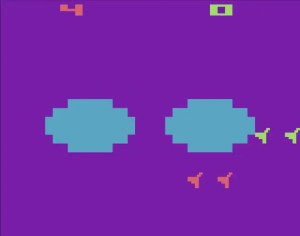
Particularly noteworthy was the collision detection, which worked precisely and reliably in the narrow mazes or during aerial combat – a must for fair competitive play. The rendering of moving objects (“sprites”) was also cleverly implemented to stay within CPU and memory restrictions. Tricks such as mirroring and replicating objects on the left and right halves of the screen were used to increase visual variety without requiring additional memory.
Another technical highlight was the way the game enabled a real competitive experience with only two controllers and very simple electronics. Each character was controlled by a joystick, with the fire button responsible for attacks. Despite its simplicity, this resulted in intense matches. Input was almost instantaneous, enabling quick reactions and essential to the feel of the game. This directness in control was remarkable for the time and contributed significantly to the quality of the game.
In addition, the code for “Combat” was optimized so that even with minimal system resources, smooth gameplay could be guaranteed. At a time when every byte counted, this was only possible through meticulous planning and a deep understanding of the hardware. Many later Atari programmers saw “Combat” as an example of well-thought-out and resource-efficient game design.
Trivia and special features
- “Combat” is loosely based on the arcade games ‘Tank’ (Kee Games, 1974) and “Jet Fighter” (1975), both of which were also developed by Atari subsidiaries. Transferring these concepts to a home device was a technical and conceptual masterpiece, as it proved that complex arcade mechanics could also be implemented on significantly weaker hardware. The decision to transfer these two classics to a new format was also a clever move, combining recognition value for arcade fans with the appeal of new challenges.
- The game was programmed by Joe Decuir and Larry Wagner, who were also instrumental in the development of the Atari 2600 itself. Their close connection to the hardware allowed them to make particularly efficient use of the limited resources. Thanks to their deep technical understanding, they were able to innovatively get the most out of the limited architecture, creating a game that offered numerous variations and stable gameplay despite minimal memory size. Their work served as a template for later developers for efficient coding under restrictive conditions.
- One special feature: there was no single-player mode. “Combat” was designed purely for two-player duels – a statement for playing together in the living room. In the days before online multiplayer and AI-controlled opponents, the focus was on direct social interaction. This conscious decision emphasized the social nature of the game and made it a medium for interpersonal encounters, where communication, competition, and shared laughter were at the forefront. This contributed significantly to its early popularity.
- Some of the game modes feel like mini-games today, which shows how early on developers were experimenting with variations and gameplay ideas. Many of these variations show approaches that could later be found in other games – such as the concept of asymmetrical playing fields or the deliberate creation of imbalance to make the game more exciting. This creative playfulness gives “Combat” an experimental and charming character that remains to this day.
Criticism at the time
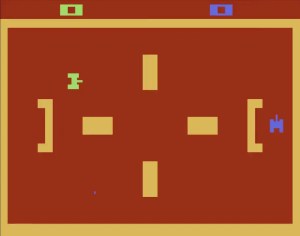
Contemporary reviews were overwhelmingly positive, despite the very young gaming press. Players praised the variety of modes, the intuitive gameplay, and the competitive excitement that resulted from the duels. For many, “Combat” was proof of the potential of home consoles, especially in multiplayer mode. Parents who bought the system at the time often saw it as a family or party game. In the living rooms of the late 1970s, Combat often became a cross-generational experience, with younger players dueling with older siblings or parents, giving the game an integrative component.
Another aspect that was positively highlighted at the time was the short learning curve. New players could jump into a match within minutes without having to read a manual. This lowered the barrier to entry and encouraged spontaneous games. The variety of game modes also ensured longevity – there was never a feeling of always playing the same game.
Although the game did not offer any background music or voice acting, it was still considered captivating. The minimalist sound – consisting of gunshot noises and hit effects – was functional and helped players concentrate. The absence of unnecessary distractions allowed players to focus fully on the gameplay and supported the tactical depth of the matches. Later reviews and retro critiques also often view “Combat” in a positive light, not least because of its historical value. In collections, retrospectives, and review articles, the game is often cited as a prime example of successful, minimalist design.
Cultural influence
Combat has a firm place in the history of video games. As a launch title for the Atari 2600, it was for many their first contact with video games in the living room. It shaped the understanding of what a console game could be – namely, more than a simple Pong clone. The game is considered a pioneer of competitive couch multiplayer – a principle that still holds true today, from Mario Kart to Super Smash Bros. The direct competition on the sofa promoted by Combat laid the foundation for many design decisions in later console developments, where multiplayer functionality was deliberately placed at the center.
In addition, Combat has often been cited and parodied, reissued in retro collections, and still serves as a teaching example for game design under extreme hardware limitations. In indie development, it is often cited as an inspiration when it comes to reduction to the essentials and creative mechanics. Combat is also a frequently displayed exhibit in exhibitions on the history of gaming. The game plays an important role, especially in museums dealing with media history, because it clearly shows how a big impact can be achieved with few resources. Academic texts on the early days of computer games also often refer to Combat as an example.
Many game designers who started out in the 1980s cited “Combat” as an early formative experience. It thus also had an indirect influence on many well-known titles in the decades that followed. In interviews, developers talk about how they spent hours playing “Combat” with friends as children and how the simple but profound gameplay inspired their own design ideas. The cultural impact is undeniable and is evident not only in the direct evolution of the genre, but also in the nostalgic references in many modern titles to the aesthetics and gameplay mechanics of early classics like this one.
Conclusion
“Combat” is more than just a launch title or a simple action game. It is a historical document of video game history. Despite its minimalist graphics and lack of AI, it set standards in the field of multiplayer gaming and demonstrated how creative ideas and skillful programming can create real gaming enjoyment. It is exemplary of a time when pioneers created great things with few resources. The game showed that content and ideas are often more important than technical possibilities and proved how much creative energy was unleashed in the early stages of game development.
Furthermore, “Combat” is an excellent example of the emotional bond that can develop between players and games – even without cinematic staging or complex narratives. The experiences you had in direct duels with a friend on the sofa left lasting memories and contributed to the development of a new social gaming culture. It was precisely this immediate gaming experience without cutscenes or tutorials that made “Combat” a game that was intuitively understood and whose appeal lay in its clarity.
Those who play “Combat” today experience not only nostalgia, but also the origins of a medium that has since evolved rapidly. It reminds us that gameplay and interaction are often more important than graphical perfection. In this sense, Combat remains a shining example of the roots of modern gaming – not only as a game, but also as a cultural artifact that laid the foundations for much of what we take for granted today.
More

Atari 2600 Combat game, History of Atari 2600, Classic Atari VCS games, Retro multiplayer video games, Tank battle Atari game, Combat Atari gameplay, Vintage console gaming, 1970s video game history, Atari Combat review, Early couch co-op games
#Atari2600 #RetroGaming #ClassicGames #GamingHistory #VintageGaming #AtariCombat #OldSchoolGaming #PixelNostalgia #CouchMultiplayer #GamersUnite







Kommentar verfassen