


An evil magician has stolen the Enchanted Chalice and
has hidden it somewhere in the Kingdom.
You quest is to rescue the Enchanted Chalice and place it inside
the Golden Castle where it belongs
Introduction
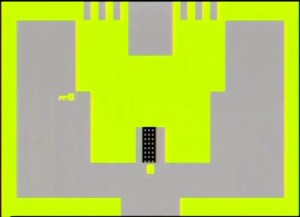
Adventure for the Atari 2600, released in 1980 by Atari and developed by Warren Robinett, is considered one of the most significant video games of its time. Not only was it the first true action-adventure game, but it was also a work that pushed boundaries that many at the time considered insurmountable. In an era when games mostly consisted of a single mechanic and were visually limited, Adventure not only offered an open world, multiple solutions, and an incomparably free gaming experience, but also established a completely new form of interactive storytelling. While many other Atari 2600 titles were strictly linear and primarily designed for high scores, Adventure encouraged players to find their own paths, take risks, experiment, and advance through curiosity. This self-determination was almost revolutionary at the time. The game proved that even a system with extremely limited hardware could offer an experience that today would be described as an early open-world concept. With its innovative structure and experimental approach, it laid the foundation for an entire genre that would later be shaped by classics such as “The Legend of Zelda,” “Metroid,” and countless modern adventure games.
Robinett’s goal was to create a playful experience that went beyond quick reactions and focused on discovery, thinking, and problem solving. He wanted to create a game that, through its design, represented a kind of “digital treasure hunt” in which players learn to interpret clues, orient themselves, and strategically overcome challenges. Despite extremely minimal graphics and limited memory resources, he created a work that is still considered a prime example of how creative vision can overcome technical limitations. His programming tricks, unconventional approaches to problem-solving, and consistent focus on playful depth rather than visual presentation made “Adventure” a surprisingly multi-layered experience that is still being analyzed and appreciated decades after its release.
Gameplay

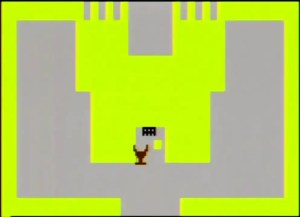
In Adventure, the player takes on the role of a simple, square avatar—a stopgap solution necessitated by the technical limitations of the Atari 2600. But behind this simple design lies an astonishingly versatile adventure that offers far more than meets the eye. Although the avatar is just a small block of pixels, it still reflects the imagination of the players, who interpret it as a brave hero. The goal is clear: find the stolen magic chalice and return it safely to the yellow castle. But the path to get there is anything but linear, as the game forces players to constantly make decisions, compare paths, and creatively overcome challenges. This creates a sense of personal responsibility and genuine freedom of exploration that was extremely unusual for the time.
The player has several items at their disposal, each of which fulfills different functions and allows for surprising depth of gameplay. The sword serves as a defensive weapon against the dragons, the magnet allows distant items to be pulled in even through walls, and various keys open the color-coded locks in the game world. In addition, each of these items can only be carried individually – a simple but effective system that requires strategic thinking. The open structure allows these tools to be used in any order, making each playthrough slightly different and creating high replay value. Many players reported that even after several rounds, they still discovered new paths, alternative tactics, or surprising situations.

The world of “Adventure” consists of numerous interconnected screens that together form a labyrinthine kingdom. This world is deliberately open-ended, so players must figure out for themselves how the areas are connected. The three dragons—Yorgle, Grundle, and Rhindle—patrol specific areas, each with its own behavior, speed, and color. While Yorgle is rather sluggish, Rhindle is much more aggressive and is considered the biggest enemy in the game. Added to this is the infamous bat, which appears randomly at any time and steals items or even dragons and deposits them in other locations. Even back then, this unpredictable factor made for chaotic but extremely memorable gameplay situations, as even well-planned actions could suddenly get out of hand. As a result, the game developed a kind of emergent gameplay long before the term even existed.
The gameplay is a mixture of skillful navigation, object management, and exploration that has far more depth than one would expect from such a minimalist title. Players must find their way through winding mazes, skillfully evade enemies, and strategically handle objects at the same time. It becomes particularly challenging when the bat disrupts the carefully planned approach and requires spontaneous adjustments. This combination created a surprisingly deep gaming experience that far exceeded the standards of the time and laid the foundation for later, more complex adventure games.
Technology
The Atari 2600 was one of the most technically restrictive platforms in video game history. With only 128 bytes of RAM and 4 kilobytes of memory for the program, complex game worlds were extremely difficult to implement. “Adventure” is therefore considered a technical masterpiece – Robinett made efficient use of every available byte. The challenges associated with this hardware forced him to develop completely new methods to accommodate functions that went far beyond what was thought possible at the time. Many of these methods are now considered prime examples of creative programming under extreme constraints.
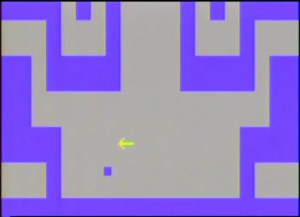
A particular highlight is the pseudo-persistent world system. As the player moves through the world, objects remain in the places where they were left. This required sophisticated management of the memory registers, as the Atari 2600 was not actually designed to remember permanent states. Instead of true persistence, Robinett used clever pointer structures and routines that minimally represented the state of the world. This created an illusion of permanence that seemed like a minor miracle to players at the time. It was one of the earliest examples of dynamic world logic in a video game.
Graphically, the game relied on purely functional symbolism. Dragons consisted of single-color pixel clusters, doors and walls were simple blocks of color. Nevertheless, Robinett managed to ensure clear visual communication: colors served as key mechanics, shapes were clearly recognizable, and the minimalist style facilitated quick comprehension of the environment. Collision detection and enemy movement were also solved with clever tricks to avoid exceeding the limited memory requirements. The screen logic had to be calculated in near real time, as the Atari 2600 could not store much data, but only generate it during image output. This led to an extremely efficient but technically demanding rendering approach known today as “racing the beam” programming.
This combination of technical limitations and creative solutions makes “Adventure” a prime example of early video game programming. It impressively demonstrates how much can be achieved with minimal resources when inventiveness, technical expertise, and playful vision come together.
Trivial
- From today’s perspective, the dragons look like large, roughly pixelated ducks – a running gag among fans of the game that is often humorously highlighted and has even led to numerous fan drawings, memes, and parodies. Their non-threatening appearance contrasts sharply with their playful role as the most dangerous opponents, which has further increased their cult status.
- The “sword” consists of nothing more than a simple line, which players often jokingly refer to as the “line of power.” This humorous name reflects the creative interpretation of the community, which lovingly embraces the iconic minimalist design and repeatedly cites it as an example of how much imagination early video games required. In addition, the “sword” became a symbol of how gameplay can sometimes be more important than detailed graphics.
- The bat is the first example of an AI-controlled, unpredictable NPC that deliberately causes chaos. It became the unofficial mascot of unpredictability, stealing items or even dragons at the most unlikely moments and dropping them in completely different locations. This mechanic contributes enormously to the replay value and has spawned countless stories of frustrated but amused players.
- “Adventure” offered three different difficulty levels, with the third mode randomly restructuring the game world – an extremely modern idea for a game from 1980. This early form of procedural variation was far ahead of its time and shows how experimental Robinett was. It allowed players to discover new paths with each playthrough, which significantly expanded the gameplay experience and made it a precursor to modern randomizer mechanics.
Easter Egg

Probably the most famous element of Adventure is the Easter Egg – one of the first documented in video game history. At a time when Atari prohibited its developers from having their names appear in games, Warren Robinett secretly smuggled a hidden room into the game. To enter it, the player had to find an invisible pixel, pick it up, and take it to a specific screen. This process was not only unusual, but also required a level of curiosity and experimentation that was completely new to many players. Finding this tiny pixel felt like solving a secret puzzle that only the most attentive or persistent adventurers could solve – and that’s what made the moment of discovery so special.
There, a secret passageway was revealed, leading to a room where the words “Created by Warren Robinett” flashed in large letters. For many players, this moment was magical – a secret that suddenly created a personal connection between developer and player. For some, it felt like a glimpse behind the curtain of an otherwise anonymous gaming industry, silent proof that behind these pixelated worlds were real people with creativity, courage, and humor. Players later reported that they perceived this room as a kind of “forbidden knowledge,” something not intended for the masses, whose existence felt like an intimate discovery.
This act of resistance had an enormous cultural impact. It inspired other developers to also incorporate secret messages or hidden content into their games, giving birth to the tradition of Easter eggs that continues to this day. Furthermore, this Easter egg was later often seen as a symbol of the emancipation of developers—an early sign that games could be more than just products, but forms of expression for creative individuals. The idea that games contain secrets that only particularly attentive or curious players can find became an integral part of gaming culture and has since shaped entire generations of gamers and developers.
Criticism at the time
Contemporary reports and magazine reviews described Adventure as revolutionary. Particular emphasis was placed on the feeling of freedom, which stood in stark contrast to the high-score-oriented games that were common at the time. Many players could hardly believe that a game on the Atari 2600 could depict a complex, coherent world. Some magazines even emphasized that Adventure was the first game to convey a real sense of place, space, and meaning—something that had previously been almost exclusively associated with text adventures. The surprise that such a limited system could create such an open game led to Adventure being described as a technical and conceptual marvel in numerous publications.
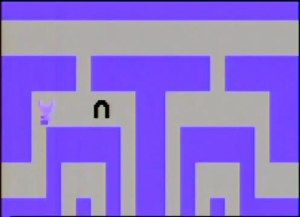
Critics also praised the replayability created by the open structures and the unpredictable bat. Many reviewers emphasized that this component presented players with new, unpredictable situations time and time again, offering a dynamic gaming experience that could hardly be repeated exactly. On the other hand, the graphics were perceived as extremely minimalistic, even by the standards of the time. Nevertheless, many critics quickly realized that the visual simplicity did little to detract from the game, as the depth of exploration, clever mechanics, and emergent situations of the bat took center stage. Even this criticism was therefore mostly mild, as the depth of gameplay far outweighed the visual simplicity, and Adventure was seen as proof that gameplay can trump graphics.
Cultural influence
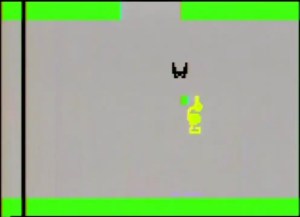
Adventure remains a cornerstone of video game history to this day. Many later classics adopted fundamental concepts such as free exploration, item-based interaction, and solving environmental puzzles. Titles such as The Legend of Zelda were based in part on ideas that Robinett had established years earlier. Even modern game developers working on open-world titles or complex puzzle adventures often cite Adventure as a source of inspiration because it showed that interactivity and freedom are possible even in highly restricted systems. Game design courses at universities now regularly use the game as an example of how early design decisions can define entire genres.
The game has also left a lasting mark on pop culture. The Easter egg became a cultural symbol for secrets in digital worlds. In Ready Player One—both the book and the movie—Adventure plays a central role as the game that established the history of Easter eggs. In addition, the game is featured in numerous documentaries, retro reviews, podcast episodes, and interviews. It is repeatedly cited when it comes to explaining the roots of playful freedom or the rebellion of creative developers against restrictive corporate structures.
Adventure continues to gain recognition through retro gaming movements, speedrun communities, and historical documentaries. It serves as a lesson in how significant innovation can be, even when technical possibilities are minimal. Many players are rediscovering the game today, whether for nostalgic reasons or out of interest in how modern game mechanics originated. At conventions, in online forums, and in museum exhibitions, Adventure is frequently discussed and analyzed, with repeated emphasis on how its influence extends far beyond its original release date.
Conclusion
“Adventure” is much more than an old Atari game – it is a milestone in video game development. Despite primitive graphics, limited memory, and minimalist presentation, Warren Robinett created an experience that is still considered the origin of an entire genre today. Its influence ranges from the design principles of modern games to the emergence of Easter egg culture. Furthermore, the game shows how courageous early developers were when it came to exploring completely new ideas – at a time when there were neither established genres nor mature tools. “Adventure” thus became not only a technical experiment, but also a creative blueprint for interactive worlds that focus on exploration and self-determination. Many modern game designers still refer to Robinett’s work as an example of how a clear design focus can produce impressive results even under the most adverse conditions.
The game impressively demonstrates that creativity and vision can transcend technical limitations. Even more than four decades after its release, Adventure remains a fascinating, instructive, and historically significant work of digital entertainment. Many museums, courses, and retrospectives cite it as a vivid example of the emergence of key game design principles. It also illustrates how strongly a developer’s personal style can shape a game – even when that style is supposed to remain invisible due to company guidelines. Adventure is a piece of living gaming history that has more than earned its place in cultural memory and whose influence will likely reach many more generations of gamers.










 McHenry's Lair
Kommentar verfassen :