


Welcome to California, home of the most awesome sports going!
You’re invited to tour the Golden State as you tackle six challenging events.
Sun, sports, and 8-bit vibes
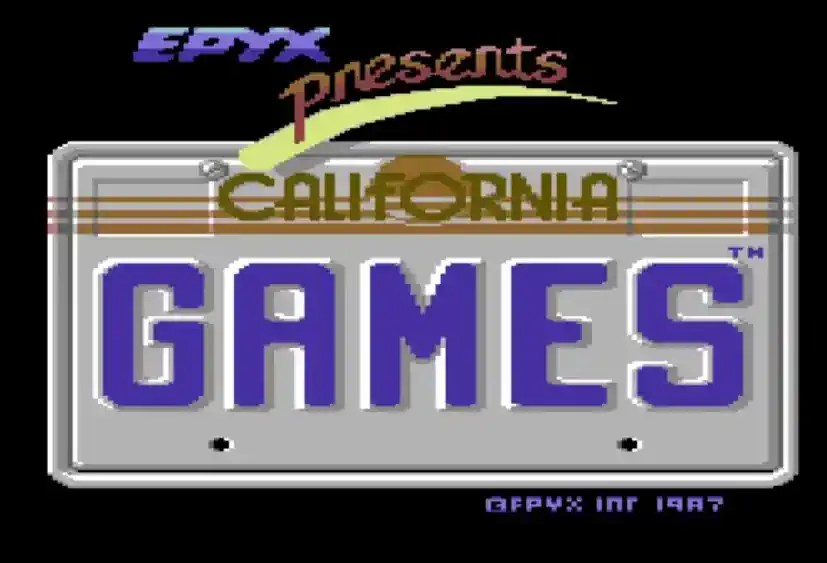
When California Games was released by Epyx on the Commodore 64 in 1987, the home computer world was at the height of creativity and experimentation. The industry was booming, gamers were looking for new themes and game mechanics, and Epyx’s vision struck a chord with the spirit of the times. While many games of that era dealt with fantasy, war, or classic arcade themes, California Games took a fresh, almost revolutionary approach. Instead of defeating monsters, chasing points, or piloting spaceships, players could experience sun, beach, sports, and a whole new attitude toward life. It was a game that focused less on competition and more on atmosphere—a digital window into the Californian lifestyle of the 1980s, characterized by music, fashion, colors, skateboards, surfboards, and youthful carefreeness.
With California Games, Epyx succeeded in creating a completely new atmosphere: not heroic, not gloomy, but optimistic, sunny, and cool. The player was not a warrior, but a free spirit with a skateboard and sunglasses who enjoyed movement, style, and expression. The game conveyed a sense of freedom that contrasted with the often linear and serious titles of its time. At a time when most games boasted high scores, violence, or pure speed, California Games offered a sense of creativity, rhythm, and self-expression—almost a precursor to modern open-world leisure experiences. It showed that video games could convey not only challenges but also moods, laying the foundation for a new kind of interactive entertainment.
Gameplay
California Games consists of a diverse collection of disciplines, all celebrating the leisure activities of the American West Coast. Each sport has its own controls, music, and mood, making each discipline feel almost like its own little game. Cutscenes, scoreboards, and small animations provide variety between competitions. The game can be played alone or in multiplayer mode – up to eight participants take turns competing against each other, providing hours of entertainment at parties or family evenings. Excitement, laughter, and schadenfreude alternated, as every fall or botched trick was met with visible delight from the audience on screen.
The disciplines at a glance
- Halfpipe (skateboarding) – In the halfpipe, as many tricks as possible, such as handplants, kickturns, or aerials, must be performed without losing balance. The precise timing of the landing was particularly tricky – one mistake and the skater landed painfully on the pixel floor. Players had to perfectly coordinate momentum and balance to maximize their score, and the cheering spectators in the background added to the competitive atmosphere.
- Footbag (Hacky Sack) – A real highlight: the player juggles a small ball and tries to combine different tricks, such as the “Around the World” or the “Header.” In addition to skill, tact was also important, as bonus points were awarded for rhythmic movements in time with the music. The setting – a sunny park with seagulls flying overhead – contributed to the relaxing and hypnotic feel of this mini-game. Players reported that they often spent minutes just following the ball without paying attention to their score.
- Surfing – Surfing a Californian wave is not only graphically impressive, but also challenging to play. The player had to find the perfect position on the wave, perform jumps, and stay on the board as long as possible. If you were “swallowed” by the wave, a charmingly animated water roll followed, humorously reminiscent of old surf comedies. The physical logic of the waves gave you a real feel for the timing and dynamics of this sport – it’s amazing how realistic it looked on an 8-bit system.
- BMX (cycling) – A dusty off-road track full of ramps, potholes, and obstacles demanded precise timing and responsiveness. If you jumped too early, you crashed; if you jumped too late, you lost speed – one of the most difficult but also most exciting disciplines. It was particularly impressive how well the designers conveyed the feeling of speed and terrain. The animations of the jumps, the crunch of the gravel, and the cheering when a trick was successfully completed made the BMX track a crowd favorite.
- Roller skating – Along the sunny beach promenade of Santa Monica, the goal was to avoid pedestrians, beach toys, and piles of sand. The animations were smooth, and the soundtrack perfectly complemented the relaxed atmosphere. The ease of movement, combined with the constant danger of falling, gave this discipline a charming balance of risk and elegance.
- Flying Disc (Frisbee) – A combination of throwing physics and skill: the player throws a Frisbee, whose trajectory must be precisely controlled, and then catches it with good timing with their teammate. Wind conditions, accuracy, and timing made this discipline more complex than it appeared at first glance, highlighting the attention to detail in every part of the game.
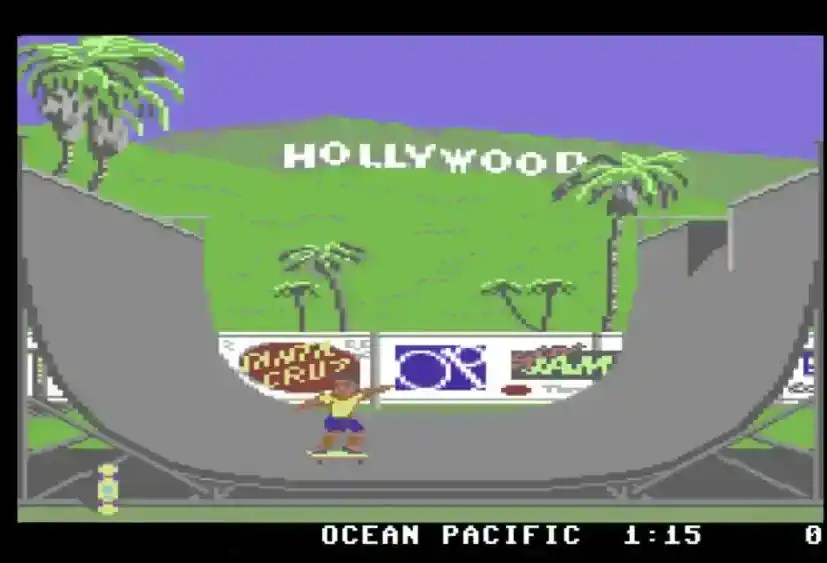
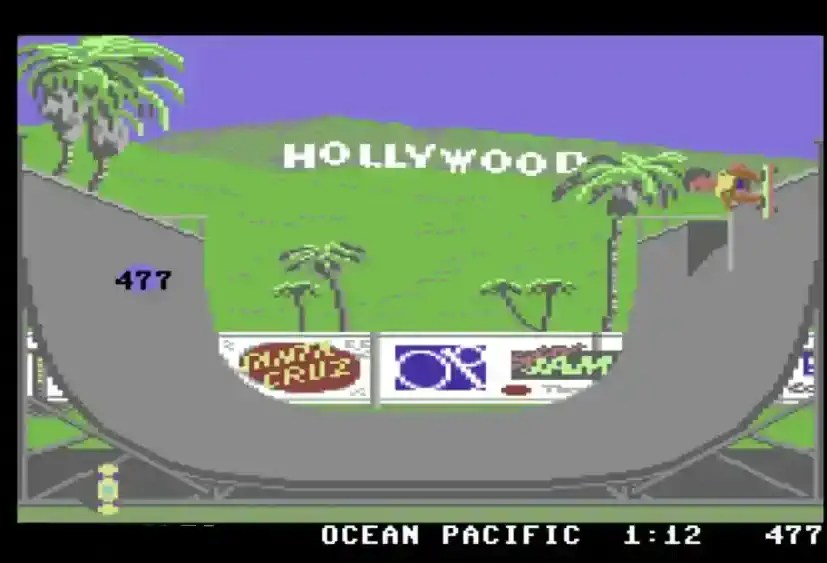
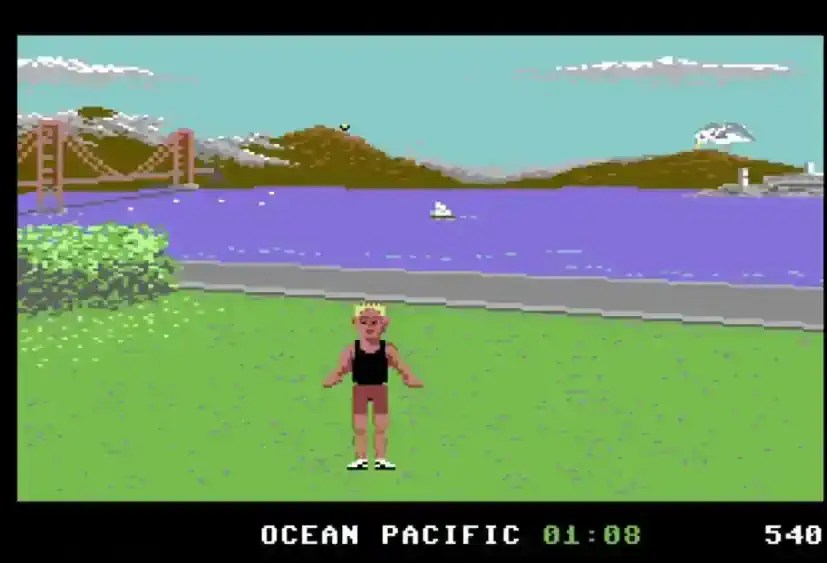
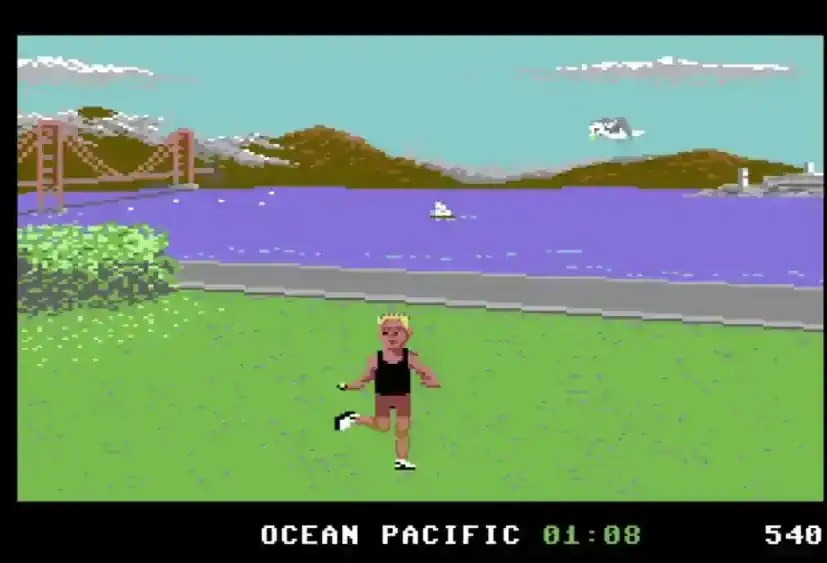
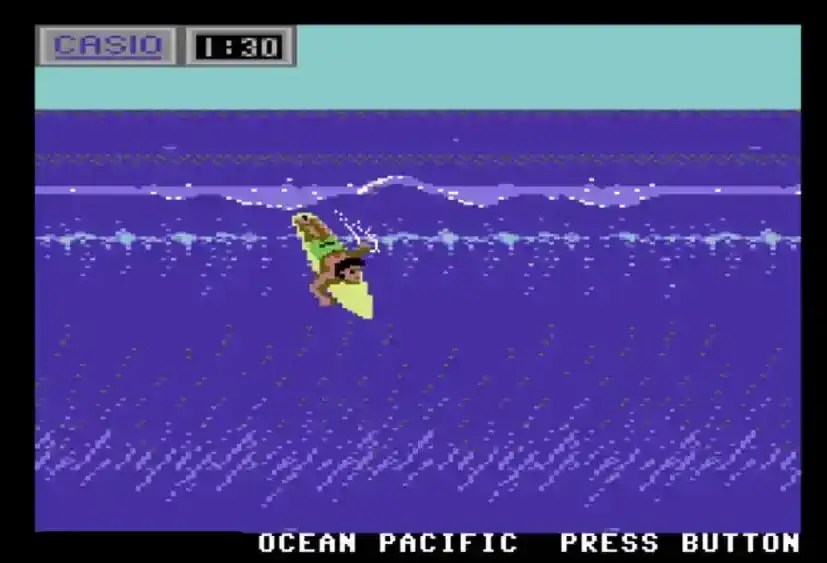
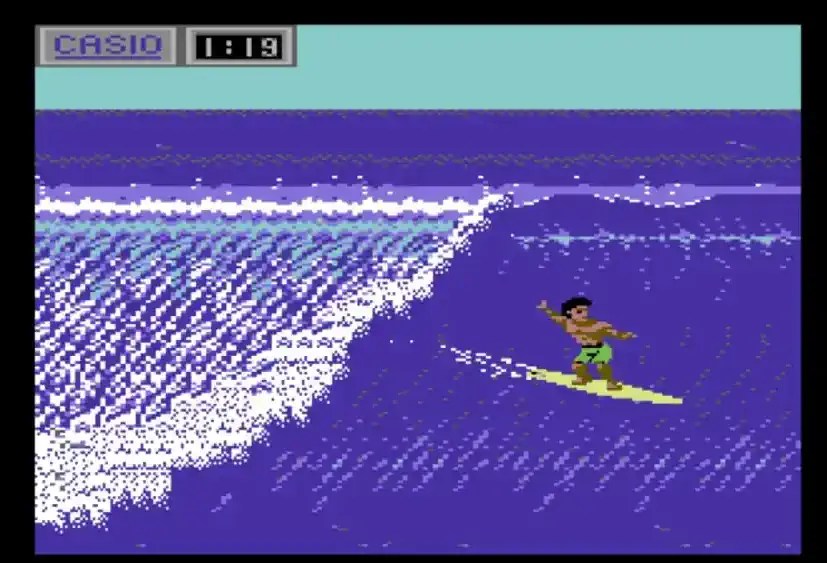
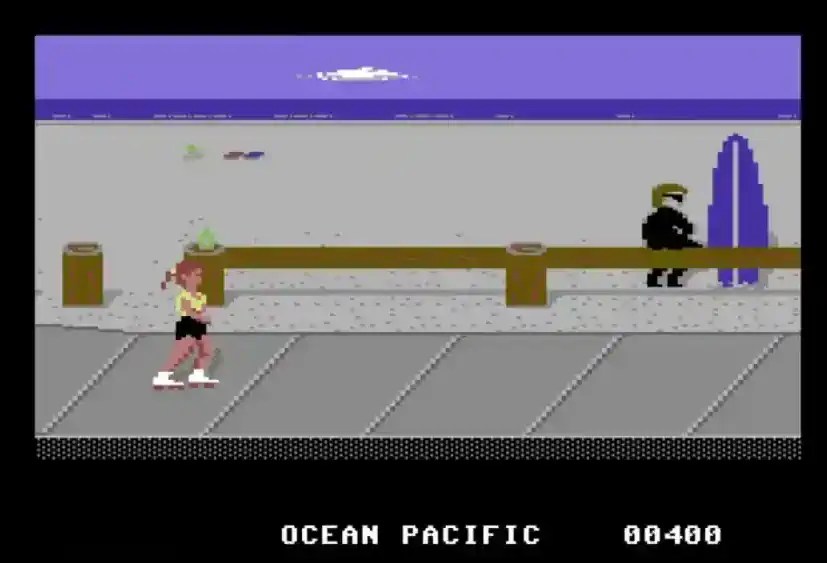
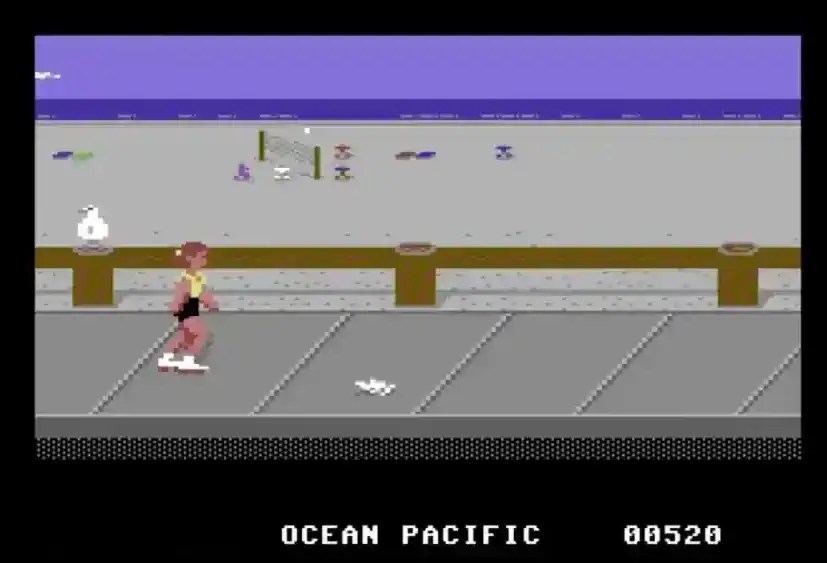
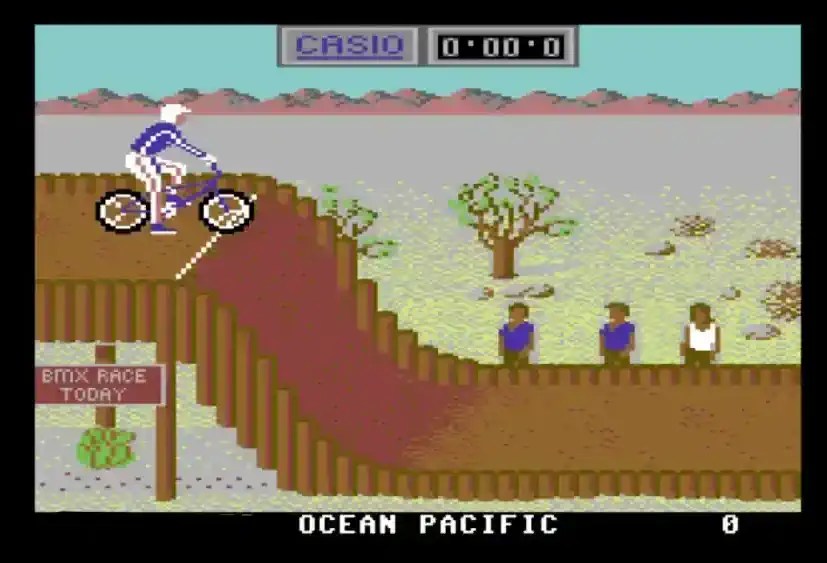
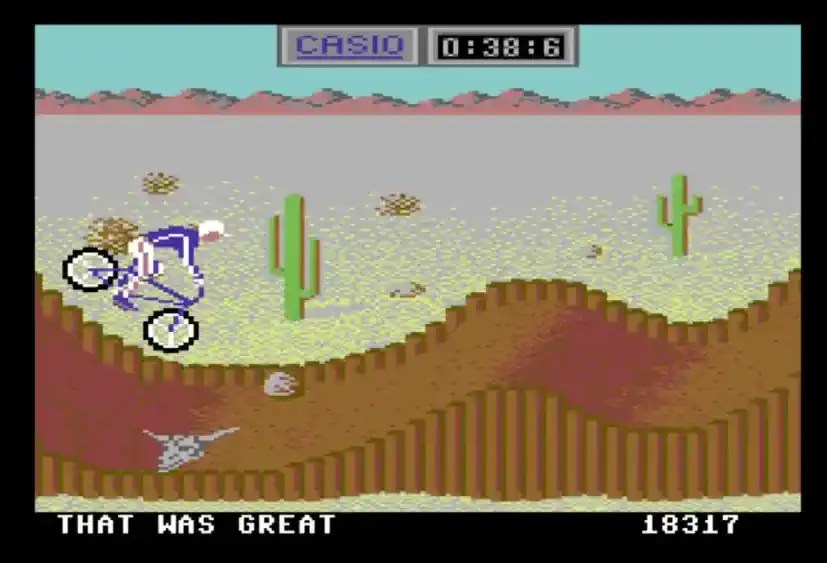
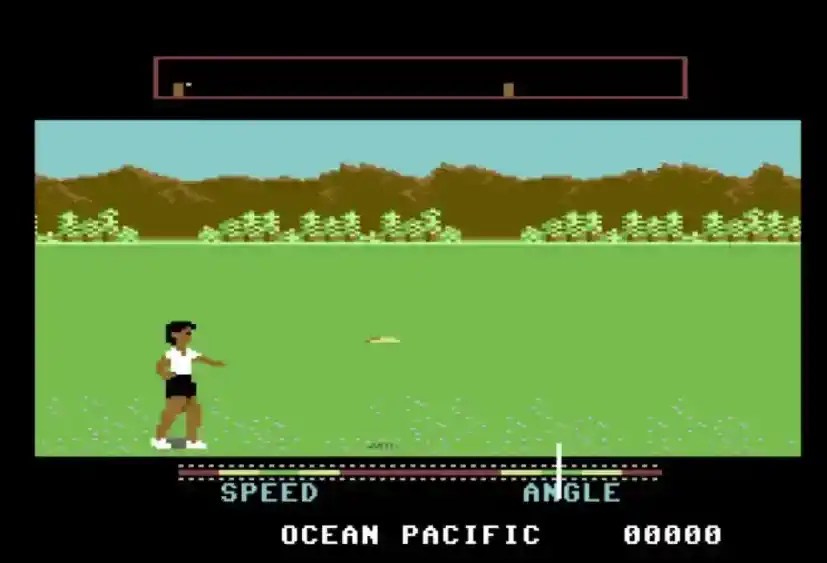
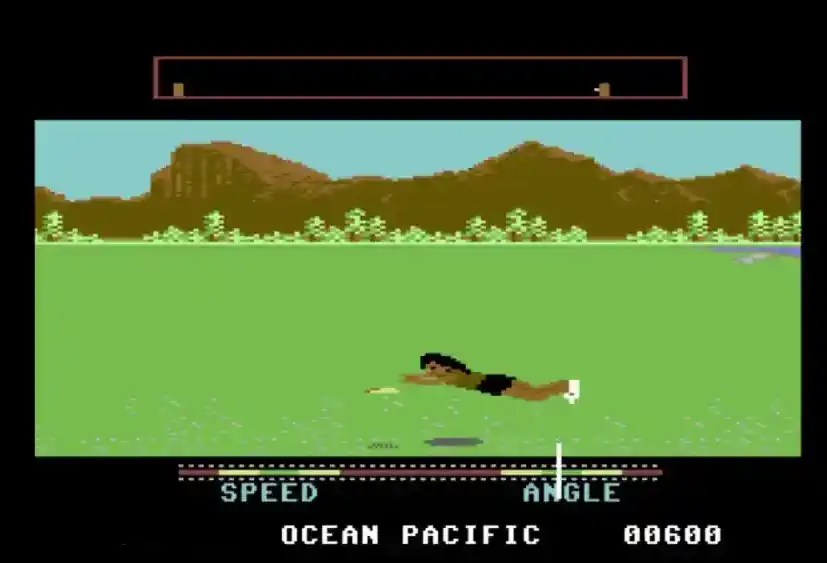
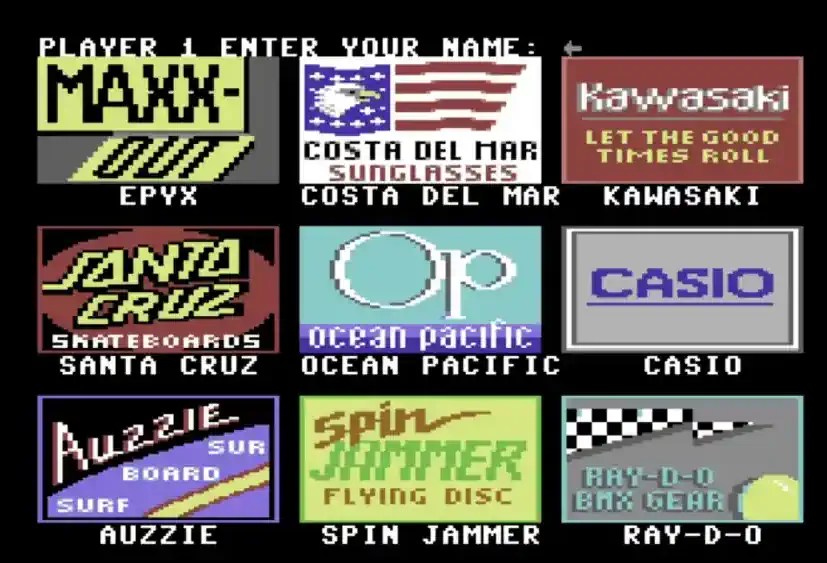
A notable feature was the ability to choose sponsors. Brands such as Ocean Pacific, Santa Cruz, Casio, and Body Glove appeared in the menus and banners – an early, visionary use of real-world advertising in video games. This lent the game authenticity and a touch of the “real world.” There was also a subtle motivational factor: depending on the sponsor, each round felt different, and many players still remembered their “favorite brand” from the game years later. California Games cleverly combined lifestyle, brand awareness, and gameplay—a concept that was far ahead of its time.
Technology
On a technical level, California Games was a true masterpiece on the C64 and set standards for later sports games. The graphics pushed the capabilities of the 8-bit hardware to their limits: colorful backgrounds, smooth scrolling effects, and detailed characters with amazingly smooth animations. The surfing and BMX cycling in particular impressed with their dynamic movements and perspective depth. Many players were amazed at how realistic the animations felt despite the limited hardware performance. You could literally feel the wind in your face as the BMX jumped over the hills, and the waves seemed almost alive as they broke beneath the surfer.
The soundtrack was legendary. The music by Chris Grigg and Bob Vieira reflected the relaxed West Coast vibe, while the sound effects—the rolling of the wheels, the splashing of the waves—added to the immersion. The C64’s sound chip, the famous SID chip, was used masterfully here: warm, pulsating bass and clear melodies that immediately stuck in your ear. Even small details such as the sound of the sea, the buzz of the spectators, or the soft clacking of the skateboard wheels created a feeling of liveliness that few games offered at the time. Many fans played individual disciplines just to listen to the music or enjoy the atmosphere.
The user interface also showed Epyx’s experience: clear menus, intuitive controls, minimal loading times – a technical masterpiece for 1987. The transitions between disciplines ran smoothly, and even the loading screens featured small animations or logos, adding to the professional feel. Particularly noteworthy was the compatibility with various input devices, including joysticks and some early gamepads. In later ports, Epyx adapted the controls perfectly to each platform, so that the game felt natural everywhere – a rarity at the time. The overall technical result was a game that was not only fun to play, but also served as a showcase for the capabilities of the C64.
Trivial
- The predecessors “Summer Games” (1984) and “Winter Games” (1985) formed the basis for the concept. Both were commercially successful and laid the foundation for the relaxed style of “California Games.” With “World Games” (1986), Epyx had further developed the principle and added a global touch, so that “California Games” was ultimately considered a kind of cultural highlight of the series. These predecessors showed that sports competitions on home computers were not only possible, but could also be extremely popular.
- The C64’s title melody has often been described as one of the most memorable tunes of the 8-bit era. Many fans can still hum it today, and it has been reinterpreted in numerous remixes and chip music compilations. It embodies the perfect blend of Californian cool and technical finesse.
- In some versions, Epyx hid little Easter eggs, such as surfboards with the Epyx logo or bizarre animations that appeared when you crashed too often. Discussions about other possible secrets, such as hidden sound effects or undocumented tricks that could only be discovered by chance, still circulate in fan forums today.
- The game was ported to countless platforms: Atari ST, Apple II, NES, Amiga, Master System, and even the Atari Lynx. The graphics and music often differed significantly, but the sunny feel always remained the same. Each version had its own charm – while the Amiga version shone with rich colors and smooth animations, the NES version scored points with clear controls and a surprisingly good implementation of the BMX mode.
- A special version was released in 1990 for the Sega Mega Drive, which slightly expanded and modernized the gameplay. It offered improved animations, faster loading times, and even some additional sound effects that made the sporting competition even more dynamic. Among collectors, this version is now considered a rarity and is often referred to as the “ultimate” California Games experience, as it combined the spirit of the original with the technical power of the 16-bit era.
Reviews at the time
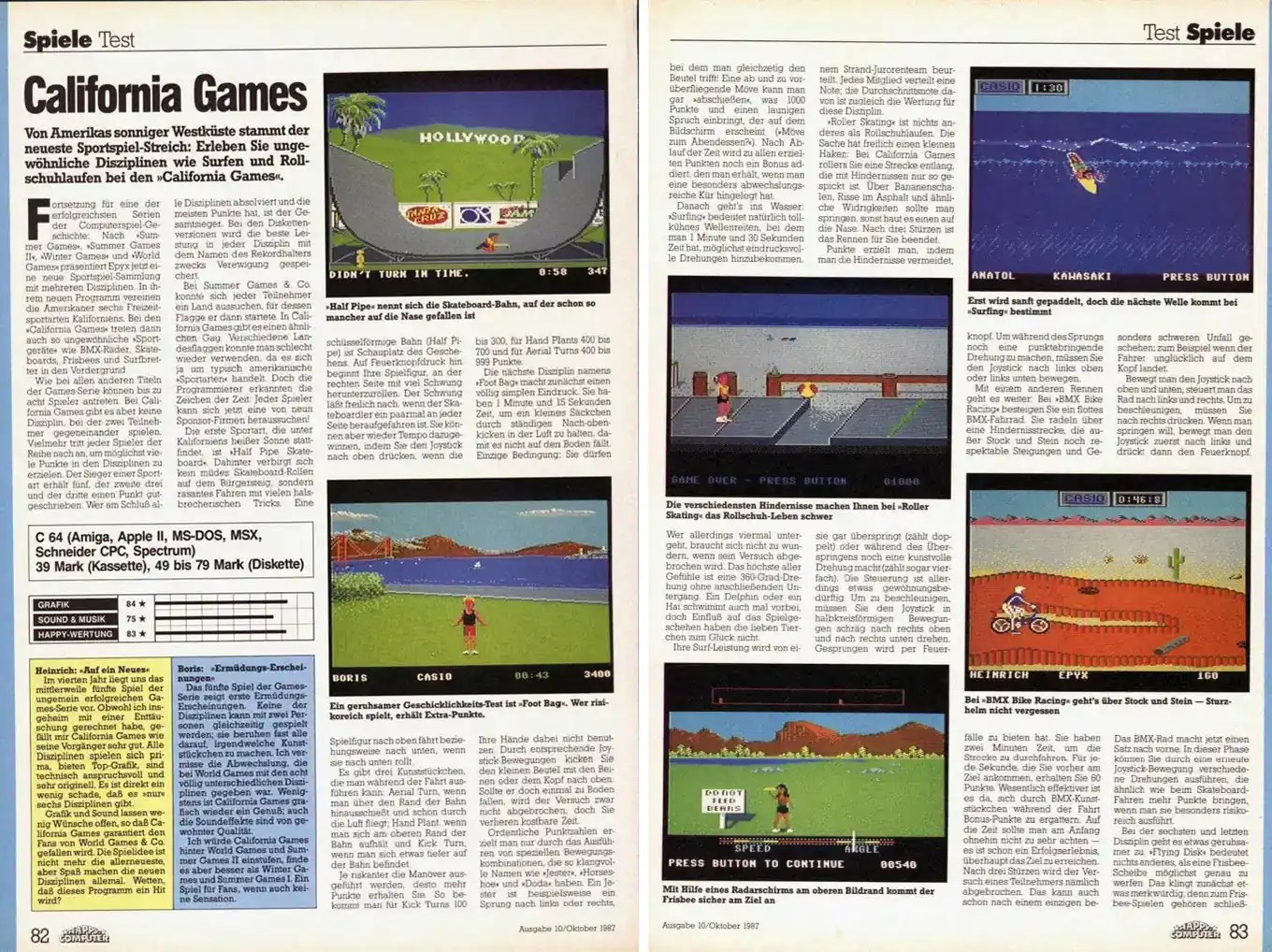
Contemporary magazines were full of praise. Zzap!64 gave it 90% and called it “the perfect summer game that shows how much fun a computer can be.” Commodore User praised the “graphical finesse” and “the high recognition value of the characters,” while Computer and Video Games particularly highlighted the party mode. Smaller magazines such as Happy Computer and Tilt were also enthusiastic about the colorful presentation and described the game as “a vacation on disk.” Particular praise was given to the pleasant balance between athletic challenge and humorous lightheartedness. Players felt transported to the West Coast – at a time when home computers mostly offered space battles or dungeons.
Criticism was mainly directed at the unbalanced difficulty – some disciplines such as footbag were easy to master, while BMX and surfing were extremely challenging. Some reviewers also complained that the scoring system was too unclear and that there were occasionally unfair crashes. Nevertheless, almost all reviews emphasized that these minor weaknesses hardly detracted from the fun of the game. The high replay value was particularly highlighted: the variety of disciplines, the ability to invite friends and compete against each other, and the constant summer vibe made “California Games” a perennial favorite. Many magazines described it as a game that you “bring out again and again when the sun is shining outside.”
Nevertheless, almost every magazine attested to the game’s excellent presentation, from the menu design to the animations to the music tracks. The game was particularly praised for radiating a feeling of joy, freedom, and summer – a rarity in the era of dark space shooters and serious simulations. In retrospective articles from the 1990s, it was often described as the epitome of the 8-bit feeling: playful, colorful, and yet technically brilliant.
Cultural influence
California Games became more than just a game—it became a symbol of an entire generation that found not only technology but also expression and identity in home computers. It coined the term “digital leisure culture” and stood for a new way of bringing joie de vivre to the screen. Many young people first learned terms such as “footbag,” “halfpipe,” and “BMX” through the game – terms that were still largely unknown in Europe at the time. In Europe, and especially in Germany, it inspired numerous imitators, including sports games with a similar flair, and even influenced magazines, advertising campaigns, and youth fashion, which suddenly picked up on skateboards and surfer graphics. The game became a pop culture phenomenon that brought the sunny optimism of California into the gray living rooms of the north.
It is considered a pioneer of modern extreme sports games. Without “California Games,” there might not have been series such as “Tony Hawk’s Pro Skater,” “SSX,” or “Skate.” Epyx also experimented early on with lifestyle aesthetics – surf motifs, colorful logos, cool typography, and a positive body image. This made it one of the first games to interpret sport not as competition, but as an expression of joie de vivre and self-expression. The focus was not only on performance, but on style, attitude, and expression – a concept that was later taken up by countless games, music videos, and even sports brands.
It also remained alive in the cultural memory: retro festivals, C64 remakes, YouTube longplays, and remix versions of the music tracks continue to celebrate the classic to this day. In many retrospectives, it is considered the game that “brought sunshine to the disk.” Even today, developers and artists cite the game as inspiration when it comes to digitally capturing freedom, fun, and youth culture. California Games thus remains a symbol of how video games can convey emotions and attitudes toward life beyond points and victories.
Conclusion
California Games is much more than just a collection of mini-games—it is a milestone in digital pop culture and a piece of living video game history. It combined technical sophistication with summery lightness and created an experience that still resonates today. With its blend of wit, style, and accessible controls, it exemplifies the creative spirit of the late 1980s and demonstrates how a game can be more than just entertainment – namely, an expression of an entire era. The charming graphics, lighthearted tone, and perfectly matched music made it synonymous with digital joie de vivre. Anyone who played California Games immediately sensed that it was not just about technology, but also about emotions and atmosphere.
Whether on the C64, Atari, or NES, anyone who has ever ridden the waves, kicked the footbag, or fallen on the halfpipe feels the special charm that only California Games exudes. It remains a game that celebrates the joy of movement, sunshine, and freedom – in 8-bit, but with a big heart. Even decades later, in the age of high-end consoles and virtual reality, the game has lost none of its fascination. It reminds us that great games don’t always have to be elaborate: sometimes all it takes is a good idea, a distinctive style, and the desire to simply make the player happy.








 McHenry's Lair
Kommentar verfassen :