


The classic among war-shooters
When the Commodore 64 conquered living rooms in the early 1980s, it marked the beginning of a new era of home computer gaming. The ability to experience complex and action-packed games on a home computer fascinated an entire generation. For the first time, young people could enjoy intense gaming experiences in their own homes that had previously only been possible in arcades or on expensive home consoles. The C64 became a playground for a new generation of developers who boldly experimented with new genres and experiences.
One of the games that made a name for itself particularly early on was Beach-Head, released in 1983 by Access Software. The title combined different game modes, simple but effective graphics, and action-packed gameplay to become one of the first successful war games on the C64. Players were thrown into a military campaign that required not only reflexes but also tactics and timing. This interplay of different elements laid the foundation for many later representatives of the genre, which relied on a similar formula. The success of Beach-Head impressively demonstrated that games with cinematic aspirations were also possible on home computers.
Beach-Head became one of the first games to attempt a cinematic presentation. It did not deliver pure shooting action, but was divided into several clearly defined mission sections. These were thematically based on scenarios inspired by real historical events, in particular the Allied landing in Normandy during World War II. Names and locations were deliberately kept fictional to avoid direct political appropriation. Nevertheless, the game conveyed a certain degree of authenticity that was remarkable for its time.
This mixture of realism, fictional freedom, and theatrical courage gave the game a special seriousness. It created a dense atmosphere that many players found exceptionally captivating, even though the technical means were limited. Instead of drifting into political or historical controversies, Beach-Head established itself as an interactive war scenario that was entertaining, challenging, and surprisingly multi-layered.
Gameplay
The gameplay of Beach Head was remarkably ambitious for the early 1980s, combining several game types in a continuous scenario. According to the original developer information and historical sources, the game consisted of several consecutive phases that simulated the course of a military invasion. The player took control of various vehicles—including warships, tanks, and anti-aircraft guns—with the goal of destroying an enemy coastal fortress.
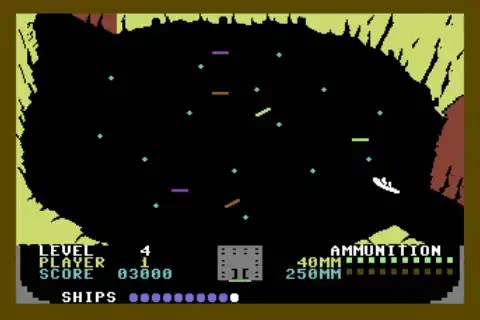
The first phase of the game consists of navigating a fleet through dangerous waters. Here, minefields and torpedoes must be avoided. This passage requires skill and precise control.
In the second phase, the focus shifts to air defense. The player now takes control of stationary anti-aircraft guns and must fend off a wave of enemy bombers. The goal is to destroy as many enemy aircraft as possible. This passage gives the game an intense arcade feel and creates increasing tension due to the steadily increasing density of attacks.
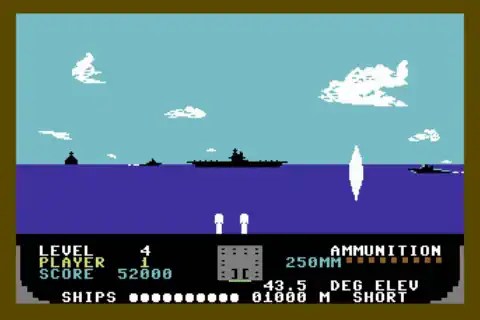
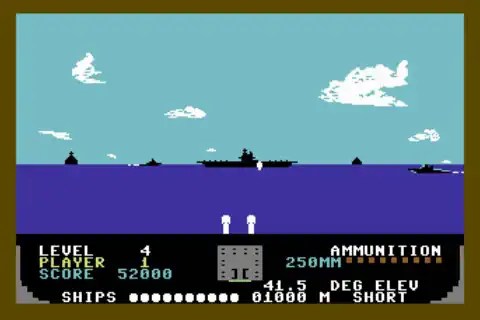
In the third phase, the player takes control of the ship’s guns and must fend off the enemy fleet. The goal is to sink the enemy ships as quickly and accurately as possible.
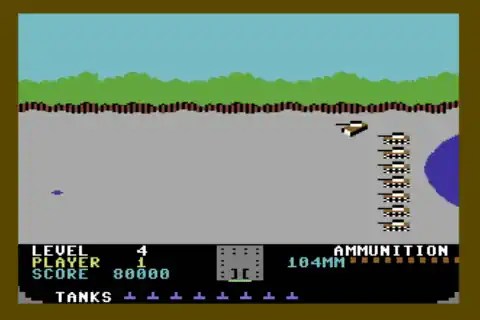
The next stage focuses on the landing troops. The player must steer their tanks across the beach while under fire and avoiding mines and obstacles. In this sequence, the perspective changes and the game becomes a tactical ground operation.
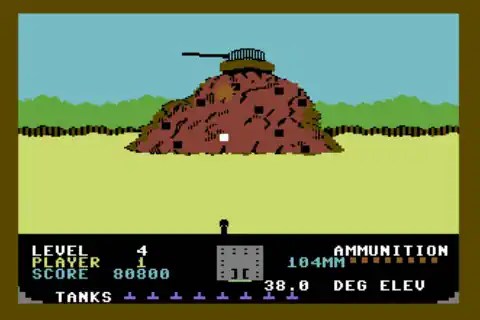
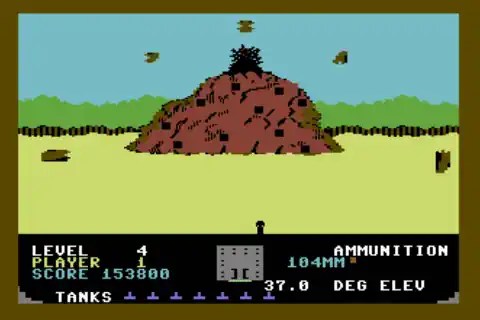
The grand finale is the attack on the enemy fortress, which is secured by a huge cannon – the so-called “gun emplacement.” The goal of this final mission is to destroy the cannon by hitting it precisely, while under time pressure as the cannon fires back.
What made Beach-Head special was the smooth transition between these different game mechanics. Each phase was a standalone mini-game, but in terms of content and theme, it was part of a coherent campaign. This combination of sea, air, and ground operations was unique in 1983 and conveyed a sense of military dynamics that most contemporary games did not achieve. The variety and challenge ensured that Beach Head was not just a simple shooter, but a versatile war scenario that combined tactics, skill, and timing.
With this structure, Beach Head laid the foundation for later games that focused on mission variety and scene changes—a concept that could be found years later in titles such as Raid over Moscow and Strike Commander.




Technology
For a game from 1983, Beach Head impresses with a multitude of technical innovations that set standards both in their implementation and in their effect:
- Multiscreen gameplay: Different game modes with smooth transitions – from naval combat to tank battles – created a cinematic impression. Instead of using just one screen or scenario, the game switched between different perspectives and mechanics. This conveyed the feeling of a coherent mission and was technically complex to implement.
- Sound: Solid effects for the time – machine gun fire, explosions, engine noises – using the C64’s SID chip. Although there was no orchestral soundtrack, the sound was atmospherically dense and clearly recognizable. The acoustic signals gave the player feedback about hits, danger, and progress – a detail that was crucial for immersion.
- Graphics: Simple but functional. Sprites were clearly recognizable, animations minimalistic but sufficient to make the combat action comprehensible. Despite the limited color palette, the developers managed to highlight important information through contrasts and symbolism. The depiction of enemy units and the transitions between levels were particularly well received.
In addition, the loading time was remarkably short compared to many other games of the time, which significantly improved the gaming experience. The menu navigation was simple but functional, allowing players to jump right in without lengthy explanations. The title ran smoothly and stably on the C64 and could even be played in two-player mode (alternately), which gave the game an additional social component.
The technical implementation was considered a benchmark for other developers who were also trying to implement action-packed scenarios on 8-bit hardware. Beach-Head impressively proved that even with the limitations of the hardware at the time, profound, dynamic game concepts could be realized. Many later games drew on these basic structures or were inspired by the modularity and sound design.
Trivia
- Beach Head was developed by Bruce Carver, co-founder of Access Software, who was later responsible for other innovative titles. Carver was originally a civil engineer before turning to computer game programming, which often gave his games a structured, technically sophisticated component. His flair for game mechanics and system architecture contributed significantly to the game’s success.
- One of the first versions of the game was originally developed for the Atari 8-bit before being ported to the C64. This port was technically complex, as it not only required graphical adjustments, but also a complete overhaul of the audio subsystem to take full advantage of the C64’s SID chip. Versions for the Amstrad CPC, ZX Spectrum, and Apple II followed later, with each platform having its own strengths and weaknesses—such as the Amstrad’s color palette or the Apple II’s sound capabilities.
- The great success led to the release of a sequel in 1985: “Beach-Head II: The Dictator Strikes Back”, which featured voice samples for the first time and boasted a two-player mode. The introduction of digitized audio was spectacular for its time and was celebrated as a breakthrough in magazines. Players could even challenge each other in various disciplines – such as storming a fortress or freeing prisoners.
- In the UK, “Beach-Head” was one of the best-selling games of 1984 and became a real blockbuster in Europe and the US. The game was prominently displayed in toy stores and department stores in particular and quickly gained a large fan base – not least thanks to its eye-catching packaging graphics and positive word of mouth in user groups and magazines.
- The name “Beach-Head” comes from military jargon and refers to a bridgehead, i.e. a secured landing area. In military strategy, such a bridgehead often represents the beginning of a large-scale advance – a metaphor that the game reflects not only in its name but also in its concept. The choice of this term gave the game an authentic, almost documentary tone without explicitly referring to real conflicts.
Controversy
Although Beach-Head did not use any explicit symbols or historical names, it was occasionally criticized as too warmongering. At a time when the depiction of war in digital media was still largely unregulated and socially sensitive, some media outlets and educators called for caution. It was argued that games with warlike content could desensitize young players or convey a distorted image of conflict. In various letters to the editor and educational articles, the game was mentioned as an example to debate violence and war as elements of entertainment.
Some voices accused the game of packaging a tactical simulation game with action elements as a mere “war game” that could convey a romanticized view of military operations through its visual presentation and suspenseful build-up. Nevertheless, there was no widespread public controversy as there was later with ‘Doom’ or “Call of Duty,” for example. One reason for this may be that “Beach-Head” did not show any explicit depictions of violence or realistic combat scenes, but remained rather abstract and symbolic in its style.
Some parents‘ associations also expressed concerns about habituation to violent content, especially in the context of the social debate at the time about the effects of media on children and young people. Nevertheless, these criticisms did not lead to calls for censorship or sales bans. Instead, the game was often cited as an example of technical pioneering and creative game structure that showed what was possible on home computers. In this ambivalence between technical innovation and moral skepticism, Beach Head became an early example of society’s debate about the medium of video games.
Criticism at the time
The trade press at the time reacted overwhelmingly positively to Beach-Head, praising it as a technically and playfully ambitious work. Particular emphasis was placed on the game’s graphic diversity, which – despite the limited technical capabilities of the C64 – offered varied and clearly recognizable scenarios. In 1984, the magazine Zzap!64 described the game as a milestone and praised not only the different types of levels, but also their successful transitions, which gave the impression of a continuous gameplay. It emphasized that Beach-Head set new standards for action titles and clearly stood out from the crowd of games at the time due to its diversity.
Commodore User was also enthusiastic, describing it as an “impressive overall experience” that appealed to both tech-savvy gamers and casual players alike. It was particularly praised for being both challenging and accessible thanks to its combination of strategy, reflexes, and variety. The structure of the missions allowed players to gradually grow into the game principle—an aspect that was not a given in titles of that era.
However, there were also some critical voices. Several reviews mentioned the lack of long-term motivation. Once the game had been successfully completed, there were no additional incentives to play it again, such as variable difficulty levels, unlockable content, or a high score system. Another criticism was that the game did not offer the option of selecting individual sections, meaning that players had to play through the entire scenario.
The ratings were mostly in the range of 70–85%, which was considered extremely good at the time. The magazine Happy Computer also joined in with the positive reviews, highlighting in particular the successful soundscape and the clearly structured game mechanics. Overall, Beach Head was a critics‘ favorite which, despite minor weaknesses, attracted a lot of attention thanks to its technical execution, innovative structure, and cinematic appeal.
Cultural influence
Beach Head was a pioneer in many ways and had a lasting influence on both game development and gaming culture. It impressively demonstrated that action games with multiple game modes were not only technically feasible on home computers, but could also be extremely successful commercially. The idea of combining different game mechanics in one title was still rare at the time and Beach-Head became a model for later productions. Games such as Raid Over Moscow, Silent Service, and Infiltrator took up similar concepts and expanded them in some cases to include strategic or narrative elements.
At the same time, the game’s success contributed to the establishment of Access Software as a major development studio. Beach-Head secured the company a firm place in the emerging home computer scene, and it later positioned itself successfully in completely different genres with brands such as the Links golf game series and the Tex Murphy adventures. The studio’s versatility had its roots in the creative and technical innovation that was already evident in Beach-Head.
Beach-Head also became a frequently used reference point in the demo scene, which developed in parallel with the gaming scene in the 1980s. The iconic title screen, distinctive sound effects, and memorable gameplay were frequently quoted, modified, or used as a starting point for technical experiments. Musicians attempted to reinterpret the game’s effects using the SID chip or present them in remix form. At the same time, graphic designers used the game’s sprites to create their own artistic versions or parodies.
In addition, Beach Head became an integral part of the retro gaming scene. It is still played, modified, and discussed in emulator communities today. Numerous retro collections and online archives list the title as a milestone of the C64 era. The game enjoys enduring popularity, especially among speedrunners, as its clear game sections and time-limited mission design offer ideal conditions for competitive play. Beach-Head is also regularly referenced at retro events and in documentaries about the early days of gaming. Thus, the title has not only burned itself into the memories of its players at the time, but has also secured a permanent place in the history of video games.
Conclusion
Beach Head is more than just an early war game—it is a fundamental piece of video game history that demonstrated the possibilities of the medium at a time when the home computer market was still in its infancy. With its innovative level design, thoughtful combination of tactical decisions and action-packed sequences, and extremely clean technical implementation for the hardware of the time, it showed as early as 1983 how complex experiences could be realized even on limited 8-bit technology. The game was a pioneer in narratively linking multiple game mechanics, resulting in a coherent and cinematic overall experience. This approach inspired numerous later titles and established a kind of blueprint for the design of linear but diverse action games.
Even though Beach Head naturally looks very dated in terms of graphics and sound design from today’s perspective, its structural influence on the genre remains undeniable. For many first-generation gamers, it was not just a game, but a formative experience that set new standards for immersion, suspense, and gameplay. The title impressively demonstrated that video games can be more than just simple entertainment; they can also be an expression of creativity, technical innovation, and narrative ambition.
A true classic, then, that not only inspires nostalgia, but is also of profound significance in the history of gaming. Anyone seriously interested in the history of video games today – whether from an academic, cultural, or technical perspective – can hardly ignore “Beach Head.” It is a title that demonstrated the courage to innovate, broke new ground, and was remarkably well-rounded, well-thought-out, and style-defining for its time. As a link between arcade influences and the dawning era of more complex home computer games, Beach-Head marks a decisive milestone – and therefore deserves its place in the digital memory of the gaming world.
More
Walkthrough
External links
- Beach-Head at lemon64
- Beach-Head at MobyGames
- Beach-Head at C64-Wiki
- Beach-Head at Wikipedia








 McHenry's Lair
Kommentar verfassen :