

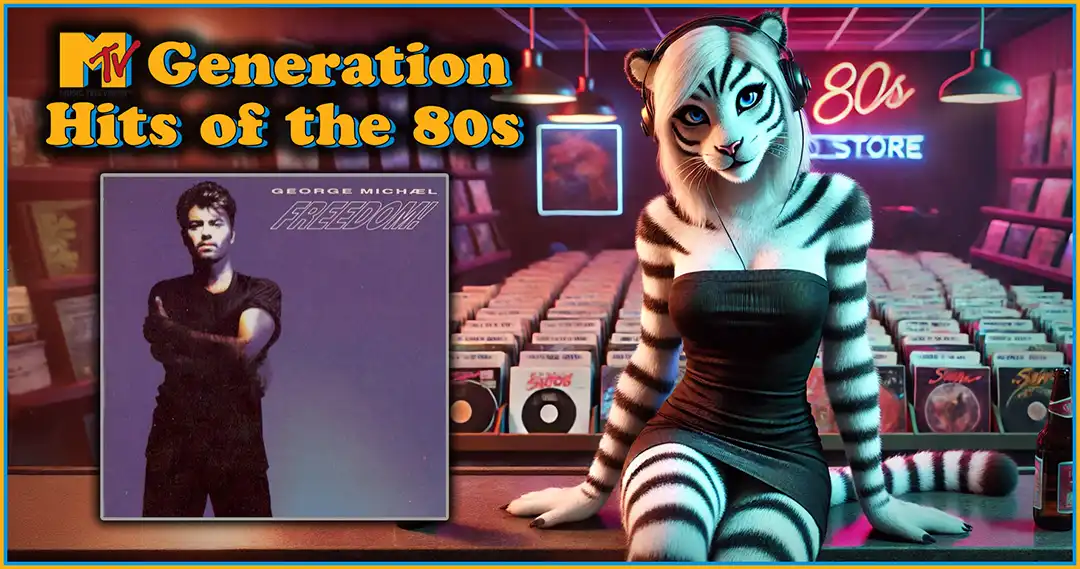
Freedom (I won’t let you down)
Freedom (I will not give you up)
Freedom (gotta have some faith in the sound)
Between rebellion and self-awareness
“Freedom! ’90,” released in October 1990, is one of the most iconic songs in George Michael’s career – and perhaps even in the entire history of pop music. After his worldwide success with Wham! and his solo debut “Faith,” Michael turned away from his image with this track, not only musically but also personally. It was a radical act of self-determination, a public liberation that reflected his musical development and personal attitude.
The song is less a hymn to classic freedom and more a multi-layered reckoning with fame, commercialization, and the pressure of being a pop star. In his lyrics, Michael processes the alienation from himself that had befallen him due to the media hype and stereotypical role assignment. He questions the mechanisms of the music industry, but also the expectations of the audience, who had become accustomed to a certain image of him. At the same time, “Freedom! ’90” is a musical declaration of a new, reflective artistic self that no longer wants to hide or pretend.
It is a conscious break with the past, a musical new beginning that paves the way for a new understanding of artistry—one based on authenticity, independence, and inner truth. With this song, George Michael shows that he was willing to take risks and reinvent himself as an artist—a step that not only shaped his career, but also influenced the self-image of many artists in the decades that followed.
Lyrics – The sound of inner liberation
The lyrics of “Freedom! ’90” are personal, reflective, and almost rebellious. In them, George Michael settles scores with the pop business – without bitterness, but with clarity. Lines such as:
“I won’t let you down / So please don’t give me up / ‚Cause I would really, really love to stick around”
show his conflict between the desire for success and personal integrity. This becomes particularly clear in:
“There’s something deep inside of me / There’s someone I forgot to be.”
Michael realizes that he has lost himself in the game of self-promotion – and wants to rediscover this part of himself. The title “Freedom!” does not refer to classic social freedom, but to self-liberation – from image, expectations, and conventions. It is an intimate reflection on identity and self-worth, manifested in a seemingly simple pop song. At the same time, the song is also a kind of self-confession, an attempt to reclaim oneself through art.
The direct language of the lyrics gives the song an emotional urgency that goes far beyond the purely personal. The repeated emphasis on the word “freedom” becomes a kind of mantra that functions not only as a chorus, but as a central idea that runs through the entire song. It is not only about external freedom, but above all about inner freedom: the freedom to be oneself – despite or precisely because of public expectations.
In addition, a subtle religious motif runs through the lyrics, for example in the form of the search for salvation or a higher truth. This motif is supported by lines such as “All we have to do now is take these lies and make them true somehow” – an appeal for honesty and spiritual purification. This makes the song not only a biographical statement, but also a universal message for all those who feel forced into roles with which they do not identify. The power of “Freedom! ’90” lies in this complexity – it is both a personal liberation and a collective song of awakening.
Music video – models instead of musicians
The music video for “Freedom! ’90” is legendary and remains one of the most influential clips in music history. It was directed by David Fincher, who would later achieve world fame with films such as Fight Club, Seven, and The Social Network. His distinctive style is already evident here: strong contrasts, elegant camera work, and symbolic imagery. Instead of George Michael himself, the video features supermodels of the time: Naomi Campbell, Linda Evangelista, Tatjana Patitz, Cindy Crawford, and Christy Turlington – each of them miming the singer in a playback performance. This visual language was not only stylistically groundbreaking, but also a political statement: the models embodied a new form of glamour, power, and autonomy. They symbolized female presence in the spotlight without subordinating themselves to a male-dominated gaze.
This deliberate absence of the artist was a clear statement against the commercialization of his own persona. Michael no longer wanted to be the face of the brand, but to focus on the music. The scene in which a leather jacket (from the “Faith” video) explodes symbolizes the destruction of his old image. Similarly, a jukebox and a guitar—also iconic symbols of his former success—are set on fire. This visually powerful symbolism marks the new beginning of an artist who wants to reinvent himself, free from the constraints and expectations of the industry. Particularly striking is the video’s dark, minimalist look, which is combined with clear high-fashion design. This creates a timeless, almost museum-like effect that keeps the video relevant over the years.
The video also had an enormous influence on the fashion, music, and advertising worlds of the 1990s. It set new standards for pop aesthetics and defined how a music video could function as a pure visual icon beyond classic performance and linear storytelling. It was one of the first videos to focus on stylistic abstraction rather than narrative storytelling. Through its close connection to the supermodel culture of the time, the video also established itself as a milestone in the visualization of fashion in moving images. Decades later, it is still considered a blueprint for the connection between music, style, and cultural commentary. Many modern artists, including Beyoncé, Lady Gaga, and Madonna, have incorporated the video’s aesthetic into their own work.
Trivia and interesting facts
- The song is officially titled “Freedom! ’90” to distinguish it from the Wham! song ‘Freedom’ (1984). The earlier title was a classic pop song about love and romantic independence, while “Freedom! ’90” is introspective, critical, and strongly personal. The two songs exemplify two very different phases in George Michael’s career—from carefree pop optimism to deep self-reflection and artistic emancipation.
- Michael was involved in an intense legal battle with his label Sony at the time. He accused the company of treating him like a product rather than an artist. “Freedom! ’90” can therefore also be understood as a musical declaration of war, in which he publicly rebels against the alienation from his own art and the constraints of the music market. The release of the song was a courageous act that showed his determination to no longer submit to the rules of the industry. This conflict ultimately led Michael to withdraw from the spotlight for years.
- Cindy Crawford lay in a bathtub full of water for her appearance in the video—a scene that made pop culture history. This visual staging became one of the most iconic images of the 1990s and symbolizes the connection between sensuality, self-confidence, and stylized femininity. Crawford’s presence contributed significantly to the myth of the music video and was imitated many times.
- The video has been frequently parodied and referenced, including in series such as Glee, music videos by artists such as Taylor Swift (e.g., “Bad Blood”), and numerous fashion magazines that referenced its aesthetic. The visual language of the clip has become firmly embedded in collective pop culture and has served as inspiration for countless visual concepts in advertising, fashion photography, and music videos.
Criticism at the time
When it was released in 1990, the response was mixed to positive. Many critics praised the musical quality and the courage to break with the image. However, there were also voices that accused Michael of retreating—for example, because he withdrew from the public eye and did not appear in the video. Some media outlets even interpreted his absence as arrogance, while others viewed the move as a bold strategy to draw attention to the music rather than the image. In retrospect, however, it was precisely this move that was recognized as a bold artistic decision, as it deliberately eschewed conventional marketing logic.
Musically, the song was described as funk-infused pop with gospel influences – more complex and less radio-friendly than earlier hits, but artistically more mature. The song features sophisticated layers of synthesizers, soulful backing vocals, and a pumping rhythm that is both catchy and sophisticated. Particularly striking is the absence of a classic chorus—instead, Michael relies on repetition and rhythmic elements that give the song a hypnotic effect. Lyrically, it is also noticeable that “Freedom! ’90” has far more depth than most pop songs of the time.
In retrospect, “Freedom! ’90” is considered one of the most courageous steps taken by an artist of the pop era, defying the expectations of the industry. It was proof that pop music does not have to be superficial, but can deal with profound themes. It also became clear that even commercially successful artists can have the courage to develop artistically, break away from the mainstream, and explore new aesthetic paths. In retrospect, the song has been honored in numerous best-of lists as a milestone of the 1990s and is now considered a blueprint for all artists who want to break free from their commercial mold.
Cultural influence
“Freedom! ’90” is now considered a precursor to a new form of pop criticism from within. While many artists used their platform to promote products or brands, Michael used his song for self-reflection—without completely turning his back on the pop world. He showed that it is possible to be part of the system and criticize it at the same time.
This balancing act between belonging and resistance was later perceived as style-defining and influenced an entire generation of musicians who no longer wanted to see authenticity and commerce as opposites. Michael paved the way for artists who see their music not only as entertainment, but as a tool for social reflection. The song inspired countless artists to consciously engage with their public image.
Many saw Michael’s open approach to his image as an encouragement to question themselves and their own artistic role. The video, in turn, shaped the era of supermodels and the idea that fashion and music can merge at the highest artistic level. It became an aesthetic blueprint for the combination of high-gloss visuals and subtext, glamour and social criticism. In this respect, “Freedom! ’90” was not only musically but also visually influential—it permanently changed expectations of the music video as an artistic form.
Today, “Freedom! ’90” is often cited in connection with topics such as bodily freedom, media criticism, and identity. The song continues to be used in films, series, and political campaigns that advocate for self-determination. Especially in times of increasing social division and digital self-expression, its appeal to inner truth and personal integrity is more relevant than ever. The combination of pop aesthetics, personal depth, and social commentary makes it one of the most significant songs of its time—and beyond.
Conclusion
“Freedom! ’90” is no ordinary pop song. It is a musical self-portrait, an artistic manifesto, and a media-critical liberation strike. George Michael managed to break away from his old image without sacrificing his musical integrity. Today, the song stands as a testament to authenticity in an industry that often demands the opposite—an environment where superficiality is often rewarded and depth rarely finds its place. “Freedom! ’90” is a rare case in which commercial pop merges with intellectual ambition and personal openness.
He showed the world that pop music is not only good for dancing or dreaming, but can also be a means of emancipation and self-awareness. Its message and impact have a power that radiates far beyond the moment of its release. George Michael once sang, “I think there’s something you should know / I think it’s time I told you so” – and with this song, he said it loud and clear. He broke with expectations, stood up against a system that wanted to shape him, and instead offered a vision in which the self, one’s own truth, takes center stage.
Today, decades later, „Freedom! ’90“ seems more relevant than ever: as a call to stay true to oneself, to break free from social expectations, and to find one’s own voice. In a world where self-promotion through social media and constant pressure to perform are omnipresent, the song reminds us of the power of inner freedom. It remains a musical beacon – not only for fans of George Michael, but for anyone seeking their own path.






Kommentar verfassen