

Contents
- Moral panic, exaggerated conservatism, and “cancel culture”
- The dawn of the video store era—freedom that caused fear
- Moral panic – a conservative culture war
- The law intervenes – state censorship as a response
- Cult status as a backlash
- Cultural significance – a lesson in censorship and social control
- Conclusion
- The Nastiness of the Nasty
Video Recordings Act 1984
1984 CHAPTER 39
An Act to make provision for regulating the distribution of video recordings
and for connected purposes.
Be it enacted by the Queen’s most Excellent Majesty, by and with the advice and consent of the
Lords Spiritual and Temporal, and Commons, in this present Parliament assembled,
and by the authority of the same, as follows:—
Moral panic, exaggerated conservatism, and “cancel culture”
When video recorders found their way into British living rooms in the early 1980s, it not only changed the leisure habits of many people – it also gave rise to a moral panic that went down in pop culture history: the “video nasties.” The British press (and later the censorship authority) used this term to describe horror and exploitation films that were considered particularly brutal, obscene, or corrupting. The fear that this new, unfiltered content could suddenly find its way into private households unchecked struck a chord with a society that was already characterized by conservative values and a desire for stability. Television and cinema had been more tightly controlled until then, and suddenly home video disrupted this order.
But the movement against these films was much more than just concern for the protection of minors—it was an expression of a conservative backlash and an example of how a society attempts to suppress cultural forms of expression through public pressure and censorship. Politicians, church representatives, and influential media outlets used fears of moral decay to strengthen their own agendas and send a signal against social change. In particular, the visibility of violence, sexuality, and taboo-breaking in these films provided a projection screen for all those who longed for a “clean” culture. In a way, it was an early form of what we might now call “cancel culture”: the exclusion of unwelcome content through media outrage and political influence—a process that was not only aimed at protecting young people, but also at pushing uncomfortable art forms out of the public sphere.
The dawn of the video store era—freedom that caused fear
In the early 1980s, video cassettes were a new phenomenon. There were hardly any legal regulations for content distributed directly on VHS. Unlike cinema films, video titles did not have to be reviewed by the British Board of Film Censors (BBFC). Many small labels took advantage of this gray area to release uncut horror and splatter films from the US, Italy, and other countries. Video stores boomed, and suddenly anyone could rent films that were previously only available in niche cinemas or not at all, without any age restrictions. For many, this was a symbol of new media freedom – for conservatives, however, it was a threat because they seemed to be losing control over cultural content. This new availability led to the emergence of a veritable subculture: young people exchanged recommendations, collected cassettes, wrote about particularly “hard” scenes in fanzines, and founded the first horror fan clubs. The black market also grew because some titles were not officially available and were therefore copied and passed on under the counter.
Titles such as Cannibal Holocaust (1980), Driller Killer (1979), The Evil Dead (1981), and I Spit on Your Grave (1978) found their way into British living rooms. The covers were designed to be sensational, with bloody motifs and shocking titles—marketing that deliberately provoked and attracted attention. The fact that young people exchanged and collected such cassettes fueled the fears of those who were concerned about moral education in a conservative society. Parents also feared that the uncut availability of violence and sexuality could undermine traditional authority and moral values, which further fueled the social debate.
Moral panic – a conservative culture war
Newspapers such as the Daily Mail and The Sun picked up on the wave and began reporting on “video nasties.” Conservative politicians and religious groups warned of alleged psychological damage to children. Headlines such as “Ban These Evil Videos!” created hysteria based less on facts than on fear.
Reports of children allegedly imitating violent acts after watching such films were rarely verified, but were widely circulated thanks to their emotional impact.
Prominent in this culture war were Conservative Home Secretary James Anderton and activist Mary Whitehouse, who had previously advocated restrictive moral policies. Whitehouse spoke of a “plague on society” and deliberately fueled the feeling that Britain was morally decaying. Churches, parents‘ initiatives, and conservative politicians joined in and called for a crackdown—not only out of concern for children, but also to send a cultural signal: content that did not fit into their moral worldview should disappear.
This dynamic is strongly reminiscent of today’s cancel culture debates: an interplay between the media, moral activists, and politics led to unpopular works being stigmatized and pushed out of the public sphere. Back then, it was called “youth protection”; today, we would speak of “social responsibility” – but the principle of collective ostracism is similar.
The law intervenes – state censorship as a response
In 1984, the government responded with the Video Recordings Act. From then on, all films released on video had to be reviewed and classified by the BBFC. Many titles were confiscated, heavily edited, or banned altogether. Retailers and video store operators faced penalties if they rented out unclassified films. This legal measure had the effect of a wave of widespread censorship, which primarily restricted cultural freedom and sent a clear signal to all producers: content that did not fit in with conservative moral values would be rigorously suppressed. Critics warned that this was the first time the state had attempted to massively regulate the private film viewing habits of its citizens, setting a precedent for cultural intervention.
Some films disappeared completely, while others survived only in heavily censored versions. Some seizures were arbitrary because local police authorities applied different levels of severity. Video store owners reported raids and fear of heavy fines or even prison sentences. This created a climate of self-censorship: retailers cautiously refrained from stocking risky titles, and labels hardly dared to release anything controversial. The campaign against the “video nasties” was thus less a policy of protecting young people than an attempt to suppress an entire subculture through state power and public pressure and to shape the cultural landscape according to conservative ideas.
Cult status as a backlash
Ironically, this repression led to the “video nasties” achieving cult status. The label became a seal of approval for horror fans – a kind of subcultural rebellion against conservative paternalism. Collectors hunted for the confiscated VHS tapes, and lists of banned titles were circulated in fanzines. Anyone who owned such a cassette also demonstrated a certain independence from the mainstream and consciously opposed the prevailing cultural policy. For many horror lovers, collecting these banned films became a statement: they actively opposed censorship and preserved works that would otherwise have been forgotten. Even small, often informally organized film clubs sprang up, where uncut versions were shown secretly—an underground cinema that saw itself as a counter-movement to conservative paternalism.
Many of these films were rehabilitated decades later and released uncut. The BBFC relaxed its standards, and with the decline of moral panic, the fear of a supposedly brutalized youth also disappeared. Works such as The Evil Dead and The Texas Chain Saw Massacre are now freely available and considered relevant to film history. Some of these once-banned titles are now analyzed in film courses at universities, and documentaries shed light on the period as an example of government overreaction and cultural oppression. Thus, what was once intended to be marginalized has, in the long run, established itself as part of Britain’s film history and pop cultural identity.
Cultural significance – a lesson in censorship and social control
The history of the “video nasties” is a lesson in the influence of conservative moral values and exaggerated protective reflexes. It shows how easily media scare campaigns can translate into state intervention and cultural oppression. Many aspects seem like an early form of “cancel culture”: uncomfortable content is morally branded, the media stokes outrage, and politicians respond with restrictions. It is particularly noteworthy how much public debate was shaped by emotional headlines rather than scientific findings. Psychological studies, which at the time found little evidence of a direct increase in violence caused by these films, were almost lost in the panic. History also shows how easily political forces can exploit outrage to gain control over cultural narratives. It is precisely this mechanism that highlights how dangerous it is when social pressure and moral outrage get out of hand: Even today’s forms of “cancel culture” can quickly tip into a dynamic that massively threatens art and freedom of expression and creates an atmosphere of fear in which creative voices are silenced. When media campaigns and social media shitstorms judge content before nuanced discussions take place, artists and thinkers can lose their voice for fear of reputational damage or economic consequences. The historical view of the Video Nasties moral panic therefore warns that such patterns, if adopted without reflection, can lead to a climate in which creative diversity and critical debate are systematically suppressed.
Today, this chapter MUST be understood as an urgent warning: new technologies and unfamiliar content can quickly become a projection screen for social fears—whether it be horror videos back then, computer games in the 1990s, or social media today. A recurring pattern emerges: first, uncertainty and moral concern arise, followed by campaigns pushing for censorship or exclusion. The “video nasties” remind us that cultural freedom must be constantly defended, because social fears and conservative reflexes repeatedly attempt to limit creative forms of expression and steer them in acceptable directions.
Conclusion
The “video nasties” of the 1980s were less a real danger than a symbol of exaggerated conservatism and the desire for cultural control. The moral panic says more about the fears and power claims of society at the time than about the films themselves. It reflects an attempt to slow down social change through restrictive moral concepts and to limit cultural diversity. At a time when social upheaval and new technologies were causing uncertainty, the censorship campaign provided conservative forces with a platform to propagate values such as obedience and purity.
What was once demonized and banned is now considered cult and shows that censorship and cancel campaigns may be effective in the short term, but in the long term they can achieve the opposite—namely, catapulting what they wanted to prevent into the cultural canon. History shows that attempts to suppress art and media often only reinforce their myth and make them more attractive to future generations. Precisely because the “video nasties” were once ostracized, they are now an integral part of film history, a symbol of resistance to excessive censorship, and a cautionary example of how easily cultural fear can lead to the restriction of freedom. This historical experience also serves as a stark reminder that today’s forms of “cancel culture” can quickly develop the same dynamics: content is morally ostracized, discussions are cut short by outrage, and artistic freedom is restricted. Those who want to protect art and opinion in the long term should recognize these parallels and remain sensitive so that the history of cultural oppression does not repeat itself.
The Nastiness of the Nasty
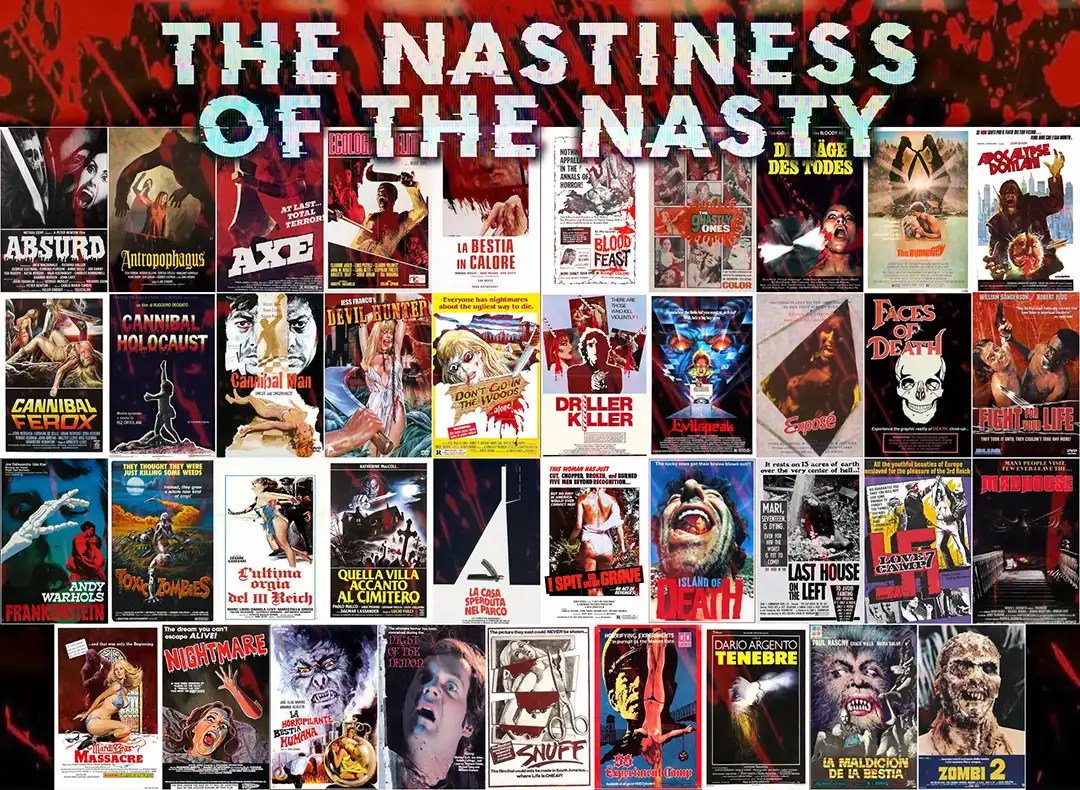
- Absurd
- Anthropophagous: The Beast
- Axe
- A Bay of Blood
- The Beast in Heat
- Blood Feast
- Blood Rites
- Bloody Moon
- The Burning
- Cannibal Apocalypse
- Cannibal Ferox
- Cannibal Holocaust
- The Cannibal Man
- Devil Hunter
- Don’t Go in the Woods
- The Driller Killer
- Evilspeak
- Exposé
- Faces of Death
- Fight for Your Life
- Flesh for Frankenstein
- Forest of Fear
- Gestapo’s Last Orgy
- The House by the Cemetery
- The House on the Edge of the Park
- I Spit on Your Grave
- Island of Death (
- The Last House on the Left
- Love Camp 7
- Madhouse
- Mardi Gras Massacre
- Nightmares in a Damaged Brain
- Night of the Bloody Apes
- Night of the Demon
- Snuff
- SS Experiment Camp
- Tenebrae
- The Werewolf and the Yeti
- Zombie Flesh Eaters





 McHenry's Lair
Kommentar verfassen :