

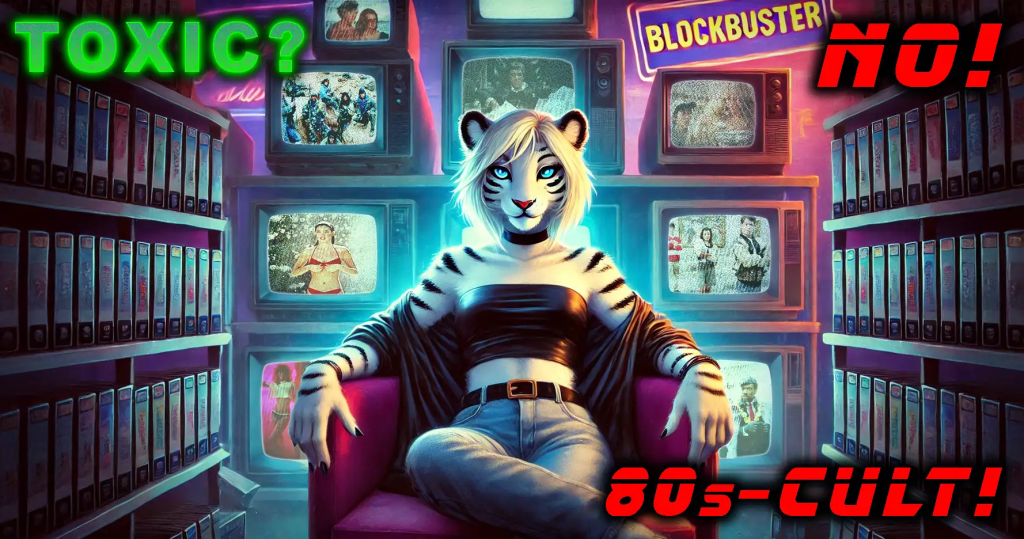

For GenX, it’s a damn good 80s movie night with friends – lots of popcorn, beer, a sofa, and a hint of rebellion in the air (again). Just like back then, all you need is a VHS tape and a couch to confirm the old truth: The 80s ruled. Period.
For Gen Z, it’s a „toxic“ movie night – with trigger warnings on popcorn cups, tears in Insta stories, dramatic TikTok comments in real time, and endless discourse about why you can’t just let a 40-year-old movie play.
I grew up with films like The Breakfast Club, Weird Science, Red Dawn, and Revenge of the Nerds. These movies were in theaters, on VHS, and on TV back then – they were part of our everyday lives and the topic of conversation in every schoolyard. We knew the dialogues by heart and imitated the characters. They made us laugh, made us think, made us dream – and yes, they were sometimes a little off the mark. But toxic? That word would never have even crossed our minds back then. For us, it was entertainment, a mirror of our times, our insecurities, dreams, and conflicts. And that should still be taken into account today before pointing the moral finger at past pop culture.
In the 80s, these films were much more than mere entertainment for us – they were topics of conversation, style icons, the soundtrack to our everyday lives, and sometimes even a source of comfort in darker moments. We laughed at the clichés, fell in love with quirky characters, empathized with them, dreamed with them – and in doing so, naturally explored the boundaries of what was permissible. Not out of provocation or malice, but out of genuine interest, out of youthful curiosity about life and its contradictions.
When I see how Gen Z gets upset about these movies – our(!) movies – I could burst with rage and would love to tell them straight to their faces how ridiculous and pointless all this fuss is! Suddenly, everything is „problematic,“ „no longer relevant,“ or worthy of being burned at the digital stake. It seems as if every scene, every line of dialogue, and every character (including the actors) has to pass a political purity test these days. In doing so, many people forget what films actually are: products of their time – not perfect lessons in morality or ideology. They reflect the culture, society, attitude, and „zeitgeist“ of the era in which they were made – with all their flaws, but also with all their charm. When we start measuring past works solely by today’s standards, we lose not only the historical context, but also the opportunity to really learn something from them.
Back then, we were happy to see stories – especially about young people – that didn’t end with a heavy moral message. Not everything was wrapped up with an educational conclusion. Much was left open, ambiguous, uncomfortable – just like real life. The conflicts were raw, the characters unpolished – and that’s exactly what made them so authentic and vivid. These films showed us that it’s okay to make mistakes, that rebellion is sometimes part of life, and that not every story needs a moral happy ending. Of course, certain things would be told differently today. But to condemn them for that, to erase them from cultural memory or even want to „cancel“ them, is honestly going too far for me. If we start looking at everything from the past only through the moral lens of today, we make history unrecognizable – and that cannot be the goal.
Art – and that includes film – must always be viewed in its historical context. Every creative work is a product of the time in which it was created and reflects the values, ideas, and blind spots of that time. Anyone who wants to ban Indiana Jones and the Temple of Doom today because of its colonial portrayals understands neither Spielberg nor the 1980s. The film was not a call for white supremacy, but an adventure flick that drew on the pop culture of the time. Anyone who doesn’t recognize Heathers as satire, but as a call to violence, simply hasn’t understood the black humor of that era.
I often think that some representatives of GenZ would love to turn an old 80s video store into an exhibition in the style of „„Entartete Kunst (Degenerate Art)“ The only difference is that back then it was censorship from above, whereas today it seems to come from morally exaggerated activism. That doesn’t make it any less problematic.
I’m not saying that it’s wrong to question films and content, but you should always see and understand them in the context of the attitudes of the time – the „zeitgeist“ – instead of immediately censoring everything. Perhaps, instead of rushing to judgment, we should pause more often and ask: What did these films want to say back then – and what can they still tell us today? Maybe that’s exactly the lesson GenZ could learn from our generation: Understand first, judge later – and think beyond your own standards.
We also had films that even we considered sick and distasteful at the time. I’m talking about the infamous extreme exploitation films, among others. Titles such as Cannibal Holocaust, Zombi, the numerous Naziploitation films, and, of course, Faces of Death. But we would never have thought of banning these films.
If you really wanted to torture yourself with terrible stories, actors, and staging – just to see a lot of blood, gore, and nudity – please seat yourself. But most people quickly realized that it wasn’t worth watching any more exploitation films. And so the genre quickly disappeared again.
BTW: Still, I’d love to watch a movie like that with GenZ- just to see how long they can last…
I know that not everyone from GenZ thinks this way, but those who are do it loud – very loud. So loud that companies, media outlets, and streaming services now often (too often) react immediately. And not after careful consideration, but reflexively, as if every criticism were a threatening shitstorm that must be avoided at all costs. In a kind of anticipatory obedience, content is removed, scenes are cut, or formats are canceled – without really questioning whether this is necessary or sensible. All this just to preempt a potentially bad image that might arise among individual groups. Whether the criticism is justified or not hardly matters anymore. The whole thing often comes across as blind activism – not as thoughtful action.
And honestly, maybe we just need to be more tolerant of cultural history today – especially when it has rough edges. Because it’s precisely those rough edges that make it human, that make it real. It’s not about condoning everything, but about understanding why something was told the way it was. Films are not perfect moral lessons, but time capsules. And maybe it’s time to view them with a willingness to contextualize them in the spirit of their time – instead of with scissors in hand.
I’m just going to reach blindly into the box of old VHS tapes and let myself be surprised by which classic will be flickering across the screen tonight…
Here are a few more examples of
„Once a cult movie – now just toxic?“

- Friday the 13th (1980)
What Gen X sees: A groundbreaking slasher film that shaped an entire horror genre
What Gen Z sees: Violence against women, sexualized victim roles, little psychological depth - Blue Lagoon (1980)
What Gen X sees: An exotic adventure about growing up in the wilderness, a symbol of romantic innocence.
What Gen Z sees: Sexualization of minors, questionable relationship dynamics. - Porky’s (1981)
What GenX sees: A coming-of-age comedy that breaks taboos.
What GenZ sees: Voyeurism, sexual harassment, misogyny. - The Cannonball Run (1981)
What GenX sees: Star-studded car comedy with slapstick and action.
What GenZ sees: Sexist portrayal of women, racist caricatures, glorification of lawbreaking. - Excalibur (1981)
What GenX sees: An epic retelling of the Arthurian legend with opulent imagery and dramatic flair
What GenZ sees: Oversexualized portrayals, outdated gender roles, glorification of violence - Fast Times at Ridgemont High (1982)
What GenX sees: A cheeky teen comedy with realistic coming-of-age moments and a strong 80s vibe.
What GenZ sees: Objectification of female characters, questionable handling of consent, sexism. - Conan the Barbarian (1982)
What Gen X sees: An epic fantasy spectacle starring Arnold Schwarzenegger—raw power, classic hero’s journey.
What Gen Z sees: Glorification of violence, toxic images of masculinity, sexualization of women. - First Blood (1982)
What GenX sees: Intense action drama with social commentary that established the action hero Rambo.
What GenZ sees: Glorification of violence, stereotypical portrayal of police and military, glorified images of masculinity. - The Outsiders (1983)
What GenX sees: Authentic youth drama with depth that addresses outsiders and group belonging.
What GenZ sees: Teen violence, stereotypical images of masculinity. - Trading Places (1983)
What GenX sees: Criticism of society and capitalism in comedy format
What GenZ sees: Blackface scenes, racist and sexist tropes. - Scarface (1983)
What Gen X sees: Cult classics of the gangster genre with iconic quotes and a legendary soundtrack
What Gen Z sees: Glorification of violence, machismo, stereotypical portrayal of Latinos. - National Lampoon’s Vacation (1983)
What GenX sees: a chaotic family comedy that depicts vacation frustrations in a wonderfully biting and exaggerated way. What GenZ sees: sexism and stereotypical role models. - Revenge of the Nerds (1984)
What GenX sees: a David vs. Goliath story with nerds as heroes
What GenZ sees: sexual assault, misogynistic portrayals, ethnic stereotypes - Indiana Jones and the Temple of Doom (1984)
What GenX sees: Cult adventure film.
What GenZ sees: Racist and colonialist portrayals of cultures. - Bachelor Party (1984)
What GenX sees: Chaotic comedy with Tom Hanks, typical of 80s party movies
What GenZ sees: Objectification of women, sexist jokes - Red Dawn (1984)
What Gen X sees: Patriotic action film with teenage heroes fighting against a Soviet invasion
What Gen Z sees: Cold War propaganda, exaggerated nationalism, racialized enemy stereotypes - Romancing the Stone (1984)
What GenX sees: A romantic adventure with humor, exotic locations, and a self-deprecating heroine.
What GenZ sees: Clichéd gender roles, a white male savior narrative. - The Breakfast Club (1985)
What Gen X sees: A coming-of-age film that authentically depicts teenage problems.
What Gen Z sees: Classism, sexism, problematic romantic dynamics, bullying. - Weird Science (1985)
What GenX sees: Nerd/geek fantasy with humor and sci-fi elements.
What GenZ sees: Objectification of women, questionable morals. - Rambo: First Blood Part II (1985)
What Gen X sees: Action icon, Vietnam revenge fantasy.
What Gen Z sees: Stereotypical portrayals of Asians, glorification of violence, US patriotism. - Soul Man (1986)
What GenX sees: „Funny“ criticism of American racism and the scholarship award system
What GenZ sees: Main character does blackface, racist and culturally insensitive. - Ferris Bueller’s Day Off (1986)
What GenX sees: Iconic school truancy comedy with lots of charm, clever dialogue, and a touch of anarchy
What GenZ sees: Ignorance of consequences, toxic charming portrayal of masculinity - Three Amigos! (1986)
What GenX sees: A parody of Westerns with slapstick humor.
What GenZ sees: Cultural appropriation, stereotypical portrayal of Mexicans. - Mannequin (1987)
What GenX sees: Romantic comedy with fantasy elements.
What GenZ sees: Objectification of women, stereotypical portrayal of LGBTQ+ characters. - Fatal Attraction (1987)
What GenX sees: Thriller with suspense and cult status.
What GenZ sees: Stigmatization of mental illness, misogynistic narratives. - Dirty Dancing (1987)
What GenX sees: Romantic dance drama with an unforgettable soundtrack, coming-of-age flair, and iconic dance scenes. What GenZ sees: Power imbalance in the central love relationship, stereotypical role models. - Heathers (1988)
What Gen X sees: Darkly humorous satire on high school life.
What Gen Z sees: Glorification of violence, toxic relationships, dealing with suicide. - Coming to America (1988)
What Gen X sees: One of Eddie Murphy’s best comedies
What Gen Z sees: Clichéd portrayal of Africa, sexist content. - Die Hard (1988)
What GenX sees: Genre-defining action film with Bruce Willis as an ironic antihero
What GenZ sees: Excessive violence, stereotypical villain characters - Dead Poets Society (1989)
What Gen X sees: The rebellious spirit and inspiration from teacher figures
What Gen Z sees: An elitist private school environment and romanticized portrayals of problematic relationships






 McHenry's Lair
Kommentar verfassen :