

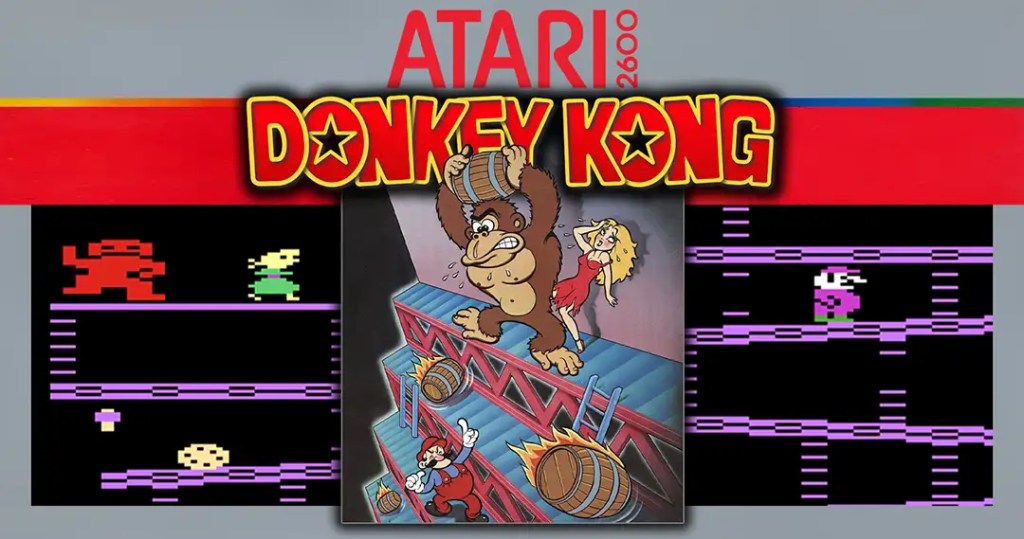
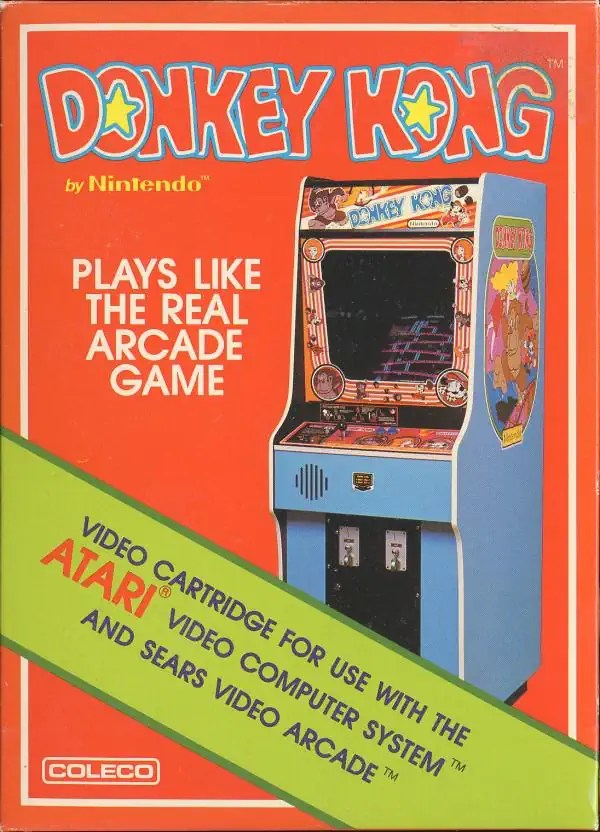
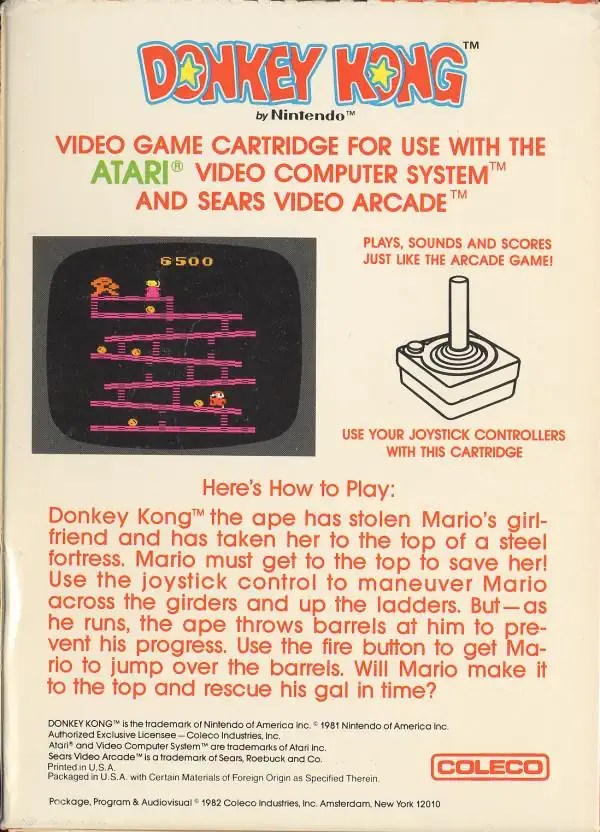
Plays, Sounds and Scores just like the real Arcade Game!
Classic or catastrophe?
When Donkey Kong took arcades by storm in 1981, it set new standards in the platform game genre and shaped an entire decade of digital entertainment. Developed by Nintendo, the game not only marked the beginning of a new era in arcade gaming, but also the first appearance of the later world-famous character Mario – then still known as “Jumpman.” The game captivated players with its innovative level design, charming graphics, and gameplay that was very intuitive for its time.
Given the overwhelming success of the arcade machine, it was only a matter of time before home console versions would follow. Nintendo licensed the game to various manufacturers, and so it came to be that the Atari 2600, one of the most popular consoles of its time, also got its own version. This adaptation raised high expectations among gamers, who hoped to enjoy the thrilling arcade experience at home. But what began promisingly quickly turned into disappointment for many players. The discrepancy between what they knew from the arcade and what appeared on their home TVs was striking. What went wrong, and why was this version considered by many to be one of the worst ports ever?
Gameplay
The basic idea remained the same: the player takes on the role of Jumpman, who bravely attempts to rescue his kidnapped girlfriend Pauline from the huge and menacing gorilla Donkey Kong. The gameplay requires climbing platforms, jumping skillfully over rolling barrels, and navigating cleverly placed ladders and obstacles. Players must always pay attention to perfect jump timing, as even the smallest mistakes can quickly lead to the loss of a life. Ideally, Donkey Kong offers smooth, precise and exciting platform gameplay that impresses with its clearly structured graphics, funny animations and characteristic, catchy music.
However, the Atari 2600 version, released by Coleco in 1982, presented the public with a heavily stripped-down and significantly simplified version of the arcade original. Of the original four arcade levels, only two were retained, with the particularly popular and mechanically varied “Elevator” and “Pie Factory” stages being omitted entirely. This reduction not only detracted from the depth of the game, but also robbed the title of much of its original dynamism. Added to this were massive technical limitations of the Atari 2600 hardware, which were noticeable in almost every aspect of the implementation – from the crude and minimalist graphics to jerky animations and a simple soundscape that was hardly comparable to the sound diversity of the arcade original.
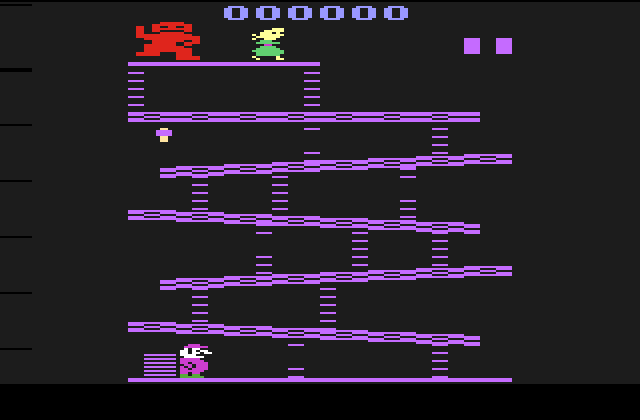
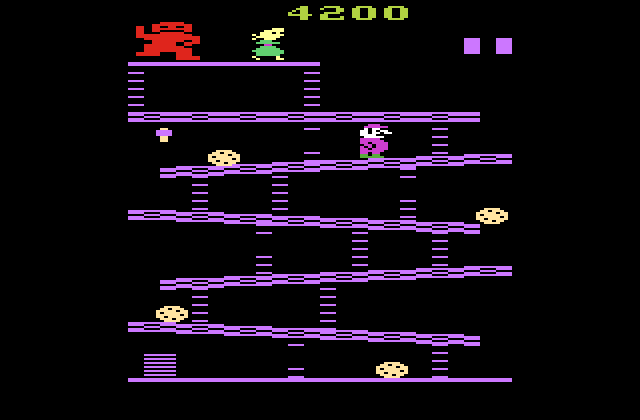
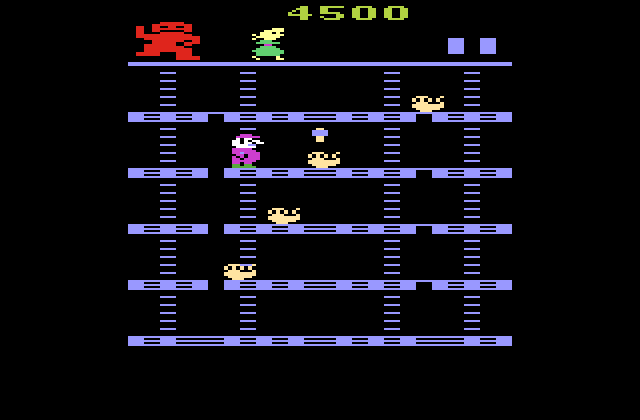
Arcade vs. Atari 2600 version
A comparison of the two versions reveals drastic differences that extend to almost every aspect of the game. In the arcade version, the graphics are colorful, detailed, and allow the player to clearly distinguish between Donkey Kong and Jumpman. The environments are lovingly designed, the animations are smooth, and the overall feel of the game is well thought out and polished. On the Atari 2600, on the other hand, the characters consist of crude sprites with an extremely limited color palette – they look clunky and are barely recognizable as the original. Players sometimes had to guess which character they were controlling because the graphics were so simplified. The sound also shows significant differences: while the arcade machine features iconic music, elaborate jingles, and clear sound effects, the home version offers only a few monotonous beeps that have little to do with the original.
Another key criterion is the number of playable levels. The arcade version contains four varied and iconic stages that differ in layout, difficulty, and gameplay mechanics. The Atari version, on the other hand, offers only two of these, which significantly reduces replay value and variety. Particularly disappointing is the absence of the popular “Elevator” and “Pie Factory” levels, which were an essential part of the gaming experience for many fans. The animations of the characters and enemies also suffered from the technical limitations of the Atari hardware: what was fluid and realistic in the original appears jerky and wooden here. Movements appear choppy, and the flow of the game suffers noticeably as a result.
Finally, the controls are particularly disappointing. The precise, responsive controls of the arcade game have been replaced by a sluggish and imprecise implementation on the home console. Jumps feel spongy, and timing is difficult to judge – a critical flaw in a game that relies on precise movement. So the Atari version was not only visually disappointing – it also lacked polish and technical sophistication in terms of gameplay. Many players found the gameplay clunky, the hitboxes inconsistent or unfair, and the graphics barely recognizable. Overall, the version became one of the most prominent negative examples of arcade conversions to home consoles of that era.
Trivia
- Developed by Coleco: Although Donkey Kong is a Nintendo game, Coleco was granted the rights to port it to home consoles. It is noteworthy that Coleco itself had a competing console to the Atari 2600 in the form of the ColecoVision – a potential conflict of interest that is still a topic of discussion today.
- One-armed Donkey Kong? In the 2600 version, the monkey appears to have only one arm – a popular running gag among retro fans. The strangely proportioned sprite initially left many players wondering what they were actually supposed to see.
- Jumpman without a cap: In the Atari version, Mario is missing not only his famous moustache, but also his iconic red cap. Due to limited graphics capabilities, the character was greatly simplified – much to the chagrin of many fans.
- No music in the game: While the arcade original shines with catchy melodies, the Atari version lacks any background music. Only a few simple sound effects remind you that there is any sound at all.
- Quick programming: According to developer reports, the Atari version was developed in less than six weeks – an extremely short time, which could explain many of the quality flaws.
Intentionally bad?
Probably the most persistent theory surrounding the Atari 2600 version is that Coleco made it bad on purpose. Why? To make their own system (ColecoVision) look better. Donkey Kong ran on ColecoVision in almost arcade quality – with better graphics, complete levels, and sound that was based on the original. By producing a technically substandard version for the rival Atari 2600 system, they could have deliberately created dissatisfaction – a questionable tactic, but not unthinkable at the time. This theory is supported by the fact that Coleco not only held the licensing rights, but also had a financial interest in making its own system look better than its established competitor.
Some observers even suspect that certain features were deliberately omitted or reduced, even though the Atari hardware would have allowed at least rudimentary implementations. Not only were two complete levels missing, but also basic graphical details that were perfectly possible in other games on the same platform. In addition, the development period for the port was extremely short – another indication that quantity took precedence over quality.
Although this theory has never been officially confirmed, statements by contemporary witnesses and industry insiders at least leave room for speculation. In interviews, developers hinted that resources were deliberately allocated to the ColecoVision project, while the Atari implementation was treated more as a chore. The assumption that this version was used as a means of market manipulation remains an exciting topic of discussion in the retrogaming community to this day.
Another point that supports this theory is that today’s homebrew versions impressively demonstrate that it would have been possible to create a significantly better version even with the technology available at the time, for example based on an 8K cartridge. In recent years, many hobby developers have created alternative implementations that show that much more would have been possible, both graphically and in terms of gameplay, even under the tight hardware constraints of the Atari 2600.
Even more impressive are the homebrew results based on 16K cartridges, which were first used just one year later. These offer enough storage space to program versions that not only come close to arcade quality, but in some cases even look better than the official ColecoVision version. These technical possibilities, which are now demonstrated by homebrew projects, shed additional light on Coleco’s porting policy at the time.
For all these reasons, I find the theory that the Atari version was deliberately kept in poor quality very plausible.
Reviews at the time
Upon release, reviews were mixed. Many gamers and console owners were excited that a popular arcade hit was finally available on a home console – a significant step for the emerging home video game scene at the time. But even by the standards of the early 1980s, the Atari 2600 version was considered weak. Many trade journals and gaming magazines criticized the crude graphics, the severely limited game content, and the poor controls. The loss of the background music and the absence of two iconic levels were also considered significant shortcomings.
Despite this justified criticism, the name “Donkey Kong” was already so strong that the game still sold well. Many buyers were willing to compromise in order to bring a piece of the arcade experience home – even if it was only a very pale imitation of the original. For children and teenagers who had never seen a real arcade machine, the 2600 version at least offered a rough impression of the hype. In addition, the gaming market was still young at the time, and many consumers had little to compare it to, which meant that even lower-quality titles found buyers.
Reputation today
Today, the Atari 2600 version of Donkey Kong is considered a prime example of a failed port. In retro circles, it is almost legendary – but in a negative sense. YouTube channels, retro game blogs, and collectors regularly remind us of this version, often with an ironic or even mocking undertone. Some videos compare the Atari version directly with the arcade version or show parodies that exaggerate the poor graphics and sound effects. The version also regularly appears in online forums as a bad example of early game design and is often cited as a case of “what should never have happened.”
However, this negative fame has also earned the version a certain nostalgic cult status – along the lines of “so bad that it’s interesting again.” Collectors now value the cartridge as a curiosity, and some retro gamers see it as a challenge to master the game despite all its flaws.
Some speedrunners and glitch hunters actually use the Atari version’s faulty programming for special runs or discoveries. At the same time, it exemplifies the structural problems of early console conversions: technical limitations of the hardware, rushed development cycles, licensing policies without quality control, and some questionable decisions at the management level.
The Atari version of Donkey Kong reminds us how much the industry has evolved since then – and how important it is to adapt games with care and respect for the original.
Conclusion
Why does E.T. always get all the blame when it comes to the video game crash of 1983?
Sure, the game had its flaws – but it was far from the worst game of its time. The Atari 2600 versions of Pac-Man and – as analyzed in detail in this article – Donkey Kong also contributed massively to the crisis of confidence that ultimately led to the collapse of the market. Perhaps even more so, because these two titles, based on popular arcade games, disappointed millions of players with their miserable implementation.
Now let’s speculate a little – tin foil hats on! What if Coleco had deliberately made the port bad, not only to make its own ColecoVision system look more attractive, but perhaps even to act in Nintendo’s interests? After all, Atari was the industry giant in North America, while Nintendo was not yet officially represented on the Western market. After the crash, Nintendo came out with the Famicom (known as the NES in the US) and quickly took over the market leadership. Sounds suspicious? Maybe – but of course, this is more of a humorous conspiracy theory than a serious scenario.
The Atari 2600 version of Donkey Kong is historically interesting – but weak in terms of gameplay. It impressively demonstrates how difficult it was in the early 1980s to transfer complex arcade games to home consoles, especially when faced with extreme technical limitations and possibly also conflicting economic goals. Despite the iconic template, the immense popularity of the original, and the existing fan base, this adaptation failed to capture the magic of the original or even deliver a technically acceptable result.
What remains is a fascinating example of the challenges and missteps in the early days of home video games. For historians of gaming culture and technology nostalgics, this game is an exciting case study that reveals a lot about the dynamics of that era. Whether the quality of the port was the result of calculation or overreach, one thing is certain: it has burned itself into history, albeit not for the reasons that developers and license holders had hoped for at the time.
Anyone who tries it today needs one thing above all else: patience, humor, and perhaps a certain curiosity for the imperfect, which, despite all its flaws, has developed a charm all its own.

Keywords: Atari 2600 Donkey Kong, Atari 2600 port Donkey Kong 1982, Worst arcade ports history, Coleco Donkey Kong Atari 2600, Retro gaming bad ports, Donkey Kong Atari 2600 review, Failed arcade conversions, Rushed video game ports, Donkey Kong nostalgic flop, Homebrew better Donkey Kong 2600
Hashtags: #Atari2600 #DonkeyKong #RetroGaming #VideoGameHistory #GamingNostalgia #ArcadePortFail #Coleco #GamingFlops #HomebrewGaming #PlatformerHistory






 McHenry's Lair
Kommentar verfassen :