


Cold War Mischief

Few Commodore 64 games captured the spirit of competitive mischief as perfectly as Spy vs. Spy. Released by First Star Software in 1984, the game transformed the famous black-and-white secret agents from MAD Magazine into one of the most distinctive multiplayer experiences of the 8-bit era. Rather than simply turning the comic strip into a conventional platform game, programmer Mike Riedel and First Star built the entire design around the characters’ defining obsession: sabotaging each other.
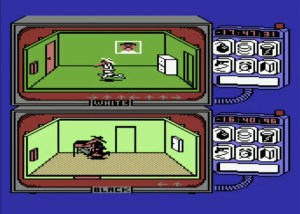
The result was an unusual mixture of action, exploration, strategy and slapstick comedy. Two spies searched the same embassy for secret items while simultaneously laying traps, stealing from one another and occasionally settling matters with a club. The screen was divided horizontally so both players could act at the same time—a crucial feature that First Star marketed as “Simulvision” and “Simulplay.”
On the Commodore 64, Spy vs. Spy became particularly memorable because it was easy to understand yet difficult to play predictably. A carefully planned mission could collapse within seconds because of a hidden bomb, an unexpected encounter with the other spy or, even more embarrassingly, a trap the player had forgotten setting himself. That combination of planning and chaos remains the essence of the game.
Sabotage in Motion
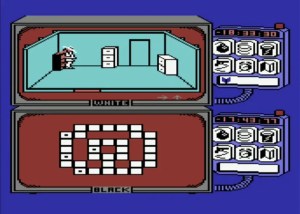
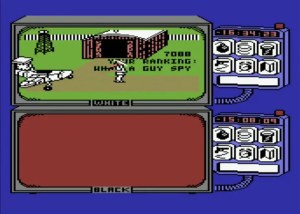
The objective sounds straightforward. Somewhere inside the embassy are a briefcase, passport, travelling money, a key and secret plans. A spy must locate the briefcase, collect the four required objects, find the exit and escape to the waiting aircraft before time expires. There is only one set of these essential objects, however, meaning that the two agents are competing directly for the same resources.
Rooms contain furniture and other searchable objects. Opening a cabinet, desk or similar hiding place might reveal something useful—or trigger a trap planted by the opponent. The embassy itself forms a maze of interconnected rooms, and more complicated layouts include multiple floors, ladders and openings concealed beneath rugs.
The real attraction is sabotage. The spies have access to five types of booby trap: bombs, springs, buckets of water used for electrocution, guns attached to strings and time bombs. Most traps have a corresponding countermeasure hidden somewhere in the embassy. Bombs can be neutralised with a bucket of water, for example, while an umbrella protects against the electrified water trap and scissors deal with the gun-and-string mechanism. The time bomb is especially dangerous because it cannot be disarmed once activated.
Choosing and placing these devices is handled through the wonderfully named “Trapulator,” a control panel that also displays remaining time, inventory information and a map. Yet setting a trap is not automatically an advantage. Traps do not recognise their owner. A careless spy can return to a room, search the wrong object and become the victim of his own scheme.
When both spies enter the same room, the strategic duel turns into direct combat. They attack each other with clubs until one is knocked out. Defeat does not permanently remove a spy from the game; instead, it costs valuable time and can result in possessions being left behind for the opponent to recover. This makes every confrontation both ridiculous and potentially decisive.
It is in two-player mode that all these systems come together. Watching the opponent’s half of the screen reveals useful information, but doing so means momentarily neglecting your own spy. The result is a wonderfully primitive form of psychological warfare: bluffing, memorising trap locations and trying to predict where the other player will go next.
C64 Craftsmanship
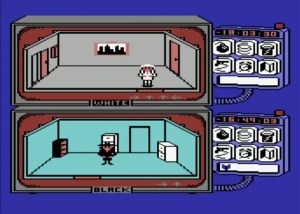
Technically, Spy vs. Spy is not remembered for spectacular scrolling landscapes or elaborate visual effects. Its achievement is more functional: it presents two independently operating characters, two views of the game world and two sets of constantly changing information on the same screen while keeping the action readable.
The horizontal split-screen is central to that design. First Star called the system “Simulvision,” emphasising that neither player needed to wait for a turn. Both could search, move, plant traps and fight in real time. In 1984, this gave the game an unusually immediate competitive character.
The Commodore 64 version uses simple but expressive character animation. The spies’ exaggerated movements, pointed faces and violent cartoon reactions preserve the look of the source material despite the machine’s limited resolution. Rooms are presented from a fixed perspective, with doors, furniture and searchable objects arranged clearly enough for rapid play.
Audio is equally economical. The C64 music is credited to Nick Scarim, while Mike Riedel is credited with designing and programming the game; Walter Guslawski created the title-screen graphics. The soundtrack and comic sound effects reinforce the frantic mood without distracting from the more important audio clues generated by traps.
Perhaps the cleverest technical decision was not graphical at all. The interface makes complicated ideas—inventory, traps, navigation and a countdown—manageable with a joystick and a single fire button. By the standards of early home computers, Spy vs. Spy contains a surprising number of interacting systems while remaining playable without a keyboard full of commands.
MAD Origins
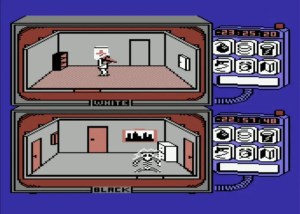
The game would lose much of its identity without MAD Magazine. Black Spy and White Spy were created by Cuban cartoonist Antonio Prohías and first appeared in MAD issue 60, dated January 1961.
Prohías had been a political cartoonist in Cuba before leaving the country in 1960 and settling in the United States. His two spies were visually almost identical apart from their colours and engaged in an endless cycle of deception, traps and revenge. The strips generally used little or no dialogue, making their humour almost universally understandable.
Behind the slapstick was an obvious parody of Cold War espionage. Neither Black Spy nor White Spy represented a morally superior side. Both were equally dishonest, paranoid and obsessed with defeating the other, and victory was usually temporary. That symmetry is important: Spy vs. Spy makes the very concept of an endless secret war look absurd.
First Star understood that structure unusually well. Instead of merely licensing familiar characters and placing them into an unrelated game, it translated the comic’s basic logic into interactive form. Every trap, counter-trap and sudden reversal feels like something that could have happened in one of Prohías’s strips. The advertising even promoted the title as MAD Magazine’s official action/strategy computer game.
Secret Trivia

Several details surrounding Spy vs. Spy underline how unusual the game was. Its manual did not simply use conventional terminology; First Star created branded names such as “Simulvision,” “Simulplay” and “Trapulator,” turning basic game functions into part of the comic presentation.
Another amusing feature is that “death” is rarely permanent. Being blasted, electrocuted or beaten senseless generally costs the victim time rather than ending the match immediately. One spy may therefore suffer a spectacular cartoon demise and return moments later, perfectly matching the indestructible logic of newspaper and magazine cartoons.
The game also grew into a substantial series. Spy vs. Spy: The Island Caper followed in 1985, moving the rivalry to a tropical setting, while Spy vs. Spy III: Arctic Antics appeared in 1987. The original itself was converted for numerous computers and consoles, including the Apple II, Atari 8-bit machines, Amiga, Amstrad CPC, BBC Micro, NES and Sega Master System. First Star later stated that combined worldwide sales of the various Spy vs. Spy games reached well into the millions.
Decades later, the concept was revived for mobile devices. A 2012 version recreated the original levels while adding new ones and offering both retro-style and modernised graphics—a sign that the underlying competitive design remained understandable long after the C64 era.
Contemporary Verdicts
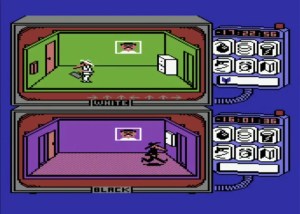
Reviews at the time were positive overall, although hardly unanimous. That disagreement makes sense because Spy vs. Spy could feel very different depending on whether it was played alone or against another person.
Archived magazine scores collected by Lemon64 show Commodore User giving the game three stars out of five in December 1984, while Personal Computer Games awarded it 8/10 in February 1985. Computer & Video Games was even more enthusiastic, rating the Beyond release 9/10 in September 1985. A later budget re-release received an extraordinary 97 percent from the same magazine in 1990. Across seven listed magazine reviews, the recorded average is about 75 percent.
The strongest praise generally centred on the concept rather than technical spectacle. The combination of real-time split-screen play, searching, traps and direct competition did not resemble many other home-computer games of the period. Two-player matches could produce stories that felt different every time.
The principal weakness was combat. Once the spies met face to face, much of the subtle strategy could temporarily disappear in favour of frantic club fighting. Later players have also pointed out that certain combat techniques can become repetitive once mastered. Yet even this roughness contributes to the game’s chaotic personality. Spy vs. Spy was never intended to represent sophisticated espionage. Its secret agents are essentially cartoon vandals with passports.
Lasting Legacy
The cultural importance of Spy vs. Spy lies less in individual technical achievements than in how naturally its systems create rivalry. Long before online competitive games made “griefing” a familiar concept, Spy vs. Spy encouraged players to interfere with one another simply for the pleasure of doing so.
Winning requires collecting objects and escaping, but some of the most memorable moments have nothing to do with efficient play. A player might spend precious time creating an elaborate trap merely because he expects the opponent to enter a particular room. Another might steal the briefcase and hide it instead of heading directly for the exit. A third might abandon the mission completely in order to chase the rival across the embassy with a club.
That freedom gives the game a quality associated today with emergent multiplayer design: the rules establish an objective, but the players create the drama.
The split-screen format also produced a social experience that is difficult to reproduce through isolated online screens. Opponents sat beside one another, could see exactly what the other person was doing and still attempted to deceive each other. Information was technically available to both players, but attention was limited. Watching your rival plant a trap meant taking your eyes off your own spy.
Most importantly, the game demonstrated how a licence could be adapted intelligently. It did not merely reproduce the appearance of Spy vs. Spy; it reproduced its structure. The eternal cycle of planning, betrayal, disaster and revenge became the game mechanics themselves. That is one reason the title remains recognisable among C64 enthusiasts more than four decades after its original release.
Final Verdict
Spy vs. Spy is a perfect example of a game whose personality matters more than technical extravagance. Its graphics are simple, its combat can be crude and experienced players can eventually learn many of its tricks. Yet few C64 games combine strategy, action and comedy with such clarity.
Its greatest achievement is the relationship it creates between two players. Every cabinet becomes suspicious, every door potentially dangerous and every encounter an opportunity for revenge. The split screen ensures that both spies remain active participants in the same absurd contest, while the Trapulator and inventory systems give the chaos just enough strategic structure.
For fans of MAD Magazine, the adaptation captures Antonio Prohías’s characters with remarkable faithfulness. For Commodore 64 players, it stands as an inventive example of early competitive game design. And for modern audiences, it offers a reminder that multiplayer games do not require vast worlds, hundreds of weapons or internet servers to create memorable rivalries.
Sometimes all that is necessary is a black spy, a white spy, one briefcase—and a bomb hidden in exactly the right place.








Kommentar verfassen