


Introduction
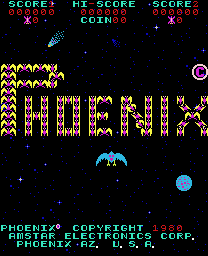
Phoenix is one of those arcade games that today are somewhat overshadowed by the big names like Space Invaders, Galaxian, or later Galaga, but are historically quite significant. The game was released in 1980, distributed by Amstar Electronics, and licensed for various markets, including to Centuri in the U.S. and Taito in Japan. In the early days of the shoot-’em-up genre, Phoenix seemed like a transitional work: still clearly in the spirit of fixed single-screen shooters, but already significantly more ambitious in structure, presentation, and narrative.
That is precisely why Phoenix remains interesting to this day. The game combined the simple basic concept of defensive shooting with several clearly distinguishable phases, a shield as a tactical tool, and a final assault on a massive space fortress. As such, it was more than just another clone of the early wave of space shooters: it demonstrated how a narrative arc could be built from a simple game concept.
Looking back, it’s easy to see why Phoenix holds a special place in the history of arcade games. Many early machines were primarily variations on an established concept: you shot at enemy formations, dodged projectiles, and tried to survive as long as possible while the speed increased. Phoenix adopted this basic principle, but supplemented it with elements that gave the game significantly more character. The individual stages felt distinct, the audio design was memorable, and the final wave of attacks felt almost like a small climax within an otherwise very minimalist game concept.
Furthermore, Phoenix was released at a time when the arcade game was still very much in the process of defining itself. Many genre conventions had not yet been firmly established. That is precisely why games that did more than just copy familiar models stood out. Phoenix was such a game. It felt familiar enough to be immediately understandable, yet distinct enough to stick in the memory. This blend of accessibility and surprising sophistication explains why the title is often rated significantly higher by retro historians today than one might expect given its current level of recognition.
Gameplay
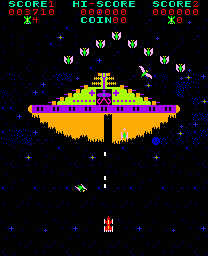
In terms of gameplay, Phoenix is easy to grasp at first. Your spaceship is located at the bottom of the screen and moves only left and right. You fire upward; there is also a force field button that allows you to protect the ship for a short time.
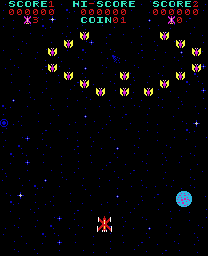
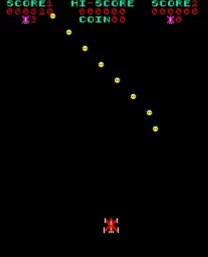
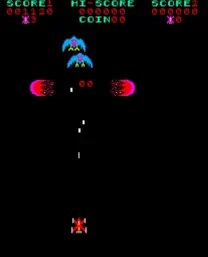
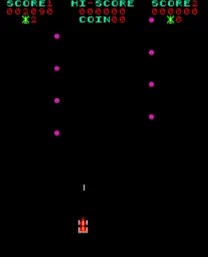
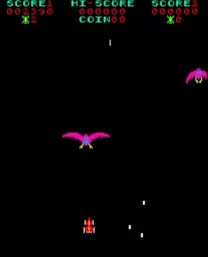
The game’s true strength lies in its structure. Phoenix consists of five repeating phases. In the first two waves, small bird-like enemies attack in formations, sometimes with dive-bombing runs and bombs. In stages three and four, larger enemies hatch from eggs; a single hit often isn’t enough against them, as their wings can be shot off and sometimes regrow. The fifth stage is the true climax: a massive space fortress with a moving barrier, behind which the actual target is hidden. Once destroyed, the cycle begins anew—but faster and more challenging.
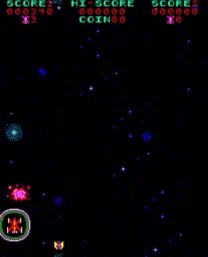
It is precisely this sequence that makes Phoenix so appealing. The gameplay constantly shifts slightly: sometimes it’s about cleanly clearing formations, sometimes about precision against sturdy large enemies, and sometimes about timing when shooting through the fortress barriers. The shield is not merely a convenience feature, but a tactical risk-taking tool, because it is active only briefly and must then be recharged.
This creates a remarkable tension between offense and defense. Players who are too cautious quickly lose control of the battlefield because enemy formations remain intact for too long. But those who are too aggressive easily find themselves in situations where the shield is either already depleted or used at the wrong moment. This small tactical decision gives the game more depth than the simple controls initially suggest.
The way enemies react to hits also adds variety. The larger bird-like enemies in the middle waves are particularly interesting from a gameplay perspective because they aren’t just destroyed but, in a sense, dismantled piece by piece. Wings can be shot off, body parts remain visible, and some enemies thus appear almost alive or mechanically assembled. For an early arcade game, this is a surprisingly effective form of visual feedback: the player doesn’t just see that an enemy has been hit, but experiences how it changes.
In addition, the fortress phase deliberately slows down and realigns the game’s flow. While the first waves rely on reaction and movement, the final phase demands precise aiming and good timing. The fortress’s moving protective barriers force the player to time their shot just right. As a result, the conclusion of a round doesn’t feel like just a more difficult standard wave, but like a different kind of challenge. It was precisely this sense that a round is building toward a climax that was by no means a given in 1980.
Technology
Technically, Phoenix was solidly and uniquely implemented for its time. In terms of hardware, the game used an 8085A CPU, along with a special sound chip, 16 KB of ROM, and 4 KB of RAM. The game ran in a fixed vertical screen layout and was released as a classic arcade cabinet.
The controls are also noteworthy. While many early arcade shooters are associated with joysticks, the original version of Phoenix was controlled using individual buttons. This demonstrates how strongly the game was designed for immediate, precise reactions: no diagonals, no complex inputs, just pure movement, firing, and timing.
The sound is particularly striking. For a game from this early arcade era, Phoenix already featured distinctive melodies, including classical pieces such as Romance de Amor and Für Elise. This musical backdrop gave the game an almost solemn, slightly eerie atmosphere that set it apart from many of its more direct, no-nonsense competitors.
This aspect of sound is particularly interesting from today’s perspective. In the early days of arcade machines, sound was often functional: gunshots, hits, warning signals, and simple short sound sequences defined the acoustic landscape. Phoenix went beyond this and used music as part of its identity. As a result, the game didn’t just seem “louder” or more eye-catching, but in a way, more staged. The machine was not only meant to draw attention to itself but to create its own atmosphere.
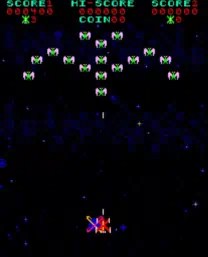
The visual design also deserves attention. The bird-like enemies were unusual enough to stand out from the typical alien or spaceship sprites of the competition at the time. The game’s title thus gained a direct visual counterpart: the enemies actually resembled futuristic, mythically charged beings. This design gave Phoenix a certain distinctiveness, straddling the line between science fiction and symbolism. The game was not a realistic space scenario, but rather felt like an abstract, stylized stage play of fire, flight, and return.
Not least, Phoenix demonstrates how much impact could be achieved with relatively limited technical means. The hardware was modest by today’s standards, yet through clear forms, recognizable enemies, distinctive sound motifs, and a well-defined structure, a game emerged that felt significantly “bigger” than its raw technical capabilities would suggest. This is typical of many strong arcade designs of that era: it wasn’t raw computing power that mattered, but the ability to create a striking impression with limited resources.
Trivia
One of the nicest tidbits is that Amstar Electronics was based in Phoenix, Arizona—a city whose name perfectly matched the game’s title. It seems almost too fitting, but it is actually documented as such.
Also interesting is the game’s somewhat unclear authorship. Later databases contain conflicting information regarding its development, so the original developers can no longer be definitively identified in every detail today.
Added to this is the astonishing number of variants and bootlegs. Due to its comparatively simple hardware, Phoenix was often copied or reused with minor modifications. Similar or modified versions appeared under various names, demonstrating just how successful and influential the concept was in the early arcade era.
It is precisely this multitude of variants that is typical of the early arcade scene. Successful games were not only officially licensed but also frequently unofficially replicated, modified in detail, or released under different names. This says a lot about the industry at the time: it was creative, fast-paced, sometimes chaotic, and legally often not yet as clearly organized as it would be later. Phoenix belongs precisely to that generation of games whose success can be gauged not only by sales figures but also by the number of imitators.
Another interesting detail is the stark contrast between its current fame and its presence back then. Many players who grew up with arcade games in the early 1980s remember Phoenix quite vividly: the music, the bird-like enemies, or the fortress at the end of the level. At the same time, the game often appears only marginally in today’s popular retrospectives. As a result, it has almost attained the status of an insider tip—not because it was insignificant back then, but because later genre giants overshadowed the memory of many early innovations.
Reviews at the Time
When considering contemporary reviews, one must distinguish between the arcade machine and later home versions. Overall, however, Phoenix was received positively. Particular praise was given to the intuitive controls, the striking graphics, the music, and the more varied structure compared to many other shooters of the time.
However, the verdict was not entirely unanimous. Some observers noted certain weaknesses in the home versions compared to the original arcade machine, as the dense atmosphere and audiovisual impact of the arcade version could only be partially transferred to weaker hardware.
Nevertheless, its success was clearly evident. Especially in Europe, Japan, and the U.S., Phoenix found an audience and became a major title within the early wave of shooters.
From the perspective of that time, it was precisely this blend of the familiar and the new that was decisive. The basic principle was immediately understandable, yet in direct comparison with other arcade games, Phoenix felt more varied. Players weren’t just presented with more attack formations at a faster pace, but with different gameplay situations. Critics and players perceived this as a quality, even if they didn’t always describe it theoretically. A game that kept surprising players for longer was also played for longer.
At the same time, one must not overlook the fact that early reviews often functioned differently from today’s game reviews. Many assessments were briefer, more focused on immediate impressions, and less analytical than modern retrospectives. This makes it all the more remarkable that Phoenix stood out precisely because of its presentation, its sound, and its structure. These three areas are exactly the points that are still considered the game’s strengths from today’s perspective. There is thus an interesting continuity between the perception at the time and its later historical classification.
Critical objections were usually directed less at the core gameplay than at its implementations. Home versions often managed to translate the gameplay well, but not always its atmosphere. This is understandable: an arcade machine thrived on its cabinet, the sound from the speakers, the screen, and its physical presence in an arcade. Those who played Phoenix at home got the rules, but not necessarily the same presentation. Especially for a title whose impact relies heavily on music and rhythm, such a difference carries particular weight.
Cultural Influence
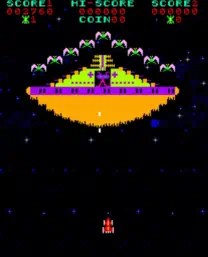
The cultural influence of Phoenix lies less in iconic characters than in design ideas. The fifth stage, featuring the space fortress, is particularly important: Phoenix is often considered one of the early shoot-’em-ups with a clearly staged boss battle. This idea later became a staple of the genre.
Equally significant was the structure featuring several clearly distinguishable phases within a single playthrough. Instead of merely repeating the same enemy formation faster and faster, Phoenix built up a small narrative arc. Combined with the music playing during gameplay—which was still unusual at the time—this made it feel more modern than many of its direct competitors.
Traces of this can also be found in later games of the genre. Phoenix may not have been a pop culture giant with world-famous characters, but it was an important building block in the development of the arcade shooter.
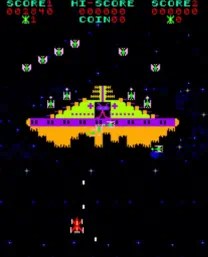
Its influence is particularly evident in how natural some of its ideas seem today. Boss enemies, changing phases, a more carefully crafted narrative arc, and distinctive musical accompaniment are now almost standard features of action games. In Phoenix, these elements can still be observed in an early, clearly recognizable form. This makes the title particularly valuable from a historical perspective: it stands at a point where design principles that later became standard first became visible.
Furthermore, Phoenix helped to infuse the shoot-’em-up genre with emotional depth. Many early shooters rely heavily on scoring, danger, and repetition. Phoenix added a touch of narrative structure: there was a build-up, a variation, a climax, and a restart at a higher level. This structure is simple yet effective. It gives the game the feel of a mini-adventure within just a few minutes.
Culturally significant is also the fact that Phoenix provides an example of how innovation in the arcade sector often occurred. New genres did not always emerge through radical breaks. Often, it was games like this one that refined existing forms, combined them, and thus pushed them in a new direction. In this sense, Phoenix was less a revolution than a very successful evolution—and influential precisely because of that.
Conclusion
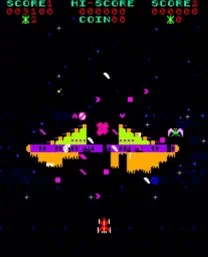
Phoenix is an excellent example of how innovation in the early arcade era often arose not through complete reinvention, but through clever refinement. The game took familiar elements of the genre and combined them with changing phases, a tactical shield, distinctive music, and an early boss battle. This made it feel more lively, dramatic, and modern than many of its direct competitors at the time.
Today, Phoenix may not be as famous as the greatest arcade legends. Historically, however, it deserves far more attention: as a game that demonstrated how to turn a simple shooter into a small-scale production. That is precisely where its true significance lies.
Anyone looking at the game today sees not just an early space shooter, but a piece of design history. Phoenix demonstrates just how precisely a game concept could be developed as early as 1980, when developers and publishers understood how to meaningfully combine rhythm, variation, and audiovisual impact. Precisely because the title is no longer constantly at the center of retro culture, it’s especially worth a second look.
Ultimately, Phoenix is therefore more than a historical footnote. It is a game that exemplifies how the arcade era found its voice: with clear rules, simple means, and a surprisingly powerful impact. Its legacy lies not only in its own popularity, but also in the fact that later games carried forward much of what was already clearly established here.








 McHenry's Lair
Kommentar verfassen :