

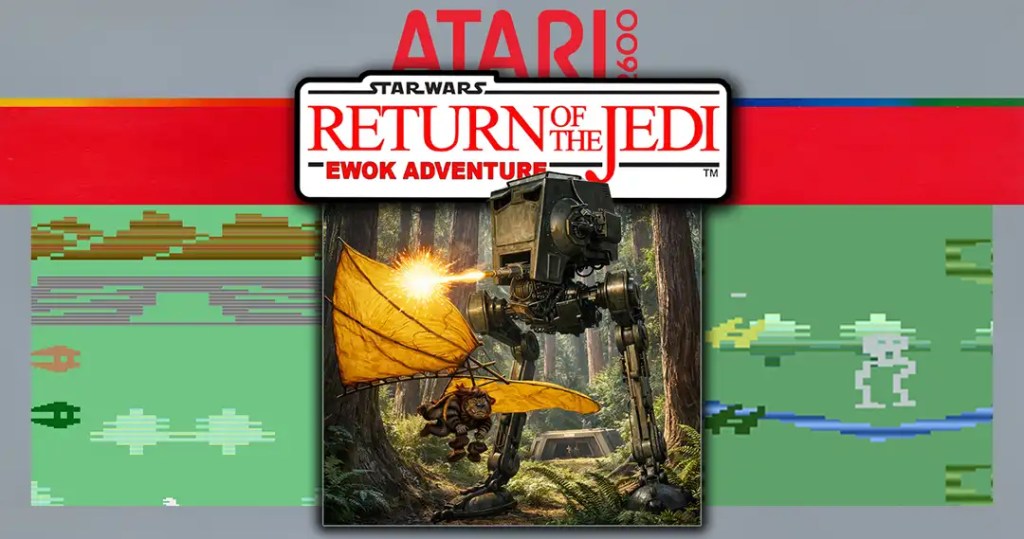
You are now an Ewok, and have volunteered your services to the Rebel cause.
Your home planet Endor, is being threatened by the evil forces of the Empire.
The prototype
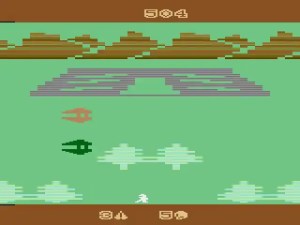
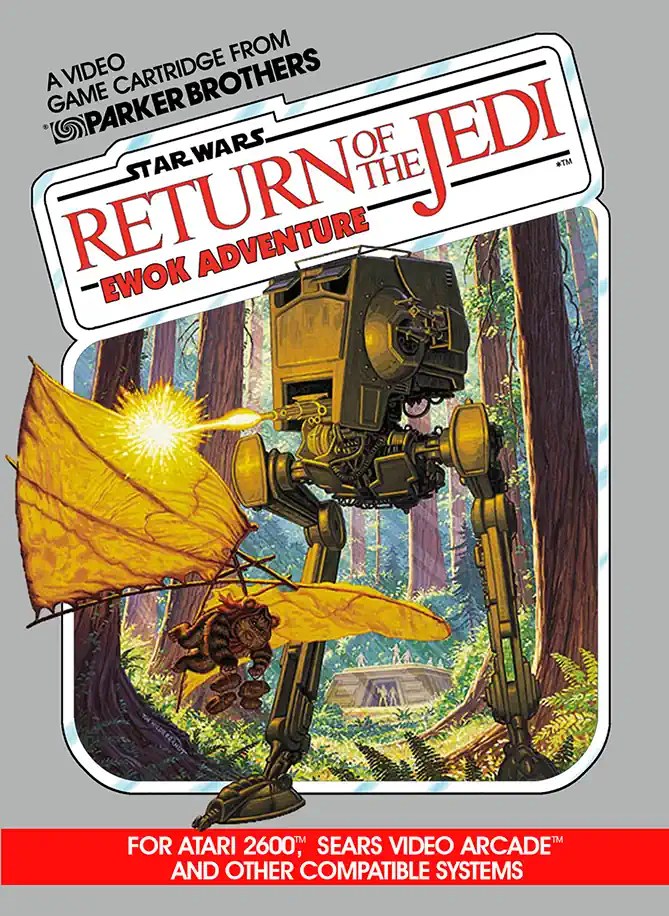
Star Wars: Ewok Adventure was a video game for the Atari 2600 that was never officially released. It was in development at Atari, Inc. in the early 1980s. The project was conceived at a time when licensed games based on major film productions were becoming increasingly popular, and publishers were trying to capitalize on the enormous success of the Star Wars series. The game was to be set in the universe of “Star Wars: Episode VI – Return of the Jedi” and focus on the adventures of the Ewoks on the forest moon of Endor – the setting that plays a central role in the film’s battle against the Empire.
Although it was never officially released, it is now considered a legendary “lost game” of early video game history. Precisely because it remained unreleased, it exerts a special fascination. It symbolizes the creative spirit of optimism, but also the economic turmoil of the industry in the early 1980s.
Gameplay
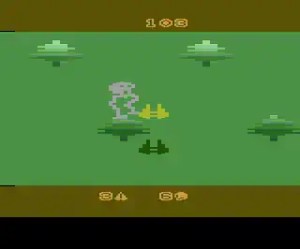
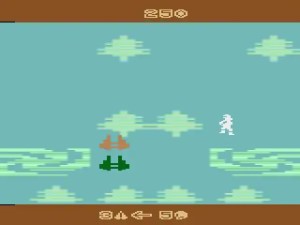
In “Star Wars: Ewok Adventure,” the player takes control of an Ewok flying through the forests of Endor in a hang glider. The goal was to attack and ultimately destroy an Imperial base. The game was loosely based on the final battle from “Return of the Jedi,” but interpreted it from an unusual perspective.
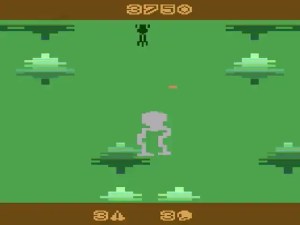
The gameplay was quite ambitious for its time. Players had to avoid obstacles such as densely packed tree trunks that were seemingly scattered randomly throughout the forest. At the same time, enemy stormtroopers appeared on the ground, which had to be fought or flown around. This required a combination of navigation, responsiveness, and strategic positioning.
The controls were considered challenging. The glider was sensitive to changes in direction, which could easily lead to collisions. Unlike many simple action titles of that era, players had to develop a feel for momentum, altitude, and distance. While this complexity made the game more interesting, it may also have been a reason why it was considered too difficult or immature internally.
The relatively open structure of the game world is also noteworthy. Instead of a strictly linear sequence of levels, “Ewok Adventure” offered a larger, contiguous playing area with exploration elements. Such an approach was unusual and technically challenging for the Atari 2600. In a sense, the game was ahead of its time, experimenting with concepts that only became more widespread years later.
History
Development began around 1983 under the direction of Atari programmer Larry Gelberg. Atari was going through a difficult phase at the time: the market was saturated with games, the quality of many titles varied greatly, and consumer confidence was beginning to wane. Nevertheless, the company hoped to launch a successful product with a strong brand like Star Wars.
The plan was to release the game to coincide with, or at least close to, the theatrical release of “Return of the Jedi.” Licensed games were intended to enhance the movie experience and tap into new target groups. Internally, however, there were apparently doubts about the quality and marketability of the game. According to reports, test players criticized the difficult controls and the sometimes frustrating game situations.
Added to this was the video game crisis of 1983, which hit the North American market particularly hard. Atari itself ran into massive financial difficulties. In this environment, numerous projects were shelved, including “Ewok Adventure.” The game never reached official distribution, and no regular cartridges were produced.
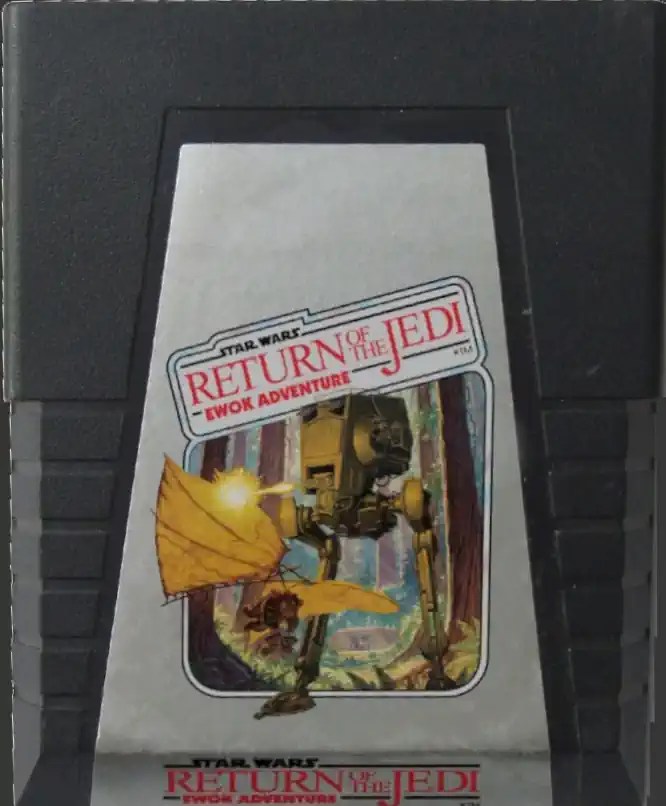
Only a few prototypes survived the test of time. Decades later, ROM versions appeared, allowing collectors and retro fans to experience the game after all. As a result, the once-failed project became a coveted collector’s item and research object for historians of the video game industry.
Technology
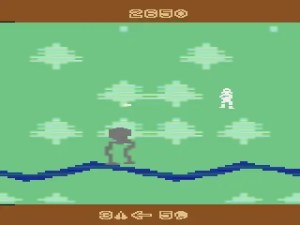
Technically, the game was based entirely on the hardware of the Atari 2600, which only had 128 bytes of RAM – an extreme limitation even by the standards of the time. Developers had to program extremely efficiently and find creative solutions to accommodate game mechanics, graphics, and sound.
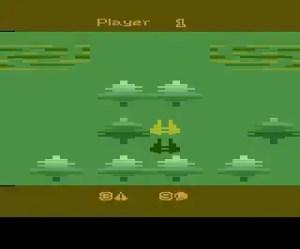
The graphics consisted of simple, block-like sprites and minimalist backgrounds. Nevertheless, it was possible to depict a recognizable forest landscape with vertical tree structures. The glider and the game character were clearly identifiable, even though the details were naturally highly abstracted.
The game world did not scroll continuously, but was built up in discrete sections – typical for the console. However, clever switching of screen content created the impression of a coherent environment. This technique required precise coordination between program code and hardware timing.
Sound effects were rudimentary and limited to simple sounds for flight movements, shootings, or hits. There was no music in the modern sense, as the console’s sound capabilities were very limited. Nevertheless, the sounds contributed to the atmosphere and conveyed a sense of action and movement.
Overall, the game shows how developers tried to implement new ideas even under extreme technical limitations. “Ewok Adventure” is therefore also an example of creative use of minimal hardware performance.
Cultural influence
Although Star Wars: Ewok Adventure was never officially released, it has become a myth among retro gamers over the years. Unreleased games often have a special appeal because they offer insights into alternative development paths and discarded concepts.
The game is representative of many ambitious but failed projects of the early 1980s. It illustrates how economic conditions can determine the fate of creative works. At the same time, it documents the early phase of Star Wars video games, long before technically complex productions with cinematic staging were possible.
In the context of video game history, “Ewok Adventure” is often referred to as a curiosity – a “what if” title within the history of Star Wars games. For collectors, the existence of prototype cartridges is particularly significant. Such modules fetch high prices at auctions and are considered rarities.
Furthermore, the game contributes to the fascination surrounding the Atari era. It is reminiscent of a time when individual developers with comparatively small teams created complete games and took creative risks.
Conclusion
“Star Wars: Ewok Adventure” is a fascinating piece of video game history. As an unreleased project, it combines technical audacity, creative ambition, and the economic difficulties of the early 1980s in a single title.
Although it never reached the official market, the game lives on as a cult object. It shows how closely innovation and risk were linked in the early days of home consoles. At the same time, it illustrates that even failed or abandoned projects can leave a lasting impression.
Today, “Ewok Adventure” serves not only as a collector’s item, but also as a historical document of a turbulent era in the video game industry – a time between boundless creativity and economic uncertainty.
More
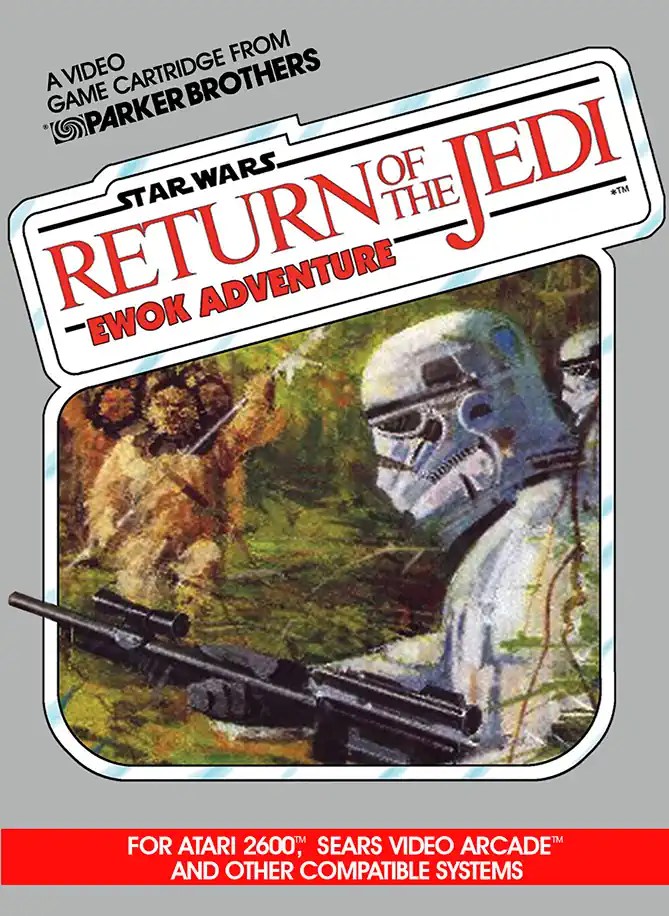
Box and Cartridge








 McHenry's Lair
Kommentar verfassen :