

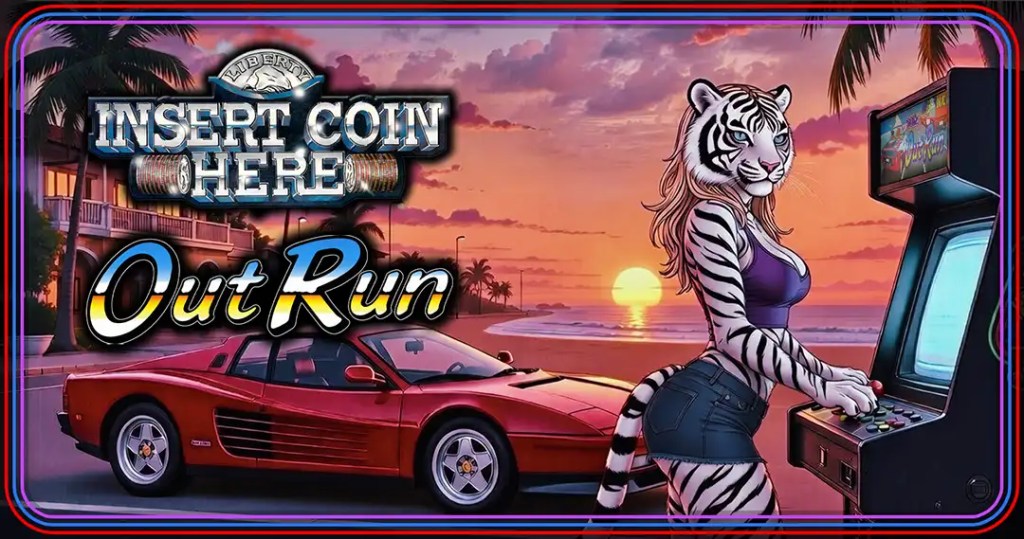
Iconic arcade racing game

Out Run, released in 1986 by Sega, revolutionized the racing game genre and is still considered one of the most influential arcade titles of all time. Developed by renowned game designer Yu Suzuki, who had already set new standards with Hang-On and Space Harrier, Out Run brought a completely new gaming experience to arcades. Instead of linear circuits, the game featured open, branching road races through an idealized, European-inspired landscape with coastal roads, Alpine passes, and rural areas.
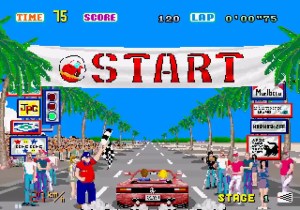
The player controls a licensed Ferrari Testarossa convertible, accompanied by a blonde co-driver, which gave the game a strong lifestyle and vacation flair. This staging was a stark contrast to the technically sober racing games of the early 1980s. Out Run quickly became a commercial and cultural success: by 1994, Sega had sold around 30,000 arcade machines, which, adjusted for inflation, brought in over $290 million.
The iconic machine, often designed as a luxurious sit-down model with a hydraulic simulator, caused a particular sensation. Players sat in a moving cockpit that physically simulated steering movements and collisions, providing an exceptionally immersive driving experience for the time.
Gameplay
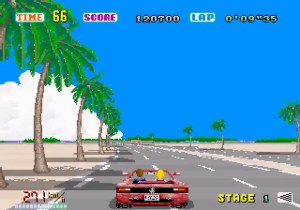
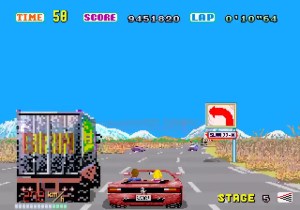
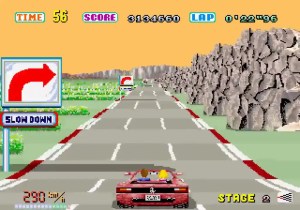
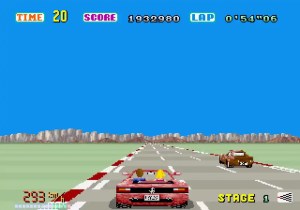
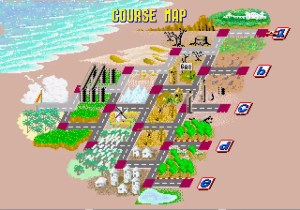
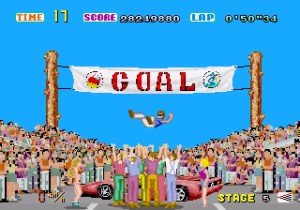
At its core, Out Run is a pseudo-3D racing game from a third-person perspective. The camera is positioned deep behind the vehicle, which enhances the feeling of high speed and makes every turn seem more intense. The goal of the game is to complete five stages within a given time limit. After each stage, the player reaches a checkpoint where the track forks and one of two possible routes can be chosen.
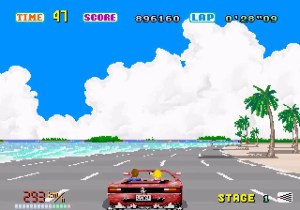
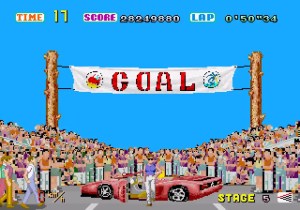
These branching paths lead to different landscapes and end sequences, such as successfully reaching a trophy or breaking down on the side of the road. There are several possible routes and endings in total, which significantly increased the replay value. Unlike many contemporary arcade games, Out Run did not resort to excessive punishment: collisions cause the car to roll over spectacularly, but it does not explode. The passenger reacts with humorous gestures and comments, which reduces frustration and focuses on pure driving pleasure.
The player has to contend with heavy traffic, sharp turns, obstacles, and changing road conditions. Realistic physics with drifting, gear shifting, and noticeable vehicle inertia require precise control. At the same time, bonus time at checkpoints, steadily increasing speed, and limited forgiveness for mistakes ensure constant adrenaline pressure.
Technology
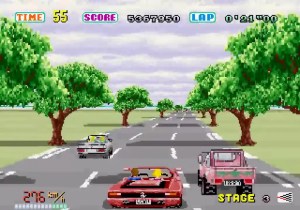
Technically, Out Run was based on Sega’s groundbreaking “Super Scaler” technology, which allowed 2D sprites to be scaled in real time, creating convincing pseudo-3D effects. This technology was a further development from Hang-On and enabled smooth zooms, wide viewing angles, and dynamic-looking landscapes.
The hardware used a specially adapted board loosely based on the System 16. Two Motorola 68000 CPUs running at 12.5 MHz were used, along with a Z80 CPU for sound, the YM2151 FM synthesizer, and additional PCM chips. The system could display up to 12,288 colors at a resolution of 320×224 pixels, which was exceptional for the time.
The development process is also noteworthy: Yu Suzuki led a relatively small team of just a few programmers, graphic designers, and a sound designer. Development took only about ten months, with Suzuki himself taking on much of the programming and game design. The game was inspired by an extended trip through Europe from Frankfurt to the French Riviera. Photos, sketches, and real engine sounds from the Ferrari Testarossa were incorporated directly into the design and contributed to the realistic driving physics.
In addition to classic upright machines, several variants appeared, including deluxe and sit-down models with hydraulic movement. These made Out Run one of the early pioneers in the field of force feedback and movable arcade cabinets.
Music
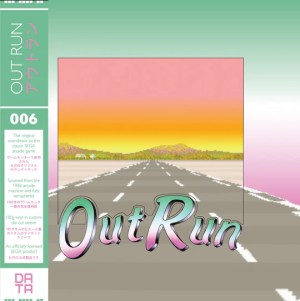
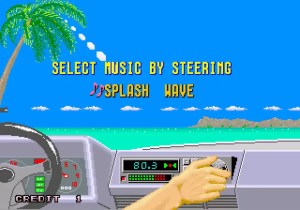
The Out Run soundtrack, composed by Hiroshi Kawaguchi, is one of the most famous and influential in video game history. Instead of a fixed piece of music, the game allowed players to choose between three different tracks via a virtual car radio before starting, which gave the driving experience an unusually personal touch. “Passing Breeze” offers a relaxed, almost melancholic sound that accompanies particularly long straight stretches, “Splash Wave” is rhythmic and energetic, while “Magical Sound Shower,” with its epic Latin jazz character, became the game’s most popular and most quoted composition.
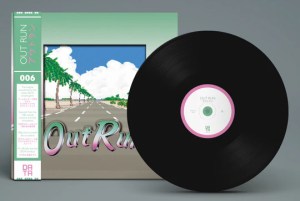
This music selection was not only technically innovative, but also lastedly reinforced the feeling of freedom, individuality, and control over one’s own gaming experience. The soundtrack was complemented by “Last Wave,” which plays on the high score screen and provides atmospheric accompaniment to the end of a drive. Kawaguchi’s compositions, inspired by contemporary fusion, funk, and Latin jazz, had a decisive influence on the hedonistic and summery character of the game and contributed significantly to its recognition value. In some countries, including the UK, the soundtrack was even released as a music cassette, underscoring the extraordinary popularity of the music beyond the arcades.
Trivial
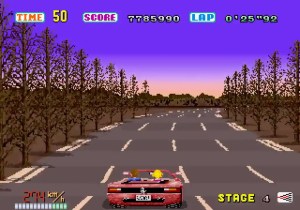
Out Run is rich in small details and curiosities that make the game particularly appealing to attentive players. For example, there are several Easter eggs that have been deliberately hidden outside the actual race: if you hold down the start button shortly before a checkpoint, a developer message appears with Yu Suzuki’s name and the exact date of development. If the player remains inactive at the start for too long, the start flag waver becomes increasingly annoyed and expresses his displeasure with increasingly frantic gestures, giving the game a humorous, almost human touch.
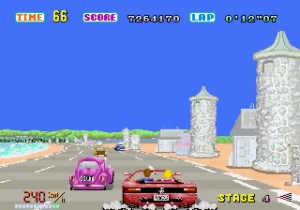
Suzuki himself traveled around Europe in a BMW 520 to study the tracks, architecture, and atmosphere firsthand; Monaco in particular had a major influence on the design of the Ferrari and the sunny coastal sections. In heavy traffic, you encounter numerous real-life vehicle models, including the VW Beetle, Porsche 911, Corvette C3, and BMW E30, which gave the game an unusual down-to-earth feel for an arcade game. Earlier ROM versions contained minor bugs and inconsistencies, which were fixed in later re-releases. There are also interesting side notes, such as a Master System version with 3D glasses support and several unfinished or discarded ports for systems such as the Sharp X68000 or the Sega 32X, which are now of particular interest to collectors and game historians.
Contemporary reviews
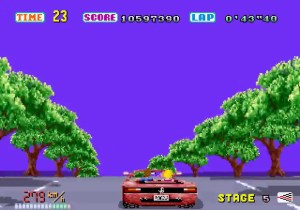
Contemporary reviews from 1986 and 1987 were overwhelmingly enthusiastic, reflecting the impression that Out Run brought something fundamentally new to arcades. Trade magazines particularly praised the graphics, which were spectacular for the time, the intense feeling of speed, and the novel, non-linear structure of the game. Particular emphasis was placed on the way Out Run combined technical brilliance with accessibility, appealing to both casual gamers and experienced arcade veterans. Computer and Video Games described Out Run as one of the most realistic and entertaining racing games of its time, while Crash and Your Sinclair emphasized its technical perfection, high production value, and constant thrills.
Out Run was also extremely successful at award ceremonies, further cementing its reputation as an exceptional game. The arcade version won the 1987 Golden Joystick Award and several Amusement Players Association awards, among others, underscoring its commercial and critical success. Home console conversions, on the other hand, received more mixed reviews. While the 16-bit versions, especially on the Mega Drive, received very high ratings due to their proximity to the arcade original, 8-bit ports received much more mixed reviews due to technical limitations, reduced graphics, and simplified music
Cultural influence
The influence of Out Run on later racing games and pop culture cannot be overestimated. Elements such as branching tracks, free music selection, and a deliberate focus on atmosphere rather than pure simulation had a lasting impact on the genre and were later found in well-known series such as Need for Speed, Forza Horizon, and Grand Theft Auto. These games not only adopted individual design ideas, but also the basic attitude that driving pleasure, freedom, and style can be at least as important as technical realism. For Sega itself, the success of Out Run contributed significantly to stabilizing the arcade division during an economically difficult market phase and cementing the company’s image as an innovation leader.
Out Run also inspired entire music genres, especially the synthwave and retrowave styles, which explicitly reference the visual and acoustic aesthetics of the game. Artists and producers took the sun-drenched soundscapes, neon-colored landscapes, and feeling of endless roads and transferred them into modern music productions. Numerous sequels and reinterpretations followed, including OutRunners and Out Run 2, which attempted to transfer the spirit of the original to new technical generations. Even decades later, the brand remains present, for example through new releases, fan projects, or announcements of film and multimedia projects, impressively underlining the enduring cultural relevance of Out Run.
Conclusion
Out Run is much more than just a classic racing game. It embodies the spirit of the 1980s in all its colorfulness and symbolizes an era in which video games began to focus not only on technical feasibility, but also on emotions, style, and atmosphere.
The game combines technical innovation with striking design, iconic music, and an unmistakable sense of freedom, joie de vivre, and escapism that appealed to players worldwide and continues to resonate today. Yu Suzuki’s work set new standards for arcade games by combining speed, visual breadth, accessibility, and playful elegance in a novel way.
Instead of pure competition or simulation, Out Run focused on the experience itself, creating a blueprint for an entire subgenre of atmospheric racing games. This design philosophy had a lasting influence on later developments in game design and was also echoed in music, fashion, and pop culture.
For retro fans and game historians alike, Out Run remains a timeless masterpiece that not only impresses technically, but is also considered a significant cultural milestone in video game history. It exemplifies how interactive entertainment can become an expression of a way of life and why certain games endure far beyond their actual game mechanics.






 McHenry's Lair
Kommentar verfassen :