


A classic from the early 80s

Bagman was released in the early 1980s and belongs to a generation of arcade games that combined simple mechanics with surprising depth. At a time when the arcade industry was developing rapidly and new game ideas were appearing almost monthly, Bagman managed to stand out from the crowd with its tension-oriented concept. While many other titles focused primarily on quick reflexes or pure action, Bagman concentrated more on planning, overview, and thrills. Developed at a time when platform and action games were still finding their form and were still very experimental, Bagman deliberately focused on suspense, constant time pressure, and skillful navigation through labyrinthine, multi-level levels. This combination ensured that each round of the game was different and mistakes were rarely forgiven. The result was a game that was easy to understand but required practice, patience, and tactical thinking to master, motivating players to keep trying again and again.
Gameplay

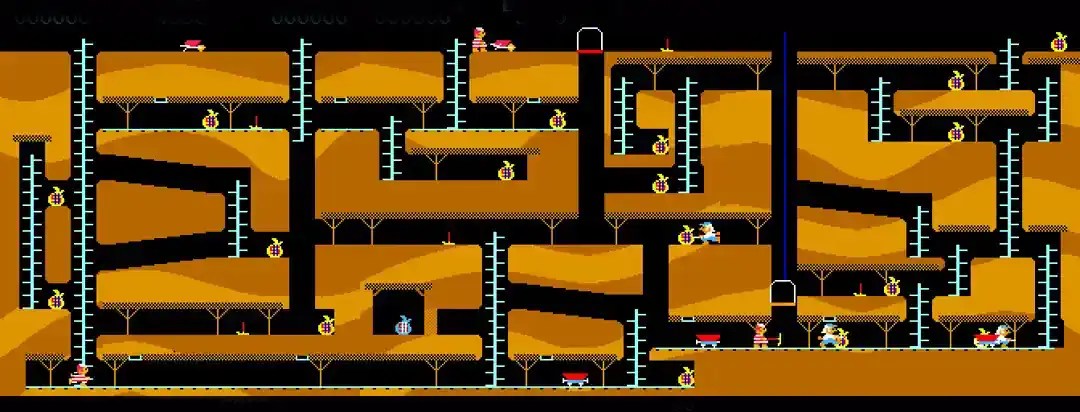
At the heart of the gameplay is a goal that was unusual for its time: the player controls a thief who must collect bags of gold in a sprawling mine and transport them safely to a wheelbarrow. Unlike many contemporary arcade games, the goal is not simply to eliminate enemies, but to successfully complete a risky task. Each bag increases the score, but at the same time prolongs the time spent in the mine and thus increases the risk of being discovered or cornered. Constant haste is required, as several guards patrol the corridors, changing their routes and putting the player under constant pressure. The game forces you to constantly weigh up the desire for points against the need for safety.
Typical for Bagman are ladders, platforms, and multiple levels that require vertical thinking and make the level design more complex than it seems at first glance. Players must not only plan their routes, but also keep an eye on escape routes. Although the controls are direct and intuitive, every move must be carefully considered, as quick changes of direction or missteps are rarely forgiven. One wrong step or a brief moment of inattention can result in the player falling into the hands of the guards and losing much of their progress. In addition, limited time, changing enemy positions, and the risk of getting stuck in dead ends significantly increase the tension. Bagman thus demonstrates early on how effectively stress, planning, risk management, and spatial awareness can be combined in arcade design.
Trivia
- Bagman was later re-released in a slightly modified form under different names in order to reach new markets and make the game known in regions where it had previously been virtually unknown.
- These alternative versions usually differed only in details such as graphics, difficulty level, or game title, but retained the basic gameplay.
- The game used simple but concise sound effects that contributed greatly to the atmosphere and recognition value and were easily audible in noisy arcades.
- Particularly striking was the mixture of platform game and chase, which was not yet commonplace in the early 1980s and gave the game its own character.
- In some arcades, Bagman was considered an “insider tip” for experienced players who were looking for a real challenge and wanted to consciously set themselves apart from more popular mainstream titles.
Reviews at the time
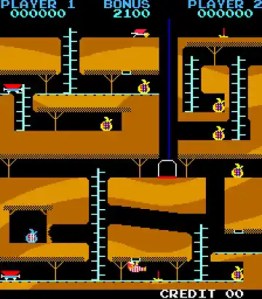
At the time of its release, Bagman was praised by players and critics alike for its clear, easy-to-understand gameplay, which was accessible without a long learning curve. Many reviews emphasized that the game was highly addictive and required a high degree of concentration and spatial thinking, as every decision could have immediate consequences. The steadily increasing tension, which grew with every gold bag collected and put the player under increasing pressure, was also highlighted positively. It was precisely this combination of simplicity and thrills that was often cited as the game’s particular strength.
At the same time, some critics complained about the comparatively simple graphics and limited visual variety, which, however, largely corresponded to the technical standard of the era and was hardly noticeable in arcades. The animations were also considered functional, but not spectacular. Overall, however, Bagman was considered a solid, exciting arcade experience that deliberately set itself apart from the space and shooter games that dominated at the time and was particularly impressive due to its game concept.
Cultural influence
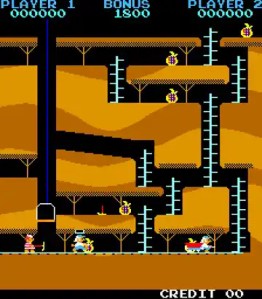
Although Bagman never achieved the cult status of giants such as Pac-Man, it nevertheless left a recognizable mark on video game history. Especially outside of the big commercial successes, the game showed how effective alternative game concepts could be. Bagman made it clear that excitement is not created solely by speed or purely reflex-based gameplay, but also by clever level design, targeted enemy placement, and the deliberate use of time pressure. These design decisions influenced the understanding of how thrills and challenges can be created in the arcade sector.
Many later platform and action games adopted similar concepts: time pressure, chase scenarios, and the tactical use of levels and paths increasingly became integral parts of the genre. In particular, the principle of closely linking risk and reward can be found in numerous later arcade and home console games. In this sense, Bagman helped shift the focus from pure action to more strategic, tension-oriented game design.
Conclusion
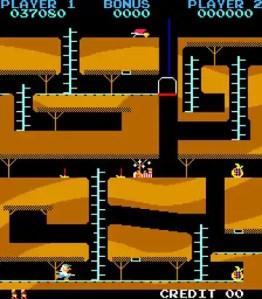
Bagman is a typical yet remarkable product of the golden arcade era and exemplifies the creative diversity of that time. It combines simple, easy-to-understand rules with challenging gameplay that requires planning, attention, and nerves of steel, creating a lasting motivation to start a new round again and again. It is precisely the balance between accessibility and challenge that ensures that the game has been able to captivate both beginners and experienced players in the long term.
Even decades after its release, Bagman remains interesting for retro fans, as it impressively demonstrates how much excitement, atmosphere, and fun could be achieved with comparatively limited technical means. The game reminds us that good ideas, clear design, and well-thought-out mechanics are often more important than elaborate graphics or complex technology. Those interested in the history of arcade games will find Bagman not only nostalgic entertainment, but also a successful example of creative, timeless game design whose basic principles continue to have an impact today.








 McHenry's Lair
Kommentar verfassen :