


Aah-eeh-ah-eeh-aaaaaah-eeh-ah-eeh-aaaaah!
Introduction
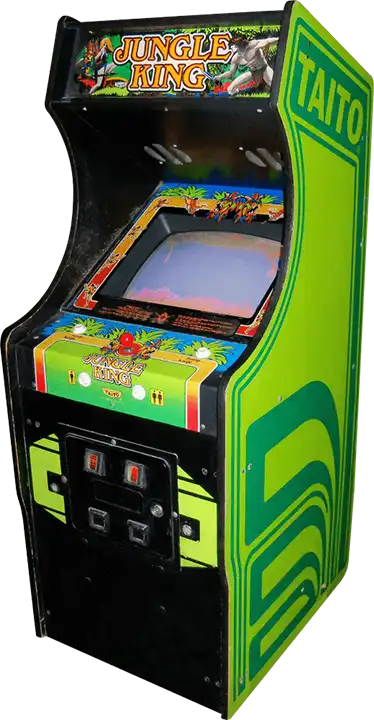
Jungle King, released in 1982 by Japanese studio Taito, is considered one of the most distinctive arcade games of the early 1980s. At a time when platformers were still in their infancy, Jungle King attracted a lot of attention with its unusual mix of acrobatics, skill sections, and adventure theme. The player takes on the role of a muscular jungle hero who swings energetically through the jungle on vines, fights crocodiles in the river, and ultimately has to rescue a kidnapped woman from the clutches of cannibals. However, the strong resemblance to Tarzan quickly led to legal problems, so Taito renamed the game “Jungle Hunt” shortly after its release and changed the appearance of the main character.
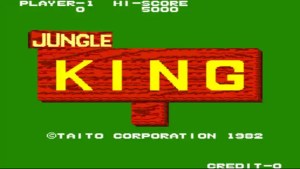
Despite this forced redesign, “Jungle King” remained a milestone of its era. Above all, the parallax scrolling, which was impressive at the time, i.e., the simultaneous movement of different background levels, gave the game a visual depth that was completely new to many players. In an arcade landscape dominated by static screens, “Jungle King” felt almost cinematic and set standards for future representatives of the genre.
Gameplay
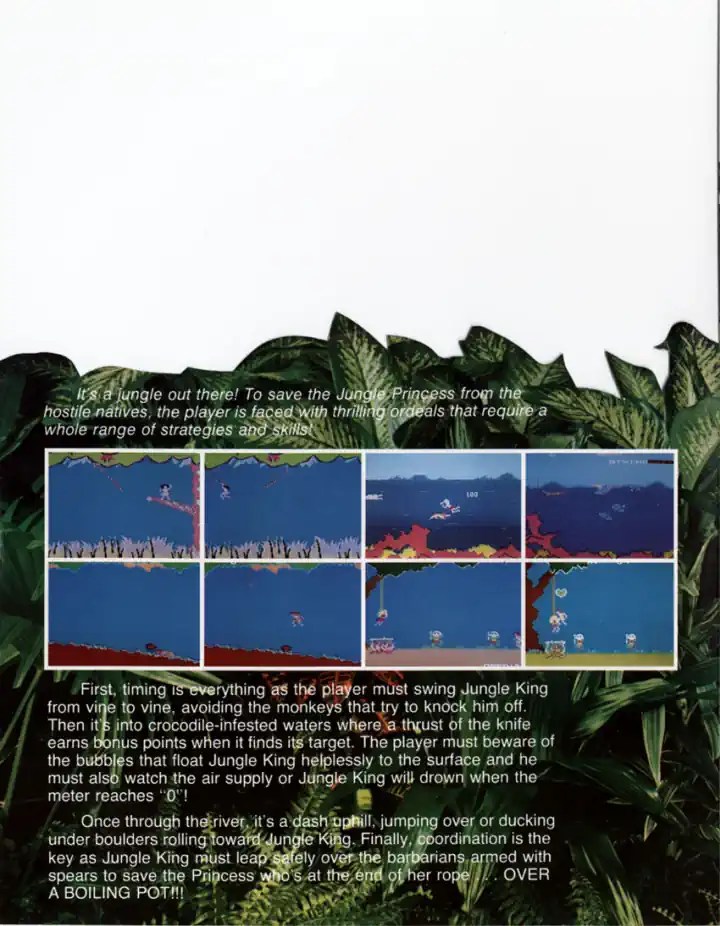
The gameplay of “Jungle King” is divided into four clearly distinct sections that are completed one after the other. It was this variety that contributed significantly to the game’s fascination, because instead of offering monotonous repetitions of a single game principle, the game presents a kind of mini-adventure consisting of four scenes that become increasingly difficult in a loop.
1. Liana sequence
In the first phase, the hero swings from vine to vine. The challenge is to time the jump correctly and correctly estimate the respective pendulum movement. The difficulty increases significantly, especially in later rounds, when aggressive monkeys turn the vines into dangerous obstacles. Timing, a sense of rhythm, and a little courage when jumping are crucial here.
2. River sequence
The second section transports the player to a deep river full of crocodiles. Now the focus is on diving, dodging, and attacking. With a well-aimed stab, the hero can defeat crocodiles—but only if they have their mouths closed. At the same time, he must dodge air bubbles and obstacles and surface in time to catch his breath. This interplay of risk and precise observation creates excitement.
3. Boulder hill
The third part shifts the game to a rocky slope. Boulders of varying sizes constantly roll down from above, forcing the player to jump or duck under them. As the difficulty increases, not only does the number of rocks increase, but so does their speed and unpredictability. This is where quick reactions are required.
4. Rescue sequence
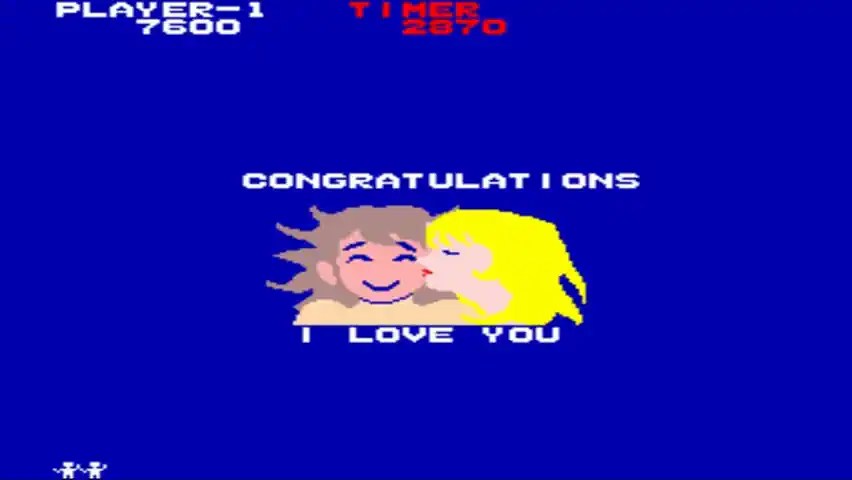
The final section leads to the dramatic rescue mission: the kidnapped woman is about to end up in a cooking pot, while enemy cannibals block the escape routes with spears. The player must jump or run forward at the perfect moment to avoid being impaled. If the rescue is successful, a short, rewarding sequence follows – before everything starts all over again, only faster and more challenging.
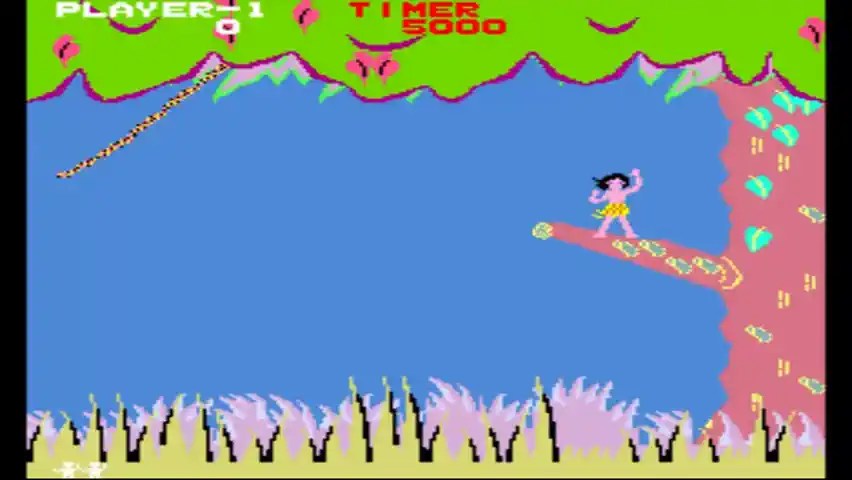
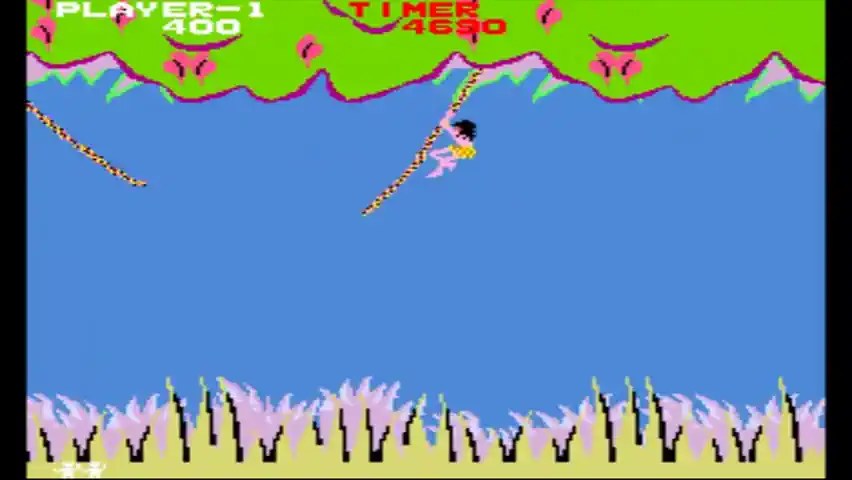
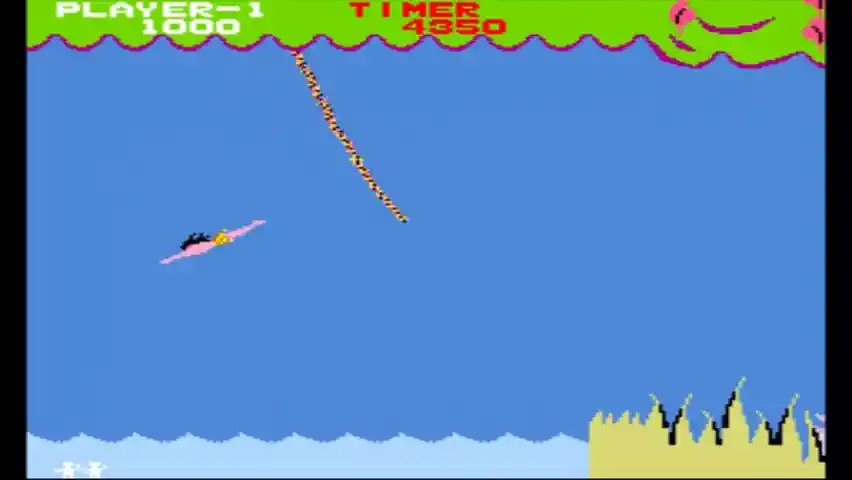
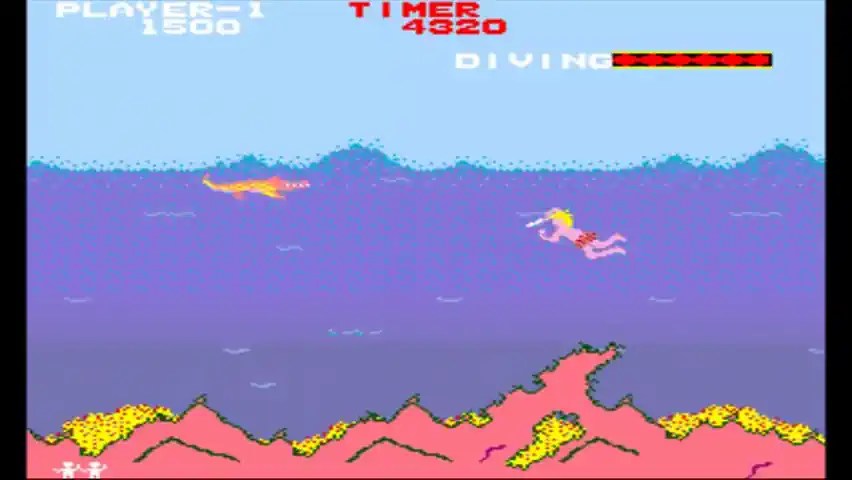
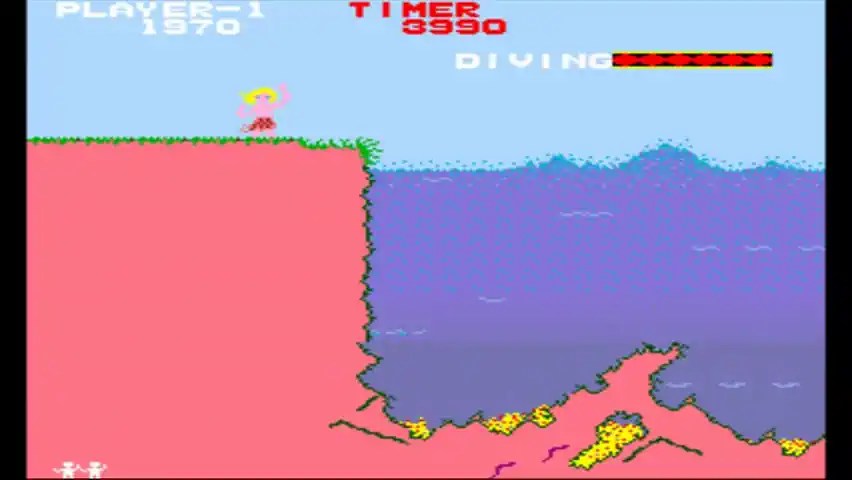
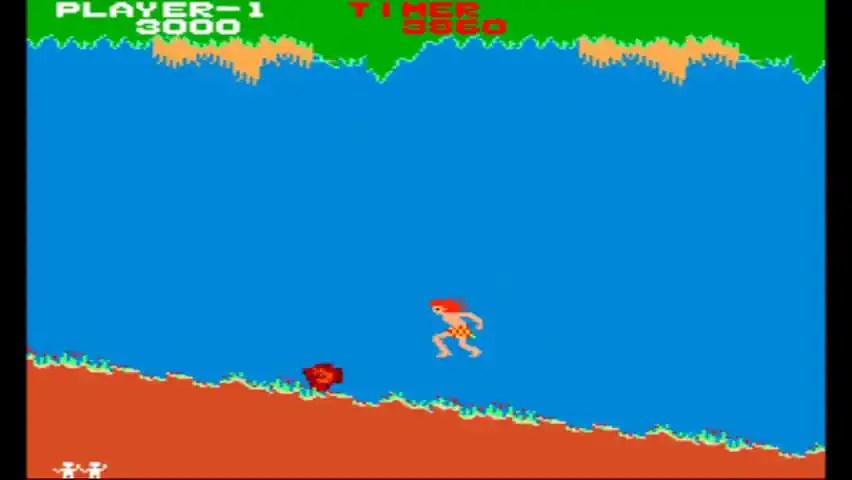
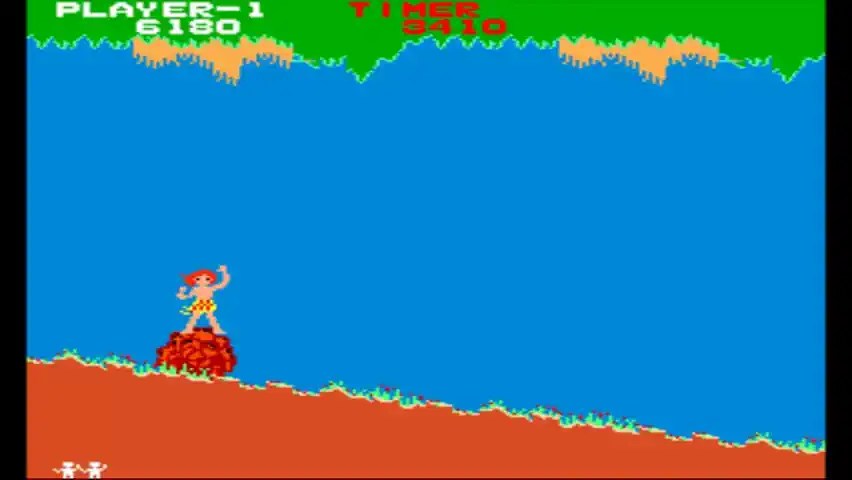
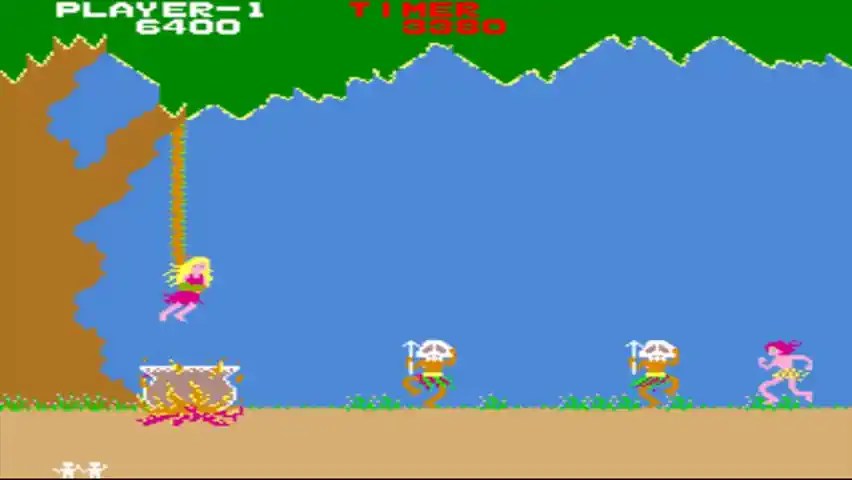
The controls are deliberately simple: a four-way joystick and a single button are all you need for the entire adventure. This simplicity made the game accessible, while the steadily increasing difficulty kept players motivated for a long time.
Technology
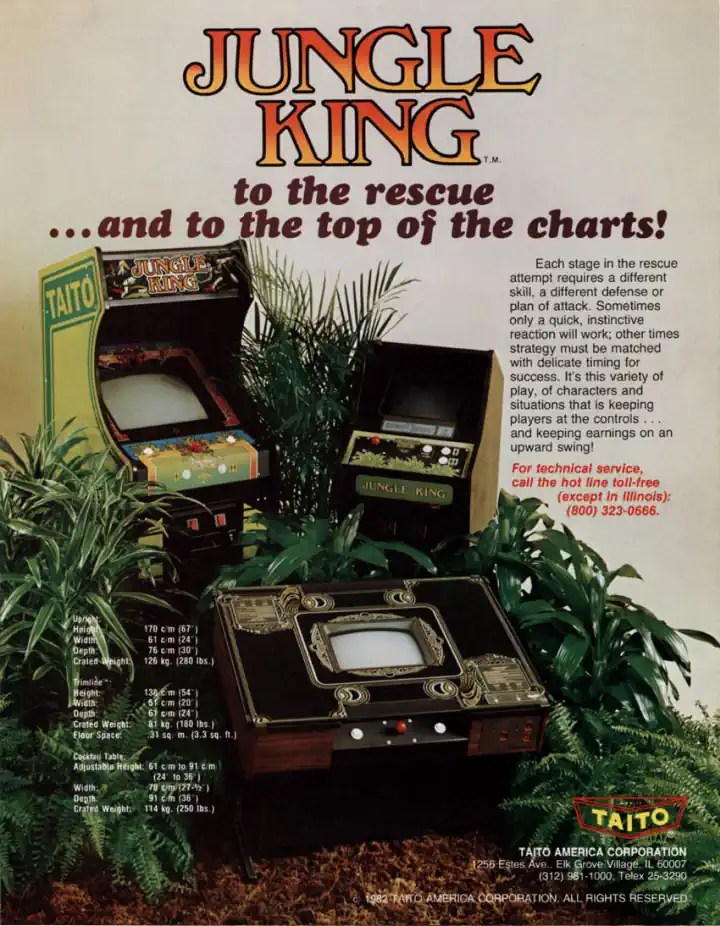
Jungle King ran on Taito’s SJ hardware at the time, which was based on a Zilog Z80 processor. In addition to this main processor, a second Z80 was used for sound processing. Several AY-3-8910 sound chips generated the typical soundscape of jungle noises, music, and effects. For many players, the main character’s characteristic scream, which had to be removed in later versions, remained particularly memorable. In addition, the hardware used various memory modules and specialized graphics modules, which made it possible to display sprites smoothly and keep multiple animations on screen at the same time. Although this architecture was modest compared to later systems, it allowed for astonishing diversity and stability, which is why Taito used it for numerous games of that era. The coordinated combination of sound chips and processor power was also a key reason why the soundscape was so distinctive and unforgettable for many players.
The graphics resolution of 256×224 pixels and a 64-color palette were quite remarkable in 1982. Parallax scrolling made the game world appear more dynamic and lively than many of its competitors. The switch between four completely different environments also placed high demands on the level design and showed that Taito skillfully exploited the technical capabilities of its hardware. In addition, the team had to make creative use of the limited color depth and number of sprites to create varied and easily recognizable animations. It is particularly noteworthy that, despite these limitations, both foreground and background elements were rendered in fluid motion. This gave the game a visual sophistication that many other titles of the early 80s did not achieve and immediately set “Jungle King” apart in arcades.
Jungle King vs. Jungle Hunt
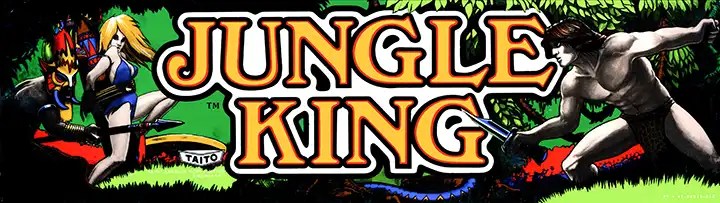

The well-known name change from “Jungle King” to “Jungle Hunt” made the game an interesting example of the legal dynamics of early video game history. The two versions differ mainly in terms of visuals, as the basic gameplay remained unchanged. In addition, it is now well documented that Taito received an official cease and desist letter from Edgar Rice Burroughs, Inc. (the so-called “ERB Estate”) objecting to the strong visual and acoustic references to Tarzan. This step was the decisive reason for the rapid redesign of the game character and the renaming. At the same time, this change opened up a discussion about how strongly visual elements can shape the perception of a game and what influence legal frameworks have on creative decisions.
- Main character:
- In “Jungle King”: a classic jungle hero in a loincloth who embodies a traditional image of adventure with his physical presence and acrobatic demeanor.
- In “Jungle Hunt”: an explorer with a pith helmet and safari outfit, who steers the setting more toward a colonial expedition and thus conveys a completely different flair.
- Vines vs. ropes:
- “Jungle King” features natural vines that are clearly modeled after Tarzan.
- “Jungle Hunt” uses neutral ropes that appear less organic and are deliberately designed to avoid any association with well-known jungle heroes.
- Sound:
- The iconic cry from “Jungle King” had to be removed because it was acoustically too close to the famous Tarzan cry.
- “Jungle Hunt” got new music tracks and modified effects, which gave the game a slightly more serious and less playful atmosphere.
- Branding and marketing: Over time, Jungle Hunt became the more well-known version and appeared more frequently in arcade lists, compilations, and home console conversions. The new, legally unobjectionable look allowed Taito to market the game more aggressively, with the result that many players were unaware of the original Jungle King version.
Although the differences remain superficial, the case is an early example of how popular literature and films influenced the gaming landscape – and how sensitively companies had to deal with borrowings from then on. It also shows how quickly a game can develop a new identity through purely cosmetic adjustments and how closely creativity and the legal situation were linked in the early video game industry.
Trivia
- Former working title: The name “Jungle Boy” was used in early stages of development. Originally, the character was supposed to appear significantly younger and lean more toward a classic adventure schoolboy. Internal documents suggest that Taito initially planned a more accessible and humorous setting before deciding on an adult jungle hero to appeal to a broader player base.
- Pirate Pete: In 1982, an alternative version called “Pirate Pete” was released. This version not only replaced the hero with a pirate, but also redesigned large parts of the game: sharks replaced crocodiles, swinging ropes became rigging elements of a pirate ship, and enemy sailors appeared instead of cannibals. This variant was an attempt to make the game more attractive to new markets while avoiding any associations with Tarzan.
- Infinite loop: The game has no real ending – after each rescue sequence, the cycle begins again, but with increasing speed and stronger opponents. This endless loop was typical of early arcade titles, as it was intended to motivate players to survive as long as possible and achieve high scores. Particularly ambitious players competed to master the increasingly difficult vine distances, faster crocodiles, and more chaotic boulders.
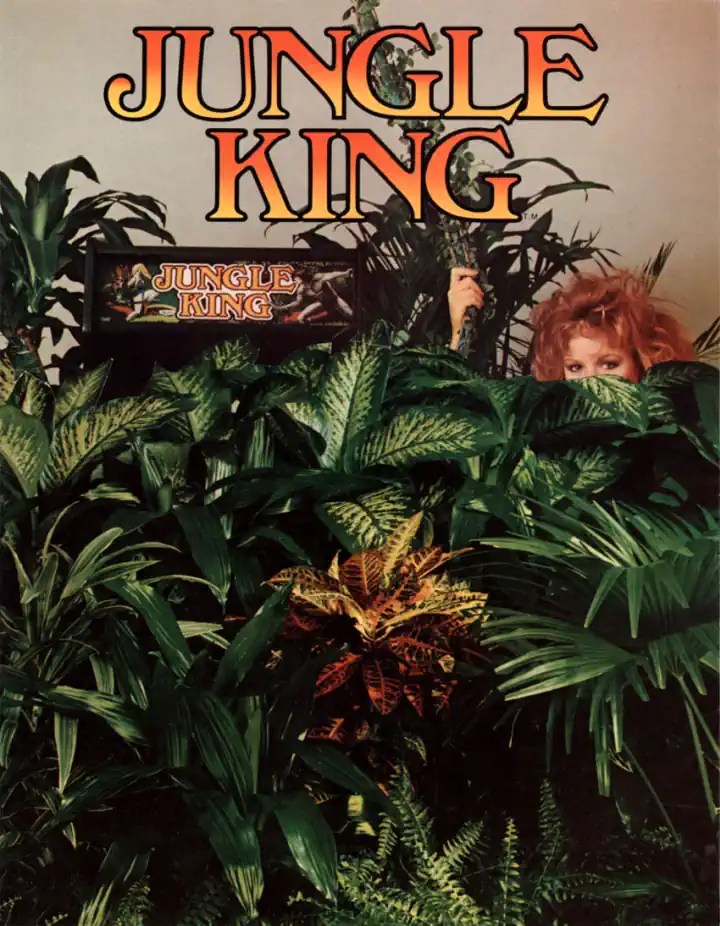
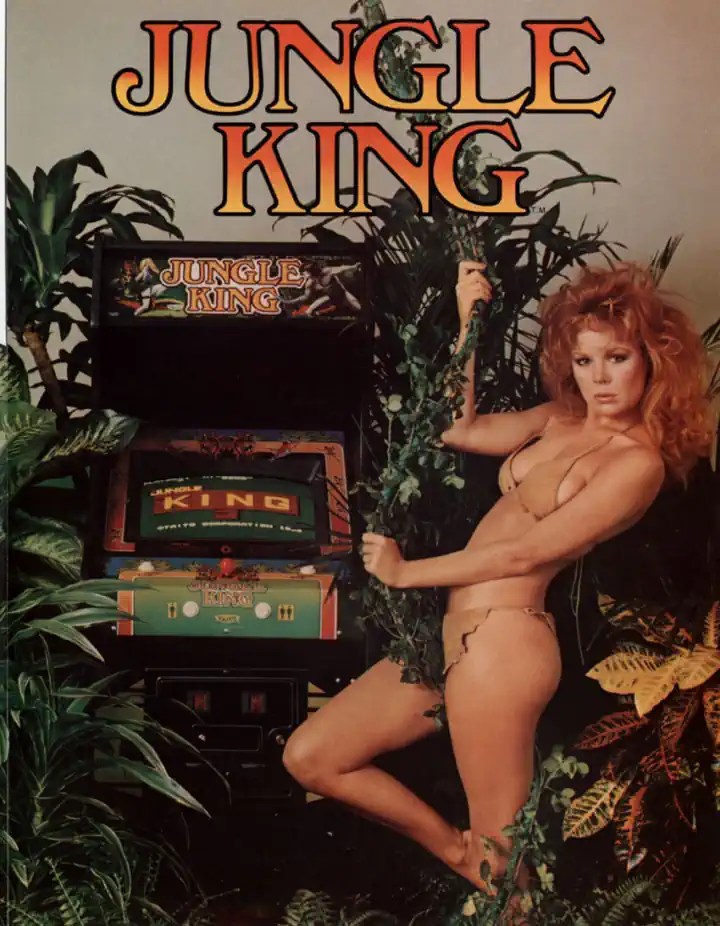
- Rarity: The original “Jungle King” variant is a sought-after collector’s item due to its short release period. Many machines were converted after being renamed “Jungle Hunt,” making functioning “Jungle King” boards extremely rare today. Collectors often pay high sums for preserved original cabinets with the original artwork showing the jungle hero in a loincloth.
Criticism at the time
The reactions of the gaming press and arcade operators at the time were generally positive. Many praised the varied layout, the clear structure of the four segments, and the good playability. It was particularly emphasized that the game appealed to both beginners and experienced players. It was often emphasized that the steadily increasing level of difficulty struck just the right balance to challenge players without overwhelming them. Many reviews stated that Jungle King was one of those games that you play over and over again to improve your score – a key quality feature for arcade titles of that era.
However, some critics complained that the graphic design of the vine section seemed a little crude and that the concept could lose its appeal during longer sessions. Some testers pointed out that the animations seemed a little wooden compared to other Taito titles, especially when several vines were visible on the screen at the same time. Nevertheless, Jungle King was widely regarded as one of Taito’s stronger titles since Space Invaders, as it had a clear identity, was easy to understand, and offered a lot of replay value despite its simplicity.
The home versions, which appeared on systems such as the Atari 2600, Atari 5200, Commodore 64, and Apple II, were also very popular and helped the game remain well known far beyond the arcade. Although these ports were technically reduced, testers praised the surprisingly good implementation of the multi-part level design. Many players appreciated the opportunity to bring the arcade experience into their living rooms, and the Commodore 64 version in particular was named one of the better arcade conversions of the year in several magazines.
Cultural influence
The influence of Jungle King is evident not only in its technical implementation, but also in its structure and presentation. The game was one of the first titles to combine several very different gameplay segments into a coherent adventure. This episodic structure was later adopted by many action games and particularly influenced titles that relied on varied level changes. It laid the foundation for later games that stylistically alternated between skill, exploration, and reaction sequences—an approach that became increasingly common in the console era of the 1980s and 1990s.
Parallax scrolling is considered one of the game’s most important technical features. It created a sense of depth and movement that was particularly popular in platform games of the following years – for example, on the NES or later on the Mega Drive. For many players at the time, this effect was a real highlight and conveyed a sense of dynamism that went far beyond the flat graphics typical of the time. This technical trick also influenced later arcade developers, who increasingly relied on multi-layered backgrounds and visual depth.
In addition, the legal dispute over the Tarzan similarities has a firm place in video game history. It made the industry more sensitive to character design and intellectual property. Developers and publishers began to pay more attention to not imitating distinctive brands and iconic characters in order to avoid legal disputes. To this day, this case is considered an early example of how pop culture influences, legal gray areas, and creative freedom collided in the growing video game industry.
Conclusion
Jungle King is much more than a simple action game from the early days of video game history. It exemplifies a phase in which developers experimented, broke new technical ground, and had the courage to combine multiple game principles in a single title. The combination of skill, reaction, observation, and timing gave the game a special depth that still thrills retro fans today. Furthermore, the game embodies the spirit of an era in which small creative teams often produced remarkable innovations within short periods of time – not out of necessity, but out of a desire to create something new that stood out from the competition. Jungle King demonstrates how effective simple mechanics can be when they are cleverly intertwined and give the player a sense of steady progress.
Whether in its original or revised version, Jungle King remains an important piece of arcade history, whose influence can be felt both in technical terms and in the development of modern action games. Many later titles adopted the idea of clearly defined level modules that keep the game flowing dynamically, and made use of visual tricks such as parallax scrolling. The lessons learned from the legal conflict over the design also resonated, leading studios to pay more attention to the uniqueness of their characters in the future. All of this makes Jungle King not just a nostalgic experience, but an important pioneer whose impact extends far beyond its own popularity.
Advertisement






 McHenry's Lair
Kommentar verfassen :