


ALIEN ATTACK!
The Last Battle on the Atari VCS
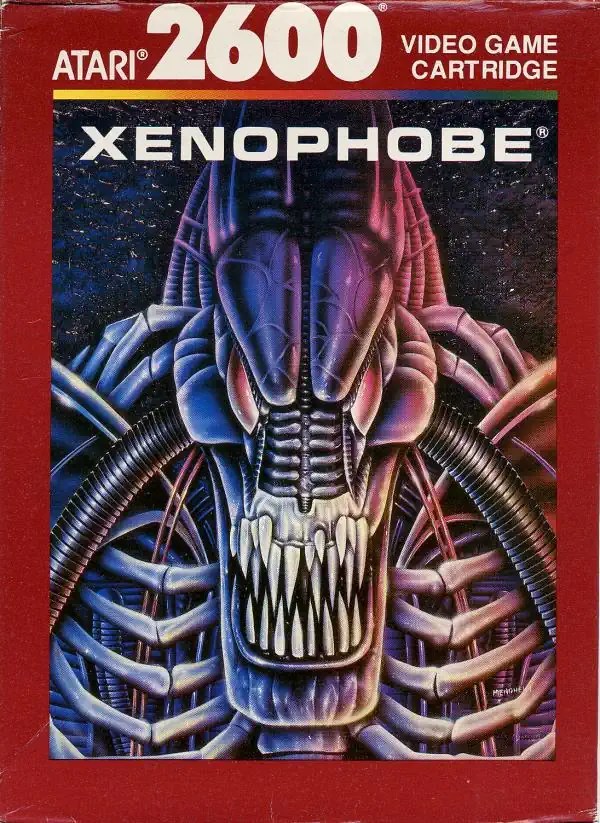
In the long history of the Atari 2600, there are a few titles that have remained memorable either because of their technical ambitions, their playability, or their curious implementations. Some games shone because of their innovation, others because of their absurdity or the pure cult status they achieved in retrospect. “Xenophobe”, released in 1990 – a full 13 years after the launch of the legendary system – is one of those games that combines several of these characteristics. It was one of the last licensed games for the console, based on a well-known arcade template, and showed what was still technically possible with the aging VCS – or rather, what was not.
What makes “Xenophobe” special is not only the fact that it was one of the very last games for a long-obsolete platform, but also that it dared to transfer a relatively complex game concept to extremely limited hardware. This clearly showed how developers of the time tried to extend the console’s life cycle once again with creativity and technical sophistication. The game is a prime example of late console ports that took on the challenge of implementing complex concepts on limited hardware. It is representative of an era in which developers wanted to achieve a lot with very few resources – and often achieved interesting, if not always perfect, results.
Gameplay
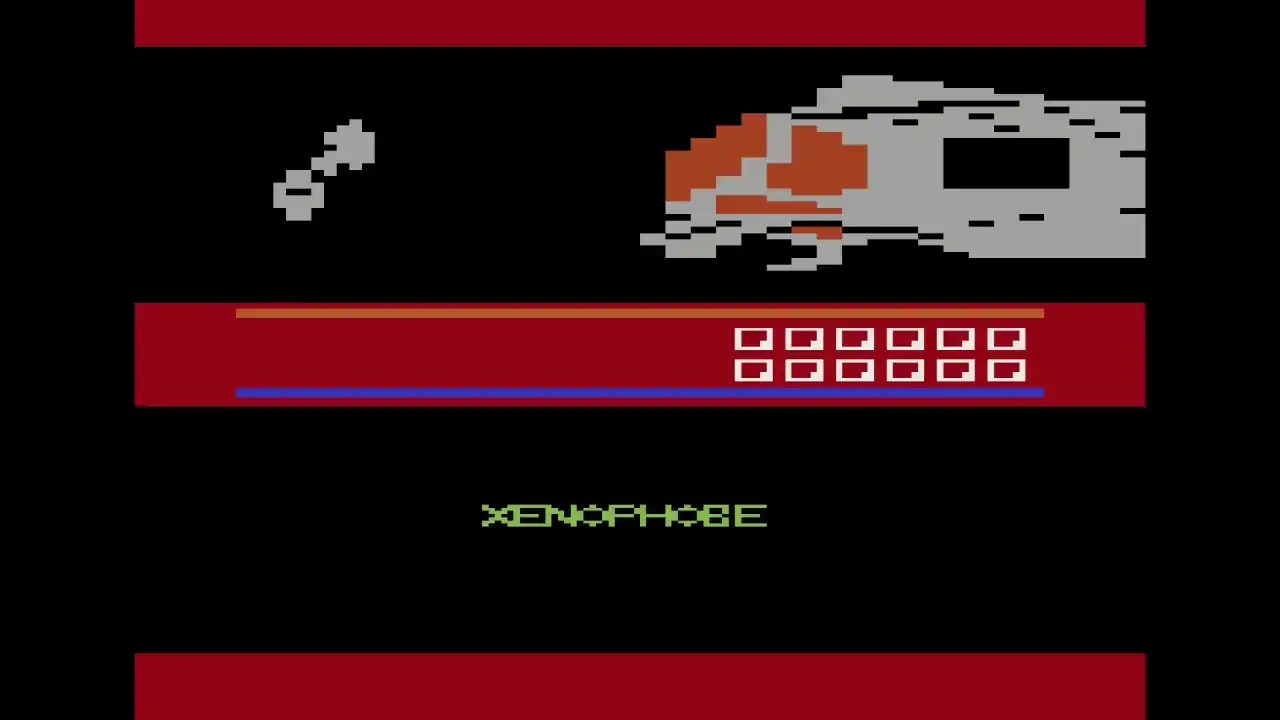
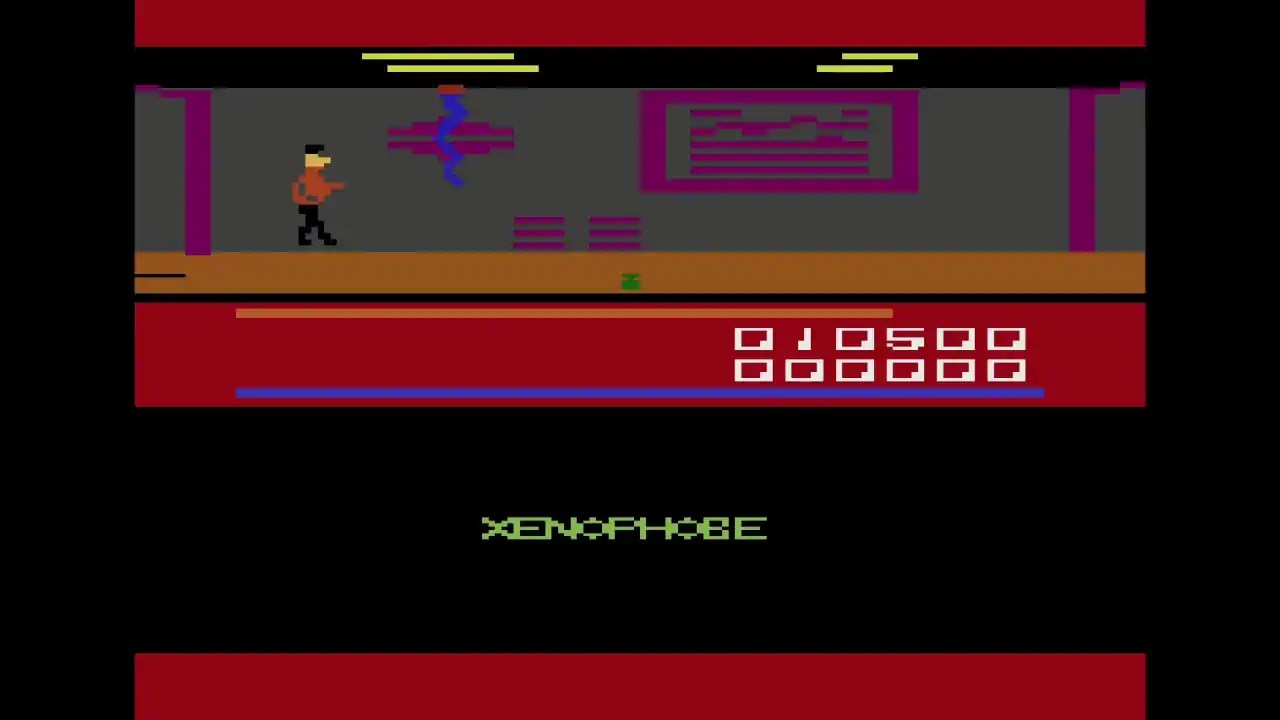
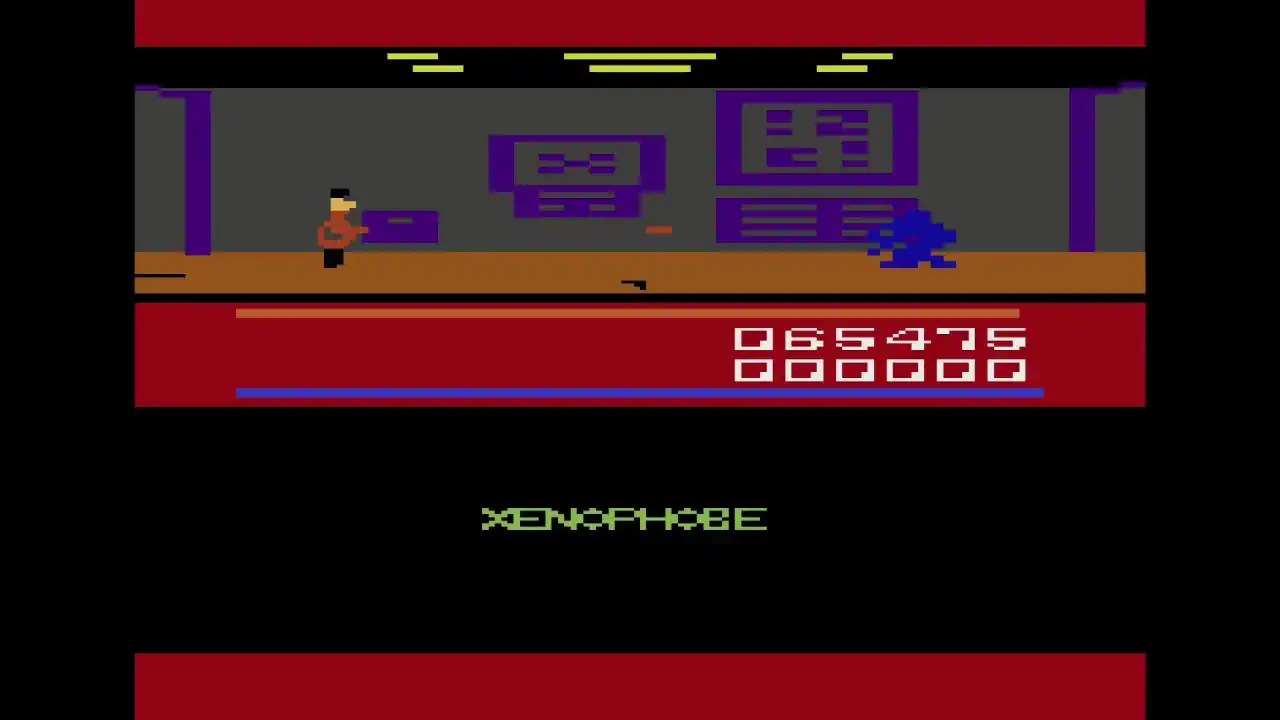
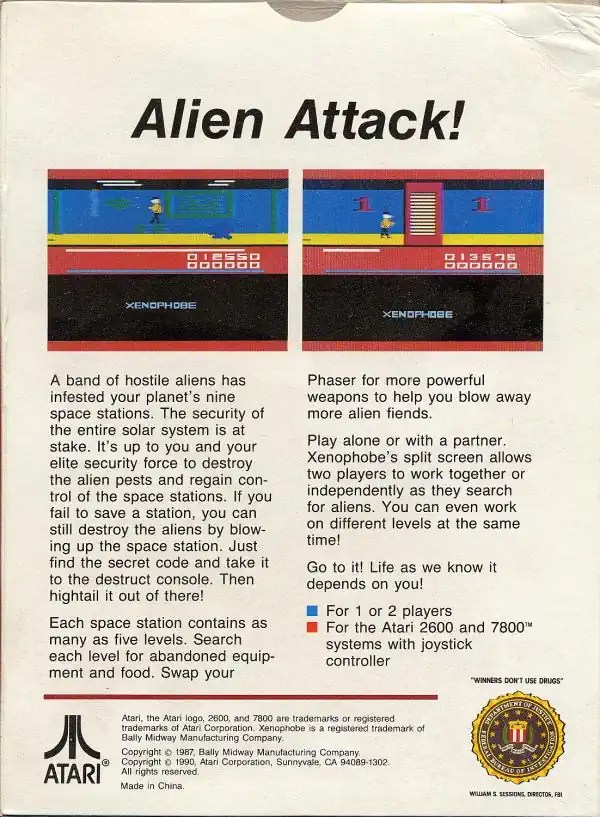
“Xenophobe” is a side-scrolling shooter with a science fiction theme and horror elements that attempts to convey a dark and threatening atmosphere. The player takes on the role of a space station defender who must fight his way through several levels of a space station infested with hostile aliens (known as Xenos). These Xenos are slimy, aggressive creatures with tentacle-like limbs that can hide in every corner and suddenly emerge from shadowed areas. The goal is to eliminate the enemy threat and regain control of the station before it is completely destroyed or taken over by the aliens. The scenario is reminiscent of films such as “Alien,” “The Thing,” and “Event Horizon,” giving the game a slightly cinematic feel that is effective despite technical limitations.
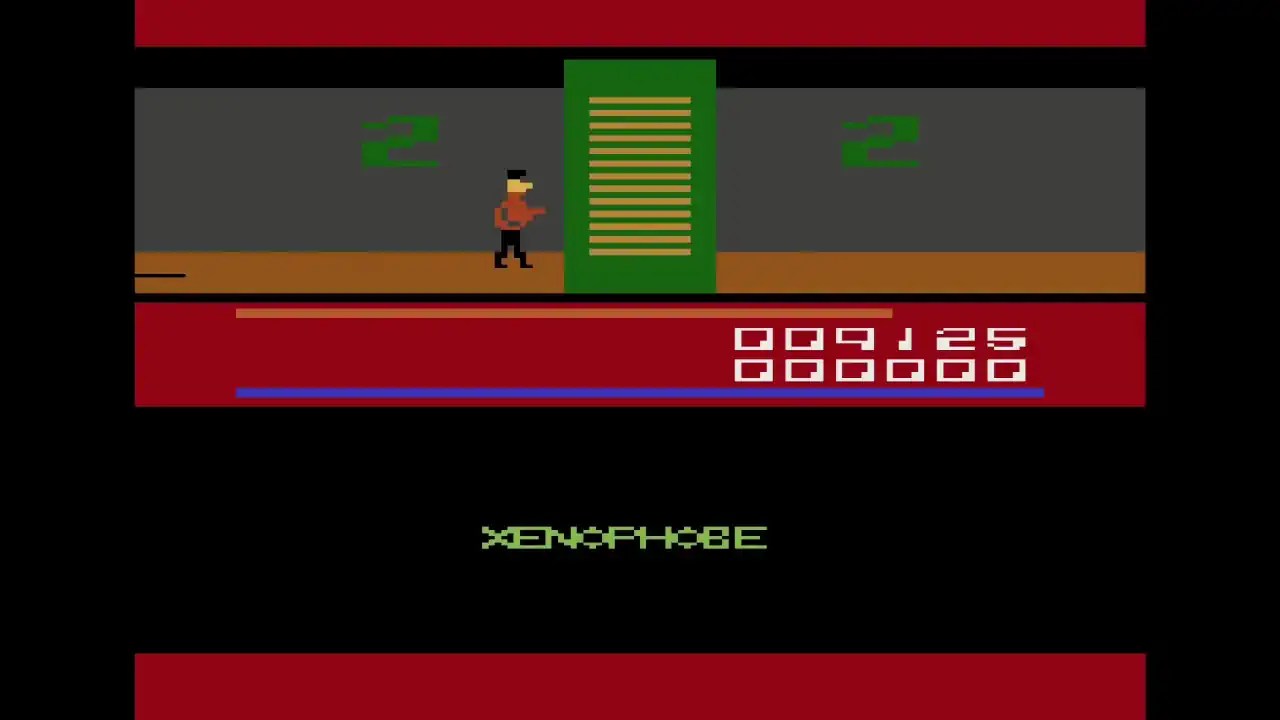
In the game, you move from room to room in a side view, with the environment mostly sparsely designed but brought to life by small details such as ventilation shafts or flashing consoles. You collect various weapons and items – including pistols, laser cannons, and grenades – eliminate the Xenos with targeted shots, and try not to become a victim of the invasion yourself. There are also medipacks, bombs, and other items, some of which earn you points, some of which are directly useful, and some of which even have a puzzle-like character when they have to be combined correctly or used in certain places. The controls are kept simple, but due to the technical limitations of the platform, they are somewhat sluggish, which adds a slight tactical element to the game, as you have to plan your movements and actions in advance.
The game only supports one player – in contrast to the multiplayer focus of the arcade original, which relied on co-op experience and parallel gameplay. This means that a large part of the social fun of the game is lost, which is particularly noticeable during longer gaming sessions. Nevertheless, “Xenophobe” offers solo players solid entertainment with a certain replay value, especially since the alien spawn points and item distributions vary slightly. For fans of the genre, it’s an interesting, albeit reduced, experience that shows how you can suggest a lot with very little.





Trivia and special features
- Miniaturization of the arcade mechanics: Due to massive technical limitations, many of the arcade version’s game mechanics had to be omitted or greatly simplified. Freedom of movement, depth of detail, enemy AI, and multiplayer modes were largely sacrificed in the simplification process. Nevertheless, the basic framework of the original is still recognizable, and the developers managed to preserve the essence of the template in a reduced form. This required a high degree of creativity in dealing with the limited memory and graphic capabilities.
- Developer: The Atari version was developed by Western Technologies, a studio known for late VCS productions. The team consisted of veterans who were very familiar with the console’s idiosyncrasies. The conversion was published by Atari Corporation, which was already experimenting with the Lynx handheld at the time and had its sights set on the next generation with the upcoming Atari Jaguar. Although the focus shifted, projects such as “Xenophobe” showed that the company had not completely lost sight of its own past.
- Rarity: Due to its late release and limited print run, “Xenophobe” is now a sought-after collector’s item. Modules in particularly good condition, ideally with their original packaging, sometimes fetch high prices at collector’s fairs and online platforms. The game has thus become a cult object that has not only nostalgic but also material value for many retro enthusiasts.
Arcade vs. VCS – An unequal battle
The arcade version of “Xenophobe” was a striking multiplayer game in 1987 with split screen and high graphic detail. Players could fight cooperatively against aliens, with the atmosphere and sound underscoring the dark mood.
The Atari 2600 version, on the other hand, was greatly simplified: only one player, blocky graphics, limited controls, and a much more linear level design. Many features of the arcade template fell victim to technical limitations.
Nevertheless, the developers managed to preserve the basic principle: fighting an alien invasion on a space station. Despite the reduced presentation, the atmosphere and concept shine through – a creative tour de force on limited hardware.
Reviews at the time
When “Xenophobe” was released in 1990, the Atari 2600 was already a relic of the past. New systems such as the Nintendo Entertainment System, the Sega Master System, and even the Mega Drive dominated the market with technically superior titles. In this late phase of the VCS, press attention was low, but some trade magazines still took an interest in the game. The reviews were mixed: while some considered the implementation ambitious, many weaknesses were also pointed out. The animations were surprisingly positively highlighted, as they were considered comparatively smooth for a game on this platform. The level design was also rated as functional, despite its simplicity. Less favorable was the assessment of the graphics, which lagged far behind other platforms in terms of detail. Particularly noticeable was the lack of a multiplayer mode, which was a central element in the arcade version but was completely omitted on the VCS.
In retrospect, it is not the gameplay quality that prevails, but rather its historical significance. Critics and players acknowledged the technical limitations, but praised the courage and creative achievement of implementing a comparatively complex arcade game on an aging home console system. This attitude contributed to “Xenophobe” being remembered not only as a game, but also as a document of the last days of the VCS.
Cultural influence
On a cultural level, “Xenophobe” was unable to exert any significant influence on the Atari 2600 – it simply came too late. The golden era of the VCS was over, the market had evolved, and new generations of gamers turned to more powerful platforms such as the NES, Mega Drive, and later the Super Nintendo. In this environment, the release of a new VCS title seemed more like an echo of a bygone era than a fresh impulse. Its relevance was limited, and it had hardly any media presence outside of niche circles.
The arcade version, on the other hand, fared better: its striking sci-fi aesthetic, cooperative gameplay, and charming B-movie style struck a chord with the zeitgeist. It was ported to several home consoles and home computers, including the NES, Amiga, and Commodore 64. It enjoyed some popularity in arcades, partly because the split-screen concept was innovative and took the multiplayer aspect to a new level. This secured the arcade version a small but respected place in the history of 1980s games.
Today, the VCS version lives on mainly in collector circles. It is not valued for its gameplay or technology, but for its historical significance: as the last licensed game for one of the most iconic consoles ever. It regularly appears as a curiosity in forums, videos, retro podcasts, and rankings—a game that deserves attention less for its quality than for its role in the life cycle of the Atari 2600. Retro fans, collectors, and historians of video game history in particular like to cite the game as an example of late, almost experimental titles that tell us more about the development of the medium than about the actual gaming experience.
The last Atari VCS game
Xenophobe was the last officially licensed game released for the Atari 2600 (1990). This release was more than just another game – it was a milestone. Xenophobe not only concludes the active life cycle of what is probably the most famous console in early video game history, but also marks the end of an entire chapter in home entertainment. The title exemplifies an era in which game ideas had to be implemented with the simplest of technology, in which limitations became a creative challenge. The fact that anyone even bothered to develop a new game for such an aging console in 1990 is a testament to the passion of individual developers and studios – and to the loyal fan base that continued to support the VCS.
The year 1990 was a turning point in the world of video games. While 16-bit consoles such as the Super Nintendo and Sega Mega Drive already represented the future with modern graphics and sound capabilities, Xenophobe was another game released for a platform that technically originated in the 1970s. This marked the end of a product cycle that had begun 13 years earlier with minimalist games such as Combat and Adventure – games that laid the foundation for what are now billion-dollar markets. In this sense, Xenophobe is a final echo of a pioneering era when video games were still uncharted territory.
“Xenophobe” was thus more than just a belated port of an arcade hit – it was a symbolic statement. It showed how far developers were willing to go to enable new experiences even on exhausted hardware. Despite its limitations, the game carried the spirit of the arcade template and offered at least a hint of what originally excited players. It was a quiet farewell, almost nostalgic, but by no means meaningless. Even though it didn’t make waves commercially, it marked the end of a chapter that had helped shape the development of the industry.
Today, “Xenophobe” is a sought-after collector’s item. It’s not just a game, but a relic – a tangible piece of history. No well-stocked Atari VCS collection should be without it. It reminds us of a time when 4 KB of ROM was enough to create entire adventures, when pixels still left room for imagination, and when the medium of video games was just beginning to define itself.
Conclusion
“Xenophobe” for the Atari 2600 is not a masterpiece – it can hardly be one due to technical limitations. The graphical possibilities were limited, the controls were simple, and many complex game mechanics of the original had to be greatly reduced or eliminated altogether. Nevertheless, it is a remarkable piece of video game history: as a port of an ambitious arcade title, as an attempt to bring complex gameplay to the simplest hardware, and as the final chapter of the Atari 2600 era. It exemplifies how an ambitious concept can be realized, at least in its basic form, under adverse conditions – with a visible desire to give the platform a worthy finale.
For collectors, historians, and fans of the system, it is a must-have, precisely because it marks a significant conclusion. It stands as a symbol of a system that, despite its limited capabilities, has thrilled generations of gamers. For casual gamers, on the other hand, it remains more of a technical curiosity that may only spark a few minutes of fascination – a reminder of how much the medium has evolved since then. Nevertheless, anyone who wants to understand how a system comes to an end will find Xenophobe a fascinating example of what developers were capable of achieving – with patience, creativity, and passion for a platform that had long since been discontinued. There is a certain charm in its simplicity – a quiet tribute to a console that made video game history.









 McHenry's Lair
Kommentar verfassen :