


The 80s – This was the Golden Age of the Commodore 64.
The undisputed ruler of home computing. It brought unforgettable games straight into homes worldwide.
Among its legendary titles was a Poker simulator with a titillating twist :
Artworx’s Strip Poker: A Sizzling Game of Chance
Introduction

Artworx’s Strip Poker: A Sizzling Game of Chance, first launched in 1982 on the Apple II and ported to the Commodore 64 in 1983–84, stands as one of the earliest and most notorious erotic-themed computer games. Developed by Artworx, the title is emblematic of early adult-oriented gaming—an era when technological novelty met teenage curiosity. Its simple premise, provocative concept, and rudimentary graphics became iconic, representing a time when developers pushed boundaries on what was acceptable—or even possible—on home computers. The game’s blend of strategy and titillation sparked intrigue, amusement, and controversy in equal measure. For many young players growing up in the early computer age, it was their first exposure to a game that strayed beyond traditional arcade-style entertainment. This made it both a source of fascination and a lightning rod for criticism. Over time, Strip Poker became more than just a novelty; it evolved into a cultural touchstone within the retro gaming world, remembered as much for its audacity as for its gameplay.
Gameplay
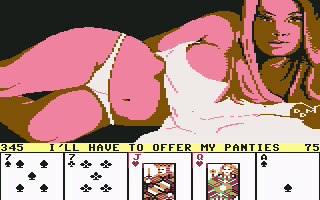
You play a male poker enthusiast facing off against computer-controlled female opponents (initially Suzi and Melissa), each represented with digitized portraits that gradually change with each lost hand. Engaging in five-card draw poker, your goal is to win successive hands by reading your opponent, bluffing strategically, and managing your virtual bankroll. Each time you win $100, the opponent removes one piece of clothing—five successful wins lead to a full undress and a cheeky victory screen. Data disks expand the roster with additional characters like Marlena and Candi, each featuring different personalities and image sets, adding variety to repeat playthroughs.
Suzi and Melissa










Candi and Marlena (Data Disk)










The poker AI is sophisticated for its time: it dynamically adjusts difficulty based on your performance—winning makes the opponent tougher, losing makes the game easier. This adaptive challenge level encouraged prolonged engagement and gave the impression that the game was learning your habits. Despite the racy theme, the underlying card game mechanics were solid enough to teach newcomers real poker basics. Combined with snarky in-game commentary and stylized animations, the gameplay delivered both amusement and genuine tension, especially when one bad bet could cost you the round.
Controversy
Even back in the mid-1980s, the concept of video-game strip poker sparked debate and raised eyebrows across both gaming and mainstream media circles. Critics argued that it was a „depressing way“ for players—particularly impressionable teenagers—to access erotic content when more traditional outlets like Playboy were readily available. Moral watchdogs questioned the appropriateness of merging adult themes with what was still considered a largely juvenile form of entertainment. Educators and parents expressed concern that games like Strip Poker could desensitize young players to objectification, while others brushed it off as harmless fun.
In response to shifting social attitudes and the potential for broader appeal, Artworx reportedly considered creating a gender-reversed version of the game, with a female player facing male opponents who would disrobe. However, this concept never moved past the planning stage, perhaps due to market hesitance or technical limitations. Despite this, the mere suggestion underscored the growing discourse about representation, agency, and gender roles in early video games. The controversy ultimately added to the game’s notoriety, fueling curiosity and boosting sales among those eager to see what the fuss was all about.
Trivia
- Artworx originated in Naples, Florida, and initially focused on developing straightforward poker games before venturing into more unconventional territory. By 1982, the company made a bold move by introducing erotic elements into their releases, giving rise to the now-iconic Strip Poker series. This shift not only set the company apart in the software landscape of the time but also opened a niche market that blended adult content with game mechanics.
- The C64 version’s teaser design—pixelated, brief, and „titillating rather than pornographic“—was carefully calibrated to appeal to teenagers and young adults. Its suggestiveness was intentional, walking a fine line that allowed it to circulate in gaming spaces without crossing into outright obscenity, thereby avoiding the kinds of backlash other more explicit content might have faced.
- Creative users quickly began exploring the game’s file structure and uncovered a playful workaround: by renaming or editing certain image files, players could effectively bypass the poker mechanics and start the game at the nudity stage. This early form of modding showed just how eager the community was to manipulate and personalize the game experience, even with limited technical tools.
- Over the years, the game inspired a variety of nostalgic reflections. One Redditor, for example, fondly remembered their experience, stating, „This was the game that taught me to play poker.“ Such anecdotes illustrate how, despite—or perhaps because of—its adult theme, Strip Poker found a place in the formative gaming memories of a generation, blending education, mischief, and experimentation in equal parts.
Reviews at the Time
Reviews from the 1980s offered a range of perspectives on Strip Poker, with many critics acknowledging its bold concept and surprisingly competent execution. In 1985, the well-regarded magazine ZZAP!64 discussed the game in detail, particularly in relation to its Amiga sequel, Strip Poker II. The reviewers highlighted the humorous tone, noting the light-hearted in-game commentary that helped frame the provocative content in a more playful, less offensive manner. They also pointed out the quality of the digitized images, which were quite advanced for the time and helped the game stand out among other titles in the growing Commodore 64 library.
While some viewed the game as a mere novelty—an attention-grabber more than a serious poker simulation—others recognized that its underlying mechanics were more thoughtful than expected. The gameplay was considered accessible yet challenging, and the use of a gradually escalating difficulty system was noted as a clever design choice. Despite the risqué theme, the title was often discussed in the same breath as more conventional strategy or card games, at least among certain gaming circles. These early reviews reveal that Strip Poker was more than just a curiosity; it was a game that prompted conversation, divided opinion, and showcased how early developers experimented with content that pushed the boundaries of video game subject matter.
Reputation Today
Today, Artworx’s Strip Poker is remembered as a niche yet enduring artifact within retro-gaming circles. Rather than being celebrated for mainstream appeal or technical excellence, its legacy is rooted in its novelty and its role in pushing the boundaries of what early computer games could address. It serves as a representation of the experimental spirit that characterized much of early home computing—where gameplay innovation, social provocation, and technical limitation all collided in unique ways.
While some remember it as a source of adolescent amusement, others see it as a milestone in the development of adult-themed gaming content. Over the years, it has found a place in retrospectives and histories of digital media not simply because of its eroticism, but because of what it reveals about the gaming culture of its time. It stands as an example of how game developers tested the edges of acceptable content and tried to capture new audiences by mixing conventional gameplay with taboo themes.
Though it may no longer be widely played, Strip Poker is still referenced as a quirky, provocative, and oddly influential title—a reflection of a time when digital games were just beginning to explore diverse themes beyond space battles and platforming.
Conclusion
Artworx’s Strip Poker is more than a game—it’s a vivid snapshot of the 1980s electronics revolution, teenage curiosity, and the provocative edge of digital entertainment. It represents a time when video games were still exploring their boundaries and experimenting with content, presentation, and audience expectations. With its responsive AI, cheeky presentation, and daring premise, the game stood out from the typical offerings of its era. It wasn’t just the undressing opponents that captured attention—it was the clever combination of legitimate poker mechanics with a playful, risqué theme that made the experience memorable. The stylized graphics and digitized images may seem crude by modern standards, but they were groundbreaking at the time and sparked many conversations about what constituted acceptable game content.
Though its content now feels dated—and frankly modest in light of today’s digital media—it retains a certain nostalgic charm, both for its innovation and for its boldness in a conservative gaming landscape. It was a product of its time, and in many ways, ahead of it, daring to mix strategy, personality, and taboo in one pixelated package.
Whether remembered for learning the basics of poker, pushing personal or societal boundaries, or simply laughing at pixelated anatomy, Strip Poker endures as a quirky, culturally significant, and often fondly recalled footnote in the colorful history of Commodore 64 gaming.








 McHenry's Lair
Kommentar verfassen :