

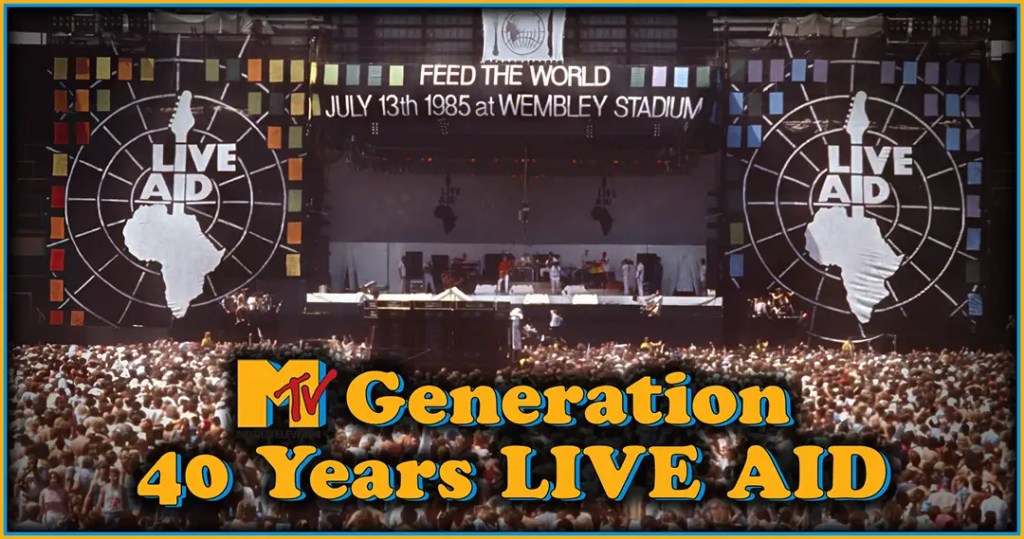
„Let the world hear our cry,“
The concert that moved the world

Music fans often ask themselves: If you had a time machine, which legendary concert would you go to? Many say Woodstock in 1969 or Candlestick Park in 1966, the Beatles‘ last performance. For me it’s the July 13. 1985 Wembley Stadium …
On July 13, 1985, in the middle of the decade of neon colors, boom boxes, and shoulder pads, music history wrote a new chapter: Live Aid. A concert that not only captivated millions of people in front of their televisions, but also attempted to alleviate the suffering of an entire region of the world. 2025 marks the 40th anniversary of this monumental event – a flashback to an era when music videos ruled, MTV was the cultural epicenter, and pop stars were celebrated like global superheroes. It’s the perfect occasion to look back on a cultural, social, and musical milestone.
Live Aid was more than a music festival – it was a global event that captured the spirit of the 1980s between stadium rock, synth sounds and political engagement. It united an entire generation in a moment of collective solidarity and showed that music not only entertains, but also moves, connects and carries responsibility. Pop stars became mouthpieces for humanitarian causes, and culture revealed its potential as a tool for global compassion.
The Background
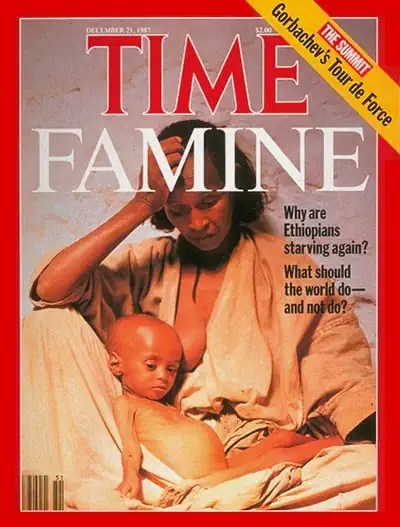
The famine in Ethiopia between 1983 and 1985 shook the world to its core. Millions of people suffered under catastrophic living conditions and were in acute danger of starvation. Entire villages were depopulated, crops failed, and medical care had virtually collapsed. Despite the dramatic situation, international aid was slow to arrive in many places. The media played a crucial role by bringing harrowing images and reports into living rooms around the world.
Irish musician Bob Geldof was deeply shaken by a BBC report documenting the extent of the disaster. Appalled by the inaction of the international community, he decided to take action. Together with Scottish musician Midge Ure, he launched the charity project Band Aid. The resulting Christmas song “Do They Know It’s Christmas?” was a huge success and raised millions for famine relief.
But Geldof and his fellow campaigners wanted more than just one-off aid: they wanted to create lasting awareness and mobilize the global music community. This gave rise to the idea of Live Aid – an unprecedented charity concert that would not only raise funds but also send a global message of solidarity and responsibility. The event was intended to show that cultural divides can be bridged when humanity is at the forefront.
The Locations
Live Aid took place simultaneously at Wembley Stadium in London and John F. Kennedy Stadium in Philadelphia. Both stadiums were filled to capacity: around 72,000 spectators in London and around 100,000 in Philadelphia. The atmosphere was electric, the audience euphoric, and the anticipation for the upcoming performances was palpable everywhere. It was a unique feeling of global togetherness that connected these two venues.
The technical organization was a masterpiece of its time. Countless technical, logistical, and organizational challenges had to be overcome to ensure that the event could take place simultaneously on two continents. Satellite connections were established at the same time to broadcast the event worldwide, which was anything but self-evident at that time. Camera crews, directors, producers, and sound engineers worked around the clock to ensure a smooth experience.
There were also live broadcasts to other cities, including Sydney, Cologne, Moscow, and Tokyo, where viewers organized their own benefit events. In many countries, spontaneous public screenings sprang up, with thousands gathering in squares and halls to watch the event together. Local programs were also launched in African countries, underscoring the international dimension of the concert. The broadcast even ran on cruise ships and military bases – a true testament to the global reach of Live Aid.
The Stars
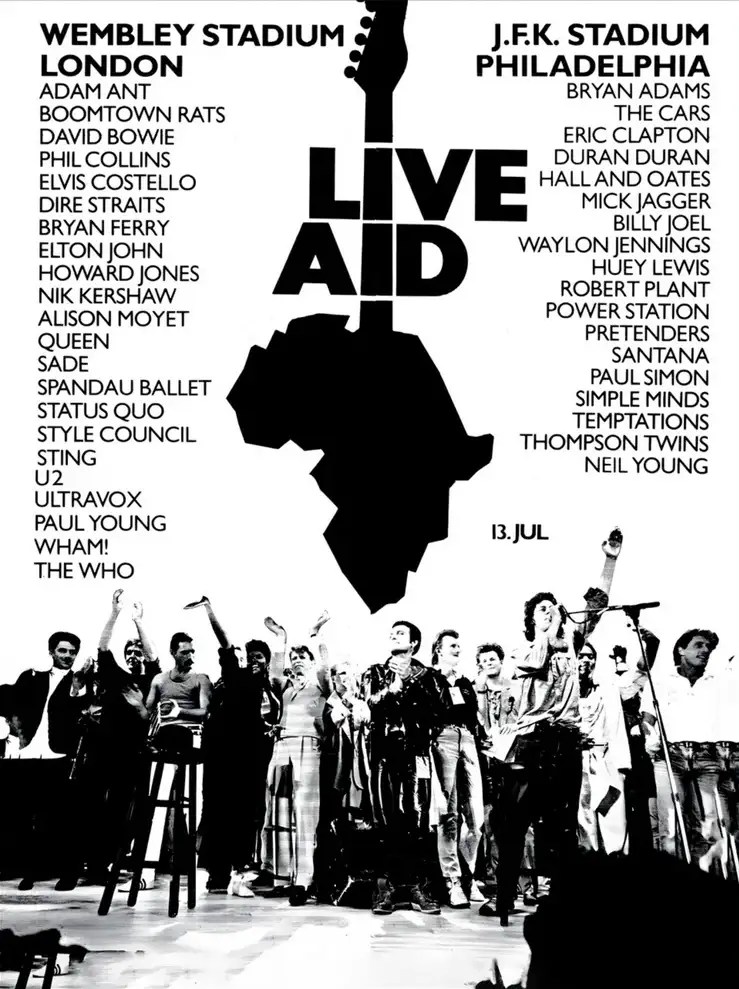
The line-up was a who’s who of the pop and rock world: Queen, U2, David Bowie, Elton John, Paul McCartney, Madonna, Led Zeppelin, The Who, Eric Clapton, Tina Turner, Mick Jagger and many more. Stars such as Bryan Adams, Neil Young, Sting, Santana and Crosby, Stills, Nash & Young also took to the stage. The event brought together several generations of artists – from rock legends to current chart-toppers of the 80s. The mix of musical experience and fresh zeitgeist made the concert not only diverse, but also historically unique. Many artists performed in unusual constellations or used the stage to break new musical ground.
Even musicians who had already retired or fallen out with each other performed together again. The reunion of Led Zeppelin with Phil Collins on drums, for example, caused a huge stir, although the performance remained musically controversial. Particularly impressive was the joint performance by Tina Turner and Mick Jagger, who caused a stir with his energetic performance and physical closeness to Turner. Paul McCartney also gave the audience goose bumps when he sang “Let It Be” solo on the piano and thousands sang along.
Surprise appearances such as that of Phil Collins, who played on two continents in one day, made the event unforgettable. He first performed in London and then flew to Philadelphia on the Concorde to perform live again – a logistical feat unmatched in pop history. Other artists such as Joan Baez and BB King also used their performances to convey political messages and emphasize the humanitarian nature of the concert. In addition, supergroups such as Power Station were represented, and numerous musicians performed in duets or spontaneous sessions, giving the event an almost improvised, lively character.
The artists waived their fees, which underscored the authenticity of their commitment. Instead, the focus was on a sense of community: a global alliance of musicians for a better world. Many of the artists involved later reported that Live Aid was one of the most moving and significant moments of their careers. For numerous fans, it was the first opportunity to see so many of their idols united in a common cause on one day.
The Highlights
Without a doubt, Queen’s performance with Freddie Mercury at Wembley Stadium was the undisputed highlight. In just 20 minutes, the band showed what live performance can mean. Songs like “Radio Ga Ga,” “Bohemian Rhapsody,” and “We Are The Champions” thrilled the audience and are still considered one of the best live performances of all time. Freddie Mercury interacted with the audience with perfect timing, his vocal power and stage presence becoming legendary. His iconic “Ay-Oh” calls, which echoed throughout the stadium, symbolized the power of music to unite people. This performance is considered not only musically outstanding, but also the emotional highlight of the entire event.
What Queen achieved was more than just a musical tour de force: the band created an atmosphere that resembled collective euphoria. Freddie Mercury’s body language, his dramatic gestures and his unbridled energy on stage captivated even those watching on television screens. Particularly impressive was how confidently the band performed despite the tight schedule and lack of rehearsal time – a demonstration of musical excellence. Brian May shone with powerful guitar riffs, Roger Taylor provided the driving rhythm, and John Deacon laid down a solid foundation on bass. It was perfect teamwork that nothing could throw off.
Many viewers later described the moment as a kind of cathartic experience, where music not only entertained but touched the collective soul. Decades later, Queen’s Live Aid performance is still regularly voted number one in polls of the best live performances of all time.
U2 also used their performance to connect emotionally with the audience with an extended version of “Bad” – a moment that made Bono a global star. During the performance, Bono climbed off the stage to pick up a girl from the crowd and dance with her. This spontaneous gesture of closeness and humanity became a symbol of the emotional authenticity of the entire concert. U2’s set showed how closely rock music can be linked to social engagement.
But it wasn’t just Queen and U2 who left a lasting impression: David Bowie also impressed with an emotionally charged performance of “Heroes,” which took on a deeper meaning in the humanitarian context. Elton John brought the stadium to its feet with “Rocket Man” and “Don’t Go Breaking My Heart” together with Kiki Dee, while George Michael later accompanied him for a duet that became one of the most memorable moments of the day. Joan Baez opened the concert in Philadelphia with “Amazing Grace,” a spiritual introduction that brought the audience to silence.
Bob Dylan, together with Keith Richards and Ron Wood, also contributed to the diversity of the performances – despite technical problems, it was a performance that will be remembered.
These musical highlights made it clear that Live Aid was more than a concert – it was a global commitment to compassion, creativity, and responsibility. Each performance became a building block of a collective moment that continues to resonate today.
The TV broadcast

Live Aid was broadcast live in more than 100 countries and watched by an estimated 1.5 to 2 billion people – a third of the world’s population at the time. It was the first global live TV broadcast of this magnitude and set new standards for international media events. The event was thus not only a musical masterpiece, but also a technical one.
In collaboration with television stations around the world, it was possible to produce a program without commercials, but with continuous encouragement to donate. Many stations even interrupted their regular programming and created their own formats in which celebrities called for donations or provided background information on the famine in Ethiopia. Viewers could donate by telephone or mail; in many countries, special hotlines were set up and staffed around the clock. Prominent presenters also hosted the program and explained the mission behind the concert.
The technical challenges—time differences, satellite connections, live broadcasts—were mastered with flying colors, making Live Aid a milestone in media history. Camera crews, directors, sound engineers, and coordinators worked around the clock to ensure the quality of the broadcast. In some countries, public spaces were even equipped with large screens to allow people without televisions to participate. The smooth execution of this mammoth project is still considered one of the most impressive achievements in the history of television broadcasting. Live Aid showed how television can create global shared experiences that emotionally connect people across continents.
The broadcast in Germany
In Germany, Live Aid was broadcast by ZDF, but not in its entirety. Unlike in the UK and the US, where it was broadcast live almost in its entirety, ZDF opted for a heavily abridged version. The concert was broadcast on a delayed basis, with only selected performances being shown. Critics at the time complained that the broadcast provided too little context and background information and that the actual scale of the event was hardly recognizable.
Internet Archive – Live Aid – German Broadcast (Part 1)
Internet Archive – Live Aid – German Broadcast (Part 2)

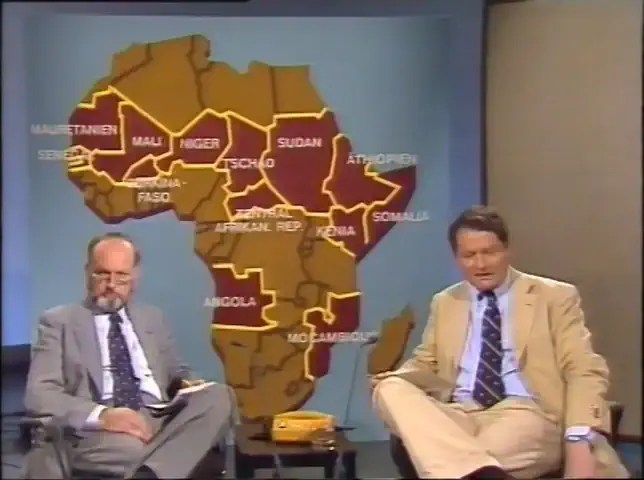
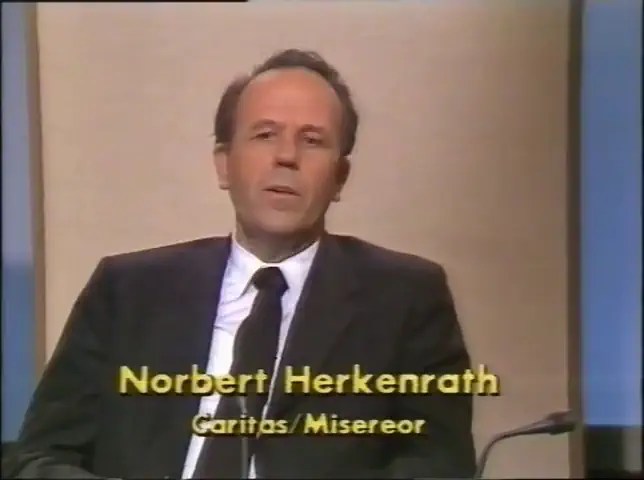
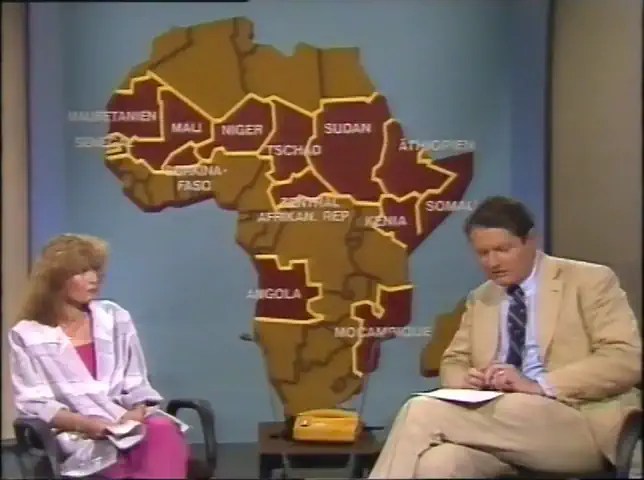
In addition, the music channel MTV, which was just gaining a foothold in the slowly growing German cable network of the 1980s, was an alternative source for fans who wanted to see more of the original program. Those who had access to MTV Europe or the English-language versions were often able to follow much more of the event than those watching public television.
I still remember exactly how I saw parts of the concert, including the legendary Queen performance, on MTV back then – a musical experience that left a lasting impression and continues to shape my view of live music to this day.
Miscellaneous
Phil Collins performed in both London and Philadelphia, flying across the Atlantic in Concorde – a logistical feat and, to this day, an unprecedented stunt in pop history. This made him the only artist to perform at both venues – a symbol of the global connection of the event. His second performance in Philadelphia took place just hours after his London show, making him one of the most talked-about stars of Live Aid.
David Bowie and Mick Jagger originally wanted to sing a duet live via satellite, but decided against it for synchronization reasons and instead recorded the now legendary music video for “Dancing in the Street” – a clip that was frequently shown on television in the run-up to the concert and contributed to the anticipation. The video itself was produced in a single day and symbolized the uncomplicated, spontaneous energy of the 1980s.
Bob Dylan, Keith Richards, and Ron Wood performed together in Philadelphia, with Dylan’s remark about struggling US farmers sparking a debate about the purpose and focus of the event. Some critics felt his words were out of place, as they seemed to distract attention from the famine in Africa, while others considered his reference to social inequalities in the US to be justified. The performance was musically mixed, but socially all the more controversial, marking one of the most controversial moments of the day.
Another curiosity: Queen were originally scheduled to perform in the early afternoon, but insisted on a better slot and, in retrospect, won over not only the audience but also history. In addition, many bands played with borrowed instruments, as technical equipment could not be easily transported between continents.
Criticism at the time
Although Live Aid was celebrated worldwide, there were also critical voices. Some journalists and aid organizations criticized the lack of transparency in the use of funds or the fact that part of the money was misappropriated by the Ethiopian government for military purposes. Questions were raised as to whether the money actually reached those most in need or instead ended up in the hands of political elites. Critics pointed out that although the media spectacle was spectacular, the long-term impact on the structural causes of hunger and poverty remained rather limited.
Others saw it as a media spectacle that generated attention but offered no sustainable structural solutions. The rapid mobilization of stars and audiences was impressive, they said, but there was no lasting strategy for combating poverty. Some NGO representatives warned that large charity events could not replace political processes and even ran the risk of obscuring political responsibility. The portrayal of Africa in the media was also criticized: too often, the image of a passive, helpless continent was conveyed, reinforcing existing stereotypes and pushing the personal responsibility of local actors into the background.
Critics warned against an “emotional economy of indulgences,” in which fundraising campaigns provide short-term peace of mind without helping in the long term. This term became emblematic of a Western attitude in which a one-time donation appeases one’s social conscience without really addressing the underlying global inequalities. Despite these concerns, however, it was also recognized that Live Aid provided an important impetus for public discussion about humanitarian aid, responsibility, and global solidarity—a discourse that continued in the decades that followed.

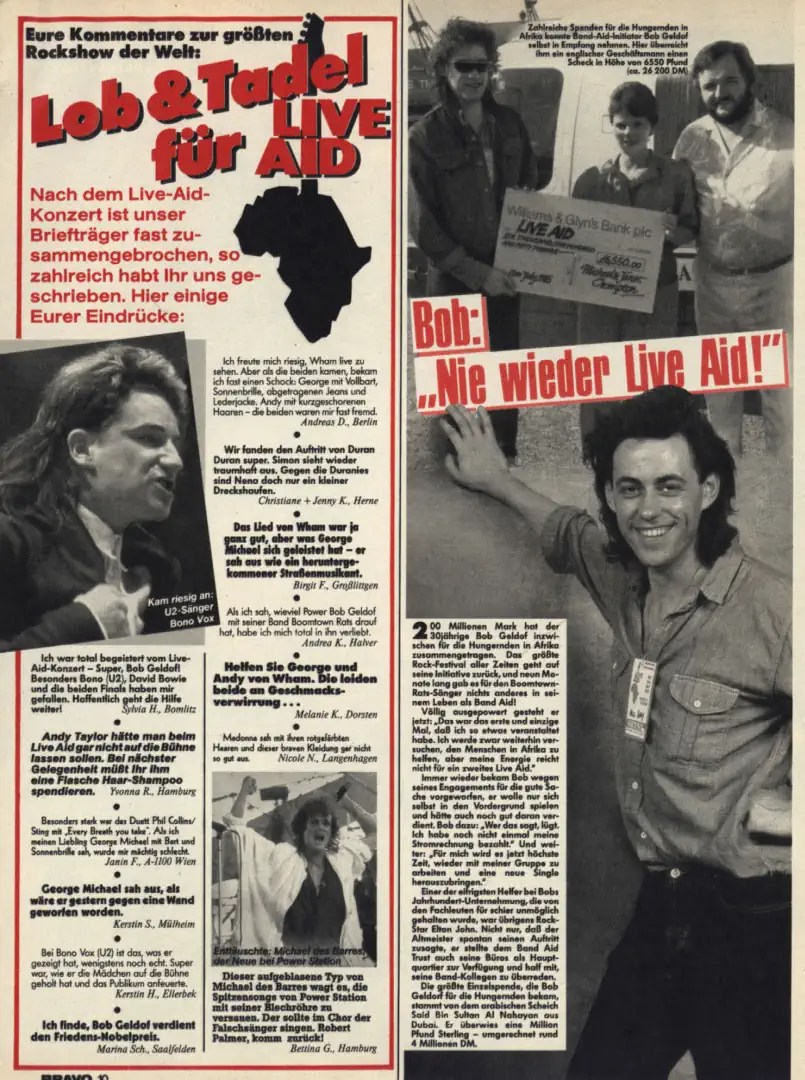

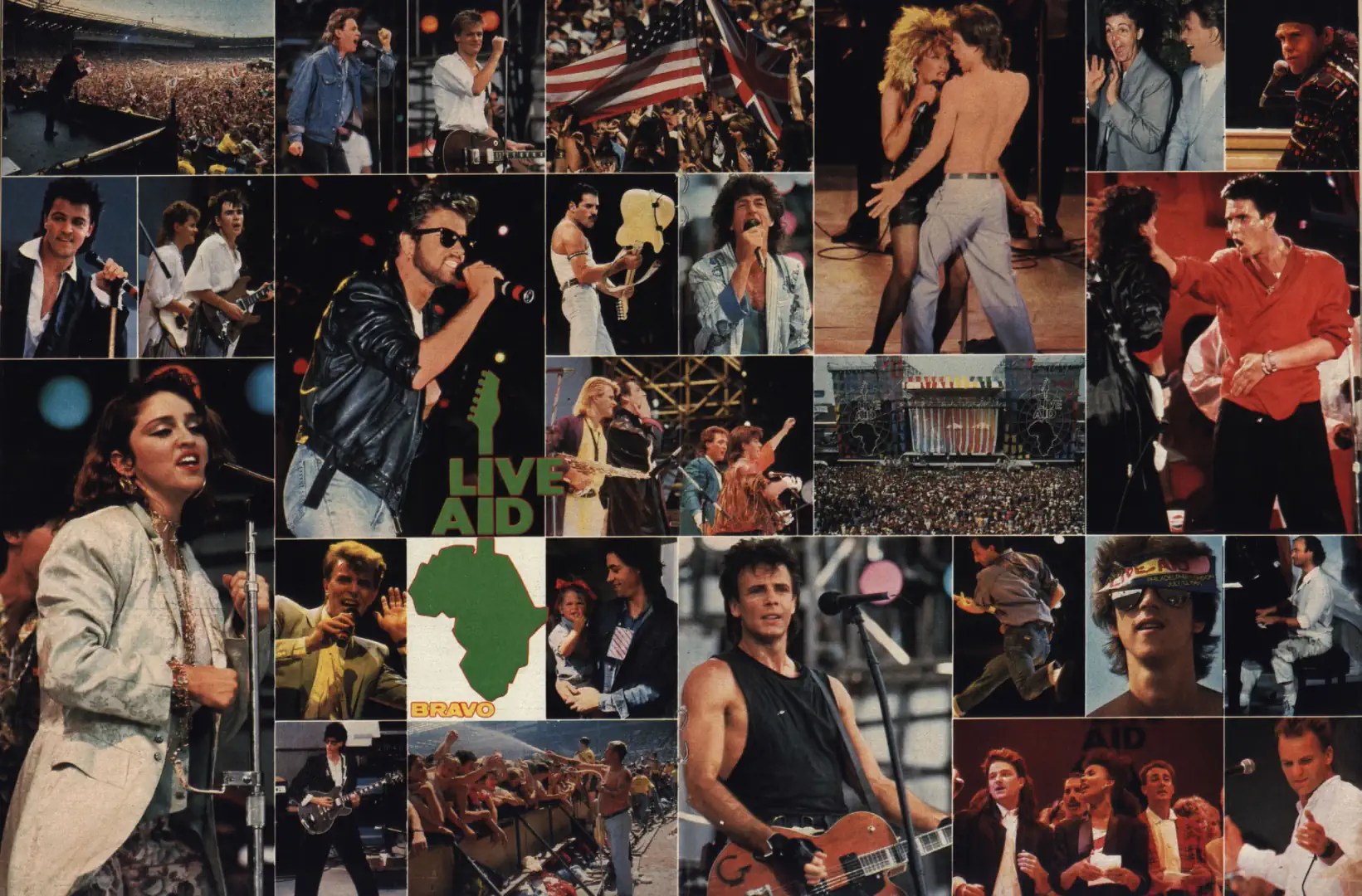
Reputation today
Despite some criticism, Live Aid is now considered a groundbreaking event in the history of pop culture. It set standards for charity events and inspired numerous similar projects such as “Live 8” in 2005, which campaigned for debt relief and fair trade conditions. Live Aid redefined the concept of the “charity concert” and was a model for many social movements that combine music and activism. The show has been listed several times in rankings of the most significant moments in pop history.
Furthermore, Live Aid is now used in the media, pop culture, and education as a prime example of the interplay between entertainment and active social awareness. Numerous documentaries, podcasts, and academic studies have examined the event—not only in terms of its musical quality, but also its social impact. Museums and exhibitions on the history of pop music regularly feature Live Aid as a central chapter.
Many modern artists also refer to Live Aid when it comes to the connection between art and social responsibility. Musicians such as Ed Sheeran, Billie Eilish, and Coldplay take up similar concepts in their own campaigns. Even decades later, Live Aid remains synonymous with the idea that music can not only entertain but also change the world—a legacy that continues to resonate today.
Influence
Live Aid showed how powerful music can be. It combined entertainment with social engagement and changed the understanding of what celebrities and their platforms can achieve. The music industry proved that it is much more than just an entertainment machine – it became a platform for real social change.
Many of today’s charity projects are based on the idea of Live Aid, including events such as “Hope for Haiti Now” and “One World: Together At Home.” Festivals such as “Global Citizen” also focus on the connection between music and activism.
The event raised awareness of global inequality among millions of people and triggered a wave of donations and civic engagement. Schools, universities, and churches took up the cause, and in many places, local aid campaigns were launched, inspired by the global example. Musicians became ambassadors for change.
Many of them became permanently involved in aid projects after Live Aid, setting up foundations or becoming politically active in development cooperation. The influence was also evident in the media coverage, which began to focus more prominently on social responsibility. Live Aid thus brought about a paradigm shift in the role of culture – away from mere entertainment and toward active participation in shaping a more just world.
Conclusion

Forty years after Live Aid, the concert remains a symbol of how art and empathy can work together. It was not only a musical triumph, but also a humanitarian appeal that continues to resonate today. Despite criticism of individual aspects, the lasting impression is that history was made here – with guitar riffs, cameras, solidarity, and vision. Live Aid is and remains a milestone – musically, socially, and historically. And perhaps also a reminder that collective action can create a better world.
The concert showed that music can not only move people emotionally, but also bring about concrete change. It brought together millions of people worldwide, regardless of language, origin, or religion, and created a global sense of community that had rarely been felt so intensely before. Live Aid was a moment of collective hope – proof that humanity, creativity, and technology can achieve great things when united. Its impact still resonates today in political discussions, cultural engagement, and in the memories of those who witnessed that day. The idea that art has a responsibility remains as relevant as ever. Live Aid is not just a chapter in music history—it is a shining example of the influence that solidarity can have.
I was lucky enough to see at least parts of the broadcast on MTV at the time, including Queen’s more then legendary performance. Even though watching it on TV was a moving experience, I can’t help thinking how amazing it would have been to experience that day live, with my own eyes and ears, with 72,000 spectators in London’s Wembley Stadium.
Maybe we do need a working time machine after all – just for one day – so I can relive that historic moment firsthand.
External links
Keywords: 40 years Live Aid anniversary, Live Aid 1985 commemoration, Live Aid legacy 2025, Bob Geldof Live Aid reflection, Queen Live Aid 40th anniversary, David Bowie Heroes Live Aid, Live Aid historical impact, Charity concert Ethiopia famine 1985, Live Aid documentary 2025, Live Aid remembrance blog
Hashtags #LiveAid40 #LiveAidAnniversary #GlobalJukebox #BandAidLegacy #QueenLiveAid #BowieHeroes #BobGeldof #RockForAfrica #CharityConcert #MusicHistory







 McHenry's Lair
Kommentar verfassen :