


Polybius – The game you’ll never forget
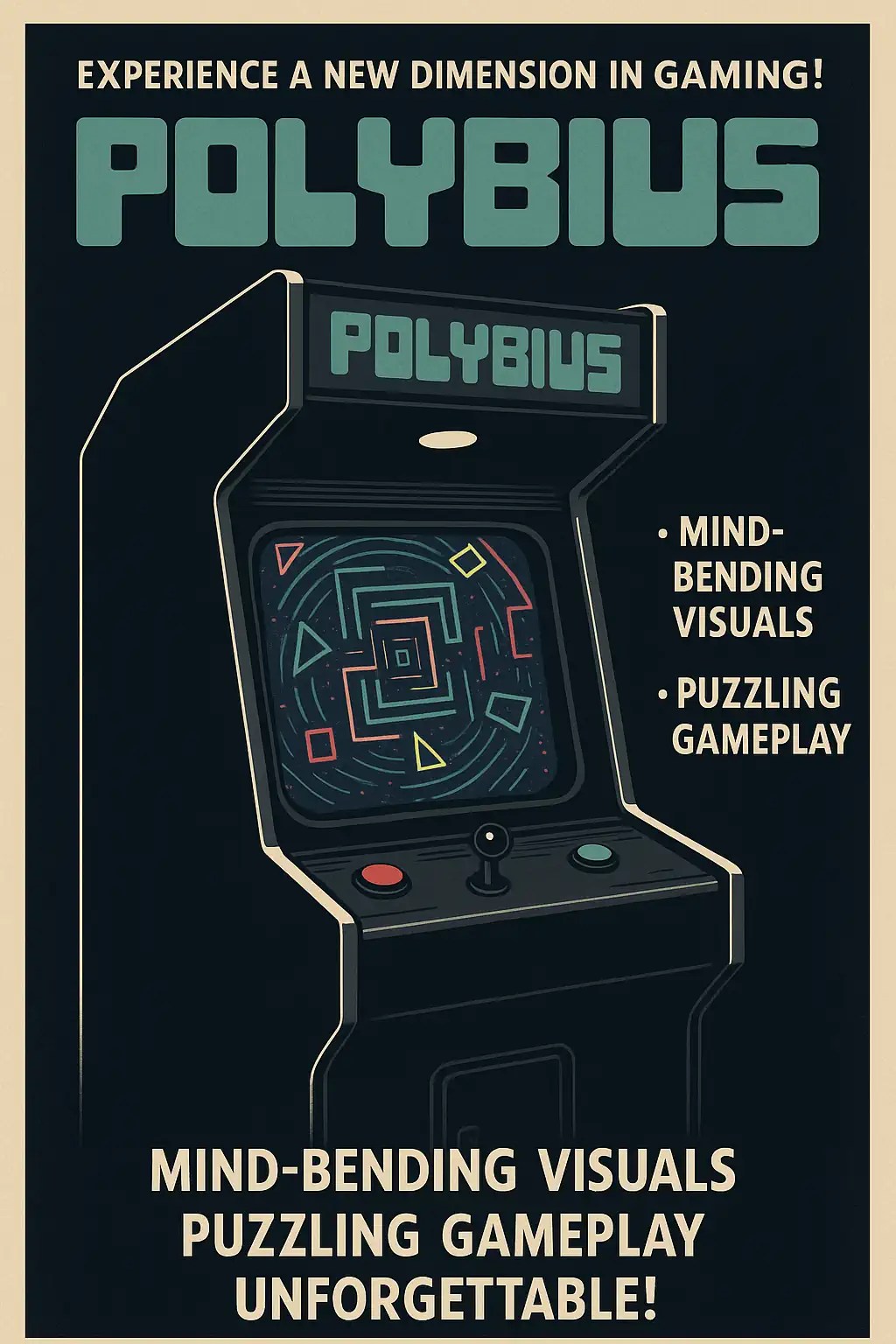
“Experience a new dimension of gaming!” – that was supposedly the advertising slogan for a mysterious arcade machine that suddenly appeared in several arcades around Portland, Oregon, in 1981. The game was called Polybius, which simply appeared on the screen accompanied by a hypnotic hum. The machine itself was matte black, with no fancy design, a glowing start button, and a minimalist control panel. No manufacturer’s name, no instruction manual – just the game itself, and that was enough to captivate an entire generation.
Players reported psychedelic gameplay: geometric shapes, constantly changing mazes, bright flashes of light, and a sound design that oscillated somewhere between science fiction and white noise. Some described it as a mixture of Tempest, Asteroids, Berzerk, and a dream you can’t escape. Polybius quickly made the rounds – not through official advertising, but through whispers, rumors, and curiosity. And through its effect, which some found downright supernatural.
Players spoke of headaches, nightmares, memory loss – some even reported panic attacks, hallucinations, and loss of consciousness after playing. There were even stories of players who completely lost interest in other games after playing Polybius or who appeared to have been “reprogrammed.” The game was said to be highly addictive. And time and again, mysterious men in black were said to have checked the machines and noted down data. Was it a government brainwashing project? A secret CIA experiment as part of MKULTRA? Or just a game that was too good to forget?
Some players claimed that the machine could influence not only behavior but even consciousness. “It was like the game was playing you,” said one anonymous report. Some even described déjà vu experiences or the feeling of entering “a different state of mind” as they progressed through the levels. A few weeks later, Polybius suddenly disappeared. No more machines in sight. No reports, no evidence. Just rumors—and a legend that lives on to this day.

The truth behind the myth
The story of Polybius is a prime example of how modern urban legends arise in the age of the internet – and how difficult they are to debunk once a myth has taken hold.
The origins of the legend
The name Polybius first appeared in 2000 on the website coinop.org, an online archive for arcade games. There, the game was described as extremely rare and “dangerous,” allegedly released in 1981 by a company called Sinneslöschen (a made-up word from German meaning “sensory deletion”). The description was atmospheric but lacked evidence – no photo, no ROM, no real machine. The website presented a fictional description with technical detail as if the game had actually existed, including alleged user reports that described disturbing effects. Despite the lack of any evidence, the account seemed plausible enough to capture the imagination of many – especially those with a penchant for the occult, the inexplicable, or the lost relics of the early days of digital technology.
But the myth was born. The story had all the ingredients for viral spread: a mysterious game, missing machines, secret government projects, psychological effects – and, of course, its disappearance without a trace. Polybius was not only discussed in forums, but soon also mentioned in documentaries, podcasts, YouTube videos, and even television series. The myth gained an extra layer of credibility through its connection to real historical CIA programs such as MKULTRA. Added to this was the thrill of the hunt: gamers, archivists, and conspiracy theorists embarked on digital treasure hunts, searching old arcade databases for clues, scouring eBay for suspicious circuit boards, and contacting former developers. The fascination grew the less concrete evidence there was – because the less you knew, the more you could project onto it.
The power of internet fakes
What made Polybius so effective was its staged authenticity. The site presented the game alongside real arcade classics, mixing real historical details (e.g., early experiments with biofeedback-controlled games, military research on visual manipulation, and MKULTRA documents) with fictional elements. Soon, fake screenshots, alleged ROM files, 80s-style game instructions, and even fake interviews with former developers appeared.
Internet forums, especially in the early days of Reddit, YouTube, and 4chan, spread the story further—every new detail became part of the myth. Polybius became a digital memetic phenomenon: anyone could contribute to the legend through fan art, fake videos, program reconstructions, and parodies. Over time, it became impossible to separate fact from fiction – which only added to the story’s appeal.
In truth, there is no evidence that Polybius ever existed – no arcade database lists it, and no eyewitnesses can confirm the location of a real machine. The “company” Sinneslöschen is a fantasy product that was only meant to sound mysterious. The side effects described can easily be attributed to exaggerations or misinterpretations of other incidents – such as an actual case in Portland where a teenager collapsed after a video game session, which Polybius fans often cite as “proof.”
Why do we believe such stories?
Polybius shows how digital narratives can take on a life of their own. The internet was particularly fertile ground for such myths in the early 2000s, a time when information was often accepted uncritically, archives were limited, and the allure of the mysterious outweighed the desire for evidence. Added to this was the nostalgia for the 1980s, which made many young and adult people alike receptive to everything “lost.” Old technology was romanticized, vanished media objects became cultural artifacts – and so a game like Polybius fit perfectly into this atmosphere of digital forgetting and rediscovery.
We were also in a phase in which digital communication was exploding, but was not yet accompanied by verified facts or professional curation. Forums, early blogs, and personal websites were the main sources of information—or disinformation. This is precisely why a well-written post with pseudo-realistic details could develop a life of its own and continue to have an impact for years.
With every YouTube video, every parody, every reenacted trailer, and every new theory, the mystery grew – not despite, but because of its implausibility. The story of Polybius is therefore not just a myth about a game, but also a lesson about the power of storytelling in the digital world. It shows us how easily collective memory can be manipulated – and how willing we sometimes are to prefer the fantastic to the mundane when it serves our longing for mystery and inexplicable phenomena.
Summery
Polybius never existed – and yet it made history. As a digital phantom that combines our fascination with the unknown, our skepticism toward authority, and our love for the uncanny. It is a modern myth, created from rumors, paired with retro-futuristic design, clever storytelling, and the perfect dose of conspiracy. The myth thrives on its vagueness – it is credible enough to fascinate and absurd enough to never be taken entirely seriously. In doing so, Polybius fulfills an almost archetypal function in pop culture: it becomes a proxy for fears of technology, manipulation, and loss of control in an increasingly digitalized world.
It is a reflection of our digital culture – a culture in which truth often counts for less than impact. Myths like this show how easy it is to spark a modern legend with a single internet post. And how readily we believe stories that tap into our cultural desires and fears. Polybius thus symbolizes our need for mystery in a world that seems to be becoming increasingly transparent, but never truly transparent.
And who knows – maybe there’s still a black machine with a flickering screen waiting somewhere. Dusty, in a dark warehouse. Ready to be discovered. Ready to be played. Ready to change you – not through code, but through imagination.








 McHenry's Lair
Kommentar verfassen :